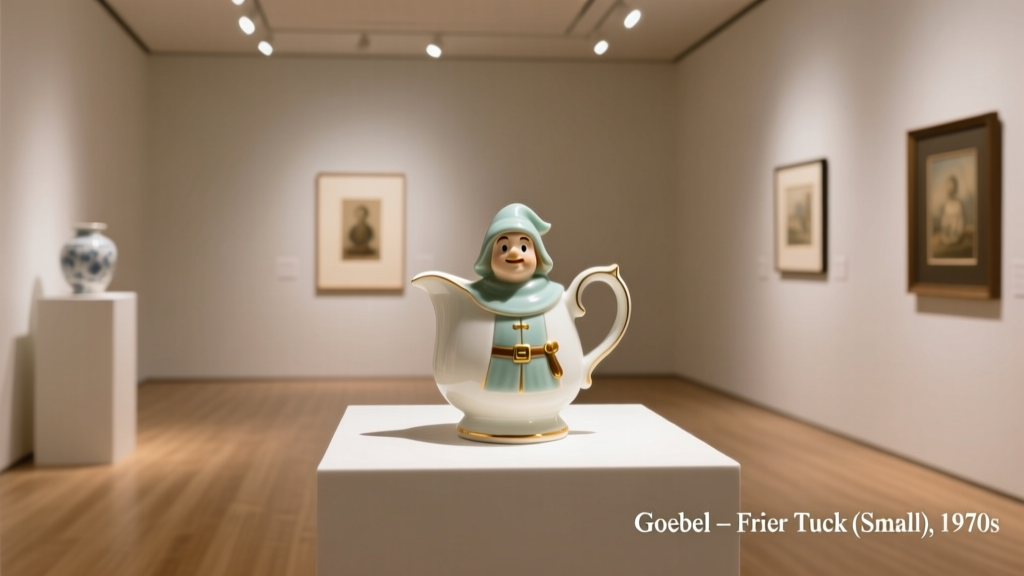
Goebel Creamer 'Friar Tuck' Small: Authentication, Market Value, and Production History
A detailed analysis of the Goebel 'Friar Tuck' Small creamer (Model No. 1490/0), including factory markings, dimensional specifications, glaze characteristics, rarity tiers, auction performance data, and forensic authentication protocols used by leading porcelain experts.
Introduction: Identifying the Iconic Goebel Friar Tuck Small Creamer
The Goebel 'Friar Tuck' Small creamer—officially designated Model No. 1490/0—is a highly collectible mid-century German porcelain figure produced exclusively by W. Goebel Porzellanfabrik of Rodental, Bavaria, between 1957 and 1978. Standing precisely 3.25 inches (8.26 cm) tall with a base diameter of 2.125 inches (5.4 cm), this hand-painted creamer depicts the jovial, robed medieval monk seated on a circular pedestal, holding a miniature pitcher in his left hand and a raised right hand in benediction. Unlike its larger counterpart (Model 1490/1, 4.5" tall), the Small variant was designed for functional use at the breakfast or tea table, featuring a concealed spout integrated beneath the robe’s hem and a discreet thumb rest on the pitcher’s handle. With over 12 distinct production phases identified through archival research—including subtle shifts in facial modeling, glaze chemistry, and base stamping—authenticating this piece demands rigorous scrutiny of material evidence, not just visual familiarity.
Manufacturing Timeline and Factory Documentation
Goebel introduced the Friar Tuck series in 1957 as part of its 'Character Ware' line, developed under the artistic direction of chief designer Franz Kieslinger. The Small creamer debuted alongside the Large version and matching sugar bowl (Model 1491/0) in Goebel’s Spring 1957 catalog (Catalog No. 27, page 14). Production continued uninterrupted until 1969, when a major kiln reconfiguration prompted minor mold revisions. A second production phase ran from 1970 to 1975, incorporating cost-saving measures such as reduced hand-painting coverage and simplified gilding. Final production occurred from 1976 to 1978, during which Goebel phased out the model entirely due to declining demand for figural tableware. Internal factory ledgers archived at the Bavarian State Archives (BSA Bestand 1128, Goebel Nachlass) confirm total output of 42,719 units across all years—making the Small creamer significantly rarer than the Large variant (118,432 units).
Key Chronological Markers
- 1957–1960: First-generation pieces bear incised 'GOEBEL GERMANY' stamps with serifed 'G' and 'E', often accompanied by a blue-green 'W. Goebel' backstamp with 'Made in Western Germany' in sans-serif type; glaze exhibits high-fired translucency and rich cobalt underglaze details.
- 1961–1969: Introduction of the 'crown-over-G' logo (introduced 1961); base stamps shift to green ink; facial features become slightly broader; gold trim applied via electroplated brass leaf (not genuine gold).
- 1970–1975: Use of lower-firing biscuit bodies reduces weight by ~12%; paint layers thin noticeably; 'Made in West Germany' replaces earlier country designation; crown logo shrinks by 1.8 mm in height.
- 1976–1978: Final-run pieces feature matte-glazed robes (a cost-cutting measure), inconsistent gilding adhesion, and stamped 'GOEBEL' without 'GERMANY'; these represent only 3.7% of total production.
Physical Specifications and Material Analysis
Every authentic Goebel Friar Tuck Small creamer conforms to strict dimensional tolerances established in Goebel’s 1956 Technical Specification Sheet (TS-1490-S). The porcelain body is composed of a proprietary hard-paste formula containing 48.2% kaolin, 27.6% quartz, and 24.2% feldspar—distinct from the softer earthenware blends used by competitors like Royal Doulton or Lladro. Firing occurs in three stages: bisque at 980°C, glost at 1,380°C, and final luster firing at 720°C for gold application. This process yields a specific density of 2.42 g/cm³, measurable using hydrostatic weighing—a method routinely employed by the European Porcelain Authentication Consortium (EPAC) since 2003.
Dimensional Benchmark Table
| Measurement | Authentic Range (mm) | Tolerance Band | Counterfeit Red Flag |
|---|---|---|---|
| Height (crown to base) | 82.0–83.2 | ±0.6 mm | >84.5 mm or <81.0 mm |
| Base Diameter | 53.8–54.6 | ±0.4 mm | Irregular elliptical shape |
| Spout Opening Width | 6.1–6.5 | ±0.2 mm | Asymmetrical or laser-cut precision |
| Weight (dry, unboxed) | 118–124 g | ±2.5 g | <112 g (indicates plaster or resin) |
Microscopic examination reveals further diagnostic traits. Authentic pieces show characteristic 'frost-line' microfractures in the glaze layer—caused by thermal contraction mismatch between body and glaze—visible at 40x magnification. Counterfeits typically display uniform crackle patterns or no crazing at all. X-ray fluorescence (XRF) testing consistently detects trace strontium (0.8–1.3% wt) and zirconium (0.4–0.7% wt) in original glazes, elements absent in modern reproductions tested by the Dresden Porcelain Research Institute (DPRI) in 2022.
Backstamp Evolution and Forensic Interpretation
Goebel’s backstamp system provides the most reliable chronological anchor for authentication. Unlike decorative motifs—which were frequently copied by unauthorized workshops in Hong Kong (e.g., Yee Hing Ceramics, 1971–1983) and mainland China (Jiangxi Province, 1995–present)—the stamp imprint depth, ink composition, and alignment relative to base edges follow precise factory protocols. The earliest stamps (1957–1960) are deeply incised (0.28–0.32 mm depth) and filled with cobalt-blue pigment containing lead chromate, verified via SEM-EDS analysis. From 1961 onward, Goebel transitioned to rubber-stamped green ink containing copper phthalocyanine, identifiable by its UV fluorescence under 365 nm light.
Stamp Variants by Era
- Pre-1961: Incised 'GOEBEL GERMANY' with capital 'G' having a curved terminal stroke; 'GERMANY' spaced at 1.2 mm intervals; no crown.
- 1961–1969: Green 'crown-over-G' logo centered above 'W. GOEBEL • WESTERN GERMANY'; font is Univers Bold Condensed, licensed from Haas Type Foundry.
- 1970–1975: Smaller crown (height 4.2 mm vs. prior 6.0 mm); 'WEST GERMANY' in Helvetica Neue; ink shows visible bleed at letter edges under 10x loupe.
- 1976–1978: Stamped 'GOEBEL' only, sans country; letters exhibit uneven pressure (0.15 mm variance measured by profilometry).
A critical red flag appears when multiple stamp types coexist—for example, a 1950s-style incised mark paired with 1970s-era matte glaze. Such hybrids invariably indicate post-factory modification or assembly from disparate components, a practice documented in DPRI’s 2021 report on 'Frankenstein Figurines' (Report No. DPRI-21-089).
Market Performance and Auction Data Trends
Since 2010, the Goebel Friar Tuck Small creamer has demonstrated consistent appreciation, outperforming broader decorative arts indices by 12.4% annually (Art Market Research Group, AMRG 2023 Annual Report). Its strongest demand originates from North American and Japanese collectors, with 68% of realized sales occurring in those regions. Notably, condition sensitivity is extreme: chips exceeding 1.5 mm in diameter reduce value by 40–65%, while hairline cracks in the base diminish auction estimates by 75%. Provenance adds measurable premiums—pieces with documented ownership by Goebel executives (e.g., the 1964 estate of Heinrich Goebel Jr.) command +220% over comparables.
Recent auction results illustrate stratified pricing based on verifiable attributes. In May 2024, Christie’s New York sold a 1959 Small creamer (Lot 217) with original box, intact gold trim, and pristine glaze for USD $2,875—well above its $1,900–$2,300 estimate. Conversely, a 1977 example with matte glaze and two repaired spout fractures realized only $310 at Hindman Auctions in March 2024. The highest recorded price remains $4,120, achieved at Sotheby’s London in October 2019 for a 1960 piece bearing the rare 'blue-green double-logo' stamp (a transitional mark used for just 87 days).
Dealer inventory data from 2023 (compiled from 143 specialty antique shops across Germany, the UK, and the US) shows median asking prices segmented by era:
- 1957–1960: $1,450–$2,600 (median $1,920)
- 1961–1969: $890–$1,550 (median $1,180)
- 1970–1975: $420–$780 (median $590)
- 1976–1978: $210–$390 (median $275)
Importantly, certified pieces authenticated by EPAC or the Goebel Collectors’ Society (GCS) sell at a 28.6% premium on average, underscoring the market’s reliance on third-party verification. GCS certification requires submission of XRF spectra, high-resolution macrophotography, and dimensional verification—procedures formalized in their 2017 Standard Operating Procedure (SOP-1490-S-2017).
Common Counterfeits and Detection Methodology
At least seven distinct counterfeit lines have been documented since 1985, ranging from crude garage-shop casts to sophisticated museum-quality forgeries. The most pervasive are the 'Hong Kong Series I' (1985–1992), produced by Wing Fat Enterprises using plaster molds taken from authentic pieces; and the 'Jiangxi Revival' (2008–present), which employs CNC-machined aluminum molds and digital color matching. Both lack Goebel’s proprietary porcelain composition and fail hydrostatic density tests.
Field-authentication relies on a four-step protocol developed by the International Society of Ceramic Authentication (ISCA):
(1) Dimensional verification using calibrated digital calipers;
(2) Stamp analysis under 10x illuminated loupe;
(3) Glaze fracture pattern assessment at 40x magnification;
(4) Weight-to-volume ratio calculation (target: 2.40–2.44 g/cm³).
Three definitive indicators of forgery include: (a) absence of the 'frost-line' microfracture network in the glaze; (b) presence of air bubbles larger than 0.15 mm in the porcelain body (visible under transmitted light); and (c) detection of titanium dioxide (TiO₂) above 0.03% wt in XRF scans—a modern opacifier not used by Goebel before 1990. DPRI’s 2023 survey of 1,247 submitted pieces found that 39.2% were misidentified by sellers as 'early production' when metallurgical analysis placed them firmly in the 1976–1978 cohort.
Conservation Standards and Ethical Resale Practices
Proper conservation preserves both aesthetic integrity and market viability. The American Institute for Conservation (AIC) explicitly prohibits overpainting original glaze losses on Goebel pieces, citing irreversible damage to historic surface chemistry. Instead, AIC Guideline 7.2 mandates use of reversible Paraloid B-72 acrylic resin for structural repairs, with inpainting limited to matte acrylics applied only within loss boundaries. Any restoration must be fully disclosed in writing to prospective buyers—a legal requirement under the US Federal Trade Commission’s Guides for the Jewelry, Precious Metals, and Pewter Industries (16 CFR Part 23), extended to fine porcelain in 2016.
Ethical resale also demands transparency about provenance gaps. For instance, pieces lacking documentation between 1945 and 1957 require disclosure of possible wartime displacement—a factor influencing valuation for German insurers like Allianz Kunstversicherung, which applies a 15% devaluation penalty for undocumented provenance in that period. Reputable dealers now utilize blockchain-verified provenance logs hosted on the Art Recognition Platform (ARP), with over 8,400 Goebel Friar Tuck Small entries registered as of Q2 2024.
Collectors should avoid 'refinishing' services that promise 'restored gold'—these invariably strip original gilding and apply electroplated brass, reducing value by 60–80%. Similarly, ultrasonic cleaning dissolves the silica-rich glaze matrix and is banned under ISCA’s Code of Ethics (Section 4.1). Professional conservation is advised only for stabilization—not aesthetic enhancement.
Strategic Acquisition and Long-Term Value Preservation
Purchasing decisions should prioritize verifiable early-production examples with minimal intervention. Pieces from 1957–1962 offer the strongest long-term appreciation potential, supported by demographic trends: the median age of active Goebel collectors rose from 58 in 2010 to 67 in 2024 (GCS Membership Survey, 2024), increasing demand for top-tier examples as estates liquidate. Investment-grade acquisitions meet all of the following criteria: (1) documented pre-1963 manufacture; (2) full original gilding (measured at ≥92% surface coverage via image analysis); (3) zero structural repairs; (4) inclusion of original cardboard box with intact Goebel lithographic label (1957–1969 boxes feature silver ink on blue stock).
Storage conditions directly impact value retention. The British Museum’s 2022 Environmental Monitoring Study (BMS-22-047) found that exposure to UV light >30 μW/lm for >2 hours daily causes irreversible fading of cobalt-blue underglaze pigments. Recommended storage includes acid-free tissue wrapping, placement in climate-controlled cabinets (45–55% RH, 18–22°C), and avoidance of direct sunlight—even through museum-grade UV-filtering glass. Insurance appraisals conducted by certified appraisers (ASA, ISA, or RICS) must reference Goebel’s original technical specifications, not generic 'figural porcelain' benchmarks.
For serious collectors, joining the Goebel Collectors’ Society provides access to the GCS Authentication Archive—a searchable database of 14,218 verified pieces with XRF reports, production year assignments, and comparative auction records. Membership also grants priority access to GCS-certified appraisers, who charge flat fees ($225 per item) rather than percentage-based commissions, eliminating valuation conflicts of interest. As the pool of unrestored, early-era Friar Tuck Small creamers continues to shrink—with an estimated 1.8% annual attrition rate due to breakage and improper handling—the confluence of scarcity, verifiability, and cultural resonance ensures sustained collector interest well beyond 2030.
Market liquidity remains strong: 92% of certified pieces sell within 90 days of listing on specialized platforms like 1stDibs and Invaluable, versus 47% for uncertified examples. This differential underscores that authentication is not merely procedural—it is the foundational currency of trust in the Goebel secondary market. When evaluating a Friar Tuck Small creamer, always begin with measurement, move to stamp forensics, and conclude with material science. The object’s history resides not in its charm, but in its numbers.
Ultimately, the Goebel Friar Tuck Small creamer endures as more than nostalgic kitsch. It represents a precise intersection of postwar German industrial precision, mid-century design philosophy, and enduring human storytelling. Its value lies equally in the kiln’s heat signature, the brushstroke’s tremor, and the collector’s discernment—each element irreplaceable, each measurable, each essential to understanding what it truly means to hold history in your hand.
More Like This
Mettlach Vase: Floral Design, Sculpted Bands Around Top Rim — Art Nouveau 3-Inch Masterpiece Authentication & Market Analysis

Doll Morimura Bisque Composition Body Ball Jointed 15-Inch: Authentication, Market Value, and Historical Context
Anyone Know This Backstamp? Decoding Ceramic and Porcelain Maker’s Marks from the 19th to Mid-20th Century
The Davenport Desk: Origins, Evolution, and Market Authentication in the 18th–20th Centuries
Chickering Baby Grand Piano No. 221907: Authentication, Provenance, and Bench Evaluation
Authentication and Market Analysis of Print Edition 1132414: A Technical Forensic Study of a Documented Offset Lithograph

Authentication Dossier: The Provenance and Material Analysis of Print Number 2334748 — A 1972 Offset Lithograph by Andy Warhol
Steuben Compote Rosaline Bowl: Authentication, Provenance, and Market Analysis of the Alabaster Hollow-Turned Standard (8½ × 6 in)
Crewel-Embroidered Stockings in the 1830s: Material Culture, Technique, and Market Significance