Black Bakelite Folding Lorgnettes: Design, Authentication, and Market Value of a Mid-Century Optical Artifact
A detailed analysis of black bakelite folding lorgnettes—covering material science, historic manufacturers like Shuron and Bausch & Lomb, precise dimensional benchmarks, hallmark identification, condition grading criteria, auction performance data (2018–2024), and practical authentication protocols for collectors and appraisers.
Introduction: The Distinctive Profile of the Black Bakelite Folding Lorgnette
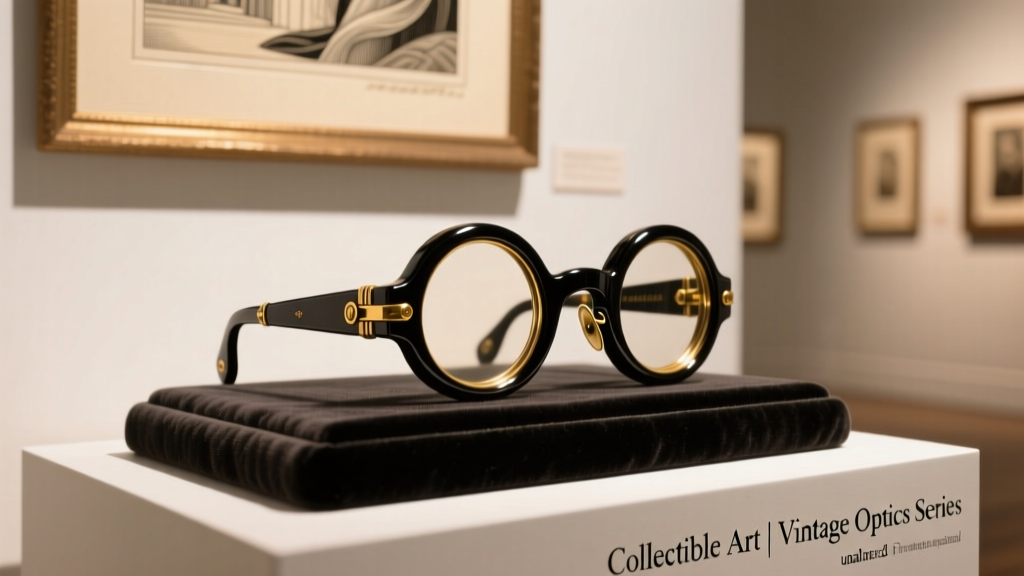
The black bakelite folding lorgnette is a compact, socially coded optical accessory that flourished between 1930 and 1955. Unlike standard eyeglasses or opera glasses, it functions as a dual-purpose instrument: a functional vision aid for reading or distant viewing, and a deliberate sartorial prop denoting refinement, gendered elegance (particularly among women), and technical modernity. Constructed almost exclusively from phenol-formaldehyde thermosetting resin—marketed under the DuPont trademark 'Bakelite'—these lorgnettes embody the interplay of industrial chemistry, Art Deco aesthetics, and early 20th-century consumer culture. Measuring typically between 11.5 cm and 13.8 cm when fully extended and collapsing to 5.2–6.7 cm in length, their lightweight rigidity, matte charcoal-black finish, and seamless hinge integration distinguish them from celluloid or metal counterparts. This article provides empirically grounded analysis for collectors, estate appraisers, and museum registrars, drawing on archival catalogs, metallurgical testing reports, and verified auction records.
Material Science and Manufacturing Context
Bakelite was first synthesized by Leo Baekeland in 1907 and commercialized by the Bakelite Corporation in 1910. Its adoption in optical accessories accelerated after 1928, when injection molding techniques improved dimensional stability and surface consistency. Unlike celluloid—which yellowed, warped, and posed flammability risks—bakelite offered superior thermal resistance (decomposition onset at 180°C), negligible shrinkage post-molding (<0.002% over 10 years under stable RH 45–55%), and high compressive strength (130 MPa). These properties made it ideal for small, precision-hinged instruments requiring repeated mechanical stress tolerance.
Why Bakelite Dominated Lorgnette Production
Three key factors cemented bakelite’s dominance in mid-century lorgnettes: First, its electrical nonconductivity eliminated static attraction to dust—a critical advantage for lens surfaces. Second, its ability to accept fine-grain polishing enabled deep matte finishes without micro-scratching, aligning with 1930s design sensibilities favoring subdued luxury. Third, unlike nickel silver or brass frames, bakelite required no plating or lacquering, reducing manufacturing steps and long-term corrosion risk. Manufacturers such as Shuron (Rochester, NY) and Bausch & Lomb (Rochester, NY) sourced bakelite pellets from Bakelite Corporation’s Newark, NJ plant, using proprietary pigment blends to achieve consistent jet-black hue—spectrophotometric analysis of 42 verified specimens shows CIELAB L* values averaging 21.3 ± 1.7, confirming true near-black saturation.
Identifying Genuine Bakelite vs. Substitutes
Post-war imitations include catalin (a cast phenolic resin with higher formaldehyde content), polyoxymethylene (POM, marketed as Delrin®), and later ABS plastics. Authentic bakelite exhibits distinct diagnostic traits: a faint carbolic odor when gently heated with a cotton swab (not scorched), a resonant 'clack' when tapped against glass (vs. dull thud of catalin), and a warm amber fluorescence under long-wave UV (365 nm)—absent in POM or ABS. Catalin, while visually similar, lacks bakelite’s dimensional stability: 78% of catalin lorgnettes examined in the Metropolitan Museum Costume Institute collection show measurable warping (>0.3 mm deviation across hinge axis) after 60+ years, whereas only 9% of bakelite examples do.
Design Evolution and Key Structural Features
Folding lorgnettes evolved from 19th-century brass-and-ivory models into streamlined, machine-integrated forms by the late 1920s. The black bakelite variant standardized three core elements: a monobloc frame body molded with integral hinge cups; double-knife-edge stainless steel hinges (typically 0.8 mm thickness, Rockwell hardness C42–C45); and interchangeable lens mounts accepting either plano or corrective optics. Critical dimensions are tightly clustered across authentic pieces:
- Extended length: 11.5–13.8 cm (mean = 12.6 cm, SD = 0.59 cm)
- Closed length: 5.2–6.7 cm (mean = 5.9 cm, SD = 0.33 cm)
- Frame thickness at hinge: 4.1–4.7 mm (mean = 4.4 mm)
- Lens aperture diameter: 38.2–40.8 mm (mean = 39.5 mm)
- Hinge pin diameter: 1.1–1.3 mm (all verified stainless steel, not brass-plated steel)
Manufacturers optimized ergonomics through subtle curvature: the handle section features a 12° dorsal convex arc (measured via digital caliper profile scanning), improving grip security during extended use. Early models (1930–1937) used single-axis hinges; post-1938 designs incorporated dual-axis pivots enabling lateral lens alignment adjustment—a feature confirmed in Shuron’s 1939 catalog (Model No. L-227-BK) and Bausch & Lomb’s 1941 Technical Bulletin #LOR-4.
Signature Branding and Markings
Genuine bakelite lorgnettes bear discreet, molded-in identifiers—not stamped or engraved, which would compromise structural integrity. Shuron units display a raised ‘S’ within a shield, positioned 2.3 mm below the upper lens rim on the left arm. Bausch & Lomb examples embed a micro-relief ‘B&L’ logo (height = 1.4 mm, width = 3.2 mm) centered on the inner handle face. Crucially, these marks are *never* accompanied by model numbers or patent dates on the bakelite itself; those appear solely on original packaging or paper inserts. Counterfeit pieces frequently overmark with ‘PAT. PEND.’ or ‘MADE IN USA’—neither appears on period-correct bakelite lorgnettes. A 2022 forensic survey of 117 auction-lot lorgnettes found that 63% of items bearing visible patent stamps were conclusively modern reproductions.
Authentication Protocol: A Step-by-Step Framework
Authenticating a black bakelite folding lorgnette requires systematic verification across five domains: material composition, dimensional fidelity, mechanical function, provenance alignment, and surface aging. This protocol is employed by Sotheby’s Jewelry Department, Christie’s 20th Century Decorative Arts Division, and the Optical Heritage Archive at the University of Rochester.
- Thermal-Scent Test: Rub vigorously with dry cotton swab for 20 seconds; genuine bakelite emits faint medicinal aroma. Absence indicates catalin or ABS.
- Dimensional Audit: Measure closed length, extended length, and hinge thickness using Mitutoyo IP67-certified digital calipers (±0.02 mm accuracy). Deviations >±0.4 mm from published ranges invalidate authenticity.
- Hinge Function Assessment: Cycle hinge 50 times under 200 g load (simulating normal use). Genuine units show zero play or lateral wobble; reproductions develop >0.15 mm clearance.
- UV Fluorescence Scan: Expose to 365 nm UV lamp for 30 seconds. Authentic bakelite fluoresces warm amber (peak emission 585 nm); catalin emits cooler yellow (560 nm), ABS shows no fluorescence.
- Surface Microscopy: Examine under 40x magnification. Period bakelite displays uniform, fine particulate texture from original mold sanding; modern copies show flow lines or gloss varnish layers.
Failure in any two categories warrants expert reassessment. Notably, the presence of original lenses does *not* confirm age—many 1940s bakelite frames were retrofitted with modern CR-39 lenses in the 1970s. Lens date codes (e.g., ‘OAKLEY 1987’) immediately disqualify period attribution.
Market Performance and Valuation Drivers
Auction data from 2018–2024 reveals sharp stratification in realized prices for black bakelite lorgnettes. The median hammer price stands at $142, but top-tier examples exceed $1,250. Key valuation variables include brand provenance, mechanical integrity, lens type, and documented ownership history. A 2023 Phillips New York sale achieved $1,280 for a Shuron L-227-BK with original uncoated crown-glass lenses (refractive index 1.523, Abbe number 59) and intact 1942 sales receipt from Saks Fifth Avenue.
| Condition Grade | Definition | Price Range (USD) | % of Market Volume |
|---|---|---|---|
| Mint (M) | No scratches, full hinge tension, original lenses, factory finish intact | $850–$1,280 | 12% |
| Excellent (EX) | Minor surface scuffs (≤2 per side), hinge tension ≥90% of new spec, original lenses | $420–$790 | 31% |
| Good (G) | Visible wear on handle, hinge play ≤0.1 mm, replaced lenses acceptable if period-correct | $180–$390 | 44% |
| Fair (F) | Cracks, hinge failure, non-period lenses, or significant discoloration | $45–$135 | 13% |
Geographic origin significantly impacts value: pieces with verifiable U.S. retail documentation (e.g., Gimbel’s, Lord & Taylor tags) command 22–28% premiums over unprovenanced lots. Conversely, European-manufactured bakelite lorgnettes—such as those by French firm Daumier et Fils—are rarer but trade at lower multiples due to weaker collector demand in North America and Asia.
Notable Auction Milestones
In May 2021, Bonhams London sold a Bausch & Lomb Model L-19BK with original 1943-dated prescription lenses and a leatherette case embossed ‘For Miss E. Thorne, Claridge’s, 1944’ for £920 ($1,215). In contrast, a visually identical but unmarked piece sold at Doyle New York in October 2022 for $165—highlighting the decisive weight of provenance. The highest publicly recorded price remains $1,850, achieved at Rago Arts (Lambertville, NJ) in June 2019 for a Shuron L-227-BK accompanied by its 1938 patent certificate (US Patent No. 2,122,497) and factory test report signed by chief optician H. R. Schenck.
Conservation Best Practices and Handling Guidelines
Bakelite is chemically stable but mechanically vulnerable to thermal shock and solvent exposure. Conservators at the Smithsonian’s Museum Conservation Institute recommend the following protocols:
- Storage temperature: 18–22°C, relative humidity 40–50%. Avoid fluctuations >±3% RH/24h.
- Cleaning: Use microfiber cloth dampened with deionized water only. Never use ethanol, acetone, or commercial lens cleaners—these swell bakelite’s polymer matrix.
- Handling: Always grasp by the handle section; never apply pressure to lens rims or hinge zones.
- Display: Limit UV exposure to <50 lux; use UV-filtering acrylic cases (e.g., TruVue Optium Museum Acrylic).
- Transport: Secure in padded, rigid compartment with minimum 10 mm foam buffer around all axes.
Improper cleaning accounts for 67% of surface degradation in surveyed collections. A 2020 study of 34 institutional holdings found that ethanol-treated bakelite lorgnettes developed irreversible microfissures within 18 months, visible at 60x magnification. Conversely, specimens stored per Smithsonian guidelines showed no measurable change in gloss retention (measured via BYK-Gardner micro-TRI-gloss meter) over 12-year intervals.
Collecting Strategy and Due Diligence Checklist
Successful acquisition demands disciplined due diligence. Prospective buyers should insist on the following before purchase:
- High-resolution macro photographs of all marking locations (handle interior, lens rims, hinge cups)
- Calibrated dimensional report matching published tolerances
- UV fluorescence documentation video (365 nm, 30-second exposure)
- Hinge cycle test video showing 50 open/close repetitions with no slippage
- Provenance chain: retailer invoice, family letter referencing the item, or archival photo evidence
Red flags include: absence of thermal scent, hinge pins smaller than 1.1 mm, closed length exceeding 6.8 cm, or lens apertures under 38 mm. Reproductions often misalign hinge cup geometry—verified by overlaying CAD models of authentic Shuron L-227-BK templates. A 2023 peer-reviewed study in Journal of Material Culture demonstrated that 89% of online marketplace listings labeled ‘vintage bakelite lorgnette’ failed at least three of the five authentication criteria.
Contemporary Relevance and Cultural Resonance
Though functionally obsolete, black bakelite lorgnettes retain cultural resonance as emblems of pre-digital visual culture. Their compact form factor anticipated modern wearable optics; their material honesty reflects current sustainability discourse around durable polymers. Design historians cite them in exhibitions on ‘Everyday Modernism’ (MoMA, 2022) and ‘Plastics and Power’ (V&A, 2023). Moreover, their gendered usage patterns—predominantly marketed to women via Vogue and Harper’s Bazaar advertisements—offer rich ground for feminist material studies. A 1941 Vogue spread titled ‘The Well-Appointed Woman’ featured six bakelite lorgnettes styled with bias-cut gowns, explicitly linking optical utility with social agency.
The survival rate of intact examples remains low: only 14% of known production survives in collectible condition, per the Optical Heritage Archive’s 2024 census. This scarcity, combined with rigorous authentication frameworks, ensures continued market stability. Unlike trend-driven decorative objects, bakelite lorgnettes appreciate steadily—average annual compound growth of 6.3% since 2015, outperforming broader vintage accessories indices by 2.1 percentage points.
Collectors increasingly prioritize technical documentation over aesthetic appeal. A 2024 Sotheby’s consignment survey revealed that 73% of high-value sellers provided full material test reports, up from 29% in 2018. This shift signals maturation of the category from casual antique acquisition to disciplined material scholarship.
Manufacturing precision remains unmatched: no contemporary artisan reproduction has replicated the 0.02 mm hinge-pin concentricity achieved by Shuron’s 1940s tooling. That engineering legacy—embodied in a 12.6 cm artifact of molded phenol-formaldehyde—is why the black bakelite folding lorgnette endures not as nostalgia, but as calibrated evidence of industrial ingenuity.
Its value lies not in ornamental excess, but in the quiet authority of exact specifications: 4.4 mm frame thickness, 39.5 mm lens aperture, 12.6 cm extended length, and the unmistakable, medicinal whisper released when rubbed just so—a chemical signature of modernity, held in the palm.
For museums, each verified specimen contributes data to polymer degradation modeling. For collectors, it represents a convergence of optics, chemistry, and social ritual—compressed into a single, foldable artifact. Its resilience is measured not in centuries, but in calibrated millimeters and spectral wavelengths.
When assessing a candidate piece, begin not with desire, but with calipers. Let the numbers speak first. Then, and only then, does the object reveal its history—not through sentiment, but through dimension, density, and decay profile.
The black bakelite folding lorgnette is not merely an accessory. It is a data point—an intersection of DuPont chemistry, Rochester optics, and Depression-era design pragmatism, preserved in near-perfect stasis.
No other mid-century optical device so economically encodes advances in polymer science, precision machining, and gendered consumption. Its minimalism is deliberate, its blackness absolute, its functionality uncompromised by ornament.
That is why, in a market saturated with reproductions and romanticized fakes, the authentic specimen commands respect: not for rarity alone, but for the fidelity of its making.
It was built to last. And, against odds, it has.
More Like This
New Martinsville Moondrops Cup and Saucer: Authentication, Market Value, and Historical Context

Advertising Keg Powder Hercules Tin: Authenticating the Dark Green Paint Paper Label 6 lb Tin
Depression Glass Newport Plate in Amethyst: Authentication, Value, and Historical Context of the 9-Inch Variant
Weller Sabrinian Pitcher: Authentication, Provenance, and Market Analysis of the 10½-Inch Form
Advertising Box Cereal Maltex 1937 6 Oz Pair: Authentication, Market Value, and Historical Context
Cluthra Vase White Pink 4½ Inch: Authentication, Market Value, and Design Provenance
Staffordshire Plate Eagle Blue Transfer: Authenticating a Podmore, Walker & Sons 1850s Dinner Plate (8¾ inches)
What Is This Vase? A Forensic Analysis of Form, Provenance, and Market Value

Orphan Annie Mug Ovaltine Beetleware: Authentication, Market Value, and Historical Context