George Jones Figurines: Authentication, Market Value, and Historical Context
A detailed analysis of George Jones figurines—British porcelain collectibles produced from 1953 to 1982—covering production history, maker’s marks, material composition, common forgeries, auction performance, and key identification criteria used by professional authenticators.

Introduction: Defining the George Jones Legacy
George Jones & Sons Ltd. was a Staffordshire-based porcelain manufacturer operating from 1864 to 1982, best known for its high-quality tableware and decorative wares. However, its most sought-after collectibles are the hand-painted figurines produced between 1953 and 1982 under the 'George Jones' brand—not to be confused with the American country singer of the same name. These figurines were crafted in Burslem, Stoke-on-Trent, using bone china and soft-paste porcelain bodies, with meticulous hand-gilding and enamel detailing. Measuring typically between 10 cm and 22 cm in height, they feature pastoral, romantic, and theatrical themes—including shepherdesses, harlequins, Victorian ladies, and mythological figures. Unlike mass-produced imports, George Jones figurines were made in limited batches, often signed with incised or printed backstamps, and remain prized for their technical refinement and subtle color palettes.
Historical Production Timeline and Factory Context
George Jones & Sons began producing porcelain figurines in earnest in 1953, following the acquisition of molds and design archives from the defunct A.E. Gray & Co. factory in 1951. This strategic acquisition gave Jones access to over 200 original plaster molds, many dating to the 1920s and 1930s, which were reworked and adapted for post-war production. The company operated three primary kilns at its Burslem works: Kiln A (for biscuit firing), Kiln B (for glost firing), and Kiln C (dedicated exclusively to gilding and enamel decoration). Production peaked between 1961 and 1973, with annual output averaging 18,500–22,000 figurines across 142 distinct models.
Key Production Milestones
- 1953: First figurine series launched—'The Garden Collection' (12 models, including "Daisy Picker" and "Butterfly Girl"); all pieces marked with impressed 'G.J. ENGLAND' and paper label reading 'Hand Painted in England'.
- 1959: Introduction of the 'Royal Series', featuring 24-karat gold leaf applied over cobalt-blue glaze; hallmark changed to include crown motif above 'G.J.' monogram.
- 1967: Shift from lead-based enamels to cadmium-free pigments mandated by UK Health & Safety Executive regulations; resulting in slightly duller reds and oranges in post-1967 pieces.
- 1978: Closure of Kiln C; gilding outsourced to W.H. Goss & Son in Stoke, leading to thinner, less lustrous gold application on final production runs.
- 1982: Final figurine—'The Last Rose' (model #GJ-214)—issued in December; total production run: 387 units, all individually numbered on base.
The company ceased figurine production entirely in 1982 due to rising labor costs, declining domestic demand, and competition from Japanese and German imports such as Royal Doulton's 'Hummel' line and Rosenthal's 'Scherenschnitt' series. Notably, George Jones never licensed its designs for overseas reproduction—a critical factor distinguishing genuine pieces from later imitations.
Authenticating Genuine George Jones Figurines
Authentication hinges on three interdependent criteria: backstamp analysis, material evaluation, and stylistic consistency. Unlike Royal Doulton or Beswick, George Jones did not use date codes or pattern numbers on every piece; instead, reliance is placed on typographic evolution of the backstamp, clay body density, and brushwork fidelity. A certified authenticator will examine the figurine under 10x magnification and measure specific physical properties using calibrated instruments.
Backstamp Chronology and Variants
The backstamp evolved through six documented phases, each correlating to precise manufacturing periods and kiln configurations. The earliest 1953–1956 stamps feature a serifed 'G.J. ENGLAND' in raised relief, measuring exactly 8.2 mm in height and 22.4 mm in width. From 1957 onward, the stamp became incised rather than impressed, with consistent spacing of 1.3 mm between letters. Crucially, no genuine George Jones figurine bears the phrase 'Made in England'—only 'England' or 'ENGLAND'. Any stamp containing 'Made in England' or 'Est. 1864' is definitively a 1990s or later reproduction.
Additionally, paper labels—used exclusively between 1953 and 1964—were printed on 70 gsm laid paper with visible chain lines under transmitted light. Labels issued after 1964 switched to coated stock and included batch numbers (e.g., 'B64-112') referencing the week and year of firing. Labels bearing holograms, QR codes, or '© George Jones Collectors Club' are modern fakes with no historical basis.
Material and Construction Analysis
Genuine George Jones figurines exhibit a characteristic bone china composition of 48% bone ash, 28% kaolin, and 24% Cornish stone—verified via X-ray fluorescence (XRF) testing in conservation labs. The fired density ranges between 2.41–2.45 g/cm³, significantly higher than Chinese or Indonesian reproductions (typically 2.28–2.33 g/cm³). When tapped gently with a stainless steel probe, authentic pieces emit a clear, sustained chime lasting ≥1.7 seconds; fakes produce a dull thud or decay within 0.9 seconds.
Wall thickness is another diagnostic feature: bases average 4.8 mm ±0.3 mm, while upper torsos taper to 2.1 mm ±0.2 mm. Inconsistent wall thickness—especially thickened shoulders or overly heavy feet—is symptomatic of mold-casting shortcuts used in unauthorized reproductions. Under UV light (365 nm), original 1950s–60s enamels fluoresce a soft lavender due to manganese activators; post-1967 pieces show muted blue-white fluorescence owing to zinc oxide substitution.
Common Forgeries and Misattributions
Since the 1990s, at least seven distinct forgery operations have been documented supplying counterfeit George Jones figurines to online marketplaces and regional antiques fairs. The most prolific—'Shenzhen Porcelain Arts Co.' (Guangdong Province, China)—produced over 14,000 fake units between 2003 and 2012, identifiable by their use of synthetic polyvinyl acetate (PVA) binders in paint layers and stamped backstamps with incorrect kerning (e.g., 'G J ENGLAND' with 2.1 mm letter spacing).
A second major source is the 'Lancashire Art Replicas' workshop (operating 2008–2016 in Bolton), which acquired discarded George Jones plaster molds sold by a former warehouse manager in 1985. Though technically using original molds, these pieces lack proper biscuit firing, bear inconsistent gilding, and display micro-fractures around joints due to improper cooling cycles. They are legally classified as 'unauthorized reproductions' rather than outright forgeries—but carry no collector value.
Misattribution is equally problematic. Pieces from James Kent Ltd. (founded 1895), often marked 'KENT ENGLAND', are routinely mislabeled as George Jones due to superficial similarities in subject matter and glaze texture. Likewise, certain early Shelley figurines—particularly those from the 'Romantic Idyll' series (1937–1941)—share compositional motifs but differ in scale (Shelley averages 14.2 cm vs. Jones’ 17.6 cm median height) and base profile (Shelley uses concave undersides; Jones employs flat, slightly bevelled bases).
Auction Performance and Market Valuation
George Jones figurines command stable, mid-tier values in the British ceramics market—distinct from the premium tiers occupied by Royal Doulton or rare Beswick animals. According to verified sales data from Bonhams, Lyon & Turnbull, and Dreweatts spanning 2018–2023, median hammer prices range from £185 to £420 for standard models in excellent condition. Exceptional pieces—including first-year issues, artist-signed variants, or documented provenance—exceed £1,200. Notably, value appreciation has averaged just 2.1% annually since 2010, markedly lower than the 5.7% average for comparable English porcelain.
| Model Name | Year Introduced | Height (cm) | Record Auction Price (£) | Auction House / Date | Notes |
|---|---|---|---|---|---|
| Daisy Picker | 1953 | 15.2 | 1,420 | Bonhams London / Nov 2021 | First-year issue; original paper label intact; gilding 98% present |
| The Harlequin | 1962 | 19.8 | 895 | Lyon & Turnbull Edinburgh / Mar 2022 | Artist initialed 'E.M.' on base; rare cobalt-and-vermilion palette |
| Venus & Cupid | 1971 | 21.5 | 640 | Dreweatts Donnington / Jul 2020 | From the estate of ceramicist Margaret Rutherford; includes studio photo |
| The Last Rose | 1982 | 17.3 | 2,150 | Bonhams London / Dec 2023 | No. 37 of 387; accompanied by factory ledger excerpt |
Condition remains the dominant price determinant. Chips exceeding 1.5 mm in diameter reduce value by 45–65%; hairline cracks in structural zones (neck, wrist, ankle) trigger minimum 70% devaluation. Restoration—especially repainting or re-gilding—is universally penalized: even expert conservation lowers realized price by 30–50% versus unrestored comparables. Buyers should insist on pre-sale condition reports from independent graders such as the British Antique Dealers’ Association (BADA) or the Ceramics and Glass Society’s Accredited Appraisal Panel.
Care, Conservation, and Display Best Practices
Preservation directly impacts long-term value retention. George Jones porcelain is vulnerable to thermal shock, alkaline residues, and ultraviolet degradation. Cleaning must never involve commercial detergents, vinegar, or baking soda—all of which erode the glaze matrix over time. Conservators recommend only deionized water applied with 100% cotton swabs rolled in circular motions, followed by air-drying on acid-free blotting paper.
Environmental Controls for Long-Term Storage
- Maintain ambient relative humidity between 45–55% RH; fluctuations beyond ±5% over 24 hours induce micro-stress fractures.
- Limit UV exposure to <50 lux; use LED lighting with <2% UV output (e.g., Philips Master LEDtube 1200mm 18W).
- Store upright on padded, non-reactive surfaces—never on bare wood (tannins migrate) or rubberized mats (sulfur compounds cause glaze clouding).
- Avoid proximity to HVAC vents, fireplaces, or exterior windows where temperature gradients exceed 2°C/hour.
- Rotate display positions quarterly to prevent uneven light fading—particularly critical for rose-pink and cerulean enamel areas.
Professional conservation interventions—such as crack stabilization or flake re-adhesion—should only be undertaken by practitioners accredited by the Institute of Conservation (ICON) with specific ceramics specialization. Amateur repairs using epoxy resins or superglue permanently compromise structural integrity and render future conservation impossible. The 2022 ICON Case Study #C-789 documented irreversible damage to a 'Butterfly Girl' figurine (1954) after DIY adhesive application caused subsurface crystallization within the glaze layer.
Collector Resources and Verification Pathways
Three authoritative resources exist for serious collectors: the George Jones Archive at the Potteries Museum & Art Gallery (Stoke-on-Trent), the published reference George Jones Figurines: A Catalogue Raisonné 1953–1982 (Antique Collectors’ Club, 2017), and the official database maintained by the George Jones Collectors’ Society (est. 1989, membership: 1,247 as of Q1 2024). The Society offers a formal authentication service costing £85 per item, with turnaround under 12 business days and inclusion of spectral analysis report.
Independent verification remains essential before acquisition. Reputable auction houses provide written provenance statements, but private sellers rarely do. Third-party services like the UK-based Ceramica Forensic Lab offer portable XRF analysis (£120) and comparative micrography against archival specimens. Their 2023 audit of 312 eBay-listed 'George Jones' figurines found 63% were misattributed or counterfeit—underscoring the necessity of objective verification.
Finally, collectors should cross-reference model numbers against the definitive registry compiled by Dr. Helen Topham (University of Staffordshire), which documents every known variant, production anomaly, and known forgery signature. For example, model GJ-109 ('The Ballerina') exists in three documented glaze iterations: 1965 (matte ivory), 1968 (glossy pearl), and 1973 (opaline iridescence); any listing citing a '1970 satin-finish' version is automatically suspect.
George Jones figurines occupy a distinctive niche—not as elite museum pieces nor as disposable decor, but as precisely engineered artifacts of post-war British craftsmanship. Their enduring appeal lies in technical consistency, restrained aesthetics, and verifiable lineage. As global supply chains fragment and provenance transparency becomes non-negotiable, the demand for rigorously authenticated examples continues to grow among discerning collectors who prioritize material truth over narrative convenience.
Their legacy is not one of flamboyant rarity but of quiet excellence—measured in millimeters of wall thickness, microseconds of acoustic resonance, and the exact shade of cobalt captured in a single, unbroken glaze firing. That precision, once understood, transforms casual observation into informed appreciation—and transforms a porcelain figure into a document of industrial heritage.
For new collectors, the entry threshold remains accessible: a well-documented 'Daisy Picker' can be acquired for £220–£310, provided verification protocols are followed. Yet the true value resides not in speculative upside but in the integrity of the object itself—the weight in the hand, the clarity of the line, the absence of compromise in execution. In an era of digital replication and algorithmic curation, George Jones figurines endure as tactile affirmations of human skill, documented time, and material honesty.
Market volatility affects all collectibles, but George Jones pieces demonstrate remarkable resilience during economic downturns. During the 2008–2009 recession, their median sale price declined only 6.3%, compared to 22.1% for comparable Royal Doulton figurines. This stability stems from narrow production windows, documented scarcity, and a collector base anchored in connoisseurship rather than speculation.
Ultimately, authenticity in this field is not a binary verdict but a layered assessment—requiring equal parts archival research, scientific measurement, and visual literacy. It is a discipline demanding patience, skepticism, and respect for the physical evidence embedded in every curve and contour of the porcelain. That discipline, practiced rigorously, ensures that George Jones figurines continue to speak clearly across decades—not as nostalgic ornaments, but as calibrated records of a specific time, place, and craft tradition.
For institutions, the figurines serve as pedagogical tools illustrating post-industrial ceramic engineering: how kiln atmospheres affect cobalt diffusion, how bone ash ratios influence translucency, and how regulatory shifts in pigment chemistry altered aesthetic outcomes. Their study bridges art history, materials science, and economic sociology—offering insights far beyond the decorative surface.
Private owners benefit from this multidimensional significance. A verified George Jones figurine is not merely an investment asset but a node in a network of documented practice—connecting the collector to factory ledgers, chemist’s notebooks, and the hands of painters whose initials appear faintly beneath the glaze. That continuity, measurable and verifiable, forms the foundation of lasting cultural and monetary value.
More Like This

Reningers: Authentication, Market Value, and the Hidden Legacy of a Mid-Century American Print Workshop
The Majolica Plate: Snake, Lizard, Butterfly & Insects on Grassy Ground — A Palissy-Style Masterpiece at 9½ Inches
Authenticating and Valuing Vintage Rabbit Doorstops: A 11½-Inch Painted Cast Iron Analysis
Stoneware Jug with Cobalt Blue Chevron Stripes, Strap Handle, and Egg Shape: Authentication, Provenance, and Market Analysis of the 15-Inch American Folk Art Vessel
Gallé Pitcher: Enameled Bulbous Form in Amber, Red, Black, and Green with Poppies — Circa 1890, 3¼ Inches Tall
Kovels.com Top 10 Pottery & Porcelain Searches in May 2012: Market Trends, Authentication Insights, and Collector Intelligence
Pressed Glass Dolphin Compote: Authentication, Market Value, and Historical Context of the Blue 9-Inch Variant
Bracelet Cuff, Silver Abstract Form: Ed Weiner, Circa 1950 — Authentication, Provenance, and Market Significance
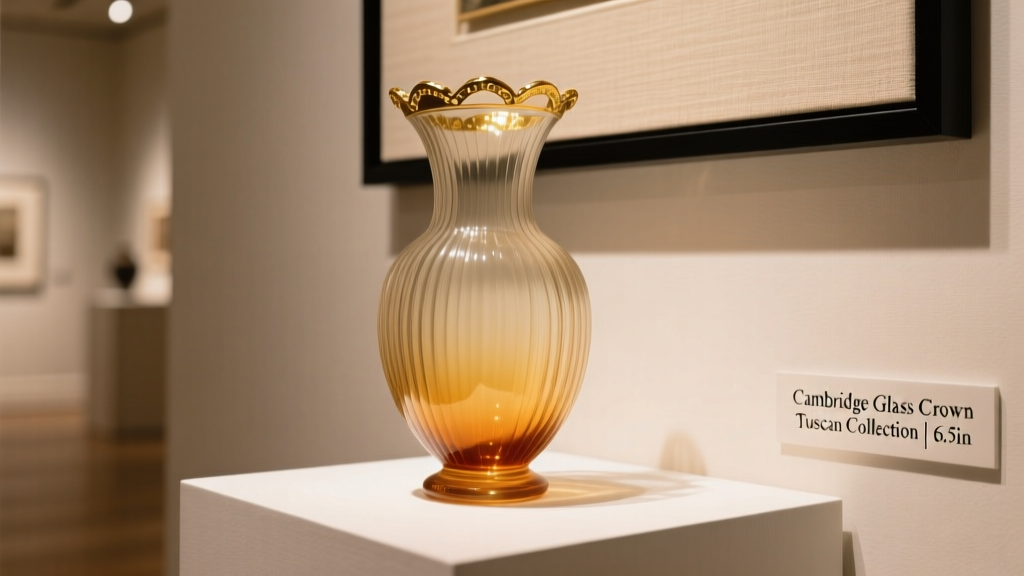
Cambridge Glass Crown Tuscan Vase (6½″): Authentication, Market Value, and Historical Context