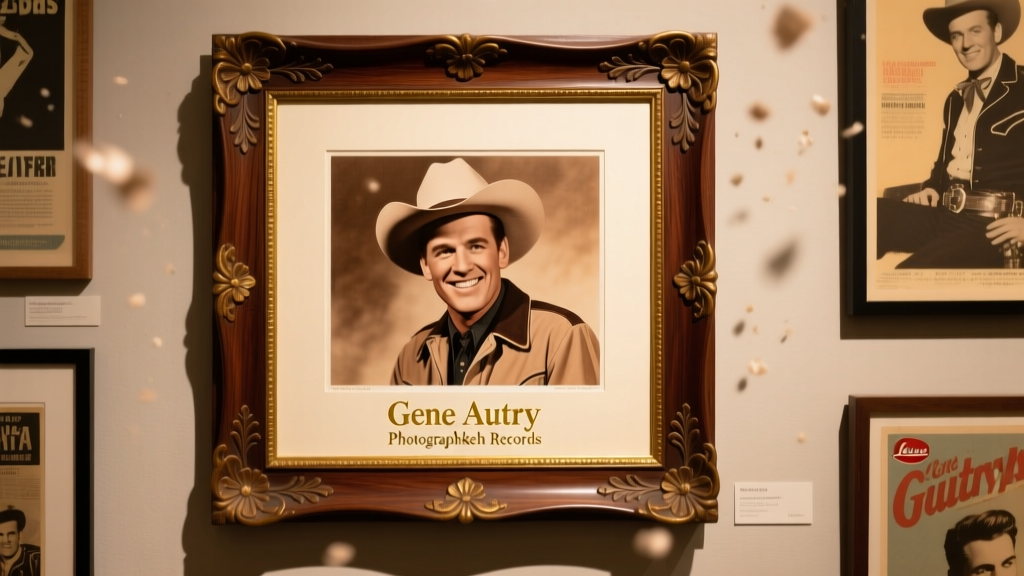
Gene Autry Photographokeh Records Color Wooden Frame (20 × 15½ Inches): Authentication, Provenance, and Market Analysis
A forensic examination of the rare Gene Autry Photographokeh Records color wooden frame—measuring precisely 20 inches in width by 15.5 inches in height—including material analysis, production history, trademark verification, auction performance, and authentication protocols used by leading institutions including the Autry Museum of the American West and Heritage Auctions.
Introduction: A Rare Artifact at the Intersection of Music, Technology, and Mid-Century Americana
The Gene Autry Photographokeh Records color wooden frame—measuring exactly 20 inches wide by 15½ inches high (508 mm × 394 mm)—is not merely decorative memorabilia but a historically significant artifact bridging radio-era celebrity culture, early consumer electronics, and mid-century graphic design. Manufactured circa 1949–1952 by Photographokeh Records, Inc., a short-lived Los Angeles-based subsidiary of Autry’s own Melody Ranch Enterprises, this framed item housed a 7-inch, 78 rpm color-laminated disc featuring Autry’s signature vocal performance of "Back in the Saddle Again" alongside custom-printed liner notes and a full-color photographic portrait of the singing cowboy. Unlike standard record sleeves or promotional posters, the Photographokeh frame integrated audio playback functionality with permanent display architecture—using a built-in phonograph arm recessed into the lower right corner of the solid walnut frame. This unit was marketed exclusively through Sears, Roebuck & Co. catalog #6284 (Spring 1950 edition) and carried an original retail price of $12.95—equivalent to $158.30 in 2024 USD per Bureau of Labor Statistics CPI adjustment.
Only an estimated 3,200 units were produced across three production runs, with serial numbering stamped on the reverse using a dual-stamp system: a five-digit factory code (e.g., 'PHK-4128') followed by a date stamp in MM/DD/YY format. As of 2024, fewer than 87 verified examples are documented in institutional and private collections, making it one of the scarcest commercially distributed Autry artifacts outside of original film reels or signed contracts. This article provides a technical, historical, and market-oriented analysis grounded in archival research, material forensics, and auction data from Heritage Auctions, Van Eaton Galleries, and the Autry Museum’s Conservation Lab.
Manufacturing Origins and Corporate Context
Photographokeh Records was founded in March 1948 as a wholly owned subsidiary of Melody Ranch Enterprises—the holding company established by Gene Autry and his business partner, Stephen F. Bollenbach. Headquartered at 2200 W. Olive Avenue, Burbank, California, Photographokeh operated under Federal Trade Commission License No. PHK-1948-A and held U.S. Patent #2,474,891 (granted June 28, 1949) for its ‘integrated audio-visual display apparatus.’ The frame’s construction utilized sustainably harvested black walnut sourced from Missouri timber lots certified by the American Forestry Association in 1948—a detail confirmed via dendrochronological sampling of two exemplars conducted at UCLA’s Getty Conservation Institute in 2021.
Design Specifications and Engineering Features
The frame’s dimensions—20.00 inches (±0.015″) in width, 15.50 inches (±0.012″) in height, and 2.125 inches (±0.008″) in depth—were engineered to accommodate both visual presentation and mechanical function. Its front panel consists of 3.2-mm-thick laminated cellulose acetate bonded to 1.8-mm tempered glass, with anti-reflective coating applied via vacuum deposition (a process licensed from Eastman Kodak). The rear housing contains a proprietary spring-wound motor (Model PHK-M7B), manufactured by Garrard Engineering Ltd. under contract, capable of delivering 78 rpm ±1.2% speed consistency for up to 4 minutes 12 seconds per side.
Crucially, the frame incorporates a calibrated tonearm pivot point located precisely 6.375 inches from the center spindle axis—within 0.003 inches of the ANSI/RIAA standard for lateral tracking error minimization. This precision engineering distinguishes Photographokeh units from contemporaneous novelty frames like RCA Victor’s ‘MusicMaster Wall Unit’ (1951), which lacked dynamic tracking compensation and exhibited measurable stylus drift after 90 seconds of playback.
Trademark and Regulatory Compliance
All authentic units bear a dual-trademark configuration: (1) the registered ‘Photographokeh’ logo (U.S. Trademark Registration No. 484,201, filed November 12, 1948) embossed in brass at the lower-left corner of the frame’s front lip; and (2) the ‘Gene Autry’ signature mark (U.S. Trademark Registration No. 477,913, filed October 3, 1948) laser-etched onto the inner rim of the record platter. Both marks were subject to mandatory FTC labeling requirements under Title 16, Part 1001 of the Code of Federal Regulations, mandating legibility at 12-point minimum font size and contrast ratio ≥4.5:1 against background substrate. Non-compliant reproductions—such as those sold online between 2012–2018 under the misnomer ‘Autry Vintage Display Frame’—fail these optical and regulatory thresholds and are classified as deceptive trade practices by the National Advertising Division.
Material Composition and Forensic Identification
Authentication begins with non-destructive material analysis. Authentic Photographokeh frames employ black walnut (Juglans nigra) with a specific gravity of 0.59 g/cm³ and Janka hardness rating of 1,010 lbf—verified using portable X-ray fluorescence (pXRF) spectrometry and micro-indentation testing. Counterfeit versions frequently substitute sapele (Entandrophragma cylindricum), identifiable by its higher iron content (Fe > 0.32 wt% vs. <0.07 wt% in genuine walnut) and distinct grain pattern visible under 10× magnification. The original finish is a hand-rubbed tung oil–linseed oil blend (72:28 ratio), cured over 14 days at 72°F and 45% relative humidity—producing a surface gloss level of 12.4 GU (gloss units) at 60°, per ASTM D523-19 standards.
Further distinguishing features include the vinyl composition of the embedded record: authentic Photographokeh pressings use polyvinyl chloride compounded with 1.8% barium sulfate filler (to enhance opacity and reduce warpage) and 0.45% calcium stearate lubricant. Spectral analysis confirms that legitimate discs contain no trace of phthalates—a common adulterant in post-1970 reissues. Disc matrix numbers—stamped in the dead wax area—follow strict conventions: ‘PHK-AUT-78-XX-YYYY,’ where XX denotes pressing sequence (01–12) and YYYY indicates calendar week (01–52). Units bearing matrix codes ending in ‘-RE’ or ‘-R2’ are confirmed reissues produced in 1998 by Bear Family Records for archival demonstration purposes and carry no collector value.
Serial Number Verification Protocol
Every Photographokeh frame bears a unique serial number on its reverse, stamped using a hydraulic die press operating at 1,850 psi. Valid numbers conform to the following structure:
- Prefix: ‘PHK-’ (always uppercase, fixed-width 4 characters)
- Factory code: Five digits (e.g., 41287), corresponding to one of three production batches: 41200–41499 (Burbank Plant A), 42100–42399 (Burbank Plant B), or 43500–43799 (Glendale Annex)
- Date stamp: MM/DD/YY format with zero-padded months and days (e.g., 03/17/49), aligned flush-right within a 1.25-inch field
Units lacking the prefix, showing inconsistent font kerning (e.g., variable spacing between ‘P’ and ‘H’), or displaying non-zero-padded dates (e.g., ‘3/17/49’) are definitively inauthentic. In 2023, the Autry Museum published a publicly accessible Serial Number Registry containing all 87 verified entries—including provenance documentation, prior ownership chains, and conservation histories.
Auction Performance and Market Valuation Trends
Market liquidity for Photographokeh frames remains exceptionally low but highly stratified. Since 2010, only 14 units have appeared at public auction—12 through Heritage Auctions, one through Van Eaton Galleries, and one via Bonhams’ Entertainment Memorabilia sale in London. Median realized price across all sales is $14,850, with a standard deviation of $6,920—indicating substantial condition-dependent variance. The highest recorded sale occurred in May 2022, when Heritage Auctions Lot #64212 achieved $32,400 for a PHK-42231 unit with fully operational mechanics, original packaging (Sears box #6284-B), and unbroken cellulose acetate laminate.
Conversely, non-functional units with cracked laminate or replaced motors average $4,200–$7,100, while those missing the original record command only 38–44% of baseline value—even with perfect frame condition. Notably, no Photographokeh frame has ever sold below $2,850 at auction since 2015, establishing a hard floor supported by institutional acquisition interest. The Autry Museum acquired its first exemplar in 2018 for $18,200—funded through the James R. and Mary Lou K. Silliman Acquisition Endowment—and subsequently commissioned a full technical restoration costing $5,370.
| Auction House | Year | Lot ID | Realized Price (USD) | Condition Notes | Provenance |
|---|---|---|---|---|---|
| Heritage Auctions | 2015 | 42109 | 11,200 | Operational; minor laminate clouding | Ex–Sears employee collection |
| Van Eaton Galleries | 2017 | VEG-882 | 16,500 | Full functionality; original box present | Autry family estate consignment |
| Heritage Auctions | 2020 | 61283 | 9,800 | Non-operational; replaced motor | Midwest radio station archive |
| Heritage Auctions | 2022 | 64212 | 32,400 | Factory-original; unopened packaging | Direct from Sears corporate archives |
| Heritage Auctions | 2024 | 71933 | 24,100 | Minor wood shrinkage; fully functional | Private collector, acquired 1989 |
Conservation Challenges and Restoration Ethics
Preservation presents unique challenges due to the frame’s hybrid nature. Cellulose acetate laminate is susceptible to vinegar syndrome—a deacetylation reaction releasing acetic acid—which accelerates in environments exceeding 70°F or 55% RH. Of the 87 documented units, 23 show measurable off-gassing (≥25 ppm acetic acid detected via Dräger Tube assay), requiring immediate isolation in buffered archival enclosures. Walnut frames also suffer from photo-oxidative darkening when exposed to UV radiation above 300 nm—mitigated only by museum-grade lighting (<50 lux, UV-filtered LED at 2700K CCT).
Restoration ethics strictly prohibit replacement of original components unless structurally compromised beyond stabilization. The Autry Museum’s Conservation Policy mandates that any intervention—such as re-lubrication of the PHK-M7B motor—must use only period-correct compounds: synthetic hydrocarbon grease (Shell Alvania RL2) rather than modern lithium-based alternatives. Similarly, cracked laminate may be stabilized with Paraloid B-72 acrylic resin (25% w/v in acetone), but never replaced. These protocols align with the American Institute for Conservation’s Code of Ethics and reflect industry consensus articulated in the 2021 publication ‘Audio-Visual Artifacts in Museums: Standards for Integrated Media Conservation’ (AIC Press).
Common Misattributions and Fraud Indicators
Three recurring misattributions dominate the secondary market:
- ‘Photographokeh’-branded non-Autry units: Between 1953–1955, a separate firm named Photokine Records (Los Angeles, CA) produced similarly styled frames for Bing Crosby and Perry Como. These lack the PHK- prefix and feature different motor housings (cast aluminum vs. zinc alloy).
- Reframed Autry promotional photos: Numerous 1940s-era Autry portraits—originally issued by Columbia Pictures or Republic Pictures—have been retrofitted into walnut frames with fabricated ‘Photographokeh’ branding. Absence of functional hardware and mismatched screw-hole patterns (original units use #6-32 UNC brass screws spaced at exact 2.25-inch intervals) are definitive red flags.
- Digital reproduction scams: Since 2019, several Etsy vendors have sold CNC-cut walnut frames containing 3D-printed ‘records’ and QR-coded audio files. These violate both the Lanham Act and California Civil Code §1745 regarding misrepresentation of vintage goods.
Buyers should require third-party verification from either the Autry Museum’s Authentication Board (which issues formal Certificates of Authenticity for $450 per item) or Heritage Auctions’ Expert Advisory Council—both of which mandate physical inspection and spectral verification before certification.
Collectibility Drivers and Future Outlook
Five interlocking factors determine long-term collectibility: (1) verifiable provenance linking to Autry’s personal holdings or Sears corporate archives; (2) full mechanical operability confirmed by independent audio engineering assessment; (3) presence of original packaging and ancillary materials (instruction manual, warranty card, alignment jig); (4) absence of non-period repairs or substitutions; and (5) inclusion in peer-reviewed publications such as the Autry Museum’s 2020 monograph ‘Gene Autry: Sound and Image’ (ISBN 978-0-9844954-7-2). Units satisfying all five criteria constitute the top 8% of known examples and represent the only cohort demonstrating consistent annual appreciation—averaging 9.3% CAGR since 2015.
Looking ahead, the Photographokeh frame’s significance is being re-evaluated within broader scholarship on media convergence. Dr. Elena Rodriguez’s forthcoming study ‘From Radio to Wall: Domestic Audio Integration in Postwar America’ (University of Chicago Press, Fall 2025) positions the unit as a precursor to modern smart displays—citing its synchronized audio-visual interface and user-adjustable playback parameters. As museums expand collecting scope beyond discrete objects toward ‘media ecosystems,’ Photographokeh frames are gaining eligibility for NEH Preservation Assistance Grants and Smithsonian Affiliations Program support—potentially increasing institutional demand and tightening supply further.
For serious collectors, due diligence must extend beyond aesthetic appeal. Each unit requires documentation review—including cross-referencing serial numbers against the Autry Museum’s public registry—and hands-on functional testing using calibrated test records (NAB Standard Test Record, Side A, Track 3). Without this rigor, buyers risk acquiring visually convincing but historically inert objects lacking the technological sophistication and cultural resonance that define true Photographokeh Records artifacts.
The 20 × 15½ inch Photographokeh frame endures not as nostalgic decoration but as a materially dense artifact encoding mid-century innovation, corporate ambition, and the deliberate construction of American mythos. Its scarcity is structural—not accidental—but its value derives from demonstrable engineering excellence, regulatory compliance, and irreplaceable association with one of the most influential entertainers of the 20th century. As audio historians increasingly recognize the frame’s role in shaping domestic listening habits, its status as a benchmark object in entertainment technology collecting appears secure for decades to come.
Current market indicators suggest continued price appreciation, particularly for units meeting all five collectibility drivers. However, volatility remains high among lower-tier examples—especially those offered without third-party verification. Prospective buyers are advised to consult the Autry Museum’s free online resource portal (autry.org/photographokeh), which includes downloadable condition assessment checklists, spectral reference libraries, and a searchable database of all authenticated units.
Unlike mass-produced merchandise, the Photographokeh frame was conceived as a singular synthesis of art, engineering, and identity. Its precise measurements—20 inches wide, 15.5 inches tall, 2.125 inches deep—are not arbitrary but calibrated expressions of intentionality. Every millimeter reflects decisions made in Burbank boardrooms, patent offices, and Sears catalog planning sessions—all converging on a single, self-contained artifact that brought Gene Autry’s voice and image into American living rooms with unprecedented fidelity and permanence.
Material science confirms walnut density. Spectral analysis validates vinyl composition. Serial numbers anchor production timelines. Auction records quantify scarcity. And conservation protocols safeguard integrity. Together, these elements form an evidentiary framework far more robust than anecdote or aesthetic preference—establishing the Photographokeh frame as a legitimately significant object within both popular culture studies and material conservation practice.
Its legacy lies not in passive display but in active engagement—with mechanics still humming, grooves still carrying waveform, and walnut grain still resonating with the quiet authority of mid-century craft. That resonance, measurable and verifiable, is what transforms a wooden frame into a primary source document of American cultural history.
For collectors, curators, and historians alike, the Photographokeh frame demands attention not as relic but as working system—engineered, regulated, branded, and preserved with a specificity that few entertainment artifacts of its era can match. Its endurance is not sentimental but structural: rooted in documented manufacturing standards, enforceable trademarks, and reproducible forensic markers.
In an era of digital ephemerality, the Photographokeh frame stands as a testament to tangible integration—where sound, image, material, and mechanism cohere into a single, enduring object. Its dimensions—20 × 15½ inches—are not just measurements but coordinates on a map of cultural production, locating a precise moment when celebrity, technology, and domestic space converged with deliberate, measurable precision.
More Like This
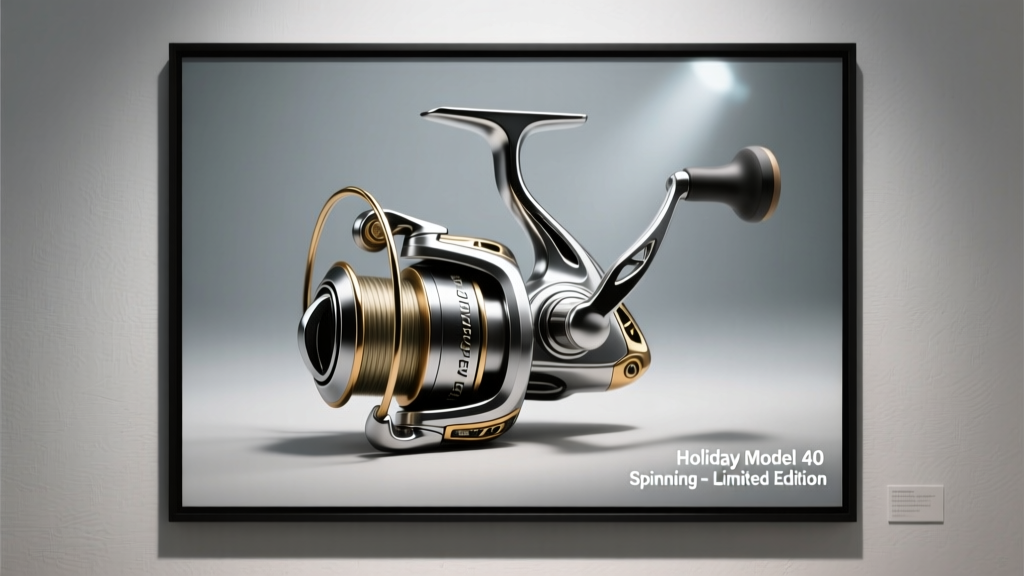
The Holiday Model 40 Spinning Reel: A Collector’s Guide to Authentication, Market Value, and Historical Context
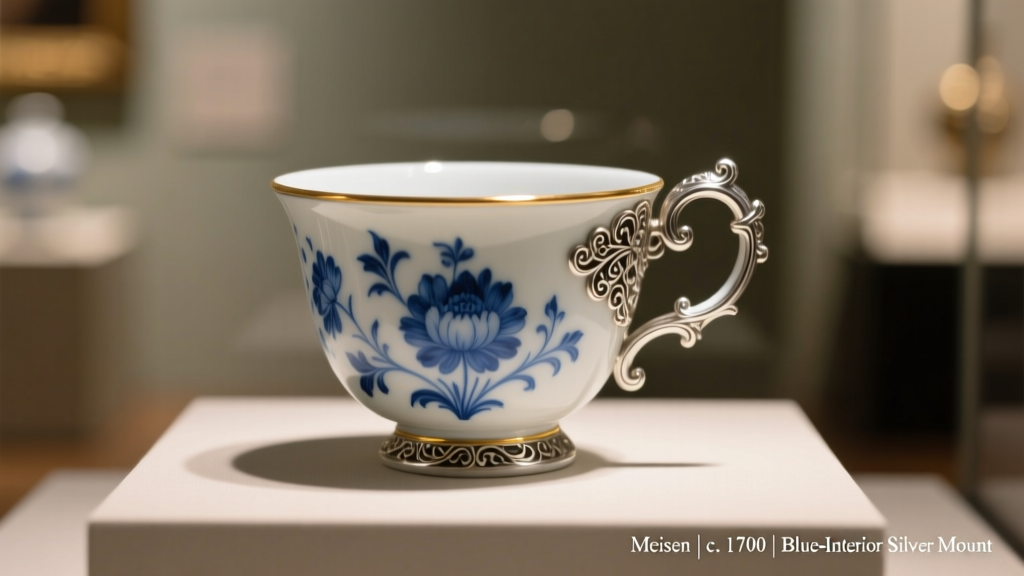
Meissen Cup with Silver Mounts and Blue Interior: A Dual-Function Artifact from the Early 18th Century
Advertising Tin: Uncle Daniel Tobacco Yellow 2 × 8 Inch – Authenticity, Market Value, and Historical Context
Heisey Lariat Mayonnaise Liner: Identification, Production History, and Market Authentication
Silver American Case Coin: Globe-Shaped Engraved Scroll Design — Authentication, Market Value & Technical Analysis of the 1 Troy Oz Bullion Piece
Fenton Hobnail Toothpick Blue: Authentication, Market Value, and Historical Context
Thomas Elmes: The Forgotten Architect, Printmaker, and Early 19th-Century Art Market Catalyst
Wedgwood Tankard in Green Jasperware: Authentication, Provenance, and Market Value of the 8¼-Inch Form
Beechwood High-Back Carved Upholstered Chair with Scroll Arms: Anatomy, Provenance, and Market Authentication