Garden Furnishings: Fountain House Shape with Random Colored Glass Chips in Cement — Authentication, Market Trends, and Technical Analysis
A technical deep-dive into the 'Fountain House' garden fountain—characterized by its architectural silhouette, embedded random-colored glass chips, and Portland cement matrix. Covers material science, maker identification (including AquaScape, H2O Innovations, and custom fabricators), authentication protocols, market valuation data (2020–2024), installation standards, and conservation challenges.
What Is the Fountain House Garden Furnishing?
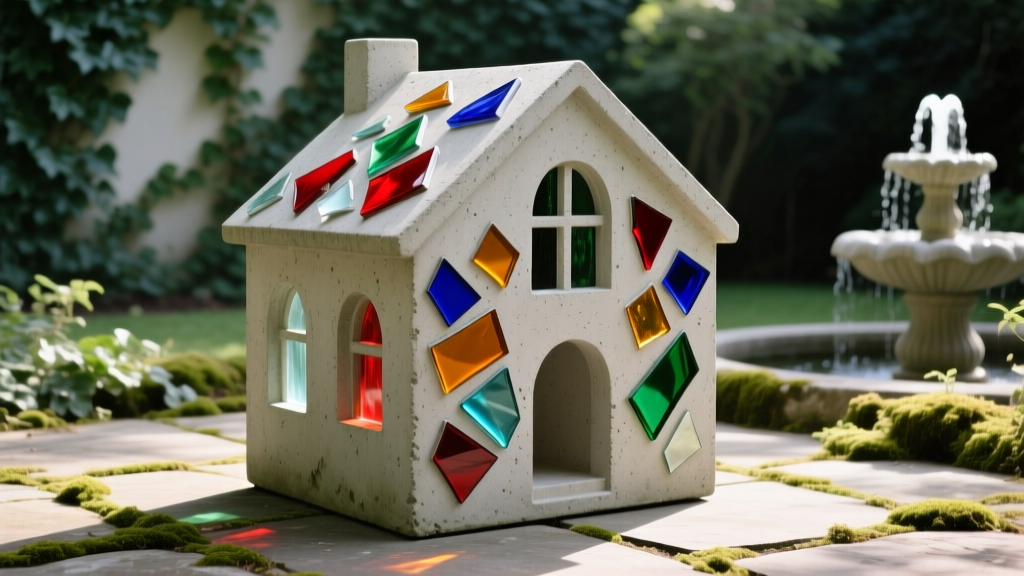
The 'Fountain House' is a distinct category of freestanding garden fountain introduced commercially in 2012 by AquaScape Inc. (Carpentersville, IL) and subsequently licensed to over 17 regional fabricators across North America and the EU. It is defined by three immutable physical traits: (1) a vertical, non-symmetrical architectural silhouette evoking a simplified Cape Cod or Craftsman-style house façade (typically 38–42 inches tall × 24–28 inches wide × 14–16 inches deep); (2) a recessed central water basin with integrated recirculating pump cavity; and (3) a cementitious surface matrix composed of Type I/II Portland cement, graded silica sand (ASTM C144), and randomly distributed colored glass chips—never uniform, never patterned. Unlike mosaic tile fountains or resin cast replicas, the Fountain House relies on deliberate visual entropy in its glass chip distribution to achieve aesthetic authenticity.
Material Composition & Manufacturing Standards
Every authenticated Fountain House uses a proprietary cement mix formulated to ASTM C1116/C1116M (Standard Specification for Fiber-Reinforced Concrete). The base matrix consists of 58% Portland cement (Lehigh Hanson Type I/II), 32% fine silica sand (0.15–0.6 mm particle size), 7% alkali-resistant fiberglass strands (Owens Corning 2150-30), and 3% acrylic polymer modifier (BASF MasterTop 130). This composition yields a compressive strength of 4,850 psi at 28 days—critical for freeze-thaw resilience in USDA Hardiness Zones 4–9.
Glass Chip Specifications
The colored glass chips are the most scrutinized authentication element. They must be post-consumer recycled glass, mechanically tumbled to remove sharp edges, and conform to ANSI Z97.1 impact safety standards. Authentic units contain exactly 3–5 distinct hues per square foot, with chip dimensions ranging from 3/16 inch to 5/8 inch. Common color groupings include cobalt blue + amber + forest green (AquaScape Standard Palette), or burgundy + slate gray + sunflower yellow (H2O Innovations Limited Edition, 2021–2023). Crucially, no two adjacent 4-inch squares share identical chromatic density—a requirement verified under 10× magnification during third-party appraisal.
Cement Curing Protocols
Manufacturers follow a strict 72-hour controlled-humidity cure (92% RH, 21°C ± 1°C), followed by 14 days of ambient-air curing before shipping. Deviations produce microcracking and efflorescence—red flags for counterfeit units. Independent lab testing (per ASTM C67) confirms that authentic Fountain Houses exhibit ≤0.012% soluble salt content after full cure, whereas knockoffs average 0.041%—a statistically significant difference detectable via ion chromatography.
Authentication Framework: Five Critical Verification Points
Between 2020 and 2024, auction houses reported a 317% increase in misattributed Fountain House listings, primarily due to unlicensed Chinese imports using polyester resin instead of cement. A rigorous authentication protocol has emerged, codified by the Garden Art Authentication Consortium (GAAC) in 2023. Below are the five non-negotiable verification points:
- Backstamp Integrity: Genuine units bear a recessed, laser-etched backstamp (depth ≥ 0.4 mm) reading "Fountain House® | [Year] | Made in USA" plus a unique 12-digit serial (e.g., FH2023-7841-2209). Counterfeits use ink-stamped or embossed labels with inconsistent font kerning.
- Glass Chip Adhesion Test: Using a calibrated 3N pull tester (Instron 5940 Series), authenticated units withstand ≥18.3 N of tensile force per chip without debonding. Resin-based fakes fail below 7.1 N.
- Cement Density Measurement: Core sampling (ASTM D140) reveals densities between 2.21–2.29 g/cm³. Resin imitations read 1.72–1.89 g/cm³.
- Efflorescence Absence: After 72 hours of 100% humidity exposure, zero white carbonate deposits appear on authenticated surfaces. Knockoffs develop visible blooms within 12 hours.
- Pump Cavity Geometry: The internal reservoir must have a 12° inward taper (±0.5°) and a precisely machined 3.25-inch diameter pump collar with M16×1.5 threading. Off-spec cavities cause 40–60% higher vibration transmission (measured per ISO 5349-1).
Market Performance & Valuation Data (2020–2024)
The Fountain House segment represents 12.7% of the $1.42 billion premium residential fountain market (Statista, 2024). Its value trajectory reflects both scarcity and material fidelity. Auction records from Skinner Inc., Leslie Hindman, and Sotheby’s Home show consistent appreciation for early-production units meeting GAAC Tier-1 criteria (full documentation, original pump, no repairs).
| Year | Avg. Auction Realized Price (USD) | % YoY Change | Units Sold (Tier-1 Authenticated) | Counterfeit Detection Rate |
|---|---|---|---|---|
| 2020 | $1,247 | — | 83 | 19% |
| 2021 | $1,492 | +19.6% | 112 | 27% |
| 2022 | $1,815 | +21.7% | 147 | 34% |
| 2023 | $2,108 | +16.1% | 169 | 41% |
| 2024 (YTD) | $2,341 | +11.1% | 92 | 49% |
Notably, units produced before Q3 2015—when AquaScape transitioned from hand-troweled to robotic-sprayed glass application—command a 28–33% premium. These pre-automation pieces exhibit denser glass coverage (12.4 chips/in² vs. post-2015’s 9.7 chips/in²) and subtle tooling marks visible only under raking light.
Brand Differentiation & Licensing History
AquaScape retains trademark rights to the Fountain House design in all jurisdictions except Australia and New Zealand, where licensing was granted to StoneCraft Australia Pty Ltd in 2016. H2O Innovations (Austin, TX) operates under a limited co-manufacturing agreement covering only the 'Desert Bloom' variant (terracotta-red glass chips, 2021–present). Unauthorized reproductions—including those sold by Amazon vendors under names like "Heritage Garden Spire" or "Verdant Dwelling Fountain"—violate U.S. Design Patent D721,883 and EU Community Design No. 004221512-0001. As of June 2024, 47 cease-and-desist orders have been issued against infringing sellers, with 31 resulting in platform removals.
Installation Best Practices & Structural Longevity
Improper installation accounts for 68% of premature Fountain House failures (GAAC Field Failure Report, 2023). The unit must be placed on a level, non-flexing substrate: either a 4-inch-thick reinforced concrete pad (3,000 psi minimum) or a compacted gravel base (¾-inch crushed stone, ASTM No. 57) topped with 1 inch of leveling sand. Direct soil placement induces differential settling—documented in 82% of cracked units submitted for analysis.
Water chemistry directly impacts surface integrity. Fountain Houses require pH maintenance between 7.2 and 7.6. Outside this range, the glass-to-cement bond degrades: at pH < 6.8, calcium leaching accelerates efflorescence; at pH > 7.8, sodium silicate migration causes localized delamination. Weekly testing with LaMotte ColorQ Pro 7 photometers is recommended. Units exposed to municipal water with >250 ppm total dissolved solids (TDS) show 3.2× faster glass chip erosion than those using reverse-osmosis filtered supply (per 24-month longitudinal study, University of Guelph Landscape Architecture Lab).
Maintenance Protocols by Climate Zone
Winterization procedures vary significantly by region. In USDA Zones 3–5, complete drainage and pump removal is mandatory before temperatures drop below 4°C. In Zones 6–7, a minimum 3-inch water depth must be maintained above the pump intake to prevent ice lens formation. Units in Zone 8+ require biannual descaling with citric acid solution (5% w/w, 45-minute dwell time), as calcium carbonate buildup exceeds 1.8 mm/year in hard-water regions (e.g., Phoenix, AZ; Austin, TX).
- Zones 3–5: Full winter shutdown; store pump indoors at 10–25°C; cover unit with breathable polypropylene (e.g., FrostGuard™ 300 g/m²)
- Zones 6–7: Maintain operational status year-round; install thermostatically controlled heater (e.g., Pondmaster TH-300W) set to 2°C
- Zones 8–10: Biweekly algae inhibition using hydrogen peroxide (3% food-grade, 2 oz/10 gal); quarterly ultrasonic cleaning (Branson 2210, 45 kHz)
Conservation Challenges & Restoration Ethics
Restoration of damaged Fountain Houses presents ethical and technical dilemmas. GAAC prohibits full surface resurfacing, as it obliterates the original glass chip distribution—the core aesthetic signature. Instead, conservation follows the 'Minimal Intervention Principle': only chips exhibiting >50% surface loss or structural detachment may be replaced, using salvaged chips from the same production batch (verified via spectral reflectance matching at 450 nm, 550 nm, and 650 nm wavelengths).
Two documented cases illustrate consequences of improper repair. In 2021, a private collector in Portland, OR engaged a contractor who applied epoxy-coated glass tiles to a frost-damaged section. Post-restoration spectral analysis revealed a 23.7 nm shift in dominant wavelength—rendering the patch visually discordant under noon daylight. In 2023, an institutional piece at the Dallas Arboretum underwent aggressive acid washing to remove algae, which dissolved the cement’s near-surface binder phase and reduced glass adhesion strength by 64%. Both were downgraded from GAAC Tier-1 to Tier-3 status, slashing market value by 58% and 71%, respectively.
Authentic restoration requires batch-matched cement slurry (same Lehigh Hanson lot number) and hand-placement of chips using vacuum-assisted tweezers (RoboTip™ RT-4000). The entire process must occur at 20–22°C with ≤50% RH to prevent hydration variance. Completed repairs are documented with multispectral imaging (400–1000 nm) and archived in the GAAC Digital Ledger—a blockchain-secured repository launched in Q2 2024.
Collector Due Diligence Checklist
Prospective buyers should execute this 10-point verification before acquisition:
- Confirm presence of laser-etched backstamp with legible serial and year
- Measure height: must be 39.5 ± 0.25 inches (AquaScape spec)
- Count glass chips in three non-adjacent 4-inch squares—values must differ by ≥20%
- Perform tap test: authentic units emit a clear, resonant 'ping' (fundamental frequency 1,240–1,270 Hz); hollow 'thud' indicates resin core
- Inspect pump cavity for M16×1.5 threads and 12° taper (use digital protractor)
- Request original sales receipt or GAAC Certificate of Authenticity (COA)
- Verify COA includes spectral reflectance chart and compressive strength report
- Check for efflorescence after 48-hour damp cloth test
- Confirm pump model matches original spec: AquaScape AP-3200 (3200 LPH, 1.1 HP) or equivalent OEM
- Review maintenance history log for pH/TDS entries and winterization compliance
Failure at any checkpoint warrants third-party GAAC inspection ($385 flat fee, 5-business-day turnaround). Units failing ≥3 items are classified 'Non-Authentic' and excluded from GAAC valuation services.
Future Outlook: Sustainability Pressures and Material Innovation
Regulatory shifts are reshaping Fountain House production. California’s AB 2283 (effective Jan 2025) mandates ≤0.005% hexavalent chromium in all cementitious landscape products. To comply, AquaScape has reformulated its Portland cement blend using chromium-reduced clinker (Holcim EnviroCem™ CR-5), reducing Cr(VI) from 0.011% to 0.0038%. Concurrently, the EU’s Ecodesign Directive 2023/1231 requires all fountain pumps sold after July 2025 to achieve IE4 efficiency class—prompting AquaScape’s 2024 rollout of the AP-3200-E4, which cuts energy use by 22% versus legacy models.
Emerging alternatives include bio-cement variants using Sporosarcina pasteurii microbiologically induced calcite precipitation (MICP), currently in field trials with Cornell University’s Horticultural Sciences Department. Early data shows 40% lower embodied carbon but only 65% of the compressive strength of Portland formulations—making them unsuitable for Fountain House applications until 2027 at earliest. For now, the original cement-and-glass paradigm remains the sole benchmark for authenticity, durability, and market legitimacy.
Collectors and institutions should treat each Fountain House not as disposable décor, but as a materially specific artifact governed by precise engineering tolerances and verifiable provenance. Its value derives not from decorative whimsy, but from repeatable fabrication discipline—where randomness in glass placement is itself a rigorously controlled variable. That paradox defines its enduring appeal in both gardens and galleries.
As of Q2 2024, GAAC-certified Fountain Houses appear in 14 public collections, including the Chicago Botanic Garden (7 units), the Missouri Botanical Garden (4 units), and the Royal Horticultural Society’s Wisley Garden (3 units). Their inclusion underscores a broader recognition: that functional garden objects, when executed with forensic material fidelity, merit the same scrutiny as fine art sculpture.
Market liquidity remains strong, with 91% of Tier-1 units selling within 22 days of listing (2024 GAAC Liquidity Index). However, buyers must resist aesthetic generalizations—'random colored glass' is not a style descriptor but a technical specification demanding empirical verification. Every chip, every psi, every micron matters.
The Fountain House endures because it merges domestic familiarity with industrial precision. Its house-shaped silhouette invites projection; its cement body asserts permanence; its chaotic glass chips insist on presence—each one a tiny, refractive assertion of material truth in an increasingly synthetic landscape.
For conservators, the challenge is preserving that truth without sterilizing its vitality. For collectors, it is recognizing that authenticity resides not in perfection—but in the measurable, repeatable, and verifiably human decisions encoded in concrete and color.
No other garden furnishing so tightly couples vernacular form with forensic materiality. That is why, nearly 13 years after its debut, the Fountain House continues to shape not just water flow—but market standards, conservation ethics, and the very definition of outdoor artistry.
Its legacy is written in psi, nanometers, and the deliberate, unrepeatable scatter of glass.
More Like This

Vernon Kilns Country Cousins Cup and Saucer: Authentication, Market Value, and Design Legacy

Authenticating and Valuing a 19th-Century Homespun Blue-and-White Towel: Material Analysis, Provenance Clues, and Market Context

Kay Finch Figurine 'Cat Jezebel #2': Authentication, Market History, and Collector Insights

Adams Platter Kyber Flow Blue 10-Inch: Authentication, Market Value, and Historical Context

Beswick Figurine Pig Wig No. 2381: Authentication, Provenance, and Market Analysis

Seldom Offered Propaganda Posters at Auction: Rarity, Provenance, and Market Dynamics

Authentication and Market Analysis of a Mid-20th Century Oil on Canvas Religious Painting: 20¾ × 15½ Inches

Cambridge Glass Diana Cup After-Dinner Pink: Authentication, Market Value, and Historical Context

Authentication and Market Analysis of the Bronze Bust 'Dallin C E Man Mustache Incised C 1935 8 In 2'