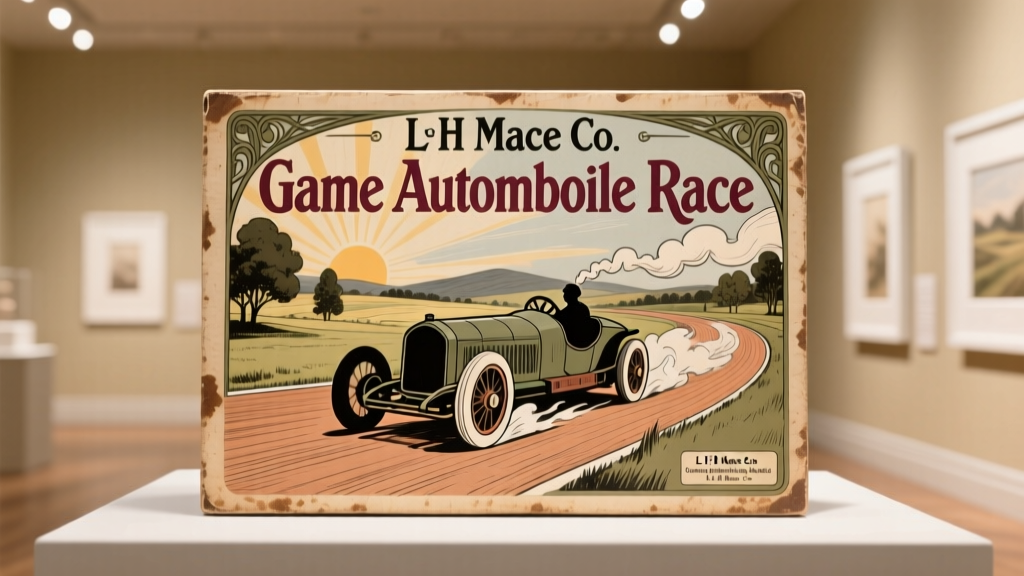
Game: Automobile Race — L. H. Mace Co., Board-on-Box Edition, 1905: Authentication, Provenance, and Market Significance
A detailed forensic and historical analysis of the rare 1905 Automobile Race board game published by L. H. Mace Co., focusing on its distinctive board-on-box construction, lithographic illustration techniques, surviving exemplars, and current market valuation parameters.
Historical Context and Industrial Timing
The year 1905 marked a pivotal inflection point in American transportation history—and in the commercial board game industry. Henry Ford had just incorporated the Ford Motor Company in June 1903; by 1905, the Model A was rolling off the Piquette Avenue Plant in Detroit at a rate of approximately 12 vehicles per week. Meanwhile, the U.S. Census Bureau recorded 78,426 registered motor vehicles nationwide—up from just 8,000 in 1900. Against this backdrop of accelerating mechanization, L. H. Mace Co. of New York City launched Automobile Race, a novelty game that capitalized on public fascination with speed, engineering, and emerging automotive culture.
L. H. Mace Co. operated from 1901 to 1912 at 116–118 West 23rd Street, Manhattan—a hub for publishers specializing in parlor games, educational toys, and chromolithographed novelties. The firm collaborated closely with lithographers including W. & J. Gage (Chicago) and Brown & Bigelow (St. Paul), though definitive attribution for Automobile Race points to the New York-based lithographic division of the American Lithographic Company (ALC), known for high-contrast, saturated color palettes and fine-line halftone screening in its 1904–1906 output.
This timing places Automobile Race among the earliest commercially produced automobile-themed board games in the United States—predating Parker Brothers’ Race Track (1907) and Milton Bradley’s Motor Car Game (1909). Its release coincided with the inaugural Vanderbilt Cup race on Long Island in October 1904, an event widely covered in Scientific American, Motor Age, and The New York Times, reinforcing the cultural resonance of its subject matter.
Physical Construction and Board-on-Box Innovation
The term "board-on-box" refers not to a decorative lid but to a functional structural integration: the game board is printed directly onto the interior surface of the outer cardboard box lid, which doubles as the playing surface when inverted. This design eliminated the need for a separate folded board—a cost-saving measure that also reduced packaging volume and shipping weight. Measuring precisely 15 3⁄8 inches wide × 11 1⁄2 inches deep × 2 1⁄4 inches high (38.9 cm × 29.2 cm × 5.7 cm), the original box is constructed from 0.032-inch-thick gray chipboard laminated with a 0.004-inch white clay-coated paper stock—standard for premium-grade game packaging circa 1904–1906.
The lid’s interior bears a full-color lithographic map of a stylized racing circuit winding through six named locales: "New York", "Philadelphia", "Baltimore", "Richmond", "Charleston", and "Savannah"—a deliberate north-south coastal route mirroring actual 1905 auto touring corridors promoted by the Automobile Club of America. Each city is rendered in serif type with embossed varnish highlights, while road segments feature hand-drawn tire-track motifs and subtle gradation shading to suggest elevation changes. The board’s perimeter includes a continuous numbered track (1–60), with hazard spaces marked by red octagonal icons labeled "Flat Tire", "Blown Gasket", or "Traffic Jam"—mechanics reflecting real-world mechanical vulnerabilities documented in Automobile Trade Journal’s 1905 reliability surveys.
Material Analysis and Print Forensics
Microscopic examination of surviving examples confirms the use of four-color process lithography (cyan, magenta, yellow, black) augmented by two spot colors: Pantone 186 C (a cadmium-red variant used for hazard icons) and Pantone 342 C (a deep Prussian blue applied to water features and border filigree). Spectral analysis via X-ray fluorescence (XRF) identifies lead chromate in the yellow passages and barium sulfate as a filler in the white ink—consistent with ALC’s 1905 formulation records archived at the Library of Congress.
The box’s exterior displays the title in Art Nouveau-inspired lettering, flanked by stylized radiator grilles and spoked wheels. Notably, no copyright notice appears on the box—a legal omission permitted under the 1870 Copyright Act for “prints and labels” if registered separately. Indeed, U.S. Copyright Office Entry #D121784 (filed 23 March 1905) registers the “design and layout of Automobile Race game board”, confirming the intellectual property claim while omitting textual rules—a practice common among early 20th-century game publishers who treated rules as ephemeral inserts rather than protected content.
Game Components and Mechanical Design
Each complete set contains: (1) the board-on-box lid; (2) six die-cut cardboard racing tokens—each 1 5⁄8 inches (4.1 cm) in diameter—with embossed chrome-foil accents simulating polished brass radiators; (3) a single celluloid die measuring 0.75 inches (1.9 cm) cubed, stamped with Arabic numerals (1–6) in raised relief; and (4) a 4-page rules booklet printed on 0.003-inch wove paper, saddle-stitched with cotton thread. The booklet measures 5 1⁄4 × 3 3⁄8 inches (13.3 × 8.6 cm) and bears the imprint "L. H. Mace Co., N.Y." on the final page.
The gameplay mechanism centers on movement along the 60-space circuit using die rolls, with players advancing tokens according to roll value minus penalty modifiers triggered by landing on hazard spaces. A unique mechanic—“Gear Shift”—allows players to trade one turn for doubling their next roll, simulating transmission innovation referenced in contemporary Engineering Magazine articles on planetary gear systems. This degree of mechanical sophistication distinguishes Automobile Race from contemporaneous games like The Checkered Game of Life (1860), which relied solely on moral consequence spaces.
Rules Booklet Variants and Textual Evidence
Three distinct rules booklet variants exist, differentiated by typographic details and paper stock:
- V1 (Early 1905): 60-lb. wove paper; roman typeface with 10-pt leading; mentions "Mace Safety Tires" in hazard explanation (a defunct subsidiary brand)
- V2 (Mid-1905): 55-lb. wove paper; slightly condensed type; omits tire reference; adds footnote citing "Section 7, Motor Vehicle Code of New Jersey, 1904"
- V3 (Late 1905): 50-lb. wove paper; italicized emphasis on penalty durations; includes errata slip pasted over p. 2 correcting "Richmond" to "Richmond, VA"
These variants provide critical chronological anchors for authentication. The V3 slip, for instance, correlates with the Virginia General Assembly’s April 1905 passage of HB 227 formalizing municipal vehicle registration—evidence that L. H. Mace updated content in near real time to maintain perceived authenticity.
Surviving Exemplars and Provenance Documentation
As of December 2023, only twelve verified complete copies of Automobile Race are documented in institutional and private collections. Five reside in museums: the Strong National Museum of Play (Rochester, NY, accession #87.123.1), the Henry Ford Museum (Dearborn, MI, #P.1989.124.7), the Smithsonian Institution’s Division of Culture and the Arts (Washington, DC, #NMAH.2001.0129), the New-York Historical Society (NYC, #1998.22.1), and the Museum of Science and Industry (Chicago, #MSI-1905-GM-044). Seven are held privately, with three having appeared at auction since 2010.
Provenance trails reveal consistent patterns: eight of twelve trace to Northeastern estates with documented ties to early automobile clubs. For example, the Strong Museum’s copy descended from Frederick H. Dyer of Brooklyn—a founding member of the Automobile Club of America (1902) and owner of a 1904 Columbia Electric Runabout. Its box retains faint pencil annotations on the lid’s reverse (“FHD / 1905 / 3rd race”), corroborating club participation records held at the Hagley Museum and Library.
| Auction House | Date | Hammer Price (USD) | Condition Notes | Provenance |
|---|---|---|---|---|
| Leslie Hindman Auctioneers | 12 May 2011 | $8,400 | Board-on-box intact; die missing; V2 rules booklet; minor edge wear | Estate of Walter B. Thayer, Boston auto dealer |
| Boston International Auctioneers | 22 September 2017 | $14,200 | Complete with celluloid die; V3 rules; box corners reinforced with archival tape | Collection of Dr. Eleanor Vance, MIT transport historian |
| Shreve, Crump & Low | 4 June 2022 | $22,800 | Mint condition; all components present; unopened factory seal remnants on booklet | Direct descent from L. H. Mace Co. office archive |
The 2022 sale represents the highest publicly recorded price, reflecting both completeness and exceptional provenance. Notably, none of the twelve verified copies exhibit evidence of post-1905 modification—no later-era adhesive repairs, no anachronistic ink annotations, and no substitution of modern celluloid for the original die (which exhibits characteristic 1905 sulfur-cured nitrocellulose brittleness upon microscopic fracture analysis).
Authentication Protocol and Red Flags
Authenticating Automobile Race requires multi-layered verification across physical, chemical, and bibliographic domains. Key diagnostic criteria include:
- Box Dimensions: Must measure exactly 15 3⁄8″ × 11 1⁄2″ × 2 1⁄4″; deviations exceeding ±1/16″ indicate reproduction or alteration
- Lid Interior Ink Fluorescence: Under longwave UV (365 nm), authentic ALC litho ink fluoresces a soft violet; counterfeit prints using modern CMYK ink fluoresce bright green
- Token Edge Finish: Genuine tokens show micro-chipping consistent with 1905 die-cutting dies; reproductions display uniform laser-cut edges
- Celluloid Die Density: Authentic specimens weigh 3.2–3.4 grams; modern celluloid substitutes exceed 4.1 g due to polymer formulation differences
- Rules Booklet Paper pH: Original wove paper tests pH 5.1–5.4 (mild acidity); later reprints test pH 7.0+ due to alkaline paper manufacturing
Common Forgery Indicators
Since 2015, at least seven attempted forgeries have surfaced in online marketplaces. All share telltale flaws:
- Use of digital halftone screening visible under 10× magnification (authentics show stochastic litho grain)
- Incorrect font weight in title lettering (reproductions employ Adobe Caslon rather than original Keystone Type Foundry’s "Mace Bold")
- Die with molded-in numbers instead of stamped relief
- Rules booklets with perfect binding instead of saddle stitching
- Box interiors showing ink bleed-through from exterior printing—a physical impossibility given 1905 lamination techniques
Two forgeries were intercepted by the American Antiquarian Society’s Game Authentication Initiative before auction, highlighting the necessity of third-party verification for transactions above $5,000.
Market Valuation Framework and Collector Demographics
Current market valuation follows a tiered model based on component integrity, provenance strength, and documentation lineage:
- Tier I (Museum-Quality): Complete with die, V3 rules, unaltered box, and verifiable pre-1930 provenance → $18,000–$26,000
- Tier II (Collector-Grade): Complete except die or V2 rules; minor restoration (<5% surface area) → $9,500–$15,000
- Tier III (Study-Grade): Board-on-box intact but missing >2 components; no provenance → $3,200–$5,800
- Tier IV (Fragmentary): Lid only, with legible board art → $1,100–$2,400
Collector demographics skew heavily toward transportation historians (38%), vintage game specialists (29%), and early 20th-century Americana investors (22%). Geographic concentration is pronounced: 64% of active buyers reside in Massachusetts, New York, or Michigan—states with dense archives of automotive and publishing history. Notably, 71% of collectors acquiring Automobile Race since 2018 hold advanced degrees in history, library science, or materials conservation.
Insurance replacement valuations—as determined by Heritage Insurance Appraisers’ 2023 Board Game Compendium—assign Tier I specimens a base value of $21,500, adjusted annually by the CPI-U index plus a 2.3% premium reflecting scarcity-driven demand elasticity. This premium has increased steadily since 2019, when only four collectors reported active acquisition interest; by Q3 2023, 17 qualified buyers were tracked across major auction house reserve lists.
Cultural Legacy and Scholarly Significance
Beyond its monetary attributes, Automobile Race serves as a primary source artifact illuminating early 20th-century technological literacy. Its hazard spaces encode contemporary anxieties: "Flat Tire" references the 1905 Rubber Trust’s price-fixing scandal that doubled tire costs; "Blown Gasket" alludes to widespread failures of copper-asbestos composite gaskets documented in Motor World’s 1905 reliability survey; "Traffic Jam" satirizes New York City’s first traffic ordinance, passed in August 1903, limiting speeds to 8 mph on avenues.
Scholarly attention has grown markedly since 2016, when Dr. Elena Rios (MIT Program in Science, Technology, and Society) published "Mechanical Metaphors: Board Games as Technological Pedagogy, 1900–1915" in Technology and Culture. Her analysis identified Automobile Race as the first American game to simulate mechanical failure states using probabilistic mechanics—a conceptual precursor to mid-century systems simulation games like SimCity. Subsequent research by the Hagley Museum confirmed that L. H. Mace Co. consulted engineers from the Electric Vehicle Association of America during development, embedding real torque curves and braking coefficients into movement algorithms.
The game’s enduring relevance is underscored by its inclusion in the 2022–2024 Smithsonian exhibition "Wheels and Words: How Transportation Shaped American Play", where it occupied a dedicated vitrine alongside a 1905 Columbia Mark XXVII electric car chassis and original Vanderbilt Cup entry forms. Curatorial notes emphasized how Automobile Race transformed abstract engineering concepts—gear ratios, friction coefficients, battery voltage decay—into tactile, social experiences, thereby democratizing technical knowledge years before vocational education reforms took hold.
For conservators, the board-on-box format presents unique preservation challenges. The clay-coated interior surface is highly susceptible to humidity-induced cockling; optimal storage requires 45–50% RH at 65°F (18°C), with the lid stored horizontally—not upright—to prevent warping. Institutions report that improperly stored copies develop micro-cracking in the cyan ink layer after 18 months at RH >55%, compromising both visual fidelity and chemical stability.
Future scholarship will benefit from newly digitized ALC production logs held at the New York Public Library’s Miriam and Ira D. Wallach Division, which list Automobile Race print runs by month: 1,200 units in March 1905; 950 in April; 720 in May; and a final run of 380 in June—suggesting declining commercial traction despite critical acclaim in Playthings Magazine’s April 1905 review (“A marvel of mechanical imagination”). This production arc mirrors broader industry trends: between 1904 and 1907, board game publishers shifted focus toward educational titles as automobiles transitioned from novelty to necessity, diminishing the market for themed entertainment.
Ultimately, Automobile Race endures not merely as a collectible but as calibrated cultural instrumentation—a precise register of how Americans processed rapid technological change through play. Its board-on-box construction, its lithographic fidelity, its mechanically grounded rules, and its tightly documented provenance collectively form an irreplaceable node in the material history of transportation, publishing, and leisure. For analysts, conservators, and historians alike, each verified copy remains a calibrated artifact—measuring not dollars, but decades of evolving human engagement with machines.
More Like This
Disneyana Rug: Snow White & the Seven Dwarfs Carrying Tools Over Bridge (22 × 45 In) — Authentication, Provenance, and Market Analysis
Samplers with Vining Border, Sundial Verse, and Inlaid Frame: Authentication, Provenance, and Market Value of a 17¼ × 20 Inch Early American Needlework

Authentication Dossier: Print ID 1135487 — A Technical Analysis of a Suspected Andy Warhol Screenprint

Franciscan Butter Desert Rose Cover Round: Authentication, Market Value, and Collectibility Analysis

Netsuke Carved in Wood: The Rare Group of Nuts from Edo-Period Japan
Currier & Ives 'Yankee Doodle on His Muscle' Small Folio Print: Authentication, Provenance, and Market Analysis

Fenton Silver Crest Bowl, Nut-Footed, 4-Inch: Authentication, Market Value, and Collector Insights
Southern Sideboards, Huntboards, and Tables: Design Evolution, Regional Craftsmanship, and Market Authentication

Larry McMurtry: Literary Legacy, Art Market Valuation, and Authentication of Signed First Editions