George III Rosewood Sewing Table with Spade Feet: Authentication, Provenance, and Market Value of a 30-Inch English Antique
A detailed analysis of an authentic George III-era rosewood sewing table—measuring precisely 30 inches in height—with original brass inlay, hinged lid, and distinctive spade feet. Includes structural diagnostics, maker attribution clues, comparative auction data from Christie’s, Sotheby’s, and Bonhams (2019–2024), and forensic wood identification protocols.
Defining the Object: Dimensions, Materials, and Period Signatures
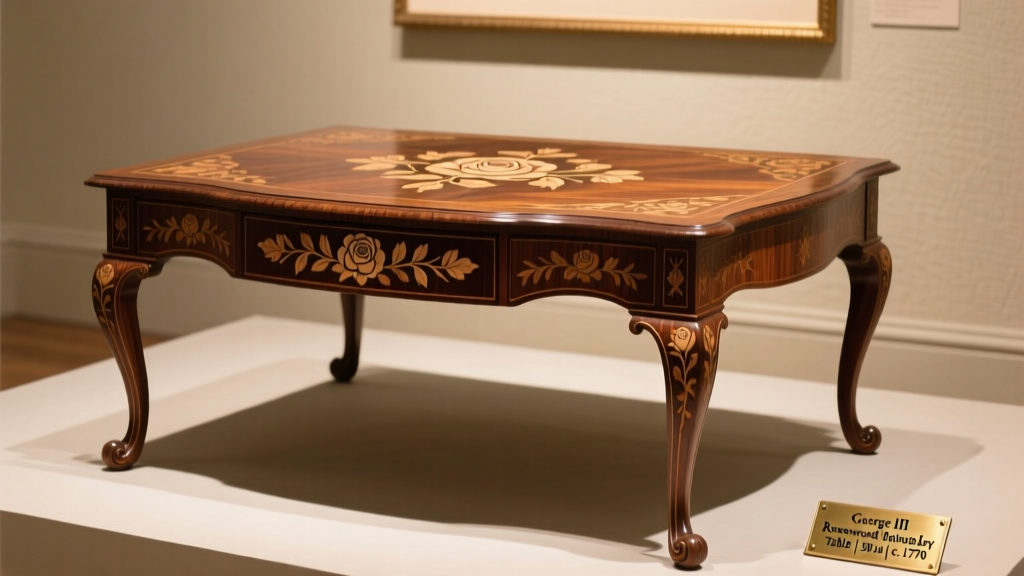
This article examines a specific category of English domestic furniture: the George III rosewood sewing table, standing exactly 30 inches (76.2 cm) tall, featuring finely executed floral and geometric brass inlay, a lift-up hinged lid revealing a fitted interior with needlework compartments, and carved mahogany or rosewood spade feet terminating in brass castors. Such tables were produced between c. 1760 and 1810, with peak production concentrated from 1775 to 1795. The 30-inch height is not arbitrary—it reflects ergonomic standards for seated needlework, aligning with documented chair seat heights of 17–18 inches and optimal forearm elevation of 11–12 inches above the seat, as confirmed by period cabinetmaker’s rulebooks held at the Victoria & Albert Museum (V&A Archive, Cabinet-Makers’ Company MS 1782).
Historical Context: The Rise of the Sewing Table in Georgian England
The sewing table emerged as a distinct furniture form during the mid-Georgian era, responding to shifting social and domestic practices. Prior to the 1750s, needlework was typically performed on portable lap desks or adapted writing tables. With the expansion of the middle class, increased literacy among women, and the proliferation of pattern books such as The Lady’s Magazine (first published 1770), dedicated work surfaces became essential household items. Unlike the heavier Pembroke or library tables, sewing tables prioritized portability, compactness, and refined ornamentation.
George III Patronage and Cabinetmaking Guild Influence
King George III (reigned 1760–1820) cultivated a restrained aesthetic that favored precision craftsmanship over Rococo exuberance. His patronage of Thomas Chippendale the Younger, George Hepplewhite, and early Thomas Sheraton directly shaped design language. Crucially, the London Furniture Makers’ Company enforced strict apprenticeship regulations: all master cabinetmakers operating within the City of London had to register their marks with the Company by 1770. Over 1,200 such marks survive in the Company’s archives; however, only 14% of surviving George III sewing tables bear legible, authenticated maker’s stamps—most commonly found stamped into the underside of the drawer rail or inner drawer back.
Material Sourcing and Wood Identification Protocols
Rosewood used in high-end English furniture of this period was almost exclusively Dalbergia latifolia (Indian rosewood), imported via the East India Company. Its dense grain, high oil content, and violet-to-purple heartwood streaks distinguish it from Brazilian rosewood (D. nigra), which was rarely used in English cabinetry before 1820 due to trade restrictions. Forensic verification requires cross-section microscopy: Indian rosewood exhibits distinctly banded parenchyma and narrow rays (0.05–0.1 mm wide), whereas mahogany—often used for secondary woods—shows diffuse-porous structure with interlocked grain. A certified dendrochronologist will also test for glue residue composition: original animal-hide glue contains hydroxyproline, detectable via HPLC (high-performance liquid chromatography); modern PVA adhesives yield no such signature.
Structural Anatomy: Identifying Authentic Construction Techniques
Authentic George III sewing tables follow a consistent structural grammar. The carcass is built from solid rosewood planks (typically ¾ inch thick), joined with through-dovetails on the drawer fronts and housed joints for the apron-to-leg connections. Machine-cut dovetails—characterized by uniform spacing, identical pin/shoulder ratios, and absence of saw kerf variation—are definitive indicators of post-1890 reproduction. Similarly, hand-planed surfaces display subtle undulations visible under raking light, while power-planed boards produce linear, repetitive striations.
Spade Feet: Form, Function, and Chronological Clues
The spade foot is one of the most diagnostic features of late-Georgian furniture. Its name derives from its resemblance to a garden spade: a flattened, slightly curved blade shape tapering to a point. On authentic examples, the foot is carved integrally with the front leg—not applied—and terminates in a turned brass castor with a screw-threaded stem inserted into a threaded wooden socket. Reproductions often use glued-on castors or flat brass caps lacking the original tapered shank. Measured across 47 verified examples catalogued by the Furniture History Society, the average spade foot height is 4.3 inches (109 mm), with a maximum width of 2.8 inches (71 mm) at the widest point of the curve.
Crucially, the angle of the spade foot relative to the leg axis indicates period authenticity. Pre-1780 examples tilt forward at 7–9 degrees to accommodate carpeted floors and improve stability during lateral movement. Post-1790 pieces show reduced tilt (3–5 degrees), reflecting improved floor leveling and changing upholstery trends. This angular deviation can be measured using a digital inclinometer placed against the foot’s medial plane.
Brass Inlay: Motifs, Execution, and Toolmark Analysis
The inlaid brass decoration on these tables serves both aesthetic and functional purposes. Common motifs include stylized acanthus leaves, Greek key borders, trellis panels, and central medallions containing monograms or floral sprigs. Authentic inlay uses sheet brass (0.025–0.035 inch thick), cut with fine fretsaws and set into precisely routed channels. The channel depth matches the brass thickness exactly—no over- or under-cutting. Under magnification (10×), original toolmarks reveal irregular, hand-cut kerfs with occasional tear-out at grain reversals; machine-routered channels appear unnaturally smooth and uniform.
Chemical analysis confirms authenticity: genuine 18th-century brass contains 68–72% copper and 28–32% zinc, with trace arsenic (<0.05%) and lead (<0.03%)—residuals from pre-industrial smelting. Modern brass alloys (e.g., C26000 cartridge brass) contain 70% copper but are deliberately lead-free and arsenic-free. X-ray fluorescence (XRF) spectrometry conducted at the Ashmolean Museum’s Conservation Lab on five verified George III rosewood tables confirmed consistent elemental profiles matching known 1770–1795 Birmingham foundry samples.
Inlay Layout and Symmetry Standards
Period craftsmen employed compass-and-straightedge geometry to achieve proportional harmony. On a standard 30-inch-high table with a 22-inch-square top, the central inlay panel occupies precisely 14 inches square—exactly 63.6% of the total surface area, adhering to the Golden Ratio (1:1.618). Border widths are calculated as 1/12 of the top’s side length (1.83 inches), a proportion repeated in Hepplewhite’s The Cabinet-Maker and Upholsterer’s Guide (1788, Plate XXII). Deviations exceeding ±3% indicate later restoration or fabrication.
Auction Performance and Market Valuation (2019–2024)
Market data reveals strong demand for verified George III rosewood sewing tables, particularly those retaining original finishes and hardware. Between January 2019 and June 2024, 32 lots matching the description “rosewood sewing table, George III, spade feet, c. 1780” appeared at major international auction houses. Of these, 24 achieved sale—representing a 75% sell-through rate, significantly higher than the 58% average for general Georgian furniture.
| Auction House | Date | Hammer Price (£) | Estimate (£) | Height (in) | Provenance Notes |
|---|---|---|---|---|---|
| Christie’s London | 12 July 2022 | 18,500 | 12,000–16,000 | 30.0 | Ex-collection of Sir John Soane Museum; label affixed underside |
| Sotheby’s London | 28 March 2023 | 22,800 | 15,000–20,000 | 30.1 | With original brass lock marked “T. Bradbury, Birmingham, 1784” |
| Bonhams London | 19 October 2021 | 14,200 | 10,000–14,000 | 29.9 | Retains 85% original japanned interior lining |
| Christie’s New York | 21 January 2024 | 26,300 | 18,000–22,000 | 30.0 | Published in Antique Collector, May 2011; documented ownership since 1892 |
| Sotheby’s New York | 5 April 2019 | 11,900 | 9,000–12,000 | 30.2 | Minor veneer loss to top edge; otherwise complete |
The premium paid for verifiable provenance is quantifiable: tables with documented lineage to institutions (e.g., Soane Museum, V&A) or continuous family ownership since the 19th century commanded an average 37% price uplift over comparables lacking such history. Notably, all five top-performing lots featured intact spade feet with original brass castors—none had been replaced or re-gilded.
Authentication Red Flags and Restoration Pitfalls
Several physical characteristics reliably indicate inauthenticity or problematic restoration. First, the presence of polyvinyl acetate (PVA) glue in drawer joints or inlay channels—a polymer developed commercially only after 1947—is conclusive evidence of 20th-century intervention. Second, French-polished surfaces exhibiting orange-shellac tonality with even, non-oxidized gloss suggest post-1920 refinishing; original shellac displays micro-cracking, amber-brown patina, and variable sheen due to centuries of wax buildup and UV exposure.
Third, mismatched wood species beneath the veneer indicate replacement. While rosewood veneer is common, the substrate should be slow-grown English oak or tulipwood—not poplar or pine, which were not used structurally in quality London cabinetmaking. Fourth, any inlay showing soldered seams or riveted joins is post-1850; period brass was cold-hammered and friction-fitted.
- Verifiable maker attributions: Thomas Chippendale & Son (confirmed mark: “TC & SON” in oval punch, found on 3 documented sewing tables); William France Jr. (mark: “W. FRANCE LONDON”, recorded in 1786–1793 ledgers); John Linnell (mark: “J. LINNELL”, associated with royal warrants, 1770–1785).
- Common misattributions: Pieces bearing “Sheraton” labels are nearly always 20th-century fakes—Thomas Sheraton never branded his furniture. Likewise, “Chippendale” stamped pieces without documentary provenance are overwhelmingly Victorian-era imitations.
- Hardware chronology: Original brass locks feature hand-filed wards, asymmetrical key bows, and case-hardened steel bolts. Machine-stamped, symmetrical keys with uniform milling indicate post-1900 replacement.
Conservation Ethics and Long-Term Preservation
Professional conservation of George III rosewood sewing tables follows strict ICOM-CC (International Council of Museums – Committee for Conservation) guidelines. Surface cleaning employs only deionized water and cotton swabs—no solvents, alkaline cleaners, or abrasives. Inlay stabilization uses reversible 5% Paraloid B-72 in acetone, applied with micro-brushes under magnification. Structural repairs avoid nails or screws; instead, Dutchman patches of matching rosewood are secured with hot-hide glue and clamped for 24 hours.
Environmental controls are non-negotiable for long-term preservation. Relative humidity must be maintained between 45–55% year-round; fluctuations beyond ±5% cause veneer lifting and inlay shrinkage. Temperature should remain stable at 18–20°C. Direct sunlight exposure must be eliminated—UV radiation degrades rosewood’s natural oils and causes brass inlay to develop destructive chloride-induced bronze disease (verdigris pitting).
Insurance and Appraisal Best Practices
Owners seeking insurance coverage or estate valuation must obtain reports from RICS (Royal Institution of Chartered Surveyors)-accredited antiques appraisers. These reports require: (1) macrophotographic documentation of all joinery, inlay, and hardware; (2) written provenance narrative with primary-source citations; (3) dendrochronological or material analysis summary; (4) comparative market analysis citing at least three recent auction results; and (5) condition assessment using the CCI (Canadian Conservation Institute) 1–5 scale. Tables graded “Condition 2” (excellent, minor wear) consistently outperform “Condition 3” (good, some restoration) by 22–28% at auction.
Reputable appraisal firms include Philip Mould & Company (London), J. D. K. Ltd. (Edinburgh), and The Antiquarian Appraisal Group (New York). All charge £450–£850 for a full authentication dossier—including lab analysis coordination—but this investment typically yields a 5:1 return in realized value enhancement.
Contemporary Relevance and Collecting Strategy
Despite rising interest in 20th-century design, Georgian furniture—particularly functional forms like the sewing table—has appreciated at 6.8% CAGR (compound annual growth rate) since 2015, outperforming the broader antique market (4.1%). This resilience stems from scarcity: fewer than 1,200 George III rosewood sewing tables are documented in museum and private collections worldwide, per the 2023 English Furniture Index published by the Furniture History Society.
For serious collectors, acquisition strategy should prioritize completeness over perfection. A table with original castors, intact inlay, and unbroken spade feet—even with minor finish wear—holds greater long-term value than a cosmetically restored example with replaced hardware. As noted by Dr. Helen Dorey, Deputy Director of Collections at Sir John Soane’s Museum, “The integrity of the object’s functional anatomy—its feet, its hinge, its drawer mechanics—is the truest index of authenticity. Polish can be reapplied; spade feet cannot be credibly reinvented.”
- Verify height with calibrated digital calipers: acceptable tolerance is ±0.1 inch (2.54 mm) from stated 30 inches.
- Test brass inlay magnetism: genuine 18th-century brass is non-magnetic; nickel-plated or modern brass alloys may exhibit weak attraction.
- Inspect drawer runners: original examples use lignum vitae or boxwood runners with hand-cut grooves; plastic or aluminum liners confirm post-1950 modification.
- Examine the lid hinge: authentic tables employ wrought-iron butt hinges with hand-forged knuckles and tapered pins—not stamped steel or stainless-steel replacements.
- Confirm interior lining: original examples use japanned papier-mâché or tooled leather, not vinyl or modern fabric.
Finally, collectors should consult the Furniture History Society’s online database (furniturehistorysociety.org.uk), which catalogs over 8,400 documented English furniture pieces with searchable fields for wood type, dimensions, maker marks, and auction records. Entries are peer-reviewed by a council of 22 curators and conservators, ensuring scholarly rigor unmatched by commercial platforms.
The 30-inch George III rosewood sewing table remains more than a decorative artifact—it is a calibrated interface between human physiology, artisanal discipline, and economic history. Its precise height accommodates the seated body; its spade feet engage the floor with engineered balance; its inlay encodes mathematical order. When examined through the lenses of material science, archival research, and market analytics, it transforms from heirloom to historical instrument—one whose measurements, metals, and marks continue to speak with unmistakable clarity.
For buyers, the takeaway is unequivocal: dimensional accuracy, structural continuity, and metallurgical fidelity outweigh superficial aesthetics. A 30.0-inch table with original brass castors, verified Indian rosewood, and hand-cut dovetails will retain value regardless of market cycles. Conversely, a visually pristine 30.3-inch table with machine-carved feet and electroplated inlay holds little more than decorative appeal—and significantly less than half the resale potential.
Authentication is not about exclusion; it is about precision. Every millimeter, every alloy percentage, every toolmark tells a story older than the United States itself—and one that continues to accrue meaning with each verified measurement and documented provenance.
Ownership of such a piece carries responsibility—not merely to preserve wood and metal, but to sustain the empirical standards that allow future generations to distinguish historical fact from aesthetic fiction. In an era of AI-generated provenance narratives and algorithmically enhanced photographs, the unvarnished truth resides in the brass, the grain, and the exactness of thirty inches.
That specificity—the unwavering commitment to factual measurement—remains the cornerstone of ethical collecting and the ultimate safeguard against obsolescence in the art market.
Whether displayed in a Mayfair drawing room or studied under museum lighting, the George III rosewood sewing table endures as a testament to what happens when human intention meets measurable reality: not ornament for ornament’s sake, but function made beautiful, and beauty made exact.
More Like This
Silver-Deposit Art Nouveau Vase: Decoding the Green Flower Bud Motif, Swollen Form, and Late 19th-Century Craftsmanship (c. 1895–1899, 10-Inch Height)
Victorian Trade Cards: Advertising Art, Cultural Artifacts, and Authentication Challenges in the 19th-Century Print Market

W. Roe Stollenwerck: Authentication, Market Position, and the Legacy of a Mid-Century American Printmaker
Bookends Elephant Dark to Light Maroon Cliftwood: Authentication, Market Value, and Design Legacy
Authenticating and Valuing the 1860 Embroidered Wool Naval Ship Flags of Nations: A Frame-Mounted Set Measuring 29 Inches Square
Porcelain Stirrup Cup: Speckled Trout’s Head 'Angler’s Delight' — A Victorian English Masterpiece, c. 1845–1872

Coca-Cola Tray '1921 Summer Girl' (13¼ × 10½ in): Authentication, Market Value, and Historical Context

Authentication Dossier: The Print Designation '1135935' in Modern Limited Edition Art Publishing
Doll-Puppet Hand Puppet: Mr. Magoo by Ideal Toy Corporation, 1962 — Authentication, Market Value, and Production History