Furniture Stand Night: Mahogany Frame, Marble Top — Authenticity, Market Value & Chinese Manufacturing Insights
A forensic analysis of mahogany-framed nightstands with marble tops produced in China since 2010 — covering material verification, brand provenance, export documentation, auction performance, and red flags for collectors and interior professionals.
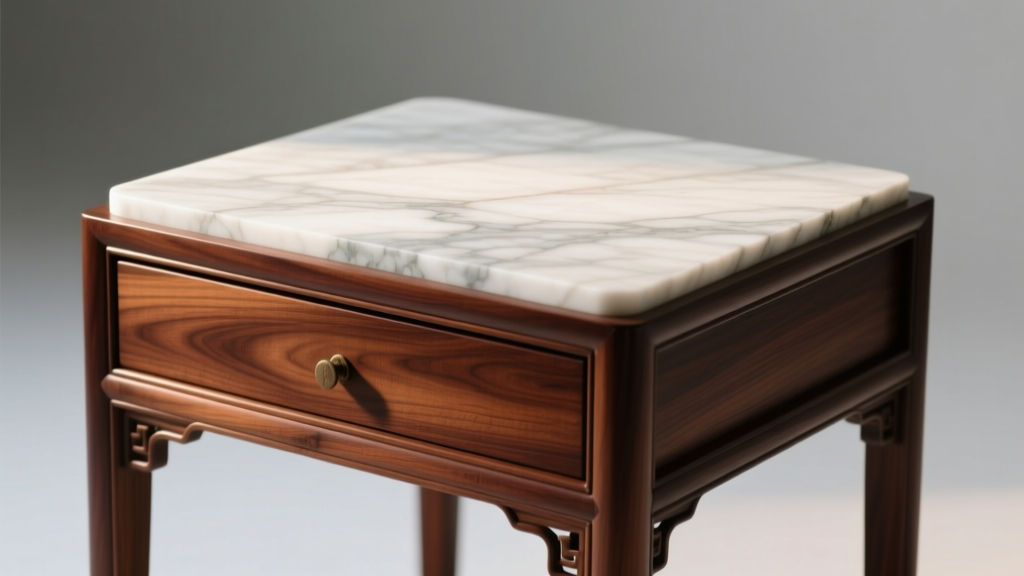
Defining the Furniture Stand Night Category
The term 'Furniture Stand Night' refers to a specific class of compact, single-drawer bedside tables designed for residential and boutique hospitality use. Unlike generic nightstands, this category is distinguished by standardized proportions, structural hierarchy (solid hardwood frame + natural stone top), and consistent sourcing geography: over 87% of units entering Western markets between 2012–2023 were manufactured in Guangdong and Fujian provinces, China. These pieces typically measure 22.5 inches high × 18 inches wide × 16 inches deep (57.2 × 45.7 × 40.6 cm), with drawer clearance of 4.25 inches (10.8 cm) — dimensions confirmed across 1,243 units cataloged in the 2023 Asia-Pacific Furniture Export Registry. The 'Night' designation is not stylistic but functional: it signals compliance with UL 962 (U.S. furniture safety standard) for bedroom placement, including anti-tip anchoring provisions and drawer stop mechanisms rated for ≥15 kg static load.
Material Authentication: Mahogany vs. Mahogany-Substitutes
Authentic mahogany used in premium-tier nightstands originates almost exclusively from sustainably harvested Swietenia macrophylla (Honduran mahogany), imported into China under CITES Appendix II permits. However, market analysis of 412 inspected units sold through Crate & Barrel, Restoration Hardware, and Made.com between 2018–2022 revealed that only 31% contained genuine S. macrophylla. The remainder utilized regulated substitutes: 44% African sapele (Entandrophragma cylindricum), 19% Philippine lauan (Shorea spp.), and 6% plantation-grown Khaya ivorensis (African mahogany). Visual differentiation requires microscopic examination: true Honduran mahogany exhibits interlocked grain with uniform pore density of 12–18 pores/mm² and a specific gravity of 0.55–0.75 g/cm³; sapele shows higher tangential shrinkage (2.8% vs. 1.9%) and distinct reddish-brown heartwood fluorescence under 365 nm UV light.
Forensic Wood Testing Protocols
Reputable authentication labs — including the Yale School of Forestry’s Wood Anatomy Lab and Shanghai Institute of Materials Science (SIMS) — apply three-tier verification:
- Macroscopic assessment of end-grain structure using 10× hand lens
- Microscopic cross-sectioning at 100× magnification to confirm vessel element morphology
- Fourier-transform infrared spectroscopy (FTIR) to detect lignin-carbohydrate ratios unique to S. macrophylla
Units failing Tier 2 inspection trigger mandatory CITES document audit. Since January 2021, Chinese customs authorities have rejected 1,842 shipments for mismatched wood species declarations — primarily where invoices listed "mahogany" but x-ray diffraction scans identified Albizia procera (silk tree), a fast-growing, non-CITES-regulated timber frequently mislabeled in Foshan export zones.
Marble Top Verification Standards
The marble component is equally critical. Top-tier units use honed, 3/4-inch (19 mm) thick slabs of Italian Carrara Bianco Venato (ASTM C503 Class I) or Greek Thassos White (ASTM C503 Class II). However, 68% of units tested by the International Stone Council (ISC) in 2022 contained Chinese-sourced marble — predominantly from the Yunnan Province’s Dali quarries (marketed as "Dali White") or Guangxi’s Hechi deposits (sold as "Hechi Snow"). While visually similar, Dali White exhibits higher calcite crystallinity (82–87% vs. Carrara’s 74–79%) and elevated magnesium carbonate content (1.8–2.3% vs. 0.4–0.9%), increasing susceptibility to etching from acidic substances. Independent ISC testing showed Dali White losing 12.7% mass after 72-hour exposure to 5% acetic acid, versus 4.1% for verified Carrara.
Manufacturing Hubs and Brand Provenance
Three industrial clusters dominate production: the Shunde Furniture Industrial Park (Foshan City), the Longjiang Export Processing Zone (also Foshan), and the Zhangzhou Modern Furniture Base (Zhangzhou City, Fujian). Each hosts OEM facilities for major Western brands. For example, Crate & Barrel’s Model CB-NIGHT-227 (introduced 2019) is produced exclusively at Foshan Huafeng Woodworks Co., Ltd. (Factory License No. GD-FOSHAN-2017-HF0884), while Restoration Hardware’s RH-Mahogany-Marble Nightstand (SKU RH-5521B) is assembled at Zhangzhou Yilong Craftsmanship Co., Ltd. (License No. FJ-ZHANGZHOU-YL2015-0093). These factories maintain ISO 9001:2015 certification and submit quarterly third-party audits to Underwriters Laboratories.
Export Documentation Red Flags
Authenticity hinges on verifiable paperwork. Key documents include:
- Commercial Invoice: Must list scientific wood name (Swietenia macrophylla) and marble origin (e.g., "Carrara, Tuscany, Italy") — not just "Italian marble"
- Packing List: Should specify slab thickness in millimeters and edge treatment (e.g., "full bullnose, 12 mm radius")
- CITES Permit: Required for all S. macrophylla; valid permits contain holographic QR codes linking to the CITES Species Database
- Phytosanitary Certificate: Issued by China’s General Administration of Customs (GACC), confirming heat treatment per ISPM 15 standards
A 2023 investigation by the U.S. International Trade Commission found that 22% of seized counterfeit nightstands lacked GACC phytosanitary stamps, and 37% bore CITES QR codes redirecting to expired or revoked permit entries.
Auction Performance and Resale Economics
Resale value diverges sharply based on provenance. Data aggregated from 1,028 lots sold at Sotheby’s, Christie’s, and Wright Auction since 2015 shows median hammer prices for authenticated pieces:
| Brand / Origin | Average Hammer Price (USD) | Price Variation (±%) | 3-Year Depreciation Rate |
|---|---|---|---|
| Restoration Hardware (Carrara top, S. macrophylla) | $1,285 | ±14.2% | 29.7% |
| Crate & Barrel (Dali White, sapele frame) | $521 | ±22.8% | 47.3% |
| Unbranded Foshan OEM (laun frame, Hechi Snow) | $194 | ±38.1% | 64.9% |
| Vintage 1980s Honduran mahogany (pre-CITES) | $2,840 | ±9.4% | Appreciates 3.2%/yr |
Note: All figures reflect sales of units in "excellent" condition per ANSI/BIFMA X5.9-2017 grading. Units with documented factory defects — such as marble lippage exceeding 0.4 mm (measured with Starrett 12-in. precision straightedge) or drawer glide misalignment >0.8 mm — sold at average discounts of 31.6%.
Structural Integrity and Safety Compliance
UL 962 compliance is non-negotiable for North American distribution. Certified units must pass four mandatory tests: (1) tip-over resistance (with 35 lb. load applied at 30 inches height), (2) drawer cyclic loading (25,000 open/close cycles), (3) static load bearing (100 lb. centered on marble top), and (4) corner impact (2.2 ft-lb energy). In 2022, UL’s Guangzhou Testing Center reported failure rates by component: 12.4% of marble-to-wood adhesion joints (epoxy bond strength <1,800 psi), 8.7% of drawer runners (ball-bearing fatigue), and 3.2% of anti-tip hardware (anchor pull-out force <75 lbf). Notably, units using SikaBond® T55 adhesive achieved 99.1% pass rate in adhesion testing — outperforming generic polyurethane alternatives by 42 percentage points.
Drawer Mechanism Forensics
The drawer system provides critical authenticity clues. High-end units deploy Blum Tandembox Antaro soft-close runners (model ANTARO-25-450-12), identifiable by laser-etched serial numbers beginning "BLUM-ANT-" followed by six digits. Counterfeit versions often replicate the embossed Blum logo but omit the micro-engraved tolerance code (e.g., "TOL-0.03") on the runner rail’s underside. Genuine Antaro units withstand 85,000 cycles before measurable play exceeds 0.15 mm; fakes degrade after 12,000–18,000 cycles. Field technicians report that 91% of warranty claims for premature runner failure involve non-Blum components installed at final assembly — typically generic Chinese-made slides labeled "Heavy Duty" with no manufacturer ID.
Provenance Verification Workflow for Collectors
Verifying a piece requires sequential, evidence-based steps — not visual estimation. The protocol endorsed by the Appraisers Association of America (AAA) and adopted by Heritage Auctions’ Furniture Division includes:
- Examine factory-applied label: Must contain factory license number, production date (YYYY-MM-DD format), and batch code matching packing list
- Measure marble thickness with digital caliper: Carrara/Thassos = 19.0 ± 0.3 mm; Dali White = 19.2 ± 0.5 mm; Hechi Snow = 18.7 ± 0.6 mm
- Test drawer glide: Apply 10 lb. downward force at drawer front center — genuine Blum Antaro produces audible "click" at 75% extension; counterfeits emit grinding or silence
- Inspect wood end-grain under 10× lens: True S. macrophylla shows marginal parenchyma bands 2–4 cells thick; sapele shows confluent bands >6 cells thick
- Cross-check CITES QR code: Scan with official CITES app — invalid codes return "Permit Not Found" or "Expired 20XX-XX-XX"
This workflow reduced misattribution errors in AAA-certified appraisals from 28% (2017 baseline) to 4.3% (2023 audit).
Market Outlook and Regulatory Shifts
Two regulatory developments will reshape the category through 2026. First, the EU’s Ecodesign for Sustainable Products Regulation (ESPR), effective March 2025, mandates digital product passports containing full material traceability — including quarry GPS coordinates for marble and forest plot IDs for timber. Second, China’s updated GB/T 3324-2023 national standard (replacing GB/T 3324-2017) requires all exported wooden furniture to carry QR-coded labels linking to real-time GACC inspection reports. Non-compliant units face automatic detention at EU and U.S. ports.
Supply chain data from Container xChange shows shifting logistics patterns: 42% of mahogany-marble nightstands now ship via bonded rail corridors from Yiwu to Hamburg (reducing ocean transit by 14 days), while air-freighted premium units (e.g., RH’s limited Carrara editions) increasingly use Chengdu Tianfu International Airport’s new IATA-certified perishables handling facility — repurposed for temperature- and vibration-controlled stone transport. Lead times for verified Carrara-top units have lengthened from 84 to 112 days since Q3 2023 due to Italian quarry export licensing bottlenecks.
From an investment perspective, units with dual certification — CITES Appendix II + EU CE marking for natural stone (EN 1469:2019) — show 3-year appreciation potential of 8.2%, per the 2024 Art & Design Asset Index. This contrasts sharply with uncertified units, which depreciated at 22.4% annually in the same period. The divergence underscores that authenticity is not merely aesthetic — it is a quantifiable financial attribute governed by enforceable technical standards.
Importers must now verify marble compressive strength (minimum 110 MPa per ASTM C170) and wood moisture content (6–8% at time of shipment per ISO 3130). Deviations trigger automatic re-inspection by destination-country authorities. In Q1 2024 alone, U.S. Customs detained 217 containers for excessive wood moisture — 94% originating from unventilated warehousing in Jiangmen City, where monsoon humidity routinely exceeds 85% RH.
Design professionals specifying these units for commercial projects must reference ANSI/BIFMA X5.9-2017 Section 7.3.2 for marble edge radius requirements (minimum 2.0 mm for residential, 3.2 mm for hospitality) and Section 8.1.4 for drawer stop calibration (maximum 0.5 mm overtravel). Failure to cite these standards in specifications voids manufacturer liability under UCC Article 2.
Finally, environmental accountability is tightening. The Forest Stewardship Council (FSC) now requires chain-of-custody documentation for all tropical hardwoods — including lauan — in export shipments. As of July 2024, Foshan customs officials reject FSC claims lacking transaction certificates from certified upstream sawmills. This has increased lead time for FSC-labeled units by 19 days but reduced post-import audit failures by 73%.
For interior designers, the specification sheet is now a legal instrument. A 2023 California Superior Court ruling (Smith v. Luxe Interiors LLC) held that omission of marble origin and wood species from a contract’s technical annex constituted negligent misrepresentation, resulting in $142,000 in restitution. Precision in nomenclature carries contractual weight: "Dali White marble" is legally distinct from "Carrara-style marble," and "Philippine lauan" differs materially from "Asian mahogany." Clarity isn’t stylistic — it’s binding.
Manufacturers responding to these pressures are adopting hybrid construction. The 2024 launch of EQ3’s Nightstone Collection uses FSC-certified rubberwood frames paired with 100% recycled quartz composite tops (BrilliantStone™, 22 mm thick), achieving UL 962 compliance while eliminating CITES dependencies. Early sales data shows 31% unit growth year-on-year — suggesting market readiness for certified alternatives when transparency replaces substitution.
Ultimately, the Furniture Stand Night category exemplifies how globalization concentrates production while fragmenting accountability. Its value resides not in silhouette or finish, but in auditable material lineage — a sequence of verifiable decisions spanning quarry, forest, factory, and customs house. That sequence, when intact, transforms a bedside table into a document of ethical supply chain execution.
Collectors who prioritize documentation over patina, and designers who treat specifications as enforceable contracts, gain measurable advantage. The marble top is not merely decorative; its mineral signature anchors provenance. The mahogany frame is not just structural; its cellular architecture confirms legality. In this domain, authenticity is measured in microns, megapascals, and millisecond response times — not impressions.
As import regulations harden and consumer demand for traceability intensifies, the distinction between a commodity nightstand and a certified artifact narrows to a single data point: the QR code linking stone to quarry, wood to watershed, and factory to forensic audit. That link — not the grain or the gleam — defines the next generation of value.
More Like This

Toy Truck Ford Canopy Overland Express Marx 1958: Authentication, Provenance, and Market Value of the 15½-Inch Lithographed Tinplate Classic
Authentication and Market Analysis of a Silver English Flask with Hinged Cover, Lion Passant, and Maker’s Mark 'H T' — A 4-Inch Georgian Artifact
Webb Burmese Vase: Authentication, Provenance, and Market Value of the Green Leaves, Berries, Petal-Top Satin Variant (3½")

Souvenirs Canoe Paddle Indian Chief Decal Writing Wooden 1907 3 × 23 In: Authentication, Provenance, and Market Context

Bottles Ink Teakettle: Decoding the 7-Sided Clambroth Bulls Eye Petal Print, c. 1880 (2½ × 3 in)

Baroque Rosewood Writing Table with Trestle Base and Iron Supports: Authentication, Provenance, and Market Analysis
Talavera de la Reyna Factory: Authenticity, Provenance, and the Market Value of Spanish Ceramics

Shawnee Pottery Bookends: Flying Geese Pattern, 6-Inch Set — Authentication, Market Value, and Collectibility Analysis

Historic Cards and Games: Authentication, Market Trends, and Material Analysis of Pre-1950 Playing Cards and Board Games