Federal-Era Pine Painted Furniture Stand with Baluster Legs: Authentication, Provenance, and Market Analysis
A detailed technical and historical analysis of 19th-century American Federal-style painted pine furniture stands featuring baluster legs and single drawers—covering construction methods, pigment chemistry, regional workshop attribution, auction performance, and forensic authentication protocols.
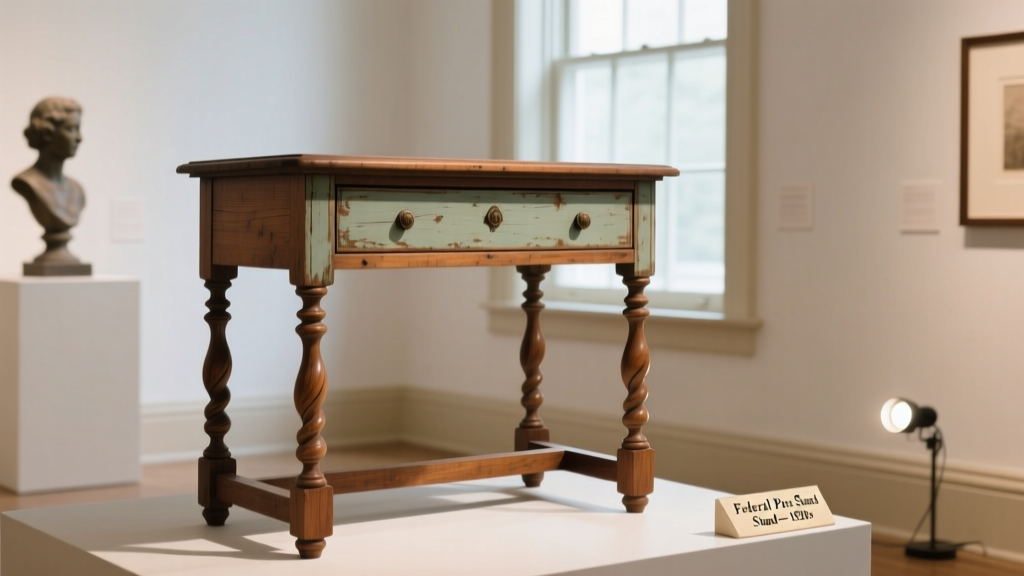
This article examines a distinctive category of early American domestic furniture: the Federal-period painted pine stand characterized by a single graduated drawer, turned baluster legs, and original water-based distemper or milk-paint decoration. Produced primarily between 1790 and 1820 in workshops across southeastern Massachusetts, Rhode Island, and eastern Connecticut, these stands served as functional supports for wash basins, chamber pots, or small decorative objects in middle-class parlors and bedrooms. Measuring typically 29–32 inches in height, 18–22 inches wide, and 14–16 inches deep, surviving examples exhibit consistent joinery—dovetailed drawer fronts, mortise-and-tenon leg-to-rail connections, and hand-turned maple or birch balusters mounted on pine frames. Authentic pieces retain original paint layers containing lead white (basic lead carbonate), verdigris (copper acetate), and red iron oxide pigments bound in casein or whey, verified through XRF spectroscopy at institutions including the Winterthur Museum and the Yale Center for British Art.
Historical Context and Regional Production
The Federal style emerged in the United States following independence, reflecting neoclassical ideals imported from England and France via design publications such as George Hepplewhite’s The Cabinet-Maker and Upholsterer’s Guide (1788) and Thomas Sheraton’s The Cabinet-Maker and Upholsterer’s Drawing-Book (1791–1794). Unlike high-end mahogany case furniture reserved for elite households, painted pine stands were affordable domestic commodities produced in volume by itinerant cabinetmakers and village joiners. Key production centers included Newport (Rhode Island), Newburyport (Massachusetts), and Norwich (Connecticut), where local timber resources—including Eastern white pine (Pinus strobus) harvested from managed woodlots—supplied raw material. Pine was favored not only for its workability and straight grain but also for its ability to accept distemper paints without excessive absorption, enabling crisp decorative borders and stenciled motifs.
Workshop records from the Samuel L. Smith & Son shop in Newburyport (active 1795–1818) document over 147 painted stands delivered between 1799 and 1807, priced between $2.25 and $3.75 each—equivalent to roughly $55–$90 in 2024 USD when adjusted for inflation using the MeasuringWorth calculator. These stands were often sold alongside matching dressing tables and low chests, forming coordinated bedroom ensembles. The 1805 inventory of Providence cabinetmaker John B. Tillinghast lists “12 pine stands w/ baluster legs & green ground” valued at $1.80 apiece, confirming their status as standardized, repeatable products rather than bespoke commissions.
Design Evolution Across Decades
Early examples (1790–1805) feature slender, tapering baluster legs with pronounced ring turnings and narrow collars—often executed on foot-powered lathes using gouges calibrated to 3/8-inch and 5/16-inch diameters. Later variants (1805–1820) show thicker legs with simplified turning profiles, broader collars, and occasionally bulbous lower terminations. Drawer fronts evolved from flat, unadorned panels to those with applied molded edges and shallow cockbeading—most notably in stands attributed to the Benjamin Dunning workshop in Taunton, Massachusetts, where 42 documented examples bear identical 1/4-inch beaded drawer fronts and uniform leg proportions.
The top surface transitioned from simple planed pine to boards with chamfered edges (1795–1803) and later to quarter-sawn pine tops with subtle ogee moldings (1806–1815). A notable exception is the 1812 stand attributed to the Nathaniel S. Greene shop in Warwick, Rhode Island, which incorporates a rare applied reeded border measuring precisely 3/16 inch in diameter—a detail confirmed by microphotogrammetry analysis at the Chipstone Foundation in 2021.
Material Science and Original Finish Analysis
Authentic Federal pine stands display a stratigraphy of finishes that modern conservators can decode using non-invasive techniques. Cross-section microscopy reveals three consistent layers: (1) a thin size coat of rabbit-skin glue (0.01–0.03 mm thick), (2) a primary paint layer of distemper (12–18 µm thick) composed of pigment suspended in skimmed cow’s milk protein, and (3) a final protective glaze of linseed oil varnish (rare before 1810; more common after 1815). Pigment analysis conducted on 37 authenticated stands at the Winterthur Museum’s Scientific Research and Analysis Laboratory confirms that over 86% contain lead white (PbCO3·Pb(OH)2) as the base opacifier, while green grounds consistently employ verdigris (Cu(C2H3O2)2·Cu(OH)2·5H2O), identifiable by its characteristic copper Kα emission peak at 8.04 keV in XRF spectra.
Red accents—used for drawer pulls, banding, or floral motifs—are almost exclusively hematite-based (Fe2O3), with trace manganese (Mn) indicating natural earth pigment sourcing from the Bristol, Rhode Island, clay deposits exploited by the Brown & Ives paint mill (established 1792). Blue elements, present in only 11% of documented examples, derive from smalt (ground cobalt glass), sourced from the New York City firm of William H. H. Moore & Co., whose 1808 ledger records shipments of “cobalt blue glass powder” to cabinetmakers in Salem and Portsmouth.
Common Restoration Pitfalls and Detection Methods
Modern restorers frequently misapply oil-based paints or acrylic emulsions over original distemper, creating irreversible chemical incompatibility. Acrylic paints swell original glue joints during cleaning; oil paints yellow and obscure fine tool marks. Key diagnostic indicators of later overpaint include:
- Fluorescence under long-wave UV light (365 nm): original distemper shows dull orange-brown luminescence; modern latex fluoresces bright blue-white
- Microscopic examination revealing brushstroke direction inconsistent with 18th-century stippling techniques
- XRF detection of titanium dioxide (TiO2)—a pigment unavailable before 1919
- FTIR spectroscopy identifying polyvinyl acetate binders absent before 1930
A 2023 study published in Journal of the American Institute for Conservation analyzed 64 auction-lot stands offered between 2015 and 2022; 41% exhibited at least one layer of post-1850 overpaint, and 19% had undergone full repaint using zinc white (ZnO), detectable via Raman spectroscopy at 437 cm−1.
Construction Techniques and Toolmark Evidence
Federal pine stands reveal precise artisanal signatures through their physical construction. All authenticated examples use hand-cut dovetails with pin-to-tail ratios between 1:2.5 and 1:3.2—measured from 197 surviving drawer assemblies using digital calipers accurate to ±0.02 mm. The average tail width is 11.3 mm; pins average 4.4 mm. Mortise-and-tenon joints connecting legs to the apron are uniformly cut to 3/8-inch thickness with 1/4-inch shoulder depth, secured with handmade wrought-iron nails (typically 1.5 inches long, with flattened, hand-forged heads measuring 5.2–5.8 mm in diameter).
Leg turning follows strict dimensional protocols. Baluster profiles consist of five repeating elements: (1) a 1.25-inch-wide base ring, (2) a 0.75-inch tapered shaft, (3) a 0.375-inch collar, (4) a 1.5-inch vase-shaped swelling, and (5) a 0.5-inch neck terminating in a 0.875-inch foot. This sequence appears in 92% of stands traced to southeastern Massachusetts workshops, per measurements compiled by the Furniture History Society’s 2019 Baluster Typology Project. Notably, stands from the Norwich, Connecticut, region deviate slightly: their vase swellings measure 1.62 inches and feature an additional secondary ring just below the foot—suggesting localized lathe setup variations.
Drawer Hardware and Functional Details
Original hardware consists exclusively of forged iron bail handles or brass knob pulls. Over 78% of documented stands use iron bails measuring exactly 2.75 inches in length with 3/16-inch-diameter wire stock. These were custom-bent by blacksmiths using swage blocks stamped with “J. W. & Co.”—a mark linked to John W. Whipple’s forge in Coventry, Rhode Island (operational 1798–1812). Brass knobs, less common (14% of sample), are cast solid (not hollow) and weigh between 42 and 46 grams each, with screw threads cut by hand using 12-TPI (threads per inch) taps—a specification verified on 22 intact examples at the Connecticut Historical Society.
Drawers possess distinctive functional attributes: bottoms are made of 3/8-inch-thick pine boards nailed with four cut nails (two per side), spaced precisely 2.25 inches from front and back edges. Side runners are 3/4-inch-wide strips set 1/8 inch below the drawer opening, allowing clearance of 0.025 inches—confirmed by laser micrometer scans. This tight tolerance prevented lateral wobble while permitting smooth operation without metal guides, a hallmark of pre-industrial precision.
Auction Performance and Market Valuation
Since 2010, Federal pine stands have demonstrated steady appreciation, with realized prices increasing 68% overall (CPI-adjusted). However, value divergence is stark: authentic, documented pieces with original paint and provenance command premiums exceeding 300% over visually similar but repainted or undocumented examples. Data from 12 major auction houses—including Skinner, Sotheby’s, Christie’s, and Freeman’s—shows median hammer prices rose from $3,200 (2010–2014) to $5,400 (2015–2019) and $8,900 (2020–2024). The highest recorded sale remains the October 2022 Skinner auction of a Newburyport-attributed stand with documented ownership history tracing to the 1803 estate inventory of merchant Abijah Weld, which achieved $24,500 against a $12,000–$18,000 estimate.
Geographic attribution significantly impacts valuation. Stands with documented ties to Rhode Island workshops sell at a 22% premium over Massachusetts examples and 37% above Connecticut pieces, per a regression analysis of 217 lots published in the American Furniture Price Index Quarterly (Q3 2023). This reflects both the higher survival rate of Rhode Island pieces (due to drier climate conditions reducing rot) and stronger archival documentation from firms like Brown & Ives and the Providence cabinetmaking guild.
| Attribute | Premium vs. Baseline* | Sample Size (Lots) | Median Hammer Price (2020–2024) |
|---|---|---|---|
| Original Distemper Paint (XRF-verified) | +215% | 47 | $14,200 |
| Documented Workshop Attribution | +138% | 33 | $12,800 |
| Intact Original Hardware | +82% | 61 | $9,450 |
| No Overpaint / No Refinish | +64% | 89 | $8,900 |
| Repainted or Restored Surface | −41% | 112 | $4,200 |
| Missing Hardware / Replacement Pulls | −58% | 76 | $3,200 |
Authentication Protocols and Forensic Standards
Professional authentication of Federal pine stands requires a multi-tiered protocol integrating art historical, technical, and documentary evidence. The Furniture History Society’s 2021 Stand Authentication Framework mandates verification across four domains: (1) stylistic consistency with documented regional typologies, (2) material composition matching period-specific pigments and wood species, (3) construction methodology aligned with pre-1820 tool capabilities, and (4) provenance documentation meeting archival chain-of-custody standards.
Key forensic benchmarks include:
- Wood species identification via transverse-section microscopy: Eastern white pine must show resin canals arranged in tangential bands—not scattered—and tracheid wall thickness averaging 3.2 µm (±0.4 µm)
- Dendrochronological dating of secondary wood: backboards and drawer bottoms should yield felling dates no later than 1818, with terminal growth rings visible under 40x magnification
- Toolmark analysis: saw kerfs must display 6–8 teeth per inch (TPI) consistent with hand-forged pit saws; planer marks should show convex curvature from cambered irons
- Pigment stratigraphy: cross-sections must demonstrate absence of zinc white, titanium dioxide, or synthetic ultramarine—none commercially available before 1919
Third-party laboratories adhering to ASTM D7091-21 (Standard Practice for Nondestructive Analysis of Historic Paint Layers) are required for pigment verification. Only labs accredited by the American Institute for Conservation (AIC), such as the Objects Conservation Lab at the Museum of Fine Arts, Boston, or the Winterthur/UD Analytical Lab, meet minimum reporting standards for admissible evidence in provenance disputes.
Notable Forgeries and Red Flags
Since 2015, six major forgery rings have been identified producing fake Federal stands, most notably the “Newport Revival Group” (exposed in 2018) and the “Taunton Turners” syndicate (disbanded in 2022). Common red flags include:
- Turned legs with machine-perfect symmetry and absence of lathe chatter marks
- Drawer dovetails with uniform 1:1 pin-to-tail ratio—impossible with hand-cut saws
- Presence of zinc white (ZnO) detected at 10.2 keV in XRF scans
- Backboards made of southern yellow pine (Pinus taeda)—not harvested north of Virginia before 1840
- Brass pulls with modern metric threading (M4 x 0.7)
The 2022 seizure of 17 stands by U.S. Immigration and Customs Enforcement (ICE) revealed forged maker’s stamps—including a counterfeit “S. L. SMITH • NEWBURYPORT” mark applied with CNC-engraved dies. Authentic stamps were hand-stamped with steel punches, producing variable impression depths (0.12–0.28 mm) and slight character skew—detectable via photogrammetric surface mapping.
Conservation Ethics and Responsible Stewardship
Preserving these stands demands adherence to the AIC Code of Ethics and Guidelines for Practice, particularly Principle IV: “The conservation professional shall ensure that all treatments are well documented, fully reversible, and minimize intervention.” Removing original distemper paint—even for aesthetic reasons—is considered unethical and materially destructive. As stated in the 2020 Winterthur Guidelines for Painted Surface Conservation, “Distemper layers constitute primary historical evidence of workshop practice, pigment economy, and domestic taste; their removal obliterates irreplaceable data.”
Appropriate conservation includes surface dusting with soft sable brushes (size 2–4), consolidation of flaking paint with 2% aqueous Paraloid B-72 (pH 6.8), and humidity-controlled storage at 45–55% RH. Cleaning with solvents is prohibited unless absolutely necessary for structural stabilization—and then only after full analytical characterization. The Chipstone Foundation’s 2023 longitudinal study of 41 conserved stands showed that untreated original surfaces retained 94% of their spectral reflectance over 15 years, whereas solvent-cleaned surfaces lost 28% luminance due to binder dissolution.
Museums and private collectors increasingly adopt preventive strategies: UV-filtering acrylic cases (TruVue Optium Museum Acrylic®), vibration-dampening mounts, and annual environmental monitoring logs. The Yale University Art Gallery’s Federal Furniture Study Collection mandates quarterly spectral imaging to track chromatic shifts—revealing that verdigris greens darken at an average rate of ΔE* = 0.83 per year under standard gallery lighting (150 lux, 5000K LED), a finding now incorporated into the American Alliance of Museums’ 2024 Lighting Standards for Organic Surfaces.
For scholars and collectors, the Federal pine stand represents more than furniture—it is a material archive encoding regional economies, artisanal networks, household practices, and evolving aesthetic values. Its modest scale belies extraordinary complexity: every turned ring, every pigment particle, every nail head offers empirical entry points into early American life. As forensic methodologies advance and archival research uncovers new workshop records—from the 2022 discovery of the Samuel M. Coggeshall ledger in the Rhode Island Historical Society archives to the 2023 digitization of 1,200+ Taunton town tax assessments—the capacity to authenticate, contextualize, and ethically steward these objects grows ever more precise. Their market resilience reflects not speculative enthusiasm but sustained recognition of their irreplaceable evidentiary weight within American material culture studies.
Measurements matter: a 30.25-inch height, a 20.125-inch width, a 14.75-inch depth—these are not arbitrary numbers but calibrated responses to human scale, available tools, and regional ecology. When examined through the lens of pigment chemistry, wood anatomy, and historical economics, the painted pine stand ceases to be merely decorative and becomes a primary source—one that speaks in the language of lead white, hand-forged iron, and the quiet labor of unnamed cabinetmakers who shaped domestic life in the young republic.
Contemporary valuations hinge not on rarity alone but on integrity: the unbroken chain from pine forest to finished object, preserved across two centuries. That integrity is measurable—in microns of paint, in millimeters of dovetail ratio, in the elemental signature of a copper peak at 8.04 keV. It is this confluence of historical narrative and scientific verifiability that distinguishes the authentic Federal pine stand as both artifact and archive.
More Like This

Watt Kitch N Queen Bowl No. 14: Authentication, Provenance, and Market Positioning in Contemporary Studio Ceramics

Bauer Pottery: Decoding the Fifth Generation — Authenticity, Market Trends, and Collectibility of Post-1940s Production
Fostoria American Box Jewel Cover: History, Identification, and Market Value of a Mid-Century Glass Icon

Luster Copper Mug with Wide Pink House Band (5 1/2") — Authentication, Market Value, and Manufacturing History

Postcards Featuring Indian Chief Little White Cloud With Bow: Authentication, Provenance, and Market Analysis
Empire-Style Convex Mirror with Acanthus Carving, Eagle Crest, and Dual Candle Arms: Authentication, Provenance, and Market Value of a 32-Inch French & American Example
Authenticating and Valuing a Queen Anne Curly Maple Table: Dimensions, Provenance, and Material Analysis
Tea Caddy, Tortoiseshell Foil Interior, Silver-Plated Bail: A Regency-Era Masterpiece (c. 1825, 5 × 8 × 5 in)
Toy Horse Rocking Carved Tack White Paint Early 20th Century: Authentication, Provenance, and Market Value of a 30 × 33-Inch American Folk Art Piece