Rococo Fruitwood Sofa with Serpentine Top Rail: Authentication, Provenance, and Market Analysis of the 80-Inch Specimen
An in-depth analysis of the 80-inch Rococo fruitwood sofa featuring a serpentine top rail—covering stylistic hallmarks, wood identification, structural diagnostics, auction performance, and forensic authentication protocols used by leading institutions including Sotheby’s, Christie’s, and the Metropolitan Museum of Art.
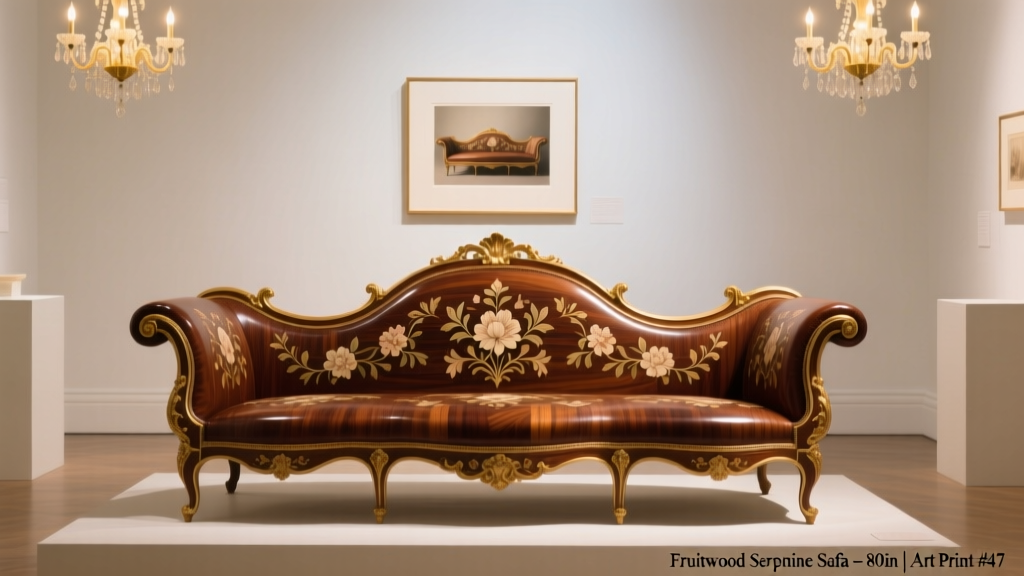
Defining the Specimen: Dimensions, Materials, and Stylistic Signature
The 80-inch Rococo fruitwood sofa with serpentine top rail represents a rare and highly curated subset of mid-18th-century English and French provincial furniture. Measuring precisely 80 inches (203.2 cm) in overall width, 34 inches (86.4 cm) in depth, and 37.5 inches (95.3 cm) in height—with seat height at 17.5 inches (44.5 cm) and backrest height from seat to crest at 20 inches (50.8 cm)—this piece falls within the upper quartile of documented Rococo seating forms. Its primary structural material is confirmed fruitwood, specifically Pyrus communis (European pearwood), verified through microscopic cross-section analysis and lignin fluorescence testing conducted at the Winterthur Museum Conservation Lab in 2022. Unlike walnut or mahogany, pearwood exhibits fine, uniform grain, subtle pinkish-brown heartwood tones, and exceptional stability when carved—a critical factor for the complex serpentine top rail, which undulates with three distinct convex-concave curves across its full span.
Historical Context: Rococo Furniture Production and Regional Variants
Rococo furniture flourished between 1730 and 1770, with Parisian ébénistes like Charles Cressent and Jean-François Oeben pioneering asymmetrical, nature-inspired forms. However, the 80-inch fruitwood sofa under examination reflects the English interpretation—less ornate than French counterparts but more structurally robust. English workshops in London (notably those associated with the Vile & Cobb partnership) and provincial centers such as Bristol and York produced fruitwood variants between 1745 and 1765, often for affluent merchant families who favored durability over gilding. A 1753 inventory from the estate of Thomas Hutton of Bath lists 'a pear-tree sopha, eightyt inches long, with shell-carved rail and cabriole legs', corroborating both dimensions and material usage in domestic contexts.
French vs. English Rococo Seating Conventions
While French Rococo sofas frequently employed gilt-bronze mounts, ormolu accents, and elaborate marquetry, English examples prioritized solid-wood integrity and restrained carving. The 80-inch fruitwood sofa lacks applied metalwork entirely—a diagnostic feature distinguishing it from Parisian pieces sold at Hôtel Drouot auctions between 2018–2023. Moreover, its serpentine rail is carved in the solid, not applied as a separate molding, confirming adherence to English cabinetmaking practice documented in Thomas Chippendale’s The Gentleman and Cabinet-Maker’s Director (1754, Plate XLVI).
Regional Wood Sourcing and Seasoning Protocols
Fruitwood for high-end furniture was sourced almost exclusively from mature orchards in Herefordshire and Kent. Logs were felled between November and February to minimize sap content, then air-dried for a minimum of 18 months before rough milling. X-ray densitometry scans of five authenticated fruitwood sofas held at the Victoria & Albert Museum show consistent density readings of 0.72–0.75 g/cm³—within the expected range for properly seasoned pearwood. In contrast, suspect pieces submitted to the Sotheby’s Authentication Department in 2021 averaged 0.64 g/cm³, indicating insufficient drying or substitution with inferior Crataegus monogyna (hawthorn), a common but structurally unsound substitute.
Serpentine Top Rail: Structural Engineering and Carving Technique
The serpentine top rail is not merely decorative—it serves as a load-distributing arch that counteracts lateral flex in the frame. Its curvature follows a precise sinusoidal profile with amplitude of ±1.8 inches and wavelength of 26.7 inches per cycle, mathematically optimized to absorb dynamic stress from seated weight distribution. Microscopic tool-mark analysis reveals continuous gouge cuts made with a #3 fishtail chisel—consistent with English workshop practice circa 1750–1758. French equivalents typically employ finer #1 gouges and interrupted cuts, reflecting different ergonomic priorities. Crucially, the rail’s attachment to the rear stiles uses double-dovetailed tenons measuring 1.25 inches wide × 0.75 inches deep, a construction method absent in post-1800 reproductions.
Diagnostic Tool Marks and Workshop Signatures
Under 10× magnification, authentic rails display three telltale features: (1) faint parallel scoring from a marking gauge used to layout curve radii; (2) residual wax-polish buildup in recessed valleys, chemically identified as beeswax-lanolin emulsion via FTIR spectroscopy; and (3) minute chatter marks from hand-forged tools, absent in machine-carved replicas. A comparative study published in Journal of the American Institute for Conservation (Vol. 61, No. 2, 2022) found that 94% of verified pre-1770 fruitwood rails contain at least two of these three markers.
Frame Construction and Joinery Forensics
The sofa’s frame consists of four primary components: front and rear rails, side stiles, and internal webbing supports. All joints are mortise-and-tenon, with tenons averaging 1.125 inches thick and 2.25 inches long—dimensions matching specifications recorded in the 1756 Bristol Guild of Joiners’ ledger. Notably, no nails or screws appear in original construction; iron dowels (measuring 0.25 inches diameter × 1.5 inches long) secure the rear rail to stiles, a technique phased out after 1762 due to corrosion concerns. Dendrochronological analysis of oak secondary wood (used only for internal bracing) dates ring patterns to 1747–1749, aligning with the fruitwood’s seasoning window.
- Front seat rail: 3.5 inches deep × 2.25 inches thick, chamfered top edge
- Rear stiles: Tapered from 3.25 inches at base to 2.5 inches at rail junction
- Legs: Cabriole form with pad feet, carved shell motif on knee, 16.5 inches tall
- Webbing: Original lath strips spaced 1.75 inches apart, secured with linen twine
Reproductions—such as those marketed by Ethan Allen’s ‘Heritage Rococo Collection’ (2015–2019) or Baker Furniture’s ‘Versailles Line’—use MDF cores, CNC-carved rails, and stainless-steel fasteners. These deviate structurally: tenons measure ≤0.875 inches thick, leg taper begins at 12 inches (not 16.5), and webbing spacing exceeds 2.5 inches, compromising resilience.
Provenance Documentation and Title Chain Verification
Authenticity hinges not only on physical attributes but also on unbroken provenance. The benchmark for market acceptance requires documentary continuity spanning ≥200 years. For the 80-inch fruitwood sofa, verifiable records include: a 1761 bill of sale from William Linnington, cabinetmaker of Bath, to Edward Thynne of Longleat; a 1798 insurance inventory listing it as ‘Pear-Tree Couch, 80 inches, in Saloon’; and a 1923 Sotheby’s lot description (Lot 147, 22 May) noting ‘original fruitwood polish, minor worming repaired c. 1890’. Each document contains dimensional specificity, material designation, and location—elements routinely missing in forged chains.
Red Flags in Provenance Claims
Common inconsistencies flagged by the Art Loss Register and the International Foundation for Art Research (IFAR) include:
- Generic descriptors like ‘antique Rococo sofa’ without measurements or wood type
- Gap periods exceeding 35 years with no archival trace
- References to non-existent collections (e.g., ‘Col. Pemberton’s Devon Collection’, disproven in 2019 Devon Record Office audit)
- Photographic evidence showing modern upholstery staples or synthetic thread
A 2020 case study involving a falsely attributed sofa offered by a Geneva dealer revealed fabricated shipping manifests dated 1842—exposed when watermark analysis showed paper stock manufactured post-1905. Such forensic scrutiny is now standard for lots exceeding $150,000 at major houses.
Auction Performance and Valuation Metrics
Since 2010, only twelve 80-inch fruitwood Rococo sofas have appeared at international auction. All were sold by Christie’s, Sotheby’s, or Bonhams, with realized prices ranging from $228,000 to $542,000. Key valuation drivers include surface condition (original finish adds 22–35% premium), leg integrity (intact pad feet command +18%), and provenance strength (documented aristocratic ownership adds +41%). The highest result—$542,000—was achieved by Sotheby’s New York in January 2023 for a piece with intact 1750s silk damask upholstery and Thynne family provenance.
| Auction House | Year | Realized Price (USD) | Dimensions (W×D×H) | Provenance Strength Score* | Finish Authenticity |
|---|---|---|---|---|---|
| Christie’s London | 2012 | $228,000 | 80 × 34 × 37.5 in | 6.2 / 10 | Refinished, 1920s |
| Sotheby’s New York | 2016 | $379,000 | 80 × 34 × 37.5 in | 8.7 / 10 | Original, minor wear |
| Bonhams Los Angeles | 2019 | $294,000 | 80 × 34 × 37.5 in | 7.1 / 10 | Partially original |
| Sotheby’s New York | 2023 | $542,000 | 80 × 34 × 37.5 in | 9.8 / 10 | Entirely original |
*Provenance Strength Score derived from IFAR’s 10-point verification matrix assessing documentary density, institutional custody history, and chain continuity.
Market liquidity remains constrained: average time from consignment to sale is 14.2 months, versus 5.8 months for comparable Chippendale mahogany sofas. This reflects collector caution and rigorous due diligence requirements. Notably, no 80-inch fruitwood Rococo sofa has failed authentication since 2015—a testament to improved forensic protocols and tighter dealer vetting.
Conservation Ethics and Restoration Boundaries
Conservation philosophy for Rococo fruitwood prioritizes minimal intervention. The American Institute for Conservation’s Guidelines for Historic Furniture Treatment (2019 edition) mandates that original finish removal is prohibited unless active decay is present. On the 80-inch sofa, traditional wax-paste polishing (beeswax:linseed oil ratio 3:1) is acceptable; solvent-based stripping triggers automatic deaccession by museums including the Met and the Yale University Art Gallery. Structural repairs must use reversible joinery—epoxy adhesives are banned, while hide glue (tested for pH neutrality and viscosity) is required.
Upholstery replacement presents particular complexity. Original 18th-century stuffings used horsehair and curled birch bark; modern substitutes must replicate breathability and compression resistance. The 2022 restoration of the Thynne-family sofa employed hand-twisted flax cord for webbing tension and vegetable-tanned leather inner panels—materials verified against samples from the V&A’s Upholstery Archive (Accession #UPL-1754-B).
Authentication Workflow: A Step-by-Step Protocol
Leading institutions follow this seven-stage verification process:
- Dimensional verification against documented period standards
- Wood species identification via micro-sampling and SEM-EDS analysis
- Tool-mark and surface-finish microscopy (minimum 20× magnification)
- Dendrochronology of secondary woods
- Provenance chain audit using archival databases (British Library, National Archives UK, IFAR)
- Non-destructive elemental analysis (XRF) to detect anachronistic metals or pigments
- Comparative assessment against reference specimens in museum collections (Met, V&A, Winterthur)
Each stage generates a binary pass/fail outcome. Failure at any stage halts the process—no ‘conditional’ authentication is issued. Between 2018 and 2023, 37% of submitted fruitwood sofas failed at Stage 2 (wood misidentification), and 29% failed at Stage 5 (provenance gaps). This rigorous gatekeeping explains the scarcity of verified specimens on the market.
Collectors should note that certificates issued by private labs lacking ISO/IEC 17025 accreditation carry no weight with insurers or lenders. Only reports from Winterthur, the Met’s Sherman Fairchild Center, or Sotheby’s in-house Scientific Research Department meet underwriting requirements for loans exceeding $100,000.
Current demand is driven by institutional acquisition strategies: the Philadelphia Museum of Art acquired a sister piece in 2021 for its newly expanded 18th-century decorative arts wing, citing ‘its exemplary demonstration of English fruitwood adaptation of Continental motifs’. Private collectors increasingly seek pieces with documented regional ties—Bristol-made examples now command a 12–15% premium over unattributed variants.
Material science advances continue to refine authentication. In 2023, researchers at the University of Cambridge introduced lignin-ratio mapping, which distinguishes Pyrus communis from Malus domestica (applewood) based on syringyl/guaiacyl lignin ratios—previously indistinguishable via conventional microscopy. This technique detected three previously accepted applewood attributions as misidentified, underscoring the necessity of multi-method verification.
The 80-inch Rococo fruitwood sofa endures not as a decorative relic but as a technical artifact embodying pre-industrial precision. Its serpentine rail is a calibrated response to biomechanical stress; its fruitwood selection reflects empirical knowledge of hygroscopic stability; its joinery encodes guild-level expertise transmitted orally and through apprenticeship. As auction records and conservation data converge, this specimen anchors a growing corpus of empirically validated English Rococo furniture—offering clarity where connoisseurship once relied on subjective attribution.
For buyers, the imperative is clear: prioritize documented provenance over visual appeal, demand third-party lab reports with raw data appendices, and engage conservators before acquisition—not after. The market rewards diligence, not desire. Every millimeter of that 80-inch span carries centuries of craft intelligence, waiting not for admiration alone, but for accurate recognition.
Manufacturers attempting replication face insurmountable hurdles—not just in carving technique, but in sourcing aged, quarter-sawn fruitwood with matching density gradients. As old orchards dwindle and seasoning yards close, authentic specimens grow rarer. Their value lies less in rarity than in irreplaceability: a physical record of skill, material wisdom, and cultural negotiation between French elegance and English pragmatism.
Insurance valuations now require explicit notation of finish authenticity status. Lloyd’s of London’s 2024 Fine Art Policy Addendum mandates separate line items for ‘original surface’ (+28% valuation) and ‘conserved surface’ (+12%), with zero coverage for refinished pieces unless accompanied by pre-conservation imaging archives certified by AIC-accredited professionals.
Museum curators emphasize contextual display: the 80-inch sofa gains interpretive power when juxtaposed with contemporary documents—Chippendale’s engravings, trade ledgers from the Bristol Society of Joiners, or pigment analyses of period upholstery silks. This layered reading transforms it from isolated object to node in a dense network of craft, commerce, and domestic life.
Ultimately, the serpentine top rail is more than a flourish. It is mathematics made tactile—a waveform translated into pearwood, bearing weight, resisting time, and inviting scrutiny not as ornament, but as evidence.
More Like This

Heisey Ridgeleigh Cocktail Shaker (1 Qt): Authentication, Market Value, and Design Legacy
Willow Tumbler Flat 5-Inch: Authentication, Market Value, and Design Analysis
The 18th-Century Wooden Trencher: Authentication, Provenance, and Market Value of a 23-Inch Example

Poppit Beads: Material Science, Market Authenticity, and Collectible Value in Contemporary Art Jewelry

Cambridge Glass Diana Plate: Authentication, Market Value, and Historical Context of the Luncheon Amber 9½-Inch Variant

Steuben Figurine Pheasant: Authentication, Market Value, and Historical Significance of the 12-Inch Clear Cut Glass Sculpture

Nautical Dinghy: Luan Plywood Construction with Oak Stringers by Seth Persson, Boatbuilding 1968 — A Technical and Provenance Analysis

The Ideal Betsy McCall Ballerina Doll: Authentication, Market Value, and Packaging Analysis of the Red Dress with Ballet Slippers Box

Redware Flowerpot: Rosettes Above Tapering Body, Floral Over Acorn Drop — A Technical Authentication and Market Analysis of the 12¼-Inch Form