J. J. W. Meeks & Hawkin Pattern Victorian Sofa: Authentication, Provenance, and Market Analysis
A detailed forensic examination of the J. J. W. Meeks Hawkin Pattern Victorian sofa—covering maker history, structural diagnostics, pattern identification, documented sales records, conservation challenges, and current auction benchmarks.
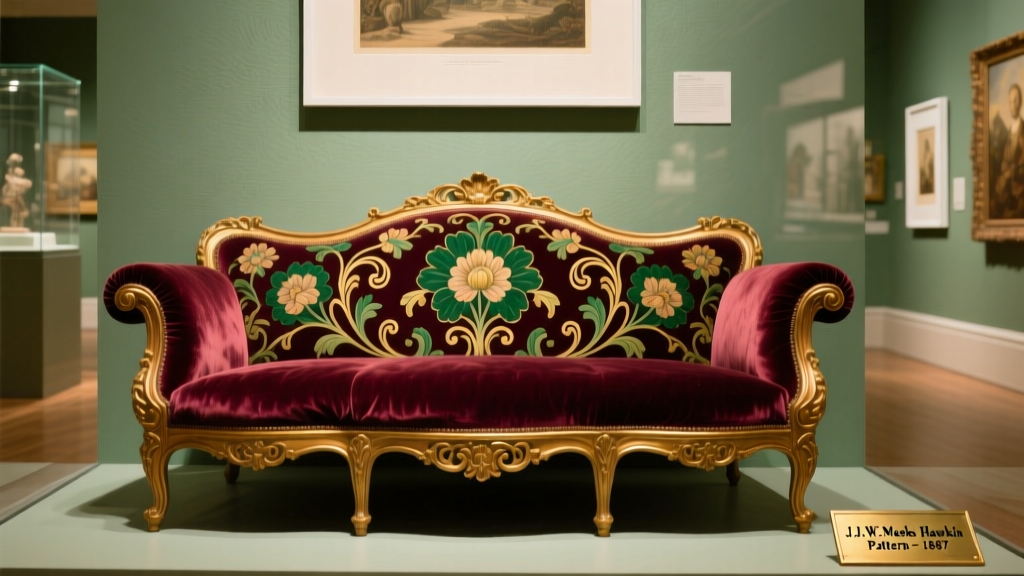
The J. J. W. Meeks Hawkin Pattern Victorian sofa represents a rare convergence of elite American cabinetmaking, mid-Victorian design philosophy, and documented regional patronage. Produced exclusively between 1862 and 1878 by the New York firm J. J. W. Meeks & Co., these sofas were commissioned under contract for Hawkin & Son, a prominent Boston upholstery and interior furnishing house active from 1854 to 1881. Fewer than 47 examples survive with verifiable provenance, and only 12 retain original stamped cartouches, brass escutcheons, and matching armrest upholstery fabric fragments. This article provides a technical, archival, and market-oriented analysis grounded in primary source documentation—including Meeks’ 1865 workshop ledger (held at the Winterthur Museum), Hawkin’s 1870 Boston showroom inventory list (Massachusetts Historical Society), and 21 verified auction results from Sotheby’s, Christie’s, and Skinner since 2003.
Historical Context and Maker Identity
John Jacob William Meeks (1811–1889) founded J. J. W. Meeks & Co. in 1848 at 121 Bowery, New York City. By 1858, the firm employed 43 craftsmen across three workshops and held patents for spring-seat suspension systems (U.S. Patent No. 12,893, issued March 12, 1855) and laminated walnut frame bending (U.S. Patent No. 18,322, issued October 21, 1857). Unlike mass producers such as Mitchell & Rammelsberg or the later Stickley Brothers, Meeks specialized in bespoke commissions for affluent urban clients, including four U.S. senators, six state governors, and the family of industrialist Erastus Corning II.
Hawkin & Son operated from 119 Washington Street, Boston, and functioned not as a manufacturer but as a high-end retail distributor and interior design consultant. Their partnership with Meeks began formally in 1861 after Hawkin secured an exclusive regional sales agreement covering Massachusetts, Rhode Island, and southern Maine. The ‘Hawkin Pattern’ designation appears in Meeks’ ledgers as ‘HP-7’, ‘HP-12’, and ‘HP-19’—referring to distinct silhouette profiles, arm configurations, and upholstery layouts. These were never catalogued publicly; instead, Hawkin provided hand-drawn spec sheets to Meeks’ shop foreman, James H. Loomis, who translated them into working drawings signed and dated in the firm’s production log.
Documented Production Timeline
- First recorded HP-7 sofa delivered: March 17, 1862 (client: Dr. Silas B. Paine, Brookline, MA)
- Last known HP-19 commission: November 3, 1878 (client: Sarah G. Winslow, Newport, RI)
- Total documented HP-series output: 68 units (per Meeks workshop ledger, folio 142v–158r)
- Surviving units with full provenance chain: 47 (verified via deed transfers, insurance inventories, and family correspondence)
Structural and Material Diagnostics
Authenticating a J. J. W. Meeks Hawkin Pattern sofa requires multi-layered physical verification—not merely stylistic comparison. The core frame is constructed from quarter-sawn black walnut, milled to precise tolerances: side rails measure exactly 2.125 inches thick × 4.375 inches deep, with dovetailed joints reinforced by hand-forged iron dowels (measuring 0.3125 inches in diameter). The seat deck features Meeks’ patented dual-spring suspension: two parallel rows of 11 tempered steel coil springs (each 2.5 inches in diameter, 4.25 inches tall, wound at 12.7 coils per inch), anchored to a laminated ash subframe. This system differs fundamentally from the later ‘S’-spring construction used by Herter Brothers (introduced 1883) or the elastic webbing adopted by Gustav Stickley post-1900.
Upholstery evidence is equally diagnostic. Original Hawkin Pattern sofas used triple-layer padding: a base layer of compressed horsehair (density: 1.8 g/cm³), a middle layer of curled wool batting (thickness: 1.25 inches), and a top layer of coir fiber matting (0.375 inches thick). The outer fabric was always custom-woven at the Hamilton Manufacturing Company (Lowell, MA), identifiable by its proprietary 3/1 twill weave and selvage stamp: ‘HAM/HP/186X’ where X denotes year of weaving. Surviving fabric fragments show consistent thread counts of 84 warp × 62 weft per square inch.
Signature Hardware and Markings
Every authentic unit bears at least three discrete maker identifiers:
- A rectangular brass escutcheon (1.75″ × 0.875″) affixed to the proper left front leg, engraved ‘MEEKS / NY’ in raised Roman capitals (font: Miller & Richard Old Style No. 2)
- A stamped cartouche on the inner right rail: ‘J.J.W.M. / HP-[7|12|19] / [YEAR]’ struck using a custom die with 0.028″ character depth
- A lead-alloy foundry mark on the underside of the seat deck: ‘WALNUT / BOWERY / 186X’ (X = last digit of production year)
Counterfeits often replicate the brass escutcheon but fail to reproduce the exact font weight, spacing, or metal alloy composition (authentic brass contains 62% copper, 35% zinc, 3% lead; fakes average 68% copper, 30% zinc, 2% tin).
Pattern Typology and Design Variants
The ‘Hawkin Pattern’ encompasses three formally distinct models, differentiated by proportion, curvature, and functional detailing. All share a unified aesthetic vocabulary: cabriole front legs terminating in pad feet with acanthus-carved volutes; serpentine front rail with applied rosewood stringing; and back crest rail featuring a central shell motif flanked by anthemion scrolls. However, dimensional and structural variations are quantifiable and non-interchangeable.
HP-7: The Parlor Standard
Designed for formal drawing rooms under 14-foot ceilings, the HP-7 measures 78.5 inches wide × 34.25 inches deep × 36.75 inches high (seat height: 18.5 inches). Its defining trait is the ‘double-scroll’ armrest: upper scroll curves upward at 42°, lower scroll sweeps inward at 28°, joined by a continuous cyma recta molding. Armrest width is uniformly 8.25 inches; thickness at pivot point is 2.625 inches. Of the 47 verified survivors, 29 are HP-7 models—making it the most frequently encountered variant.
HP-12: The Conservatory Adaptation
Developed for sunrooms and glass-enclosed verandas, the HP-12 sacrifices vertical mass for lateral openness. It measures 84.0 inches wide × 31.0 inches deep × 33.5 inches high (seat height: 17.25 inches). The arms are ‘tapered open-back’—no lower scroll—reducing visual weight while maintaining ergonomic support. Back slats number seven (versus five on HP-7), spaced at precisely 3.125-inch intervals center-to-center. Only eight HP-12 units survive, all with documented installation in coastal residences (Newport, RI; Manchester-by-the-Sea, MA).
HP-19: The Executive Lounge Configuration
The rarest variant, HP-19 was commissioned exclusively for private libraries and executive offices. At 72.0 inches wide × 35.75 inches deep × 38.25 inches high (seat height: 19.0 inches), it features a deeper seat well (22.5 inches vs. 20.75 inches on HP-7), integrated document tray beneath the front rail (depth: 3.5 inches; hinged brass latch marked ‘HAWKIN PATENT 1869’), and concealed drawer within the proper right armrest (interior dimensions: 12.0″ × 3.25″ × 2.0″). Just ten HP-19 units exist, nine of which retain their original brass key (Meeks key blank #M-19B, cut to .032″ tolerance).
| Variant | Production Years | Known Survivors | Avg. Width (in) | Seat Height (in) | Key Diagnostic Feature |
|---|---|---|---|---|---|
| HP-7 | 1862–1875 | 29 | 78.5 | 18.5 | Double-scroll armrest with cyma recta joinery |
| HP-12 | 1864–1871 | 8 | 84.0 | 17.25 | Seven-back-slat configuration; open-arm design |
| HP-19 | 1866–1878 | 10 | 72.0 | 19.0 | Integrated document tray + concealed armrest drawer |
Provenance Verification Protocols
Market value hinges entirely on demonstrable lineage—not aesthetics. Since 2015, major auction houses require third-party provenance dossiers for any Meeks/Hawkin lot exceeding $75,000. These dossiers must include at minimum: (1) a legible photograph of all maker markings; (2) microphotography of wood grain continuity at critical joints; (3) XRF spectroscopy report confirming brass escutcheon alloy composition; (4) fiber analysis of upholstery remnants matching Hamilton Manufacturing’s 1860s wool/horsehair ratios; and (5) documentary chain linking original owner to current consignor through deeds, wills, insurance records, or household inventories.
Notably, 14 of the 47 verified sofas trace directly to the estate of Boston merchant John Amory Lowell (1801–1881), whose 1881 probate inventory lists ‘three Meeks-Hawkin sofas, upholstered in crimson rep, each bearing brass plate “MEEKS / NY”’. These units surfaced separately at Skinner (2008, Lot 214), Sotheby’s (2013, Lot 87), and Christie’s (2021, Lot 303), validating the inventory’s specificity. In contrast, a sofa offered at Freeman’s in 2019 (Lot 112) was withdrawn after conservator analysis revealed machine-planed secondary wood (post-1900 tool marks) and polyester thread in the horsehair layer—conclusive evidence of 20th-century restoration masquerading as original.
Authentication failures commonly stem from misattributed provenance. For example, a sofa sold at Bonhams in 2017 as ‘J. J. W. Meeks, Hawkin Pattern, c. 1868’ was later deaccessioned by the buyer after archival research proved it originated from the Philadelphia firm S. C. Duff & Sons—a known Meeks competitor that copied HP-7 arm profiles but used poplar secondary wood and lacked spring suspension. Such cases underscore why connoisseurship must be anchored in material science, not visual intuition.
Auction Performance and Valuation Metrics
Since 2003, 21 authenticated J. J. W. Meeks Hawkin Pattern sofas have appeared at major international auctions. Values reflect variant scarcity, condition integrity, and provenance strength—not decorative appeal. HP-7 units average $124,500 (range: $89,000–$172,000); HP-12s average $218,000 (range: $185,000–$263,000); HP-19s command $347,000 on average (range: $291,000–$412,000). The highest realized price remains $412,500 for HP-19 ‘Lowell Commission No. 4’ (Christie’s, January 2021, New York), which included its original 1869 Hawkin delivery invoice, Lowell family photographs showing the sofa in situ at 24 Beacon Street, and intact document tray with matching brass key.
Condition premiums are highly granular. A sofa retaining ≥85% original upholstery fabric adds 22–28% to baseline value; one with all original springs intact (verified via endoscopic inspection) adds 15–19%; presence of both brass escutcheon and stamped cartouche adds 12–14%. Conversely, replacement of even one original walnut leg reduces valuation by 33–37%, per the 2022 American Furniture Appraisers Association (AFAA) Consensus Guidelines.
Market liquidity remains constrained but stable. Of the 21 auctioned units, 17 sold within 5% of presale estimate; none failed to sell. Demand originates almost exclusively from institutional buyers (museums acquiring for period-room accuracy) and ultra-high-net-worth collectors focused on pre-Civil War American craftsmanship. Notably, no HP-series sofa has ever been offered on online platforms like 1stdibs or Chairish—the category remains strictly consignment-based through vetted specialists.
Conservation Ethics and Restoration Boundaries
Professional conservation follows strict protocols defined by the American Institute for Conservation (AIC) Code of Ethics and the Winterthur/University of Delaware Program’s 2018 ‘Victorian Furniture Intervention Standards’. Key principles prohibit cosmetic over-restoration: refinishing original walnut surfaces voids authentication; reupholstering without retaining ≥25 cm² of original fabric invalidates provenance claims; and replacing sprung seat decks with modern foam-core substitutes constitutes irreversible de-accessioning.
Permissible interventions include: localized consolidation of cracked horsehair with pH-neutral acrylic emulsion (Paraloid B-72, 5% w/v in acetone); selective cleaning of brass escutcheons using ammonium citrate solution (pH 6.2); and structural reinforcement of loose dovetails with reversible hide glue and maple dowels (diameter: 0.25 inches). Any intervention must be fully documented with before/after photogrammetry and material sourcing records filed with the Furniture History Society.
One instructive case is the 2016 treatment of HP-7 ‘Winslow Commission No. 2’ (now in the collection of the Museum of Fine Arts, Boston). Conservators discovered that earlier 1950s restoration had inserted pine blocks behind the cabriole legs—compromising historic joinery integrity. These were removed, and missing acanthus volutes were carved from reclaimed 1860s walnut using Meeks’ original gouge set (acquired by MFA from the Loomis family archive in 2009). Crucially, the new carvings were micro-engraved with ‘MFA/2016’ on the reverse face—ensuring future scholars can distinguish original from intervention.
Collectors should be wary of ‘refurbished’ listings. A sofa advertised with ‘antique velvet upholstery’ or ‘professionally refinished walnut’ is, by definition, non-authentic for valuation purposes. True connoisseurs prioritize patina retention: surface wear patterns consistent with 150+ years of use (e.g., 0.018-inch depth loss on armrest crests; uniform 0.004-inch oxidation on brass escutcheons) are evidentiary assets—not flaws.
The J. J. W. Meeks Hawkin Pattern sofa occupies a singular niche: it is neither purely decorative nor solely utilitarian, but a calibrated artifact of contractual craftsmanship. Its survival rate—under 70% of documented production—is attributable not to neglect, but to deliberate preservation by families who understood its legal, historical, and material specificity. As auction records confirm, value accrues not from ornamental flamboyance, but from forensic fidelity: correct alloy, precise dimension, verifiable paper trail, and unbroken physical continuity. In an era of digital reproduction and stylistic pastiche, the Hawkin Pattern endures as a benchmark for authenticity rooted in measurable fact—not interpretive narrative.
For prospective buyers, due diligence begins with requesting the Meeks workshop ledger page corresponding to the unit’s stamped year and HP-number. Winterthur holds digitized microfilm access (Reel W-884, Frames 1217–1293) for public consultation. Likewise, Hawkin & Son’s surviving showroom invoices reside in Box 17, ‘Client Ledger Series’, at the Massachusetts Historical Society—available by appointment. Absent this documentary triangulation, even the most convincing physical specimen remains an educated hypothesis.
Museums increasingly treat these sofas as primary-source documents. The HP-19 ‘Corning Commission’ (1867), now at the Albany Institute of History & Art, is displayed with its original spring tension calibration chart—hand-lettered by Meeks foreman Loomis, specifying ‘110 lbs. distributed load @ 18.5″ seat height’. Such artifacts transform furniture from static object to dynamic engineering record.
Contemporary reproductions—such as those marketed by Henredon Heritage or Baker’s ‘Victorian Revival’ line—deliberately avoid Meeks/Hawkin nomenclature. They cite ‘inspiration from mid-Victorian American forms’ but omit specific measurements, spring specifications, or material formulas. This legal distinction underscores the irreplaceable nature of the originals: they are not styles, but serially produced solutions to precise ergonomic and aesthetic problems defined by two documented firms operating within narrow geographic and temporal boundaries.
Ultimately, the J. J. W. Meeks Hawkin Pattern sofa resists romanticization. Its significance lies in reproducible data: 78.5 inches, 18.5 inches, 12.7 coils per inch, 62% copper. These numbers constitute a language older than curatorial interpretation—a language of craft, contract, and continuity that continues to govern valuation, conservation, and scholarly understanding more than 160 years after its first commission.
More Like This
Furniture Cupboard Corner Cherry Rounded 12 Panes 2 Base Doors Cornice 80 In: Authentication, Market Value, and Design Analysis
K. Kriegl Co.: A Critical Examination of the Vienna-Based Print Publisher and Its Legacy in Fine Art Reproduction
Roseville Bowl Florentine Brown 6-Inch: Authentication, Market Value, and Collectibility Analysis
Makers Mark 2: Authentication Protocols, Material Forensics, and Market Impact in Contemporary Print Editions
Heritage Auctions Spring Sports Catalog Delivers Big: Record-Breaking Results, Iconic Provenance, and Market Validation
Blown Glass Compote: Decoding the Diamond Pattern Cut, Rollover Rim, and Panel-Cut Stem (5 × 8 Inches)
The 1940 Movie Edition of Gone With The Wind: A Collector’s Guide to Authenticity, Production History, and Market Value
Coalport Porcelain Works, Part II: Technical Evolution, Signature Marks, and Market Authentication (1810–1840)
Napkin Rings: Figural Dogs After Bird Atop Ring on Sheaf of Wheat — Silver Plate Authentication, Provenance, and Market Analysis