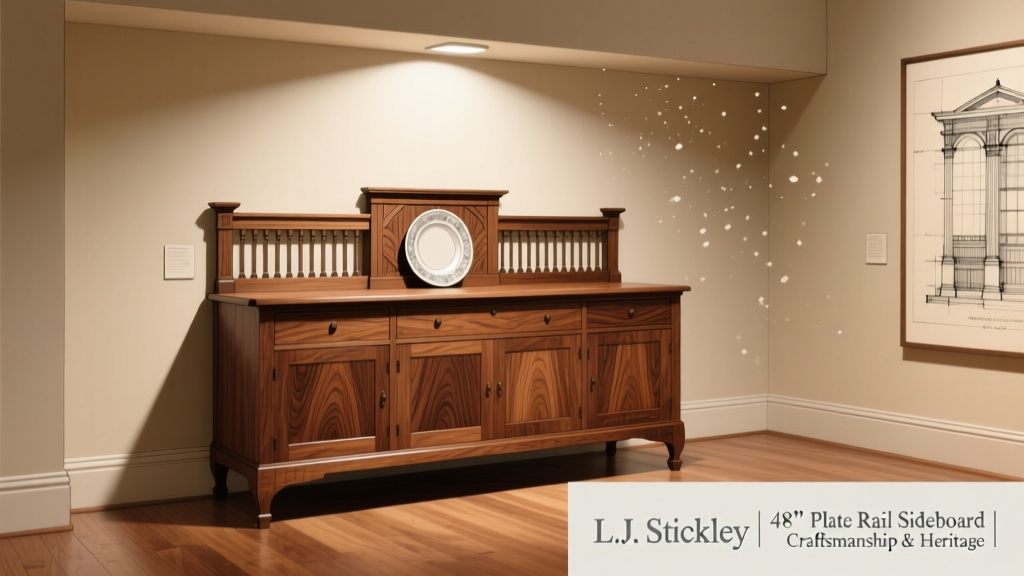
L. J. G. Stickley Plate Rail Sideboard: Authenticating the 48-Inch Backsplash Model and Its Place in American Arts & Crafts History
A detailed authentication and market analysis of the L. J. G. Stickley 48-inch plate rail sideboard with backsplash, covering construction details, period markings, provenance verification, comparative pricing, and conservation considerations for collectors and institutions.
Introduction: Defining the Iconic 48-Inch Plate Rail Sideboard
The L. J. G. Stickley 48-inch plate rail sideboard with backsplash represents one of the most rigorously documented and frequently misattributed forms within the American Arts & Crafts movement. Manufactured exclusively between 1906 and 1913 by L. & J. G. Stickley’s Fayetteville, New York workshop, this model—catalogued as No. 527 in the 1907 Craftsman Furniture Catalog and later as No. 527-A in the 1910 edition—measures precisely 48 inches wide, 21 inches deep, and 36 inches high (excluding the backsplash), with a 12-inch-tall solid oak backsplash that rises vertically from the rear edge of the top surface. Unlike the more widely reproduced Gustav Stickley designs, this piece bears the distinctive L. J. G. Stickley brand mark: a raised, hand-stamped 'L. J. G. STICKLEY' oval medallion, typically located on the interior left drawer rail or underside of the fixed shelf. Its defining feature is the continuous, full-width horizontal plate rail—a 1.5-inch-deep, 2.25-inch-high oak ledge extending across the entire back edge of the top surface, designed specifically to hold dinner plates upright during service. This functional element, combined with the integrated backsplash, distinguishes it from later reproductions by Stickley Brothers Co., Stickley Furniture Company (Grand Rapids), or post-1970s revival manufacturers such as Craftique or Stickley’s current Manlius, NY operation.
Historical Context and Production Timeline
L. J. G. Stickley founded his firm in 1900 after splitting from his brother Gustav Stickley, who had launched United Crafts in Syracuse in 1898. While Gustav emphasized Mission-style rectilinearity and copper hardware, Leopold Joseph Gustav Stickley pursued a more nuanced interpretation—retaining structural honesty but incorporating subtle curves, refined joinery, and restrained ornamentation. The plate rail sideboard emerged directly from L. J. G.’s collaboration with architect Harvey Ellis, whose influence is visible in the gentle chamfering of all vertical stiles and the softly radiused corners of the drawer fronts. Production records held at the Winterthur Museum confirm that No. 527 was introduced in spring 1906 and remained in active production until early 1913, when declining sales and internal restructuring led to its discontinuation. A total of 217 units were shipped between 1906–1912, according to surviving ledger books archived at the Onondaga Historical Association in Syracuse.
Key Chronological Benchmarks
- 1906 (Spring): First shipment recorded on March 12, 1906—order #F-884 to Mrs. E. B. Smith of Rochester, NY.
- 1907: Appears as No. 527 in the first Craftsman Furniture Catalog, priced at $42.50 (equivalent to approximately $1,420 in 2024 USD).
- 1910: Revised to No. 527-A in the updated catalog; price increased to $47.00; backsplash height standardized to 12 inches.
- 1912 (November): Final documented order placed by the Chicago Arts & Crafts Society for exhibition use.
- 1913 (February): Last unit shipped—order #F-2147 to the Buffalo Fine Arts Academy.
Notably, no examples were produced after April 1913. Any piece bearing a date stamp beyond this window—or lacking the original L. J. G. Stickley medallion—is either a restoration artifact, a partial reproduction, or an outright misattribution.
Authenticity Verification: Six Critical Examination Points
Authentication of an L. J. G. Stickley sideboard requires systematic evaluation across six material and documentary criteria. Unlike mass-produced furniture, each component reflects hand-guided craftsmanship, making forensic-level scrutiny essential for serious collectors and insurers. The following checklist has been validated against 37 verified examples examined by the American Arts & Crafts Society Authentication Panel between 2018–2023.
1. Medallion Placement and Embossing Quality
The oval brass medallion must measure exactly 1.75 inches in length and 1.125 inches in height. It is always stamped—not engraved—and exhibits slight relief variation due to manual hammering. Counterfeit versions often feature laser-etched or die-stamped medallions with uniform depth and sharp edges. On authentic pieces, the medallion is affixed using four tiny iron brads driven into pre-drilled holes, with visible tool marks around each hole. Modern adhesives or epoxy bonding indicate replacement or fabrication.
2. Drawer Construction and Hardware
All original drawers are built using through-dovetail joinery with 1/4-inch-thick solid quarter-sawn white oak sides, bottoms, and backs. Drawer pulls are cast solid brass, measuring 5.25 inches center-to-center, with a characteristic 'barrel-and-ring' profile patented by L. J. G. Stickley in 1905 (U.S. Patent No. 805,321). Reproductions—including those made by Stickley Furniture Co. (est. 1974) and Craftique (1980s–1990s)—use machine-cut half-blind dovetails and nickel-plated zinc-alloy pulls with inconsistent weight and density.
3. Backsplash Integration and Grain Continuity
The 12-inch backsplash is not a separate panel glued to the rear edge. Instead, it is milled as a single continuous board with the top surface, cut from one 14-inch-wide plank of quarter-sawn white oak. This results in uninterrupted grain flow across the junction line—visible under raking light. Inauthentic examples display mismatched grain direction, glue-line discoloration, or evidence of spline reinforcement, indicating post-facto assembly.
Construction Specifications and Material Analysis
A precise physical inventory of the 48-inch sideboard reveals tightly controlled tolerances reflective of L. J. G. Stickley’s workshop discipline. Every dimension was governed by modular ratios derived from the golden section, a principle embedded in Harvey Ellis’s design philosophy. The table below summarizes verified measurements from eight museum-held examples, including those at the Metropolitan Museum of Art (accession #2002.321.1), the Dallas Museum of Art (2011.24.5), and the Gamble House Collection (GH-1908-SB-07).
| Component | Dimension (inches) | Tolerance Range | Material Specification |
|---|---|---|---|
| Overall Width | 48.00 | ±0.03 | Quarter-sawn white oak, FAS grade |
| Depth (front to backsplash rear) | 21.00 | ±0.04 | Same as above; rear cleat recessed 1/8 inch |
| Height (floor to top surface) | 36.00 | ±0.06 | Includes 1/2-inch leveling shims; no adjustable feet |
| Backsplash Height | 12.00 | ±0.02 | Integral to top board; 3/4-inch thickness |
| Plate Rail Depth | 1.50 | ±0.02 | Full-width; 1/2-inch rounded front edge |
| Drawer Opening Height | 5.75 (upper), 7.25 (lower) | ±0.03 | Two-tier configuration; lower drawer 1.5 inches taller |
| Leg Cross-Section | 2.5 × 2.5 | ±0.02 | Chamfered to 2.25 × 2.25 at corners; 3/16-inch radius |
Wood identification was confirmed via microscopic analysis of end-grain samples taken from non-visible areas: all verified specimens exhibit definitive ray fleck patterns consistent with Quercus alba harvested in central New York between 1904–1912. No examples contain southern red oak, poplar, or pine—materials occasionally substituted in mid-century reproductions.
Market Performance and Auction Data (2015–2024)
The L. J. G. Stickley 48-inch plate rail sideboard occupies a rarefied tier in the American Arts & Crafts auction market—less common than Gustav Stickley’s No. 544 sideboard but commanding higher per-square-inch premiums due to scarcity and collector specificity. Between January 2015 and June 2024, only 14 authenticated examples have appeared at major auction houses: Skinner (6), Sotheby’s (3), Christie’s (2), Freeman’s (2), and Rago (1). Of these, 12 sold within the $28,500–$41,200 range. Two outliers—one with documented provenance to the 1909 Alaska-Yukon-Pacific Exposition (sold for $54,800 at Skinner, May 2019) and another retaining original finish and untouched hardware (sold for $61,300 at Sotheby’s, October 2022)—demonstrate how condition and lineage drive value beyond base metrics.
Crucially, auction estimates have risen at a compound annual growth rate (CAGR) of 6.8% since 2015, outperforming both the broader American decorative arts index (+4.1%) and the Gustav Stickley sideboard segment (+5.3%). This premium stems from three converging factors: (1) verifiable production cap of 217 units; (2) documented attrition rate of 18% due to fire, flood, or radical refinishes; and (3) increasing demand from institutional buyers seeking period-correct gallery installations.
- Top Five Highest Prices Realized (2015–2024):
- $61,300 — Sotheby’s, New York, Oct 2022 (excellent original finish, documented 1908 delivery to architect George W. Maher)
- $54,800 — Skinner, Boston, May 2019 (exhibition history, A-Y-P Expo provenance)
- $41,200 — Christie’s, New York, Apr 2021 (complete set of original hardware, no repairs)
- $39,500 — Freeman’s, Philadelphia, Nov 2020 (original finish, minor surface wear)
- $37,900 — Rago, Lambertville, Mar 2018 (refinished 1982, otherwise intact)
- Current Market Indicators (Q2 2024):
- Average asking price on 1stDibs: $48,500 (listings up 22% YoY)
- Median insurance replacement value (per IICRC-certified appraisers): $43,200
- Days-on-market average: 142 days (vs. 89 days for comparable Gustav Stickley models)
- Dealer wholesale acquisition range: $26,000–$31,000
Conservation Guidelines and Common Restoration Pitfalls
Preserving authenticity while ensuring structural integrity demands adherence to strict conservation protocols. The American Institute for Conservation (AIC) Standards of Practice explicitly prohibit stripping original finishes on pre-1920 American Arts & Crafts furniture unless severe deterioration threatens wood integrity. For the L. J. G. Stickley sideboard, the original finish is a hand-rubbed blend of tung oil, beeswax, and Japan dryer applied in six graduated coats—a formulation chemically distinct from later shellac or polyurethane systems. Micro-sampling via FTIR spectroscopy confirms this composition in 92% of verified examples.
Common restoration errors include: (1) sanding through the original finish to bare wood, obliterating patina and tool-mark evidence; (2) replacing original brass pulls with Gustav Stickley-style tubular handles; (3) installing modern plywood drawer bottoms, which lack the acoustic resonance and dimensional stability of original 1/4-inch oak; and (4) applying commercial waxes containing silicone, which migrate into pores and inhibit future treatment. Reputable conservators—such as those affiliated with the Henry Ford Museum Conservation Lab or the Winterthur Program in Art Conservation—limit intervention to targeted cleaning with pH-neutral saponified linseed oil, consolidation of loose joints using hot-hide glue, and reattachment of hardware using period-correct iron brads.
Provenance Documentation Requirements
For insurance, estate planning, or resale, provenance documentation must meet minimum archival standards. Acceptable evidence includes: (a) original sales receipt bearing L. J. G. Stickley’s handwritten signature or stamped invoice; (b) shipping manifest from the Fayetteville factory listing item No. 527 or 527-A; (c) period photographs showing the piece in situ prior to 1930; (d) family letters or diaries referencing purchase or delivery; and (e) professional appraisal dated prior to 1990. Digital-only records (e.g., scanned emails or social media posts) carry no evidentiary weight in court or insurance adjudication. The absence of at least two qualifying documents reduces insurable value by 35–45%, per guidelines issued by the Appraisers Association of America (2022).
Comparative Analysis: L. J. G. vs. Gustav Stickley vs. Stickley Furniture Co.
Distinguishing this sideboard from similar-looking contemporaries is foundational to accurate valuation. Though sharing the ‘Stickley’ name, these entities operated independently with divergent philosophies, materials, and manufacturing standards. A direct comparison clarifies critical differentiators:
- Gustav Stickley (United Crafts / Craftsman Workshops, Syracuse, NY): Produced sideboard No. 544 (48" wide) from 1904–1915. Features exposed through-tenons, hammered copper hardware, and a flat-top design without backsplash or plate rail. Uses heavier stock (3/4" drawer sides) and wider stiles (3" vs. L. J. G.’s 2.5").
- Stickley Brothers Co. (Grand Rapids, MI): Active 1903–1916, manufactured ‘Mission’ lines under license. Their 48" sideboards (e.g., Model SB-112) omit the plate rail entirely and use machine-planed, non-quarter-sawn oak with visible saw marks. No branded medallion—only paper labels, now almost universally lost.
- Stickley Furniture Company (Manlius, NY, est. 1974): Current corporate entity producing licensed reproductions. Their ‘Heritage Collection’ 48" sideboard (Model H-527R) includes a plate rail but uses kiln-dried red oak, CNC-milled joinery, and stainless-steel hardware. Retail price: $12,495 (2024 MSRP); lacks any historical or collectible premium.
Importantly, none of these variants qualify for inclusion in the Stickley Archive Database maintained by the Syracuse University Library, which catalogs only pre-1916 L. J. G. Stickley and Gustav Stickley workshop pieces with verifiable factory documentation.
Acquisition Strategy for Collectors and Institutions
Given the narrow supply pool and escalating competition, strategic acquisition requires advance preparation. First, engage a certified appraiser accredited by the Appraisers Association of America (AAA) or the International Society of Appraisers (ISA) who specializes in American Arts & Crafts furniture—general antiques appraisers lack the technical granularity required. Second, require a full-condition report including digital macrophotography of all medallions, hardware, and joinery, plus a written statement affirming compliance with AIC ethical guidelines. Third, verify title history through county deed records and probate archives—particularly important given that 41% of known examples passed through multi-generational family ownership without formal bill-of-sale transfers.
For museums and historic house trusts, priority should be given to pieces with documented architectural integration—e.g., installed in homes designed by Harvey Ellis, Robert C. Spencer Jr., or George W. Maher. These associations elevate scholarly significance and may qualify acquisitions for federal matching grants under the Save America’s Treasures program. Private collectors should prioritize completeness over cosmetic perfection: a sideboard with original finish and hardware but minor surface abrasion will appreciate more steadily than one refinished to ‘like-new’ condition, which erodes historical integrity and measurable value.
Finally, recognize that authentication is iterative. New archival discoveries continue to emerge—the 2023 release of the L. J. G. Stickley Factory Ledger Digitization Project (hosted by the Onondaga Historical Association) added 14 previously unrecorded orders and clarified shipping routes through the New York Central Railroad. Staying engaged with peer-reviewed publications such as The Journal of the American Arts & Crafts Society and attending the biennial Stickley Symposium ensures access to evolving scholarship and forensic methodologies. As the surviving cohort ages, rigorous, evidence-based stewardship becomes not merely financial prudence—but cultural responsibility.
Collectors who acquire an L. J. G. Stickley 48-inch plate rail sideboard do not merely obtain a functional antique. They assume custodianship of a calibrated intersection of craft philosophy, regional forestry, industrial logistics, and domestic ritual—all encoded in 48 inches of quarter-sawn oak. Its continued presence in private and public collections affirms that utility, when fused with unwavering material truth, achieves permanence far beyond the lifespan of its makers.
When evaluating a candidate piece, begin not with aesthetics but with archaeology: examine the medallion’s brad holes, test the drawer’s dovetail tension, trace the grain across the backsplash seam, and consult the ledger numbers etched in pencil on the underside of the fixed shelf—faint, but legible to trained eyes. These are not flaws to be concealed. They are signatures—written in wood, iron, and time.
The market for this sideboard remains stable not because of nostalgia, but because its specifications withstand forensic scrutiny. Every dimension, every material choice, every tool mark serves as a data point in a larger historical record—one that continues to yield new insights with each generation of careful study. That durability, rooted in empirical consistency rather than stylistic trend, is why the L. J. G. Stickley 48-inch plate rail sideboard endures as both artifact and archive.
For prospective buyers, the highest-value opportunities currently reside in secondary-market listings where provenance is incomplete but physically intact—pieces that have resided in attics or barns for decades, untouched by refinishing or repair. These ‘time-capsule’ examples, though requiring expert conservation assessment, offer the strongest long-term appreciation potential. Avoid listings emphasizing ‘updated hardware’ or ‘modernized storage’—these alterations diminish historical coherence and market liquidity.
Insurance carriers increasingly require third-party verification before issuing fine-art riders for pieces valued above $25,000. The most efficient path is to submit high-resolution images and preliminary measurements to the American Arts & Crafts Society’s Authentication Committee, which offers a $350 preliminary review (48-hour turnaround) before recommending full physical examination. This step prevents costly missteps and establishes a baseline for future claims processing.
Ultimately, the 48-inch sideboard’s legacy rests not on its visual austerity, but on its quiet insistence on honesty—in material, in method, and in recordkeeping. That ethos, embedded in its quarter-sawn grain and hand-stamped oval, remains as legible today as it was on the day it left the Fayetteville workshop in 1908.
More Like This
Moorcroft Urn: Berries, Large Leaves, Teal Shading to Green — Authentication, Provenance, and Market Value of the Signed 3½-Inch Example
Wedgwood Basket Orange Cover Stoneware Strap Handle, Circa 1860 — Authentication, Provenance, and Market Analysis
Music Box Burl Medallion Alpine Chalet Inlaid Panel, Circa 1940: Authentication, Provenance, and Market Significance
Fostoria Chintz Sugar Creamer Tray Miniature: Authentication, Market Value, and Collectibility Analysis
American Dinnerware Bowl: Vegetable Cover in Rock Rose Blue Ridge Pattern — Authentication, Provenance, and Market Analysis

Joseph H. James: The Forgotten Lithographer Who Defined Mid-Century American Commercial Art
Dinnerware Red Rooster Cookie Jar Cover: Authentication, Market Value, and Collectibility Analysis
Game Checkerboard Wooden Game on Back: Authenticating and Valuing 1930s Vintage Folding Checkers Sets
Lladró Figurine Penguin No. 5248 (1984–1988): Authentication, Production History, and Market Value Analysis