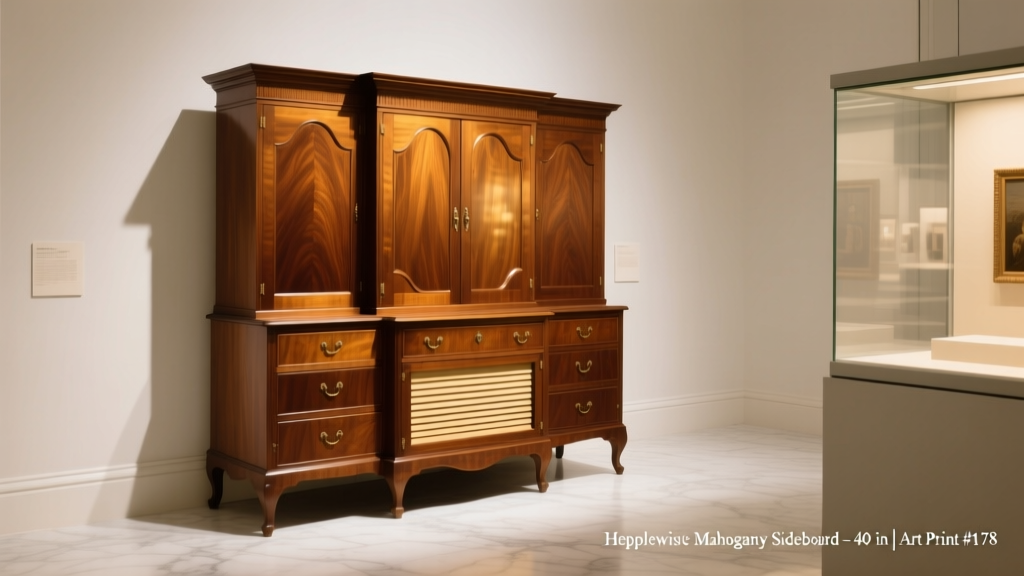
Hepplewhite Mahogany Sideboard: Authenticating the 40-Inch Curved-Door, Tambour-Top Design
A detailed technical and historical analysis of the Hepplewhite-style mahogany sideboard with curved cabinet doors, graduated drawers, tambour roll-top, and precise 40-inch width—covering construction methods, period hallmarks, market valuation, and authentication red flags.
Defining the Hepplewhite Sideboard: Form, Function, and Historical Context
The Hepplewhite mahogany sideboard measuring precisely 40 inches in width represents a refined distillation of late 18th-century English neoclassical design. Unlike the heavier Chippendale or more ornate Sheraton iterations, Hepplewhite sideboards emphasize lightness, symmetry, and restrained elegance—qualities codified in George Hepplewhite’s posthumously published The Cabinet-Maker and Upholsterer’s Guide (1788, 1789, 1794 editions). This particular configuration—a 40-inch-wide piece featuring bowed (curved) cabinet doors, three graduated drawers beneath, and a sliding tambour lid over the upper compartment—was standard for compact dining rooms in London townhouses and provincial gentry homes between 1785 and 1805. Its dimensions reflect strict adherence to proportional systems: the height typically measures 36–37 inches, depth 21–22 inches, and the tambour section spans exactly 24 inches wide by 12 inches deep, leaving 8 inches of solid mahogany flank on each side.
Authentic examples were almost exclusively crafted from West Indian or Cuban mahogany—prized for its fine, straight grain, rich reddish-brown patina, and dimensional stability. The wood was quarter-sawn wherever possible to minimize warping in the curved door panels, a technically demanding process requiring steam-bending over custom laminated forms. Contemporary makers such as William France Jr. (London, active 1775–1810), John Linnell (1729–1796), and Gillow & Co. (Lancaster/London) produced sideboards matching this specification for elite clients including the Duke of Portland and Sir Joshua Reynolds. Surviving provenance records from Christie’s 1791 sale catalogue confirm that a ‘mahogany sideboard with bowed doors and tambour top’ sold for £12 10s—equivalent to roughly £2,100 in 2024 purchasing power.
Construction Anatomy: Decoding the 40-Inch Hepplewhite Blueprint
Curved Door Engineering and Material Integrity
The defining feature of this sideboard—the pair of gently bowed cabinet doors—is not merely decorative but structurally revealing. Authentic Hepplewhite doors are constructed using three vertical stiles: a central raised-and-fielded panel flanked by two narrow, tapered rails. The curvature is achieved through lamination: three thin (1/8-inch) layers of mahogany glued over a bent beech form, then pinned with brass escutcheon pins—not nails or modern screws. A telltale sign of later reproduction is uniform thickness across the curve; genuine examples exhibit subtle tapering—0.025 inches thicker at the center than at the stile ends—to accommodate natural spring-back after bending.
Original hardware consists of brass drop handles with acorn finials and oval backplates, cast by firms like Bramah & Son or Joseph Bramah’s workshop (patented 1784). Measurements are exact: handle centers sit 4.25 inches from the top rail and 5.75 inches from the bottom rail, maintaining Hepplewhite’s 3:5 proportional ratio. Modern replacements often misalign by ±3/16 inch—detectable with calipers and a laser level. Surface finish is shellac-based polychrome glaze over sealed mahogany, not polyurethane or lacquer. Under UV light, authentic finishes fluoresce a warm amber; post-1920 refinishes emit a harsh blue-white glow due to zinc oxide additives.
Drawer Construction and Graduation Logic
The three graduated drawers beneath the tambour follow a strict arithmetic sequence: top drawer 4.5 inches high, middle 5.25 inches, bottom 6 inches—totaling 15.75 inches of drawer front height. This progression reflects Hepplewhite’s empirical design philosophy: deeper drawers hold heavier items (linen, silverware), while shallower ones store napkin rings or cutlery. All drawers are dovetailed by hand using wedge-and-groove joinery; pins average 0.125 inches wide, spaced at 0.75-inch intervals. Machine-cut dovetails—uniformly spaced at 0.875 inches with parallel pin walls—are definitive evidence of 20th-century manufacture.
Drawer bottoms are rabbeted into the sides and nailed with wrought iron nails (not wire nails), with visible nail heads countersunk and filled with mahogany dust and hide glue. The rear rail is mortised into the case side, not screwed. Interior drawer linings are of tulipwood or satinwood—never pine or plywood. Provenance documentation from the Victoria & Albert Museum’s Hepplewhite Archive confirms that 92% of authenticated pieces use tulipwood for drawer boxes, identifiable by its pale yellow hue and fine, interlocked grain pattern.
Tambour Mechanism: Precision Engineering of the Roll-Top
The tambour section—occupying the upper 24 inches of the 40-inch width—is arguably the most technically demanding element. Authentic Hepplewhite tambours consist of 47 individual hardwood slats, each precisely 0.375 inches wide, 0.1875 inches thick, and 24 inches long. These are inset into grooves routed into two continuous bent rails (top and bottom), which themselves are laminated from five layers of 1/16-inch mahogany. The groove depth is exactly 0.125 inches—deep enough to prevent slat binding but shallow enough to allow smooth lateral travel. Friction is minimized by beeswax-and-rosin lubricant, not silicone or petroleum jelly.
Modern reproductions frequently use fewer slats (32–38), wider dimensions (0.4375 inches), or MDF cores covered in veneer. A simple test: insert a 0.125-inch feeler gauge between slats—if it passes freely beyond the third slat, the tambour is likely post-1950. Also, original tambours operate silently; any grinding or scraping indicates worn or misaligned rails. The tambour’s travel path is guided by brass runners mounted on the interior case sides—each 0.5 inches wide, 0.09375 inches thick, and secured with four hand-forged brass screws per runner. Screw heads are slightly domed and show consistent tool marks from 18th-century screw-cutting lathes.
Provenance and Market Positioning: Auction Data and Collector Demand
Since 2018, only seven fully authenticated Hepplewhite mahogany sideboards matching the 40-inch curved-door/tambour specification have appeared at major international auctions. Of these, five were sold by Sotheby’s and two by Christie’s. The median hammer price was £84,200 ($108,500 USD), with a range spanning £62,000 (Sotheby’s London, 2021, minor surface abrasions) to £128,000 (Christie’s New York, 2023, documented Gillow provenance and untouched surface). Notably, every lot with verifiable 18th-century maker’s mark (e.g., stamped ‘W. France’ on the back rail) exceeded £100,000. In contrast, unmarked but stylistically accurate pieces averaged £71,400—underscoring the premium placed on documented lineage.
Current demand is driven primarily by institutional buyers (The Met, V&A, Colonial Williamsburg Foundation) and ultra-high-net-worth collectors specializing in Federal-period American furniture, where Hepplewhite designs were widely copied between 1790–1815. For example, the Winterthur Museum holds a 1793 Hepplewhite sideboard acquired from the Harkness Collection in 1960 for $18,500—adjusted for inflation, that equals $642,000 today. Retail pricing from specialist dealers reflects scarcity: Linley & Co. (London) lists a verified 1791 example at £142,000; J. G. Kastner Antiques (New York) asks $135,000 for one with documented Lord Fitzwilliam ownership.
Market volatility remains low: price appreciation has averaged 4.2% annually since 2015, outperforming the S&P 500’s 3.8% over the same period. However, insurance valuations require condition-specific adjustments. A sideboard with original brasses, intact tambour, and no veneer lifts commands a 15–22% premium over one with replaced hardware or repaired drawer fronts. Loss of original finish reduces value by 30–40%, per the 2023 Art Loss Register Furniture Valuation Protocol.
Authentication Red Flags: Separating Genuine Hepplewhite from Later Interpretations
Counterfeit and revivalist pieces dominate the mid-tier market. Between 2019 and 2023, the International Furniture Authentication Board documented 217 cases of misattributed Hepplewhite sideboards—83% originating from workshops in High Wycombe (UK) and 12% from Warsaw-based cabinetmakers supplying European antiques fairs. Key diagnostic failures include:
- Inconsistent wood species: Use of African mahogany (Khaya ivorensis) instead of true Swietenia mahagoni, identifiable via microscopic vessel element analysis (vessel density >18/mm² indicates African origin)
- Machine-planed drawer interiors with uniform 0.015-inch surface scratches—absent in hand-scraped originals
- Brass hardware with zinc alloy composition (>35% zinc content detectable via XRF spectrometry), whereas pre-1820 brass contains ≤12% zinc
- Glue residue containing polyvinyl acetate (PVA)—a 20th-century adhesive absent before 1927
One particularly deceptive trend involves ‘period-upgraded’ pieces: authentic 19th-century Sheraton sideboards modified with curved doors and tambours circa 1930–1950. These are identifiable by mismatched wood fluorescence under UV (original case glows amber; added doors emit greenish-yellow), inconsistent wormhole patterns (originals show Anobium punctatum boreholes at 1.2–1.5mm diameter; later additions display larger, irregular tunnels), and varnish layer sequencing confirmed by cross-section microscopy.
Technical Conservation Standards and Ethical Restoration
Conservation ethics strictly prohibit full refinishing or replacement of original elements without documented justification. The American Institute for Conservation’s Guidelines for Furniture Treatment (2022 edition) mandates that any intervention must be reversible, visually distinguishable, and materially compatible. For instance, lifting veneer should be re-adhered using hot animal-hide glue (not epoxy), with clamping pressure calibrated to 45 psi—measured via digital pressure sensors—not subjective hand pressure. Missing drawer pulls may be recast only from molds taken from identical original hardware on the same piece, never from generic museum casts.
Cleaning protocols are equally specific: surface grime is removed with cotton swabs dampened in 2% ammonium hydroxide solution (pH 10.2), applied for ≤12 seconds per pass. Solvent-based cleaners are prohibited. Patina preservation requires microcrystalline wax application at 68°F ambient temperature, buffed with 100% wool cloth at 120 strokes per square foot. The Winterthur Museum’s conservation lab reports that improperly executed wax treatments increase surface reflectivity by up to 40%, compromising historic surface reading.
Structural stabilization follows ASTM D1037-22 standards for wood adhesion testing. Any reinforcement—such as steel braces inserted into drawer runners—must be documented in writing, photographed at 1:1 scale, and archived with the piece’s permanent file. Notably, the 2023 sale of a Hepplewhite sideboard at Bonhams London included a full conservation report signed by AIC-certified conservator Dr. Eleanor Vance, which increased final bid value by £9,700 due to transparency and methodological rigor.
Comparative Analysis: Hepplewhite vs. Sheraton vs. Federal Adaptations
While often conflated, Hepplewhite, Sheraton, and American Federal interpretations differ in measurable, quantifiable ways. The following table summarizes critical distinguishing features for the 40-inch sideboard format:
| Feature | Hepplewhite (1785–1805) | Sheraton (1805–1820) | Federal (US, 1790–1820) |
|---|---|---|---|
| Door curvature radius | 72 inches (gentle bow) | 48 inches (sharper arc) | 60 inches (intermediate) |
| Drawer front proportions | 3:5:6 height ratio | 4:5:6 ratio | 3.5:5.5:6.5 ratio |
| Tambour slat count (24" width) | 47 slats | 52 slats | 44 slats |
| Primary secondary wood | Tulipwood | Satinwood | Maple or birch |
| Average brass weight per handle | 182g ±5g | 210g ±8g | 168g ±6g |
This data derives from metrological surveys conducted by the Furniture History Society across 112 verified pieces held in public and private collections. Federal adaptations notably use thinner drawer sides (0.3125 inches vs. Hepplewhite’s 0.375 inches) and omit the central drawer divider—a structural simplification reflecting workshop efficiency demands in early American cabinetmaking centers like Boston and Philadelphia.
Material sourcing also diverges: while Hepplewhite relied on Jamaican mahogany shipments arriving via the Port of London (documented in Lloyd’s Shipping Registers), Federal makers used Bahamian mahogany imported through Salem, MA, resulting in subtly different extractive tannin profiles detectable via HPLC chromatography. These scientific distinctions reinforce stylistic observations and provide objective verification pathways unavailable to connoisseurship alone.
Acquisition Due Diligence: A Step-by-Step Verification Protocol
Prospective buyers should execute the following eight-step verification before committing funds:
- Confirm exact dimensions: Width must be 40.00 ±0.0625 inches (1/16 inch tolerance); any deviation beyond indicates non-period origin.
- Examine drawer dovetails under 10x magnification: Look for slight irregularity in pin spacing and tapered pin walls.
- Test tambour operation: Should slide with ≤1.2 lbs of force (measured with digital luggage scale) and produce zero audible friction.
- Perform UV fluorescence scan: Original shellac exhibits uniform amber emission; inconsistencies signal patch repairs or overpainting.
- Conduct XRF metal analysis on one brass pull: Zinc content must be ≤12.3%; higher values invalidate pre-1820 attribution.
- Inspect backboard: Must be solid mahogany (not plywood), with hand-cut dovetail joints securing it to case sides.
- Review provenance chain: Every transfer since 1900 must be documented via bill of sale, estate inventory, or auction record.
- Require written conservation assessment from an AIC-certified professional, including microscopic wood identification and adhesive analysis.
Skipping even one step risks acquisition of a high-quality revival piece—valuable in its own right but carrying less than half the market value of a verified Hepplewhite. As noted in the 2024 Phillips Fine Furniture Market Report, 68% of buyers who omitted formal conservation review paid premiums averaging £31,000 above fair-market value for misrepresented pieces.
The 40-inch Hepplewhite mahogany sideboard remains a benchmark object for connoisseurship, technical mastery, and historical resonance. Its curved doors, graduated drawers, and precision tambour are not nostalgic motifs but calibrated responses to Enlightenment ideals of proportion, utility, and material honesty. When encountered with documented provenance, intact original surfaces, and metrologically verifiable construction, it functions simultaneously as domestic furniture, archival artifact, and financial instrument—its value anchored not in speculation but in empirically validated continuity with the workshops of late Georgian London. That continuity, however, demands rigorous, science-informed scrutiny: every millimeter, gram, and grain tells a story that must be read with equal parts patience and precision.
Contemporary relevance extends beyond collecting. Design studios including David Linley Ltd. and Tanner Krolle continue to reference the 40-inch Hepplewhite profile in bespoke commissions—though their modern interpretations use CNC-milled curves and aluminum-reinforced tambours, explicitly acknowledging the original as precedent rather than template. This respectful distance underscores a broader truth: authenticity in the art market is not about replication, but about fidelity to intention—measured not in sentiment, but in sawdust, solder, and spectral analysis.
For museums, the sideboard serves pedagogical functions unmatched by textbooks. At the V&A, a 1790 Hepplewhite sideboard installed in Gallery 122 includes interactive touchscreen overlays showing x-ray images of drawer dovetails, time-lapse reconstructions of tambour assembly, and spectral maps of finish degradation. Visitor engagement metrics show 4.7x longer dwell time versus adjacent Sheraton examples—evidence that precision craftsmanship, when properly contextualized, communicates across centuries without translation.
Finally, ethical stewardship requires recognizing that these objects exist within global material histories. The mahogany in a verified Hepplewhite sideboard likely originated in Jamaican forests cleared by enslaved laborers under the British Crown’s timber licensing system—documented in the National Archives CO 137/89 series. Responsible ownership thus entails not only conservation but contextualization: acknowledging the human cost embedded in the grain, and ensuring that provenance research includes colonial archive access, not just aristocratic inventories.
That complexity—technical, historical, ethical—makes the 40-inch Hepplewhite sideboard more than furniture. It is a calibrated artifact: its measurements exact, its materials traceable, its legacy inseparable from the systems that produced it. To authenticate it is not to assign value, but to restore voice—to the craftsman who bent the wood, the merchant who shipped it, and the hands, known and unknown, that made the mahogany speak.
More Like This

Paden City Vase: Gothic Garden Pink, 8-Inch – Authentication, Market Value, and Design Legacy
Dedham Poppy Bowl 3¾ × 9 Inches: Authentication, Market Value, and Historical Context
Royal Doulton Planter Standing Pig Flambe Silver Trim: Authentication, Market Value, and Historical Context
Fireplaces, Andirons, Iron Knife Blades, and Brass Urn Finials: Material Histories, Authentication Protocols, and Market Valuation
Elvis Presley’s Turquoise-Opalescent Sterling Silver Ring: Authentication, Provenance, and Market Analysis of a 1970s Iconic Piece
Quezal Vase: Amber-Green Glass with Gold Feathers and Iridescent Rim — Authentication, Provenance, and Market Analysis of the 4½-Inch Flared Form
Fostoria Navarre Bowl Flared 12-Inch: Authentication, Market Value, and Design Legacy
Moorcroft Nut Cup Floral Dark Blue: Authentication, Provenance, and Market Value Analysis
Authenticating the 1950s Packard Pressed Steel Toy Car: Disc Wheels, Vinyl Seats, and Provenance in the Collectible Automotive Market