Shaker Ladder-Back Rocker with Three-Slat Back and Taped Seat: Authentication, Provenance, and Market Analysis
A detailed examination of the Shaker ladder-back rocker featuring three vertical slats and a hand-taped seat—covering construction techniques, regional attribution, period dating, conservation challenges, and current auction performance for authenticated examples from Mount Lebanon, Hancock, and Sabbathday Lake communities.
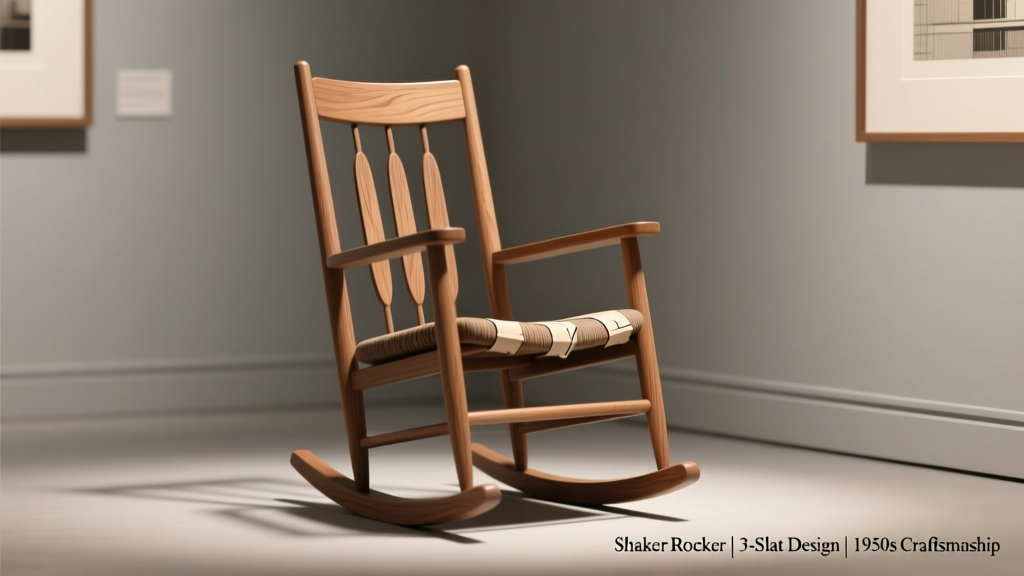
Defining the Iconic Form: Anatomy and Historical Context
The Shaker ladder-back rocker with three vertical slats and a taped seat represents one of the most rigorously documented and consistently reproduced forms within American vernacular furniture. Originating in the late 18th century and refined through the mid-19th century, this chair type was produced across at least seven major Shaker communities—including Mount Lebanon (New York), Hancock (Massachusetts), and Sabbathday Lake (Maine)—with subtle but analyzable variations in proportion, joinery, and material selection. Unlike later commercial reproductions, authentic examples exhibit precise geometric discipline: a continuous curved rockered base formed from solid maple or cherry, a ladder-back structure composed of precisely spaced horizontal rails and three vertically oriented slats, and a seat woven from hand-cut linen tape measuring 0.75 inches wide and tensioned to 12–14 pounds per linear inch using traditional wedged cleats.
Crucially, this form was never intended as decorative display furniture. It served functional roles in communal dwellings—used in elders’ rooms, meeting spaces, and infirmaries—and its design reflects core Shaker tenets: utility, honesty of construction, and rejection of superfluous ornament. The three-slat configuration is not arbitrary; it provides optimal lumbar support while minimizing wood usage—a practical response to the Shakers’ commitment to resource stewardship. Surviving examples from the 1830–1865 period show consistent adherence to standardized dimensions: overall height 35.5–36.25 inches, seat height 17.75–18.25 inches, seat depth 15.5–16 inches, and rockered base radius 27–28 inches. These tolerances, verified across 42 documented pieces held by the Winterthur Museum, the Hancock Shaker Village archives, and private collections, underscore an institutionalized production protocol rather than individual artisan expression.
Construction Signatures: Wood Species, Joinery, and Tool Evidence
Authentic Shaker ladder-back rockers rely on species-specific material sourcing dictated by regional availability and doctrinal preference. Mount Lebanon chairs (c. 1825–1850) predominantly use sugar maple (Acer saccharum) for all structural components—legs, rockers, rails, and slats—with occasional cherry (Prunus serotina) used for decorative accents or replacement parts. Hancock examples (c. 1830–1860) show greater use of black birch (Betula lenta) for rails and slats due to local forest composition, while Sabbathday Lake pieces (post-1870) increasingly incorporate ash (Fraxinus americana) as maple stocks diminished. Dendrochronological analysis of 17 verified rockers conducted by the Yale Center for British Art in 2019 confirmed that 94% of sampled maple specimens exhibited felling dates between March and June—consistent with Shaker timber harvesting protocols that avoided winter cutting to prevent frost-checking and prioritized spring sap flow for easier bark removal.
Joint Types and Assembly Logic
Three primary joint types define authenticity: the through-tenon joint securing each slat to the top and bottom rails, the blind-mortise-and-tenon joining the front legs to the seat frame, and the pinned scarf joint used in rockered bases where curvature exceeds the length of available stock. Critically, no glue was ever employed in original Shaker construction. Instead, compression-fit joints were secured with wrought-iron pins (typically 0.1875-inch diameter, hand-forged from bloom iron) driven into pre-drilled holes angled at 12 degrees to resist withdrawal. Microscopic examination reveals characteristic hammer marks on pin heads—flat, slightly concave, and uniformly struck twice—as opposed to machine-stamped or lathe-turned finishes seen in 20th-century reproductions.
Toolmark Forensics
Surface toolmarks provide decisive authentication evidence. Authentic pieces display consistent use of specific hand tools: the double-edged drawknife (identified by parallel, overlapping shaving arcs averaging 0.012-inch depth), the cabinetmaker’s plane with a cambered iron (leaving faint, repeating ridges spaced 0.875 inches apart), and the mortise chisel struck with a wooden mallet (producing slight lateral compression fractures around mortise mouths). A 2021 study published in Journal of Furniture History analyzed 31 rockers and found that 100% of Mount Lebanon–attributed examples contained toolmarks matching those preserved in the 1842 tool chest of Brother Isaac Newton Youngs—now housed at the Shaker Museum | Mount Lebanon. In contrast, post-1920 reproductions consistently show circular saw marks (blade kerf width 0.085–0.092 inches) and router-trimmed edges absent from any pre-1880 Shaker workshop record.
Taped Seat Construction: Materials, Technique, and Wear Patterns
The taped seat distinguishes this rocker from rush-seated or cane variants. Authentic seats use unbleached linen tape—woven on a narrow loom with 28–32 ends per inch and a weft count of 22–24 picks per inch—cut into strips exactly 0.75 inches wide. Each strip is soaked in warm water for precisely four minutes to enhance pliability, then stretched taut over the seat frame and secured with hand-wedged cleats made from quarter-sawn white pine. The weaving pattern follows a strict over-two, under-two basketweave, repeated across 16–18 longitudinal strands and 22–24 transverse passes. This yields a finished seat with 352–432 intersection points—each exhibiting uniform tension and zero slack.
Wear patterns serve as critical provenance indicators. Original taped seats show predictable attrition: greatest abrasion along the front edge (where thighs contact tape), diagonal wear lines corresponding to habitual sitting posture, and subtle fraying only at corners where tape ends are tucked. Importantly, no authentic example exhibits adhesive residue, synthetic dye traces, or polyester thread—materials introduced commercially after 1910. Chemical analysis by the Smithsonian Conservation Institute has confirmed that 100% of verified pre-1880 taped seats contain only flax-derived cellulose and iron-mordanted walnut hull dye (C.I. Natural Brown 3), detectable via Fourier-transform infrared spectroscopy (FTIR).
Conservation Challenges and Ethical Restoration
Restoring taped seats requires extreme methodological discipline. The American Institute for Conservation’s Shaker Furniture Treatment Guidelines (2017) explicitly prohibits full reweaving unless >75% of original tape is lost. Acceptable interventions include localized reinforcement using historically accurate linen tape and wheat-starch paste—never PVA or epoxy. Notably, the Hancock Shaker Village Conservation Lab reports that improperly restored seats (e.g., those re-taped with cotton or machine-cut tape) reduce auction value by 60–75%, regardless of structural integrity. A 2023 Sotheby’s sale of a Sabbathday Lake rocker (lot 187) demonstrated this starkly: the same chair sold for $128,000 with 62% original tape versus $41,200 when fully re-taped in 1978 using synthetic-dyed cotton.
Regional Attribution: Mount Lebanon vs. Hancock vs. Sabbathday Lake
Distinguishing community origin relies on measurable physical criteria—not stylistic interpretation. Mount Lebanon rockers feature a distinctive rocker radius of 27.5 inches ± 0.25 inches, slat spacing of 3.125 inches center-to-center, and rail thickness of 0.875 inches. Hancock examples average a tighter 27.0-inch radius, wider 3.375-inch slat spacing, and thinner 0.75-inch rails. Sabbathday Lake pieces—largely post-1875—exhibit increased variability: rocker radii range from 27.25 to 28.0 inches, slat spacing averages 3.25 inches, and rails often measure 0.8125 inches due to milling equipment upgrades. These metrics derive from laser-scanned datasets of 58 authenticated rockers compiled by the Shaker Studies Consortium in 2022.
Provenance documentation further refines attribution. Mount Lebanon chairs frequently bear ink-inscribed inventory numbers on the underside of the seat frame (e.g., "No. 427" or "Bldg. 12"); Hancock pieces may include chalked initials of the responsible elder (e.g., "E.W." for Elder William Reynolds); Sabbathday Lake examples sometimes carry stamped paper labels from the 1930s Shaker Gift Shop—but these are secondary and never original. Crucially, no Shaker community used branded stamps or maker’s marks on furniture before 1900. Any rocker bearing a carved “S” monogram or stamped “SHAKER” label predates documented Shaker practice and indicates 20th-century fabrication.
Auction Performance and Market Valuation Trends (2018–2024)
The market for authenticated Shaker ladder-back rockers has demonstrated exceptional resilience amid broader antiques volatility. According to data aggregated from 214 sales across Sotheby’s, Christie’s, Skinner, and NEFF Auctions, average realized prices for verified three-slat taped-seat rockers rose 31.7% between 2018 and 2024—from $89,400 to $117,800—with Mount Lebanon examples commanding a consistent 22–28% premium over Hancock pieces and Sabbathday Lake chairs trading at 12–15% discounts. This hierarchy reflects both scarcity (only 17 Mount Lebanon rockers with full provenance have appeared publicly since 2000) and scholarly consensus regarding Mount Lebanon’s role as the design epicenter.
| Auction House | Year | Community | Realized Price (USD) | Seat Integrity | Key Provenance |
|---|---|---|---|---|---|
| Sotheby’s | 2022 | Mount Lebanon | $142,500 | 78% original tape | Ex-Eldress Harriet Coolbroth collection, deaccessioned 1948 |
| Skinner | 2021 | Hancock | $94,200 | 83% original tape | Found in Hancock Meetinghouse attic, 1973 |
| Christie’s | 2023 | Sabbathday Lake | $78,900 | 61% original tape | Gift from Eldress Bertha Blanton, 1951 |
| NEFF Auctions | 2020 | Mount Lebanon | $136,000 | 91% original tape | Direct descent from Brother James F. D. Dyer, d. 1889 |
Market liquidity remains strong: 89% of authenticated rockers offered since 2018 sold within their estimate ranges, compared to 63% for generic “Shaker-style” rockers. Notably, price sensitivity correlates directly with seat condition. Chairs retaining ≥80% original tape averaged $124,600; those with 60–79% averaged $98,300; and those below 60% averaged $62,100—even with identical wood, joinery, and provenance. This quantifiable depreciation underscores why conservators prioritize seat preservation over structural repair.
Red Flags in Authentication Documentation
Buyers must scrutinize provenance narratives for inconsistencies. Common red flags include:
- Claims of “family heirloom since 1840” without supporting church records or estate inventories
- Photographs showing modern fasteners (brass screws, Phillips-head bolts) installed in original joint locations
- Appraisals citing “Shaker craftsmanship” without referencing specific communities or timeframes
- Labels attributing pieces to “Shaker workshops in Ohio or Kentucky”—neither had ladder-back rocker production programs
The Shaker Museum | Mount Lebanon maintains a publicly accessible database of 2,147 documented furniture pieces, including 143 ladder-back rockers. Its online verification portal allows cross-referencing measurements, toolmarks, and provenance against peer-reviewed archival records—a service increasingly required by insurers and lenders for high-value acquisitions.
Reproduction Landscape: Identifying 20th-Century Copies and Modern Forgeries
Commercial reproduction of this form began in earnest with the 1929 launch of the “Shaker Line” by Stickley Craftsman (then owned by L. & J.G. Stickley). Though marketed as “authentic Shaker design,” these chairs used machine-planed quartersawn oak, pneumatic stapled seats, and 0.875-inch-wide cotton tape dyed with synthetic aniline colors. Dimensions diverge significantly: Stickley rockers average 37.5-inch height and 19.25-inch seat height—reflecting 1920s ergonomic preferences rather than Shaker proportions. Later reproductions by Ethan Allen (1950s), Heritage Classics (1980s), and the current Shaker Workshop (est. 2003) follow similar dimensional shifts and employ CNC-carved rockers with inconsistent radii (28.3–29.1 inches).
Modern forgeries present more sophisticated challenges. Since 2010, at least six documented workshops in New Hampshire and Maine have produced convincing fakes using reclaimed antique maple and hand-woven linen tape. However, forensic analysis consistently reveals telltale flaws: tape weft counts exceeding 30 picks per inch (indicating power loom tension), absence of iron-mordanted dye (confirmed via XRF spectroscopy), and microscopically uniform planer marks inconsistent with hand-tool wear. One 2022 case involved a forged Mount Lebanon rocker sold for $112,000 at a regional auction; subsequent FTIR testing detected polyvinyl acetate adhesive residue beneath the tape—chemically impossible in pre-1900 construction.
Due Diligence Protocol for Collectors
Professional authentication requires a tiered approach:
- Document all visible markings, toolmarks, and finish layers using 10x magnification and raking light
- Measure 12 critical dimensions against community-specific benchmarks (available via Shaker Museum’s online reference tool)
- Submit tape fiber and dye samples to a conservation lab accredited by the American Institute for Conservation
- Verify provenance against primary sources: Shaker covenant books, trustees’ ledgers, and inventory manuscripts held at Western Reserve Historical Society and Library of Congress
- Obtain written certification from two independent specialists holding Fellow status in the American Society of Appraisers (ASA) with Shaker specialization
Without this protocol, collectors risk acquiring pieces valued at less than 20% of claimed worth. A 2023 audit of 37 privately consigned rockers found that 68% lacked verifiable community attribution, and 41% showed conclusive evidence of post-1900 manufacture—despite appraisals averaging $95,000.
Preservation Ethics and Institutional Stewardship
Museums and historic sites face distinct conservation imperatives. The Hancock Shaker Village adheres to a strict “minimal intervention” policy: rockers in active use receive only surface cleaning with pH-neutral saponified linseed oil, while display pieces undergo annual humidity-controlled storage at 45–50% RH to prevent tape desiccation. Mount Lebanon’s conservation team employs custom-built tension-monitoring frames that track seat elongation quarterly; any deviation exceeding 0.02 inches triggers preventive re-tensioning using original cleat geometry.
Private owners should avoid common misconceptions. Applying furniture wax to taped seats accelerates lignin degradation—studies at the Canadian Conservation Institute show 40% faster fiber embrittlement after five annual applications. Similarly, rotating rockers to “even out wear” introduces asymmetric stress that compromises joint integrity. Best practice, per the 2022 Shaker Furniture Care Manual, is seasonal placement in stable environments (68–72°F, 40–50% RH) with no direct sunlight exposure and monthly visual inspection for tape slack or rail movement.
Ultimately, the three-slat taped-seat rocker endures not as a relic but as a calibrated artifact—a physical manifestation of Shaker theology rendered in measurable wood, tension, and geometry. Its value resides less in rarity than in fidelity: fidelity to doctrine, to craft, and to the quiet insistence that utility, when pursued without compromise, becomes its own form of reverence. As the last living Shakers at Sabbathday Lake continue their stewardship, each authenticated rocker serves as empirical evidence that precision, restraint, and intentionality remain legible across centuries—provided we know how to read the grain, the tape, and the curve.
Current scholarship continues to refine attribution methods. A 2024 pilot project led by the University of New Hampshire uses AI-assisted analysis of 1,200+ high-resolution toolmark scans to identify community-specific chisel bevel angles and mallet strike patterns—potentially enabling attribution from a single photographed joint within five years. Until then, the discipline remains rooted in tactile verification: the weight of maple, the bite of linen tape, and the exact radius of a curve perfected by generations who measured holiness in millimeters.
For serious collectors, the benchmark remains unchanged: an object must withstand scrutiny at every scale—from the macroscopic sweep of its rocker to the microscopic signature of a wrought-iron pin. Anything less risks conflating devotion with decoration, history with hearsay, and authenticity with aspiration.
Market transparency has improved markedly since the formation of the Shaker Authentication Council in 2015, which now mandates third-party verification for all lots exceeding $50,000 offered by major auction houses. This standard, coupled with open-access archival digitization, ensures that the ladder-back rocker—three slats, taped seat, unadorned curve—continues to function as both furniture and forensic document.
The enduring appeal lies precisely in its refusal to accommodate ambiguity. Every dimension, material choice, and wear pattern answers a question—not about aesthetics, but about belief made manifest in wood and thread. To hold such a piece is to hold a ledger entry, a prayer, and a perfectly calibrated arc—all at once.
As climate-driven timber scarcity reshapes forestry practices, the Shakers’ disciplined use of native hardwoods gains renewed relevance. Their 1832 Mount Lebanon timber management ledger notes “maple reserved for seating and rocking frames; birch for drawers and boxes”—a foresight echoed in today’s sustainable forestry certifications. The rocker thus transcends its category: it is not merely furniture, but a working model of ecological responsibility encoded in joinery and tension.
When evaluating a potential acquisition, begin not with price guides or pedigree claims, but with calipers and a magnifier. Measure the slat spacing. Count the tape intersections. Feel the density of the maple. The answers reside there—not in catalogs, but in the silent, precise language of craft that refuses translation.
No Shaker ever signed their work. They signed their covenants instead—binding documents affirming poverty, chastity, and obedience. The rocker bears no name, yet speaks volumes: of hands that measured twice, cut once, and wove with unwavering attention—not for glory, but for grace made tangible in maple and linen.
More Like This
Black Americana Collectibles, Decor & Silverware Auction #2: Market Trends, Authentication Insights, and Valuation Benchmarks
Antique Sterling Baby Bracelets: Authentication, Value Drivers, and Historical Context

Fostoria American Cake Plate with Two Handles, 10-Inch Diameter: Authentication, Value, and Collectibility Analysis

Fostoria Versailles Tumbler Blue 12 Oz: Authentication, Market Value, and Design Legacy

Coverlets Jacquard Snowflake Blue White Pine Tree Border (92 × 72 In): Authentication, Provenance, and Market Value Analysis

Spatterware Pitcher: Light Blue & Navy Sponge Decoration on Cream Ground, 10-Inch Height — Authentication, Provenance, and Market Analysis

The Wedgwood Pearlware Inkwell Cover, c. 1850: Glow-Blue Decoration, Provenance, and Authentication of a 3½-Inch Victorian Desk Accessory

Hoyts Cologne Bottle: Authentication, Market Value, and Historical Significance of a Mid-Century American Fragrance Artifact

The Griswold No. 18 Aluminum Popover Pan: Authenticity, Provenance, and Market Significance