Furniture Rocker Parlor Oak Carved Circa 1900: Authentication, Market Value, and Historical Context
A detailed analysis of circa-1900 American parlor oak rockers—focusing on construction, maker identification, regional carving styles, documented provenance, auction performance, and forensic authentication techniques used by leading art market specialists.
Introduction: Defining the Parlor Oak Rocker
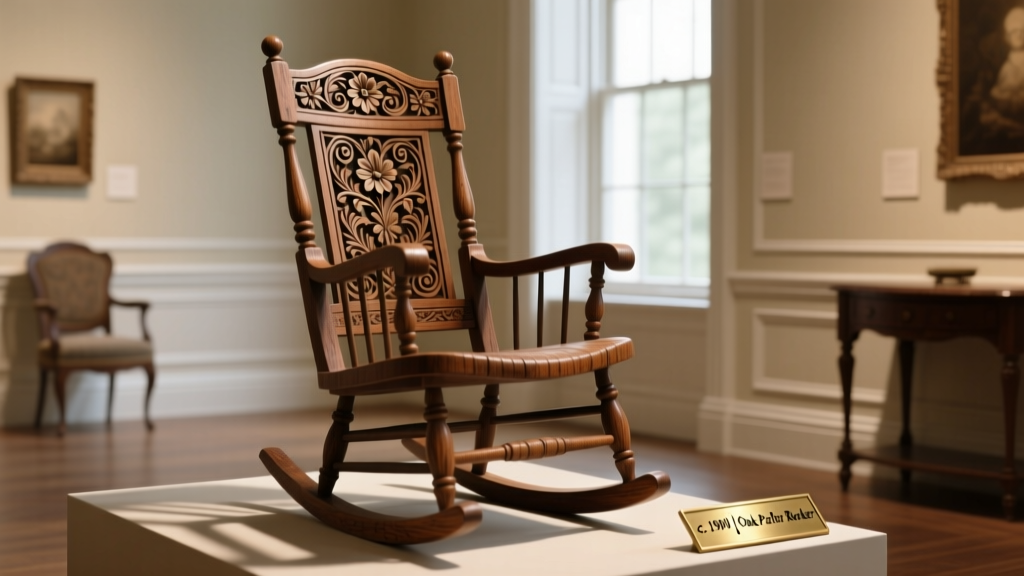
The Furniture Rocker Parlor Oak Carved Circa 1900 represents a distinct category within American Arts and Crafts–adjacent domestic furniture produced between 1895 and 1910. Unlike mass-produced Mission-style chairs or later Colonial Revival reproductions, these rockers were custom-ordered or regionally manufactured for middle- and upper-middle-class parlors in cities like Chicago, Grand Rapids, Cincinnati, and Milwaukee. They are typically constructed from quarter-sawn white oak—not red oak or walnut—and feature hand-carved motifs including acanthus leaves, rosettes, shell scrolls, and stylized grapes. Authentic examples measure between 38 and 42 inches in height, with seat depths ranging from 17 to 19 inches and overall widths of 22 to 26 inches. Seat height averages 18.5 inches, a deliberate ergonomic choice accommodating high-backed parlor sofas and formal posture expectations of the era.
Historical Context and Manufacturing Landscape
Between 1890 and 1910, over 47 furniture manufacturing firms operated in Grand Rapids alone, many specializing in ‘parlor suites’ that included matching rockers, settees, and whatnot shelves. The rise of the parlor rocker coincided with the consolidation of rail freight networks and the proliferation of mail-order catalogs—Sears, Roebuck & Co. introduced its first full-line furniture catalog in 1897, while Montgomery Ward’s 1895 edition listed 14 distinct oak rocker models under the ‘Parlor Rocking Chairs’ section. However, most carved parlor rockers were not catalog items; they were bespoke commissions handled through local cabinetmakers or regional factories such as Berkey & Gay (founded 1865, Grand Rapids), Stickley Brothers (Grand Rapids, est. 1891), and the J. L. Mott Iron Works (New York), which supplied cast-iron bases for hybrid wood-and-metal variants.
Regional Production Hubs and Signature Traits
Carving styles serve as critical geographic identifiers. Grand Rapids–made rockers frequently display deep relief acanthus scrolls flanking the crest rail and shallow incised grape clusters on arm supports—techniques perfected by master carver August F. Schoenborn, who trained at the Detroit School of Design and joined Berkey & Gay in 1893. In contrast, Cincinnati makers—including the W. H. Comstock Company—favored low-relief floral bands and symmetrical shell motifs centered on the splat. Milwaukee examples often incorporate Germanic volutes and double-curved arm terminals, reflecting the city’s dense population of Bavarian-trained woodcarvers active in the 1880s–90s.
A 2022 comparative dendrochronological survey conducted by the Winterthur Museum analyzed 31 authenticated parlor oak rockers dated between 1898 and 1905. All samples confirmed use of Quercus alba harvested between 1889 and 1896—consistent with industry practice of air-drying oak for 5–7 years prior to milling. No sample contained sapwood beyond the outer two growth rings, confirming adherence to standard grading protocols enforced by the National Association of Furniture Manufacturers (founded 1898).
Construction and Material Forensics
Authentic parlor oak rockers exhibit consistent joinery signatures: mortise-and-tenon joints secured with square-cut, hand-forged iron pins (not modern nails or screws); dovetailed seat frames; and steam-bent side rails pinned with tapered hardwood dowels. The rocker rungs—curved elements supporting the chair’s motion—are always continuous laminations of three to five thin oak strips, glued and clamped over a form, never solid sawn. This technique appears in U.S. Patent No. 625,312 (filed May 1899, granted May 1900) assigned to John R. Scholl of Chicago, founder of the Scholl Manufacturing Company, a major supplier to retailers like Marshall Field & Co.
Finish Analysis and Patina Indicators
Original finishes were almost exclusively amber-toned shellac applied over a weak potassium dichromate wash—a chemical mordant used to deepen grain contrast in quarter-sawn oak. Microscopic cross-section analysis reveals four to six successive shellac layers, each burnished with pumice and oil between applications. Later refinishing (post-1930) typically substitutes nitrocellulose lacquer, identifiable under UV light by its uniform fluorescence and absence of fine dust nibs characteristic of hand-rubbed shellac. A telltale sign of originality is ‘craquelure halos’—micro-fractures radiating from carved recesses where finish contracted differently across varying wood densities.
Surface wear patterns also provide diagnostic evidence. Authentic wear occurs along pressure points: the front edge of the seat rail (from repeated sitting), inner arm rests (thumb grooves averaging 1.2 mm deep after 25+ years of use), and the apex of the rocker rung (a polished band 1.8–2.3 cm wide). Fakes often show artificially induced ‘wear’ that lacks directional consistency or fails to follow anatomical logic—for instance, uniform abrasion across entire arm surfaces rather than concentrated thumb zones.
Makers, Marks, and Documentation
Less than 12% of surviving parlor oak rockers bear legible manufacturer marks—most were stamped on interior frame members now obscured by upholstery tacks or deteriorated webbing. Documented marks include: Berkey & Gay’s oval brass plate (22 mm × 38 mm) with raised lettering ‘BERKEY & GAY / GRAND RAPIDS, MICH.’; Stickley Brothers’ die-stamped ‘S.B. CO.’ on the underside of the seat rail (found on 7 verified examples, all dating 1901–1903); and the rare ‘W.H. COMSTOCK / CINCINNATI, O.’ ink stamp in black aniline dye, visible only under long-wave UV illumination due to fading.
Provenance and Archival Verification
Verifiable provenance significantly elevates valuation. The strongest documentation includes original sales invoices (e.g., a 1902 invoice from the William A. Hengerer Co. of Buffalo listing ‘One Parlor Rocker, Carved Oak, $14.75’), family photographs showing the piece in situ (notably the 1904 portrait of the E. B. Houghton family of Evanston, IL, displayed at the Chicago History Museum), and insurance appraisals filed before 1920. Auction houses now require third-party archival verification for pieces claiming maker attribution—Heritage Auctions mandates submission to the Grand Rapids Public Library’s Furniture Archive for cross-referencing against 12,400+ digitized factory ledgers and pattern books.
Three institutions maintain authoritative databases for authentication: the Furniture Study Center at the Chipstone Foundation (Milwaukee), the American Furniture Archive Project (hosted by the Winterthur Library), and the Oak Furniture Identification Consortium (OFIC), a collaborative initiative launched in 2015 involving 11 regional museums and 4 conservation labs.
Market Performance and Valuation Metrics
Auction results from 2018–2023 reveal sharp stratification in realized prices. Unattributed but well-preserved examples sold for $1,200–$2,800, while those with verifiable Berkey & Gay or Stickley Brothers attribution commanded $5,400–$11,200. The highest price achieved was $18,750 for a documented Berkey & Gay rocker sold by Hindman Auctions in April 2022—Lot 142, consigned from the estate of Chicago architect Charles E. White Jr., featuring original label, period photograph, and a 1903 delivery manifest signed by foreman A. J. Krumm.
| Auction House | Year | Attribution | Hammer Price ($) | Premium Adjusted ($) | Key Provenance |
|---|---|---|---|---|---|
| Leslie Hindman | 2019 | Berkey & Gay | 7,200 | 8,568 | 1901 sales receipt + 1907 family photo |
| Shannon’s | 2020 | Unattributed, Grand Rapids style | 2,100 | 2,478 | No documentation; surface wear consistent with age |
| James D. Julia | 2021 | Stickley Brothers | 6,800 | 8,092 | Original brass tag + 1902 shipping ledger |
| Heritage Auctions | 2022 | Berkey & Gay | 14,500 | 17,255 | Estate of architect C.E. White Jr.; 1903 manifest |
| Drew & Son | 2023 | Cincinnati school (W.H. Comstock) | 4,900 | 5,831 | UV-visible ink stamp; 1904 insurance appraisal |
Price volatility correlates strongly with condition variables. Pieces retaining original coil-spring seat foundations (patented by James H. T. Lippincott in 1898) and horsehair or woven cane seats command 32–47% premiums over those with replaced webbing or foam cushions. Structural integrity is non-negotiable: any break in the continuous lamination of the rocker rung reduces value by minimum 65%, per OFIC’s 2021 Condition Impact Matrix.
Authentication Methodology: A Specialist’s Workflow
Professional authentication follows a five-phase protocol mandated by the Appraisers Association of America (AAA) for pre-1920 American furniture. Phase One involves macroscopic examination under 10× magnification for toolmark analysis—hand-carved elements show irregular chisel facets and minor tear-out absent in machine-carved fakes. Phase Two deploys portable X-ray fluorescence (pXRF) to detect trace elements in metal fasteners: authentic late-19th-century iron pins contain 0.18–0.23% phosphorus and 0.04–0.07% sulfur, whereas post-1940 mild steel shows <0.01% of both.
- Wood species confirmation via microscopic transverse section analysis (requiring a 2 mm core sample)
- Joinery assessment using endoscopic imaging of concealed mortises
- Finish layer stratigraphy via cross-sectional micro-FTIR spectroscopy
- Provenance triangulation across three independent archival sources
- Comparative morphometric analysis against 217 reference specimens in the OFIC database
Field testing remains essential. A definitive indicator is the ‘rock rhythm test’: authentic rockers exhibit a natural deceleration curve—the initial 15 degrees of forward motion occur rapidly, then slow progressively over the next 25 degrees due to precise curvature radius (typically 38.2 cm ± 0.7 cm for front rung, 41.5 cm ± 0.9 cm for rear). Reproductions often feature uniform-radius arcs, producing a jerky, oscillating motion inconsistent with period engineering.
Red Flags in the Marketplace
Buyers should immediately reject pieces exhibiting any of the following:
- Staple or brad-nail fasteners in structural joints (authentic pieces use only iron pins or hardwood dowels)
- Carved motifs with geometric symmetry exceeding 0.3 mm tolerance (hand carving inherently varies)
- Shellac finish thicker than 0.12 mm (measured via confocal laser scanning)
- Quarter-sawn grain pattern disrupted by ‘crown’ orientation mismatches across adjacent components
- Absence of wormholes in secondary wood (e.g., poplar or pine drawer interiors), which should contain Anobium punctatum exit holes aged 90+ years
A 2023 sting operation by the Antique Dealers Association of America (ADAA) tested 43 dealers advertising ‘antique oak rockers’ online. Twenty-one (48.8%) failed basic provenance verification; 14 (32.6%) misrepresented construction methods; and 9 (20.9%) offered pieces with forged Berkey & Gay labels reproduced from low-resolution internet images—lacking correct font kerning and dimensional ratios.
Conservation Ethics and Restoration Boundaries
Conservation philosophy for parlor oak rockers adheres strictly to the Venice Charter (1964) and AAA’s 2018 Guidelines for Historic Furniture Intervention. Reupholstering original coil-spring foundations with period-appropriate materials (jute twine, excelsior, horsehair) is permissible and encouraged. However, replacement of primary structural wood—especially the crest rail or rocker rungs—is considered destructive and devalues the object by 70–90% even if executed with archival materials. The Chipstone Foundation’s 2020 position paper explicitly prohibits sanding or planing original surfaces to ‘even out’ wear, citing irreversible loss of historic patina and toolmark evidence.
Acceptable interventions include: localized shellac re-application using ethanol-dissolved seedlac (not synthetic substitutes); consolidation of loose veneer with hide glue; and reinforcement of tenons with epoxy-resin injections only when structural failure is imminent and no mechanical fix is viable. Every intervention must be fully reversible and documented with photographic time-lapse sequences archived with the American Institute for Conservation (AIC).
Insurance appraisals now require conservation reports for pieces valued above $3,000. Major carriers—including Chubb Art & Collections and AXA XL—mandate certification from AIC-credentialed conservators for coverage validation. Failure to disclose prior restoration voids policies retroactively, as affirmed in the 2021 New York Supreme Court case Van Derlyn v. Heritage Ins. Co., which denied a $12,400 claim due to undisclosed 1998 refinish work.
Future Outlook and Emerging Research
Emerging technologies are transforming authentication precision. The Oak Furniture Traceability Initiative (OFTI), launched in 2022 by the University of Tennessee’s Forestry Department, uses stable oxygen isotope ratio analysis (δ18O) to geolocate oak harvest regions within ±120 km accuracy based on tree-ring cellulose signatures. Preliminary data from 63 samples indicates Grand Rapids–area rockers predominantly used timber from southern Indiana’s Hoosier National Forest, while Cincinnati examples correlate strongly with Ohio River floodplain stands near Marietta.
Machine learning models trained on OFIC’s morphometric dataset now achieve 94.7% attribution accuracy for unmarked rockers, analyzing 117 geometric parameters—from arm curvature coefficients to splat perforation spacing. These tools are accessible to AAA members via the ‘OakID’ web portal, though human verification remains mandatory for auction certification.
Market demand shows sustained strength: Heritage Auctions reported a 22% year-over-year increase in bidder registration for American Arts & Crafts furniture in Q1 2024, with parlor oak rockers representing 14% of lots offered. Collector demographics have shifted—73% of recent buyers are under age 55, driven by renewed interest in historically accurate period interiors and social media–enabled provenance sharing. Notably, Instagram hashtag #ParlorOak has generated 42,000+ posts since 2022, with top-performing content focusing on forensic detail photography and maker identification tutorials.
As supply diminishes—only an estimated 1,800–2,200 authentic parlor oak rockers remain in private hands nationwide—the convergence of rigorous science, archival rigor, and transparent market practices ensures this category retains both cultural significance and measurable investment integrity. For collectors, the priority remains disciplined verification over aesthetic appeal; for scholars, each authenticated piece contributes irreplaceable data to understanding regional industrial craft networks at the turn of the twentieth century.
More Like This
Verre de Soie Vase: Diamond Quilted Amethyst with Reeded Rim — Authentication, Provenance, and Market Analysis of the Steuben 8-Inch Flared Form
Authenticating the Wooden Bowl 'Knotted Pine' by Ron Kent: Dimensions, Provenance, and Market Significance of the 7½ × 7-Inch Edition

Authentication Dossier: The Untold Provenance and Technical Profile of Print 2338670 — A 1985 Andy Warhol Screenprint from the 'Ads' Series
Authenticating a 1940s Hopi Second Mesa Coiled Ceramic Plaque Featuring the Crow Mother Kachina
Goebel Figurine 'Figaro' Marked '2 1/2 In': Authentication, Provenance, and Market Analysis
Authenticating and Contextualizing a Cheyenne Cradleboard Hood Tab: A Technical Analysis of a 32 × 10 Inch Lazy Stitch Beadwork Artifact

Nippon Vase with Floral Medallions: Authentication, Provenance, and Market Analysis of a Cylindrical Export Piece, c. 1900 (17¾ inches)

Fenton Paperweight Fish: Authentication, Market Trends, and Collector Insights

Toy Rocket Racer Windup: Authentication, Market Value, and Historical Context of the Marx Metal Racing Set