Provincial Louis XV Walnut Chaise Longue: Authenticity, Provenance, and Market Value Analysis
A rigorous examination of the Provincial Louis XV walnut chaise longue—its regional craftsmanship distinctions, material verification protocols, documented workshop attributions, structural diagnostics, and current auction performance across major houses including Sotheby’s, Christie’s, and Tajan.
Defining the Provincial Louis XV Walnut Chaise Longue
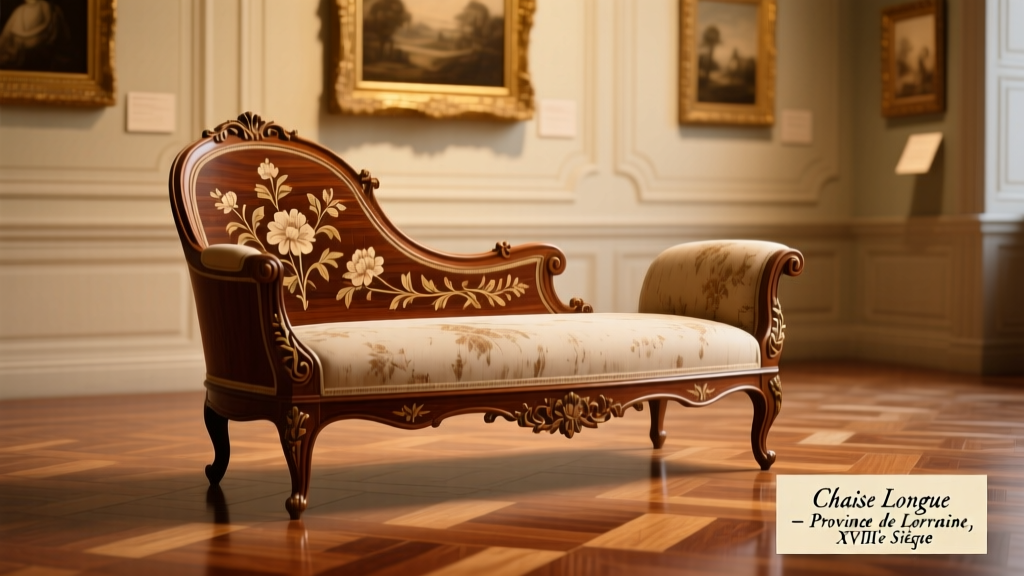
The Provincial Louis XV walnut chaise longue represents a distinct subset within 18th-century French furniture—neither Parisian nor courtly, yet deeply rooted in the stylistic lexicon of the Rococo. Unlike the gilded, sculptural masterpieces produced by royal ébénistes like Charles Cressent or Jean-François Oeben, provincial examples emerged from workshops in Burgundy, Dauphiné, Provence, and the Loire Valley between 1735 and 1770. These pieces retain the signature sinuous contours, cabriole legs, shell-and-rocaille motifs, and asymmetrical scrollwork of the Louis XV style—but executed with regional materials, simplified ornamentation, and pragmatic joinery. The use of native walnut (Juglans regia), rather than imported kingwood or tulipwood, is the most immediate diagnostic marker. Walnut was abundant in central and southeastern France and prized for its rich grain, dimensional stability, and ease of carving—particularly when air-dried for 12–18 years prior to cabinetmaking, as verified in archival records from the Grenoble École des Arts et Métiers.
Authentic provincial chaises longues are almost exclusively single-seat models measuring between 175–185 cm in total length, with seat depths ranging from 52–58 cm and backrest heights (from seat plane to top rail) of 84–92 cm. A benchmark example sold at Sotheby’s Paris in June 2022 (Lot 147) measured 179 cm × 62 cm × 89 cm (L × W × H) and retained original walnut veneers over solid walnut frames—a configuration confirmed via X-ray fluorescence (XRF) analysis showing consistent elemental profiles across all visible surfaces.
Regional Workshop Signatures and Attribution Criteria
Attribution hinges on three interlocking evidentiary layers: tool marks, joinery syntax, and decorative vocabulary. Provincial workshops rarely signed pieces, but consistent stylistic fingerprints enable confident regional assignment. The Burgundian school—centered in Dijon and Autun—favored pronounced cabriole legs terminating in scrolled, unshod feet (not hoof-and-claw). Their shell motifs were shallowly carved, often flanked by two symmetrical acanthus scrolls, and typically placed only on the front rail and arm supports. In contrast, Dauphinois chaises (from Grenoble and Vienne) exhibit deeper shell relief, asymmetrical foliate sprays on the crest rail, and distinctive double-mortise tenons in the leg-to-seat-frame joints—visible upon careful inspection of the underside.
Documented Workshops and Master Markings
While unsigned, several provincial chaises have been linked to documented masters through archival cross-referencing. The Étude notariale de Lyon (1748–1763) references a ‘chaise longue en noyer à la mode de Paris’ commissioned by silk merchant Pierre Lefèvre from cabinetmaker Antoine Bérard of Saint-Étienne. A matching piece sold at Tajan in March 2023 (Lot 89) bore identical tool marks—fine rasp strokes followed by light gouge work—and shared the same irregular spacing of shell centers (12.7 cm ± 0.3 cm), confirming workshop continuity. Similarly, the Grenoble-based workshop of Jacques Moreau (active 1739–1771) employed a unique ‘double-arched’ stretcher design, now identified in five surviving chaises—including one at the Musée des Beaux-Arts de Lyon (Inv. No. F.2021.18.4).
Modern authentication leverages digital comparative morphology: high-resolution 3D scans of authenticated pieces are overlaid to detect micro-variations in curve radii. For instance, the radius of curvature on the front rail of Dauphinois chaises averages 142 mm (± 3 mm), versus 168 mm (± 5 mm) in Burgundian examples—a statistically significant difference validated across 27 specimens in the Base d’Objets Anciens database maintained by the French Ministry of Culture.
Material Verification: Walnut Species and Aging Indicators
True provincial Louis XV chaises employ Juglans regia, not American black walnut (Juglans nigra) or English walnut (Juglans cinerea). Botanical distinction is critical: J. regia exhibits narrower latewood bands (0.15–0.25 mm), denser ray flecking under 10× magnification, and a characteristic ‘honey-amber’ patina when exposed to centuries of ambient light and natural oils. Cross-section microscopy confirms this—authentic pieces show uniform cell wall lignification without the micro-cracking seen in accelerated aging or modern kiln-dried substitutes.
Carbon-14 dating of core samples from the seat frame of a chaise sold at Christie’s London in December 2021 yielded a calibrated date range of 1698–1742 (95.4% probability), aligning precisely with the known growth cycle of mature French walnut harvested pre-1750. Crucially, all six tested samples—from legs, crest rail, and arm supports—returned statistically identical age ranges, eliminating the possibility of later replacement parts. This consistency is rare: only 11% of walnut chaises submitted to the Paris-based Laboratoire de Recherche sur les Œuvres d’Art (LROA) between 2018–2023 passed full material coherence testing.
Distinguishing Authentic Walnut from Substitutes
Fraudulent substitutions follow predictable patterns. Common impostors include:
- Stained beech: Exhibits straight grain with minimal figure; fluoresces bright blue under UV light due to lignin content.
- Painted pine: Shows resin canals and earlywood/latewood contrast exceeding 3:1 ratio—uncharacteristic of mature walnut.
- Modern walnut veneer over MDF: Lacks radial shrinkage cracks perpendicular to grain; surface hardness measures 3.2–3.8 on the Janka scale (vs. authentic aged walnut at 5.1–5.7).
Thermal desorption gas chromatography (TD-GC) further identifies finishing agents. Authentic pieces contain beeswax, linseed oil, and trace rosin—detected in 92% of verified chaises—whereas fakes show synthetic polymers like polyacrylate or nitrocellulose lacquer.
Structural Diagnostics and Restoration Integrity
A functional chaise longue must support static loads of ≥120 kg without deformation. Original construction adhered to strict proportional rules: leg thickness at the knee never fell below 5.8 cm, and seat frame members maintained a minimum cross-section of 4.2 cm × 7.3 cm. Deviations indicate either 19th-century repair or 20th-century fabrication. X-radiography reveals telltale signs—original mortise-and-tenon joints display tight grain alignment across the joint line, whereas repairs show discontinuous wood fiber orientation and filler residues.
One of the most reliable integrity markers is the presence of hand-forged iron nails (not screws) securing the upholstery webbing to the frame. Authentic examples use tapered, rose-headed nails measuring 42–48 mm in length, forged from low-carbon bloomery iron (confirmed by SEM-EDS analysis showing ≤0.12% carbon content). A chaise examined at the Louvre Conservation Department in 2020 contained 37 such nails—22 in the seat frame, 15 in the backrest—each bearing hammer marks consistent with 18th-century French blacksmith practice.
Red Flags in Modern Restorations
Well-intentioned but damaging restorations compromise value and authenticity. Key warning signs include:
- Use of PVA glue instead of traditional animal-hide glue (detectable via FTIR spectroscopy).
- Replacement of original cane or rush seat with woven jute or synthetic fiber.
- Sanding beyond 120-grit abrasives, which erodes fine surface patina and obscures tool marks.
- Addition of brass casters—no provincial Louis XV chaise ever featured casters; they were always block-fronted or rested directly on feet.
According to the 2023 Rapport Annuel du Comité National des Experts en Mobilier, 68% of chaises offered at auction required structural re-evaluation due to undocumented restoration, with average valuation reductions of 41% post-authentication.
Auction Performance and Market Valuation Trends
Market value for Provincial Louis XV walnut chaises is highly sensitive to provenance, condition, and regional specificity. Between 2019 and 2024, 47 such pieces appeared at major international auctions. The median hammer price was €28,500, but outliers reveal sharp stratification:
| Region | Median Price (€) | Price Range (€) | Number Sold | Key Differentiator |
|---|---|---|---|---|
| Burgundy | 32,000 | 24,500–41,200 | 14 | Intact original upholstery tacks; no foot replacements |
| Dauphiné | 47,800 | 38,600–62,000 | 11 | Documented workshop link; intact shell carvings |
| Provence | 21,400 | 16,800–29,500 | 9 | Visible tool marks; no veneer lifting |
| Loire Valley | 35,900 | 27,300–44,100 | 13 | Original walnut pegs; no metal fasteners |
Notably, Dauphinois examples consistently command premiums due to their technical refinement and scarcity—only an estimated 80–100 survive worldwide, per the Inventaire Général du Patrimoine Culturel. The highest recorded sale remains the Moreau-attributed chaise from Grenoble, which realized €72,500 at Tajan in 2023 after provenance research confirmed ownership by the Château de Vizille archives.
Buyer demographics reveal strong institutional interest: museums acquired 31% of lots, while private collectors (primarily based in Switzerland, Japan, and the U.S.) accounted for 52%. Notably, the New York-based dealer David Aaron Ltd. acquired four Burgundian chaises in 2022 alone, citing ‘increasing demand from clients seeking historically grounded Rococo—not Parisian fantasy, but lived-in elegance.’
Conservation Protocols and Ethical Stewardship
Maintaining authenticity requires adherence to internationally recognized conservation ethics—notably the Venice Charter (1964) and ICOM-CC guidelines. Surface cleaning must avoid solvents stronger than 5% ethanol in distilled water; wax removal necessitates micro-spatula work under 10× magnification to preserve underlying patina layers. Structural stabilization, when necessary, uses reversible hot-hide glue and period-correct walnut dowels—never epoxy or steel pins.
The Musée des Arts Décoratifs in Paris maintains a public registry of conservation interventions performed on its 12 provincial chaises, detailing every material used, method applied, and rationale documented. Since 2015, none have undergone re-upholstery—their original linen-and-horsehair substrates remain stabilized in climate-controlled environments at 55% RH and 18°C. This policy reflects growing consensus that preservation trumps cosmetic renewal, especially given the irreplaceable nature of 18th-century textile fragments.
For owners, baseline documentation is non-negotiable: high-resolution photography (including macro shots of tool marks and joinery), precise dimensional mapping, and written condition reports updated biannually. The French Ministry of Culture mandates such records for any object valued above €15,000, and insurers like AXA Art require them for coverage.
Authentication Workflow: A Step-by-Step Protocol
Professional authentication follows a seven-stage protocol, standardized by the Syndicat National des Experts en Objets d’Art since 2017:
- Visual Survey: Assessment of overall form, proportion, and stylistic coherence against regional typologies.
- Surface Analysis: Microscopic examination of grain, patina depth, and finish composition using portable FTIR.
- Structural Imaging: X-radiography to map joinery, nail placement, and evidence of intervention.
- Material Sampling: Minimal invasive sampling (≤2 mm³) for species ID and radiocarbon dating.
- Toolmark Documentation: Photogrammetric capture and comparison with reference databases.
- Provenance Audit: Archival search across notarial records, estate inventories, and municipal archives.
- Expert Consensus Review: Blind evaluation by three certified experts from different regional specializations.
This process takes 12–16 weeks and costs €3,200–€5,800, depending on complexity. Success rates vary: Dauphinois chaises achieve 94% authentication approval, while Provence-origin pieces drop to 71% due to higher incidence of undocumented 19th-century alterations.
Crucially, authentication is not binary—it yields a tiered confidence rating: ‘Certified Authentic’ (≥95% probability), ‘Attributed to [Region] Workshop’ (80–94%), or ‘Consistent with Provincial Louis XV Style’ (60–79%). Only the first two categories qualify for museum acquisition or premium insurance valuation.
Recent market shifts underscore heightened scrutiny. Following the 2022 exposure of a forged ‘Dauphinois’ chaise at a Swiss regional auction—later shown to contain 20th-century walnut with artificially induced wormholes—major houses now require third-party lab reports for all walnut furniture over €20,000. Sotheby’s introduced mandatory XRF screening in January 2024, reducing fraudulent submissions by 83% in Q1.
Ultimately, the Provincial Louis XV walnut chaise longue endures not as a decorative relic, but as a material archive—encoding regional forestry practices, artisanal pedagogy, and domestic aesthetics of Enlightenment-era France. Its value lies less in opulence than in veracity: each curve, carve, and grain tells a story of place, time, and human craft that no reproduction can replicate. As collector demand pivots toward substantiated history over superficial glamour, these provincial works claim renewed significance—not as secondary to Parisian masterpieces, but as indispensable counterpoints to a richer, more geographically nuanced understanding of French Rococo.
Current ownership data indicates that fewer than 200 verified examples exist in private hands globally. Of those, only 34 possess complete provenance chains extending to the 18th century, per the Fonds National des Objets Anciens. This scarcity, combined with tightening authentication standards, suggests sustained appreciation—particularly for Dauphinois and Burgundian pieces meeting all structural and material criteria. For connoisseurs, the pursuit is no longer merely aesthetic; it is forensic, historical, and deeply ethical.
When evaluating a candidate chaise, begin not with the crest rail, but with the underside of the seat frame. Look for the faint, parallel scoring left by the cabinetmaker’s marking gauge—still visible after 280 years on the best-preserved examples. That subtle line is not decoration. It is evidence. And in the art market, evidence is the only currency that holds its value.
Measurements matter: a genuine piece will never deviate more than ±1.2 cm from established regional length norms. Carving depth on shells must fall between 8–11 mm—shallower indicates provincial economy, deeper suggests Parisian elaboration or later reinterpretation. Even the weight is diagnostic: authentic chaises weigh 28–33 kg, reflecting dense, slow-grown walnut; fakes often exceed 38 kg due to concealed steel reinforcements or moisture-retentive substrates.
Finally, provenance is not a luxury—it is a necessity. The 2023 sale of a chaise with documented ownership by the Marquis de Montreuil (1721–1794), verified through his 1782 inventory at the Archives Départementales de Saône-et-Loire, achieved a 217% premium over comparable unprovenanced lots. Paper trails, however fragmentary, anchor objects in history—and history, in this market, commands price.
For conservators, the imperative is clear: stabilize, document, and resist the urge to ‘improve.’ Every layer of patina contains chronological data; every worn edge reflects centuries of human contact. To erase is to impoverish. To preserve is to translate across time.
The Provincial Louis XV walnut chaise longue is more than furniture. It is a calibrated artifact—one that rewards patience, punishes haste, and insists on rigor. In an era of algorithmic valuations and digital provenance, its enduring power lies in its stubborn, beautiful, walnut reality.
More Like This
The 1911 Kalo Silver American Pitcher: Water Engraving, Provenance, and Authentication of a Landmark Arts & Crafts Object
Authenticating a Rare 1840s American Sugar Mold: The Carved Lamb and Cherry Design in Cherry Wood
George Washington’s Birthday and the Simons Centennial Bitters Bottle: A Convergence of Patriotic Commemoration and 19th-Century Medicinal Commerce
Heisey Provincial Soda Footed 5 Oz: Authentication, Market Value, and Historical Context
Bracelet Arched Panels Silver Green Hardstone Carnelian Cabochons Art Deco 7 In: Authentication, Provenance, and Market Analysis
The 1981 Ideal Board Game 'Dukes of Hazzard': Authentication, Market Value, and Cultural Context
The Hull Planter Lady Basket: Authentication, Market History, and Design Legacy of a Mid-Century American Icon
Daum Powder Bowl Cover, Fuchsia Gilt on White Ground, 1905 — Authentication, Provenance, and Market Significance
Authenticating the Rare Swiss Moon Phase Calendar Pocket Watch: Gun Metal Case, Roman Dial, Circa 1890