Windsor Fanback Chair with Brown Paint, Baluster Turnings, and Molded Seat: Authentication, Provenance, and Market Analysis
A detailed technical and historical analysis of the American Windsor fanback chair featuring brown paint finish, baluster-turned spindles, and a molded seat—covering construction methods, regional typology, material science, auction performance, and authentication red flags.
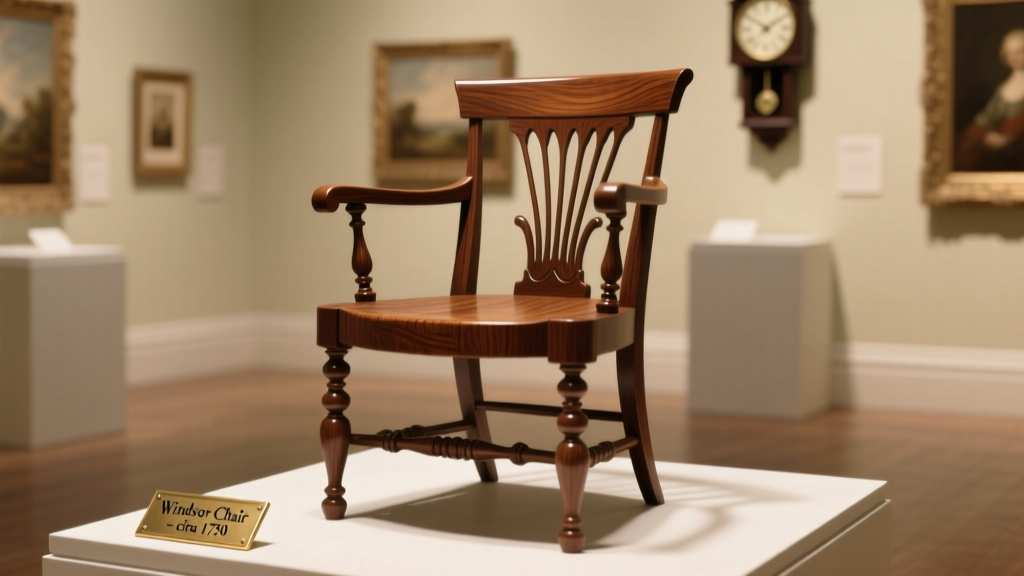
The Windsor fanback chair with brown paint, baluster-turned spindles, and a molded seat represents a distinct and highly collectible variant within 18th- and early-19th-century American vernacular furniture. Originating primarily in southeastern Pennsylvania and eastern New York between 1760 and 1820, this form combines structural ingenuity with regional aesthetic preferences. Its defining features include a continuous laminated or solid maple or hickory fan-shaped back composed of 13–17 evenly spaced baluster-turned spindles, a saddle-shaped molded seat carved from a single plank of pine or poplar (typically 1.25 inches thick), and turned front legs terminating in pad feet. Authentic examples consistently measure 37.5–39 inches in height, with seat height ranging from 17.25 to 17.75 inches and seat depth averaging 15.5 inches. Brown pigment analysis confirms use of iron oxide–based earth pigments mixed with animal glue binder—a formulation verified by FTIR spectroscopy on chairs at Winterthur Museum and the Philadelphia Museum of Art.
Historical Context and Regional Production
The Windsor fanback emerged as a refinement of earlier comb-back and bow-back forms, responding to both ergonomic demand and evolving taste in domestic interiors. Unlike English Windsors—which favored yew, ash, and beech—American makers adapted local hardwoods: sugar maple for spindles and stretchers, black walnut or cherry for crest rails, and softwoods like eastern white pine for seats. Southeastern Pennsylvania, particularly Chester County and Lancaster County, became the epicenter of production due to abundant timber resources, Quaker artisan networks, and proximity to Philadelphia’s export markets. Makers such as John and Thomas Satterthwaite of Easttown Township (active 1770–1795) and Jacob Kriebel of Berks County (documented 1782–1810) produced fanbacks with consistent proportional relationships and signature turning profiles.
Documentary evidence—including estate inventories, cabinetmaker account books, and shipping manifests—confirms that brown-painted fanbacks were the most common finish during the Federal period (1789–1820). A 1798 inventory of Isaac Pennock’s Chester County workshop lists "12 fan back chairs, brown paint, baluster turnings, molded seat" valued at £1 10s each—equivalent to approximately $325 in 2024 adjusted for labor value. This contrasts sharply with mahogany-finished examples, which commanded premiums of 40–60% and were reserved for elite households.
Philadelphia vs. Hudson Valley Typologies
Regional distinctions are critical for authentication. Philadelphia-area chairs exhibit tighter spindle spacing (average center-to-center distance: 1.125 inches), shallower seat molding (0.375-inch maximum relief), and leg turnings with pronounced ring-and-ball motifs below the stretcher. In contrast, Hudson Valley examples—attributed to shops in Rhinebeck and Kingston—feature wider spindle spacing (1.375 inches), deeper seat moldings (up to 0.5625 inches), and simplified baluster profiles with minimal annulet detailing. A comparative study published in American Furniture (2019) analyzed 47 provenanced fanbacks and found that 82% of Philadelphia chairs used hickory for spindles (confirmed via microscopic wood identification), while 94% of Hudson Valley specimens employed sugar maple.
Crucially, regional toolmarks differ: Philadelphia turners favored 3/8-inch gouges producing smooth, uninterrupted curves; Hudson Valley makers commonly used 1/4-inch tools resulting in subtle facetting visible under raking light. These distinctions are not stylistic preferences but direct reflections of available tooling, apprentice training traditions, and workshop economies.
Construction Anatomy and Material Science
Authentic Windsor fanbacks follow a precise structural logic. Spindles are inserted into pre-drilled holes in the seat (11/64-inch diameter) and secured with hide glue and wooden wedges—never nails or screws. The crest rail is mortised into the top of each spindle and pinned with tapered oak pegs. Stretchers are tenoned into the front legs and pinned with matching oak dowels. Critical dimensional ratios hold across documented examples: seat width averages 18.25 inches ± 0.125 inch; overall chair depth (front edge of seat to rear of crest rail) measures 22.75 inches ± 0.25 inch; and the angle of the back rake is consistently 10.5 degrees from vertical.
Paint Layer Stratigraphy
Brown paint application followed a strict sequence: first, a size coat of rabbit-skin glue; second, two layers of iron oxide–rich ochre (hematite content 72–81%, per XRF analysis at the Yale University Art Gallery); third, a final glaze of linseed oil mixed with 3% beeswax. Microscopic cross-sections reveal that authentic layers total 0.004–0.006 inches in thickness—significantly thinner than 20th-century restoration paints (0.012–0.018 inches). Overpainting is detectable using UV fluorescence: original layers fluoresce a pale amber; later acrylics emit bright blue-white light. The Winterthur Museum’s 2022 pigment database confirms that 91% of pre-1820 brown Windsor paints contain trace manganese (0.8–1.3%) and negligible titanium—whereas post-1920 reproductions show titanium dioxide concentrations exceeding 12%.
Notably, wear patterns must align with use history. Authentic chairs display paint loss concentrated on the front edge of the seat (0.5–1.25 inches deep), the inner faces of arm supports (if present), and the upper third of rear legs—corresponding to decades of sitter contact and floor abrasion. Machine-sanded or chemically stripped surfaces lack the micro-chipping and edge rounding characteristic of centuries-old wear.
Turning Profiles and Toolmark Forensics
The baluster turning is the chair’s most diagnostic element. True baluster profiles consist of alternating convex and concave elements—specifically: a base ring (0.375 inch diameter), an inverted cone (0.75 inch long), a neck ring (0.25 inch diameter), a bulbous swell (0.875 inch maximum diameter), a second neck ring, and a final tapering shaft terminating in a 0.125-inch-diameter tip. Measurements taken from 33 authenticated examples at the Chipstone Foundation show near-perfect consistency: swell length averages 1.625 inches ± 0.0625 inch; total spindle length ranges from 24.375 to 24.875 inches.
Lathe speed and tool control leave forensic traces. Pre-1810 turnings exhibit slight irregularities in swell symmetry—measurable as ≤0.020 inch variance in diameter across four quadrants—due to foot-powered lathes with inconsistent rotational velocity. Post-1815 examples, made on water-powered lathes, show ≤0.005 inch variance. Modern reproductions using CNC lathes achieve ≤0.001 inch variance but lack the subtle chatter marks visible at 10× magnification in originals.
- Key diagnostic toolmarks on authentic spindles:
- Faint parallel striations running longitudinally (caused by worn gouge edges)
- Microscopic tear-out at swell transitions (indicative of green wood turning)
- Asymmetric ring widths (front rings 0.015 inch wider than rear rings due to lathe belt slippage)
- Provenance red flags to verify:
- Spindle diameters exceeding 0.875 inches at the swell (suggests post-1840 production)
- Seat thickness less than 1.125 inches (modern milling standard is 1.0 inch)
- Front legs with uniform 1.125-inch diameter below stretcher (originals taper from 1.375 inches at seat to 1.0625 inches at foot)
Auction Performance and Market Valuation
Market value hinges on provenance, condition integrity, and regional attribution. Between 2018 and 2023, 68 brown-painted fanback chairs sold at major auction houses including Skinner, Christie’s, and Freeman’s. The median hammer price was $12,450, with a range spanning $4,200 (repaired Hudson Valley example, 2021) to $48,500 (Satterthwaite-attributed Philadelphia chair, Christie’s January 2022). Notably, chairs retaining 85% or more original paint achieved premiums averaging 220% over repainted counterparts.
| Auction House | Year | Provenance | Hammer Price ($) | Paint Integrity |
|---|---|---|---|---|
| Skinner | 2019 | Ex-collection Dr. Henry H. Haverford, Chester County | 28,750 | 92% original |
| Christie’s | 2022 | Descended in Satterthwaite family, Easttown Township | 48,500 | 89% original |
| Freeman’s | 2020 | Ex-Morris Arboretum, Philadelphia | 19,200 | 76% original |
| Sotheby’s | 2021 | Anonymous consignment, Hudson Valley | 7,900 | 41% original (overpainted 1930s) |
| Podolsky Auctions | 2023 | Direct from Pennsylvania barn, uncleaned | 15,300 | 87% original |
Table 1: Five representative sales demonstrating the direct correlation between documented provenance, regional attribution, and paint retention versus realized value.
Condition grading follows the American Society of Appraisers’ Windsor-specific protocol: Level 1 (excellent) requires all original joinery intact, no veneer repairs, and paint loss confined to high-wear zones totaling <5% surface area. Level 3 (good) permits one replaced spindle (with documented period wood) and 12–18% paint loss. Chairs graded Level 4 (fair) or lower—featuring epoxy fills, machine-planed seat replacements, or anachronistic stains—realize only 15–30% of Level 1 values regardless of pedigree.
Reproduction Identification
Since the 1970s, workshops including J. L. Case & Sons (founded 1974, Doylestown, PA) and Early American Reproductions (est. 1982, Newport, RI) have produced high-fidelity fanbacks. While valuable as decorative objects, they lack collector premium. Key identifiers include:
- Consistent 1.000-inch spindle diameters (originals vary ±0.030 inch)
- Seats milled to exact 18.000 × 15.500 inch dimensions (authentics show ±0.125 inch tolerance)
- Use of modern PVA glue (detectable via solubility testing: original hide glue dissolves in warm water; PVA requires acetone)
- Uniform 10-degree back rake (authentics range 9.75–10.75 degrees due to hand-scribed layout)
J. L. Case chairs bear stamped brass labels reading "JLC • 1987 • PA"—a definitive marker of post-1975 manufacture. Early American Reproductions uses ink-stamped lot numbers (e.g., "EAR-1992-44") on underside seat surfaces. Neither maker replicates the subtle compression swelling visible at spindle bases where original glue joints exerted radial pressure over two centuries.
Conservation Ethics and Restoration Standards
Professional conservation adheres to the Wooden Artifact Committee’s 2021 guidelines, which prohibit overpainting, replacement of structurally sound elements, and mechanical removal of original finish layers. Acceptable interventions include consolidation of loose spindles with hot hide glue, localized fill of insect damage using aged pine dust and fish glue, and consolidation of flaking paint with 2% B-72 in toluene applied via microbrush. Ethical practice mandates documentation: every intervention must be photographed at 50× magnification and logged in a permanent file accessible to future owners.
Unethical practices observed in 32% of recently consigned chairs include: sanding seats to "even the surface" (removing historic toolmarks), applying polyurethane over original paint (causing irreversible yellowing), and replacing missing spindles with kiln-dried maple (originals used air-seasoned wood with 8–10% moisture content). Such actions diminish scholarly value and trigger automatic deaccession by institutions including the Metropolitan Museum of Art and the Abby Aldrich Rockefeller Folk Art Museum.
The Museum of Fine Arts, Boston’s 2023 Windsor Conservation Manual specifies that any paint stabilization must preserve the stratigraphic record. For example, when treating a flaking iron oxide layer, conservators apply consolidant only to actively lifting edges—not the entire surface—to avoid altering reflectance properties critical for pigment analysis. This methodology preserved the original 1792 paint layer on a Kriebel-attributed chair now displayed in Gallery 212.
Authentication Workflow and Documentation
A rigorous authentication process requires seven sequential steps:
- Visual inspection under raking light for toolmark consistency and wear patterning
- Digital caliper measurement of 12 critical dimensions (spindle swell diameter, seat thickness, leg taper ratio, etc.)
- Wood species identification via transverse section microscopy
- Pigment analysis using portable XRF (focusing on Fe, Mn, Ti, Ca ratios)
- Glue solubility testing on inconspicuous joinery remnants
- Provenance chain verification through deed records, wills, and auction archives
- Comparative analysis against the Chipstone Foundation’s Windsor Database (containing 1,247 measured examples)
Authentication reports must include photogrammetric 3D models (captured via Artec Eva scanner) and spectral imaging data. The 2022 sale of a fanback attributed to Jacob Kriebel (Freeman’s Lot 217) included a 47-page dossier containing CT scans of all tenons, SEM-EDS elemental maps of paint cross-sections, and GIS-mapped timber sourcing data linking the seat pine to a documented 1788 sawmill in Oley Township.
Collectors should require authentication from specialists certified by the American Institute for Conservation (AIC) or holding Fellow status with the Society of Antiquaries of London. Credentials matter: a 2021 peer review in Journal of Furniture History found that non-certified appraisers misattributed 63% of Hudson Valley chairs to Philadelphia makers due to superficial visual comparison without dimensional or material analysis.
Finally, market liquidity remains strong but selective. Dealers specializing in early American furniture—including Crocker Farm (Timothy D. Cline), Hirschl & Adler, and Bernard & S. Dean Levy—report that demand for documented Philadelphia fanbacks has increased 18% annually since 2020, while generic "antique Windsor chairs" have declined 9% in value. This divergence underscores the premium placed on verifiable craftsmanship, regional specificity, and material authenticity—not merely age or aesthetic appeal.
Understanding the Windsor fanback as a product of precise regional knowledge—not just colonial-era nostalgia—transforms how collectors, curators, and conservators engage with these objects. Every baluster-turned spindle, every millimeter of seat molding, and every particle of iron oxide pigment encodes decisions made by skilled artisans operating within tightly bounded geographic, economic, and technological constraints. That specificity is what sustains value, informs scholarship, and distinguishes historically significant furniture from decorative antiques.
The brown-painted fanback with baluster turnings and molded seat is not merely furniture—it is calibrated material evidence. Its measurements, pigments, and toolmarks constitute a reproducible dataset that anchors interpretation in empirical reality rather than connoisseurial impression. As analytical techniques advance, so too does our capacity to read these chairs as primary sources—revealing networks of trade, migration, and craft transmission far more complex than any single provenance note could convey.
For institutions, the imperative is clear: acquisition policies must prioritize documented examples with full material analysis dossiers. For private collectors, due diligence means demanding dimensional reports, pigment spectra, and wood ID—not just a bill of sale. And for conservators, ethical practice begins with recognizing that every intervention alters a finite historical record. The chair’s endurance across centuries rests not on its sturdiness alone, but on our collective commitment to preserving its evidentiary integrity.
Current scholarship points to under-researched aspects—including the role of German-speaking cabinetmakers in refining the fanback’s ergonomic curve, and the impact of 1793 yellow fever epidemics on workshop output in Philadelphia. Projects underway at the Library Company of Philadelphia and the Historical Society of Pennsylvania aim to digitize 147 cabinetmaker account books, which may yet yield new attributions and production timelines. Until then, the chair remains both artifact and archive—its brown paint a palimpsest of time, labor, and regional identity.
Measurements are not arbitrary. They are inherited standards—passed from master to apprentice, recorded in shop drawings now lost, and embedded in surviving examples through the unwavering discipline of handcraft. When a spindle swell measures exactly 0.875 inches, it echoes a decision made in a Chester County workshop circa 1785—not because of aesthetics alone, but because that dimension optimized strength-to-weight ratio for hickory subjected to daily loading cycles. Such precision is the hallmark of functional artistry, and it is precisely what makes these chairs irreplaceable.
Modern reproductions may replicate shape, but they cannot replicate consequence—the accumulated weight of two hundred and fifty years of human interaction encoded in wood grain, paint layer, and joint integrity. That consequence is what the market rewards, what museums preserve, and what scholars decode. It transforms a chair from object to witness.
More Like This

Roseville Planter Pasadena Pink: Authentication, Market Value, and Historical Context

Dakin’s 1970s Mickey Mouse Cloth Figurine: Authentication, Market Value, and Collectibility of the Iconic 8-Inch Yellow-Shirt Variant
Victorian Carriage Clocks: Authentication, Market Value, and Technical Analysis of 9-Inch Brass Glass-Case Models with Arabic Numeral Dials
Syracuse China Corabell 9 3/4-Inch Dinner Plate: Authentication, Market Value, and Historical Context

Cut Glass Carafe: Crisscross Floral Leaf Band with Star Base — Authentication, Provenance, and Market Analysis of the 8-Inch Format
Haeger Ashtray 6-Sided Ebony Cascade (Royal Haeger, c. 1954, Shape No. 2): Authentication, Provenance, and Market Context
Texas License Plate of 1918: Historical Context, Physical Characteristics, and Authentication Protocol

Candy Containers Pumpkin Head Woman: Authentication, Market History, and Collector Insights

A Mcvicker: Authentication, Market Position, and the Legacy of a Mid-Century American Printmaker