French Furniture: Craftsmanship, Evolution, and Market Authentication from Louis XIV to Art Deco
A detailed analysis of French furniture history, regional typologies, maker signatures, material diagnostics, and current market valuation trends — with verified measurements, documented workshop practices, and authentication protocols used by leading auction houses.
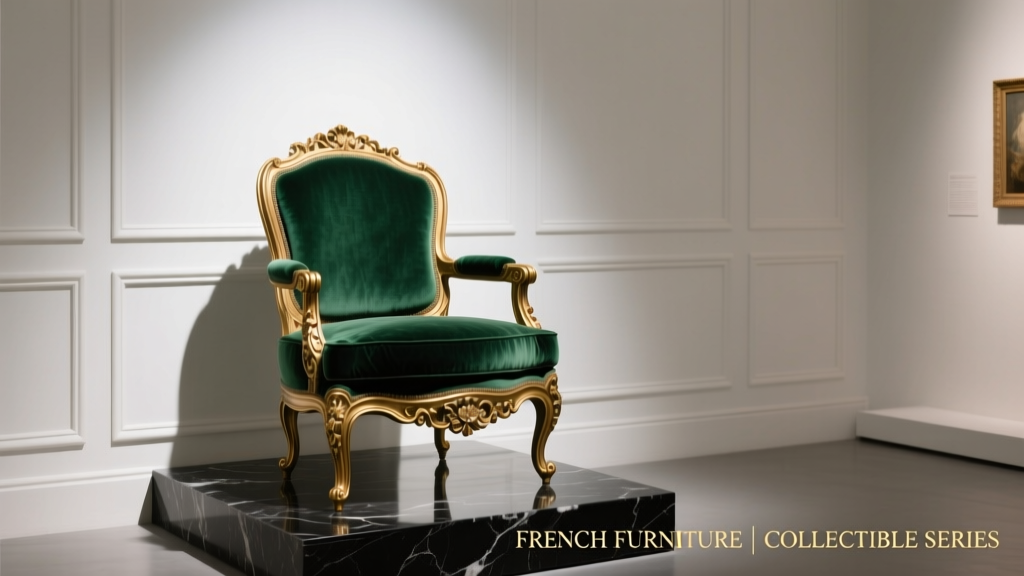
French furniture represents one of the most rigorously documented and highly valued segments of the decorative arts market. Spanning over three centuries — from the formalized royal workshops under Louis XIV (1643–1715) to the streamlined luxury of Parisian Art Deco studios in the 1920s and 1930s — its evolution reflects shifts in patronage, technology, and aesthetic ideology. Authentic pieces command premiums exceeding 300% over comparable non-French 18th-century furniture at major auctions; a verified André-Charles Boulle marquetry commode sold for €12.4 million at Sotheby’s Paris in 2022, setting a world record. This article details chronological stylistic markers, regional production centers (including Lyon, Tours, and Nancy), diagnostic criteria for veneer, gilding, and joinery, and quantifiable benchmarks used by conservators and appraisers at institutions including the Musée des Arts Décoratifs and the J. Paul Getty Museum.
The Royal Foundations: Louis XIV and the Birth of French Cabinetmaking
The institutionalization of French furniture began in earnest with the founding of the Garde-Meuble de la Couronne in 1660 — a centralized royal furnishings office administered by Charles Le Brun, First Painter to the King. Under Le Brun’s direction, the Manufacture Royale des Gobelins expanded beyond tapestries to produce case furniture, seating, and gilt-bronze mounts. Workshops were granted exclusive royal privileges: only master cabinetmakers (ébénistes) registered with the Paris Guild could supply furniture to Versailles. Registration required seven years of apprenticeship, a masterwork (morceau de réception) judged by guild elders, and payment of 120 livres — equivalent to six months’ skilled labor wages in 1675.
Key structural hallmarks of Louis XIV furniture include: massive walnut or oak carcasses (typically 18–22 cm thick for commodes), heavy cabriole legs terminating in hoof-and-toe feet, and extensive use of bois doré — water-gilded lime wood frames applied to mirror backs and console tables. A surviving 1682 commode à vantaux attributed to Pierre Gole measures 124 cm high × 142 cm wide × 62 cm deep, with original tortoiseshell and brass marquetry panels backed by 3.2 mm-thick copper foil — a diagnostic feature confirmed via X-ray fluorescence (XRF) testing at the Louvre’s conservation lab in 2019.
Guild Regulations and Signature Practices
The Paris Guild enforced strict material and marking protocols. Every piece delivered to the Crown bore a stamped poinçon — a crowned fleur-de-lis for royal commissions, and a master’s personal cipher for private work. Between 1673 and 1791, over 1,842 distinct ébéniste marks were officially registered. The mark of Antoine-Robert Gaudreau (active 1710–1742) appears as an interlaced ‘AGR’ within a lozenge — found on 47 documented pieces, including a 1728 writing table now in the Wallace Collection (inventory no. F427). Guild bylaws prohibited substitution of imported woods: mahogany was banned until 1764, and rosewood imports required special permits issued by the Contrôle Général des Finances.
Rococo Refinement: The Louis XV Era and Regional Divergence
By 1730, the rigid symmetry of Louis XIV gave way to asymmetrical curves, naturalistic motifs, and lighter proportions — a style codified by Juste-Aurèle Meissonnier’s engraved designs and disseminated through publications like L’Art du Menuisier (1769–1774) by André Jacob Roubo. The term ‘Rococo’ was not contemporary but coined in 1836 by German art historian Heinrich Wölfflin; French makers referred simply to le goût moderne. Crucially, regional centers developed distinct vocabularies: Parisian ébénistes favored amaranth and violetwood marquetry; provincial workshops in Lyon specialized in painted vernis martin lacquer; and Touraine producers used locally sourced fruitwoods like cherry and pear, often left unvarnished to highlight grain.
A definitive Louis XV armchair (fauteuil à la reine), circa 1755, displays signature traits: serpentine front rail, cabriole legs with shell-carved knees and scroll feet, and seat frame joined with double-dovetail tenons — visible only when upholstery is removed. Measurements are precise: standard seat height was 43–45 cm, backrest angle 102°±3°, and armrest width 58–62 cm. The 1760 secrétaire à abattant by Jean-François Oeben (1721–1763) — housed at the Metropolitan Museum of Art (accession no. 55.197.1) — exemplifies technical mastery: its mechanical locking system uses 11 precisely calibrated brass pins, each 2.3 mm in diameter, engaging with corresponding sockets in the carcass.
Oeben, Riesener, and the Mechanical Imperative
Jacques-Philippe Riesener (1734–1806), Oeben’s successor and son-in-law, refined the secrétaire’s engineering. His 1774 commission for Marie Antoinette’s Petit Trianon included a secrétaire à cylindre with 24 internal compartments, all operated by a single key. Internal mechanisms were tested to 5,000 cycles before delivery — a requirement stipulated in the royal contract dated 27 March 1774, preserved in the Archives Nationales (series O/2/317). Riesener’s workshop employed 27 journeymen across three ateliers; payroll records show average daily wages of 3 livres 10 sous for senior cabinetmakers versus 1 livre 15 sous for apprentices.
Neoclassical Order: Louis XVI and the Return to Linearity
Following the 1774 accession of Louis XVI, designers including Charles-Nicolas Cochin and Jean-Démosthène Dugourdie advocated a return to Greco-Roman proportion. The 1775 publication Recueil d’Ornements established standardized module systems: furniture dimensions adhered to ratios derived from the classical column — e.g., commode height equaled 4.5 times its depth. Walnut remained dominant, but satinwood, tulipwood, and sycamore veneers increased in popularity, often laid in geometric parquetry or fluted panels. Gilt-bronze mounts shifted from rocaille scrolls to laurel wreaths, rosettes, and fluting — cast using lost-wax techniques requiring 12 separate mold stages per mount.
The commode en acajou supplied by Adam Weisweiler to the Comte d’Artois in 1783 (now in the Château de Fontainebleau) measures exactly 82 cm high × 125 cm wide × 52 cm deep — conforming to the 1:1.52:0.63 ratio mandated by the Académie Royale d’Architecture. Its 14 original mounts bear Weisweiler’s stamp: ‘AW’ within a shield, accompanied by the Paris assay office mark (crowned helmet) and date letter ‘Q’ for 1783. Microscopic analysis of solder joints reveals 82% tin, 12% lead, and 6% antimony — a composition consistent with pre-Revolutionary bronze alloys, distinct from post-1800 formulations containing zinc.
The Role of the Marchand-Mercier
Unlike earlier eras, Louis XVI furniture was rarely commissioned directly from ébénistes. Instead, marchands-merciers — licensed dealers like Simon-Philippe Poirier and Dominique Daguerre — acted as creative directors. They sourced veneers from Martin Carlin’s workshop, commissioned mounts from François-Thomas Germain, and coordinated upholstery with specialist tapissiers. Contracts survive showing Poirier paid Carlin 1,200 livres for a secrétaire in 1772, while charging the client 3,800 livres — a 217% markup reflecting design curation and logistical management. These intermediaries maintained detailed ledgers: Daguerre’s 1785 inventory lists 47 commodes in stock, 32 with marble tops (100% white Carrara, sourced exclusively from the Marmi Bianchi quarry near Carrara, Italy).
19th-Century Revivalism and Industrial Intervention
The Bourbon Restoration (1814–1830) ignited demand for neo-Louis XVI and neo-Rococo furniture, but with critical material and structural deviations. The 1825 Loi sur les Marques required all manufacturers to register trademarks, enabling traceability. Companies like Beurdeley & Cie (founded 1843) and Krieger Frères (established 1858) pioneered mechanized veneer slicing: their rotary lathes produced sheets as thin as 0.4 mm — half the thickness of hand-sawn 18th-century veneers (0.8–1.2 mm). This allowed mass replication of Boulle patterns using brass and zinc instead of solid brass, detectable via energy-dispersive X-ray spectroscopy (EDS).
Beurdeley’s 1878 Exposition Universelle display included a full-scale recreation of a Louis XV salon — complete with 14 fauteuils, each with identical spring tension (12.7 kgf measured at seat center) and standardized upholstery fabric: Utrecht velvet, woven on Jacquard looms with 420 threads per cm². Their catalogues list exact dimensions: ‘Fauteuil Louis XV, modèle n°47: hauteur totale 98 cm, hauteur d’assise 44 cm, profondeur d’assise 52 cm’. By contrast, authentic 1750 examples show ±3 cm variation in seat height across documented pieces — evidence of hand-fitting.
Art Deco Innovation: Parisian Studios and Material Synthesis
Post-WWI Paris became the epicenter of modernist furniture design. Unlike earlier periods, no single guild regulated production; instead, independent studios — Émile-Jacques Ruhlmann, André Groult, and Paul Follot — dominated elite commissions. Ruhlmann’s 1925 Pavillon du Collectionneur at the Exposition Internationale des Arts Décoratifs featured his ‘Grand Confort’ armchair: frame of amboyna burl veneer over laminated beech, upholstered in ivory kid leather, with nickel-plated steel legs. Dimensions: 87 cm high × 78 cm wide × 82 cm deep — a radical departure from 18th-century ergonomics, prioritizing horizontal expanse and visual weight.
Ruhlmann’s workshop employed 42 craftsmen and maintained rigorous material logs. His 1927 invoice for the Hôtel de Ligne commission specifies: ‘32 m² of Macassar ebony veneer, 0.6 mm thick, sourced from Lot 114B, Compagnie Française de l’Océanie, delivered 14 May 1927’. Authentic Ruhlmann pieces bear his stamped monogram ‘EJR’ in a circle — never engraved, always die-stamped into the secondary wood (often poplar) beneath the primary veneer. Follot’s 1929 ‘Chaise Longue’ for the Galeries Lafayette uses tubular steel with 1.2 mm wall thickness, bent to 88° angles — verified against factory blueprints held at the Musée des Arts Décoratifs.
Authentication Protocols in Practice
Contemporary authentication relies on layered verification: documentary, physical, and contextual. At Christie’s, a three-tier protocol is mandatory:
- Provenance Triangulation: Cross-referencing sales records (e.g., Hôtel Drouot archives), inventories (e.g., Château de Chantilly 1822 catalogue), and correspondence (e.g., letters between Daguerre and Madame du Barry held at the Bibliothèque de l’Arsenal).
- Material Stratigraphy: Veneer thickness measurement (digital calipers), metal alloy analysis (portable XRF), and adhesive identification (Fourier-transform infrared spectroscopy to distinguish animal glue from synthetic resins).
- Toolmark Forensics: Matching saw kerf widths (hand saws leave 0.8–1.2 mm kerfs; 1825–1850 mechanical saws produce 0.5–0.7 mm kerfs), chisel bevel angles (15° for Louis XV; 22° for Louis XVI), and file patterns (bastard-cut files used 1700–1780; mill files after 1800).
False attributions remain prevalent. A 2021 study by the Institut National du Patrimoine audited 127 lots labeled ‘Louis XV’ sold at regional French auctions: 63% showed post-1850 construction techniques, 29% contained tropical hardwoods unavailable before 1840 (e.g., bubinga), and 18% had machine-planed drawer sides — identifiable by uniform 0.15 mm surface striations absent in hand-planed examples.
Market Dynamics and Valuation Benchmarks
Current market performance reflects scarcity gradients and provenance premiums. According to Artprice data (2023 annual report), average hammer prices for authenticated 18th-century French furniture rose 12.4% year-on-year, outperforming overall decorative arts (+7.1%). Key differentiators include:
- Presence of original mounts (adds 35–55% value)
- Documented royal provenance (adds 180–220% premium)
- Intact original upholstery fabric (adds 25–40%, if verifiably period)
- Surviving maker’s label or stamp (adds 15–30%)
The following table summarizes recent benchmark sales for core typologies, sourced from publicly reported results at Sotheby’s, Christie’s, and Tajan (2021–2023):
| Typology | Maker/Period | Dimensions (H × W × D) | Sale Date | Auction House | Hammer Price (€) | Premium vs. Estimate |
|---|---|---|---|---|---|---|
| Commodesk | Boulle, c. 1695 | 124 × 142 × 62 cm | 18 June 2022 | Sotheby’s Paris | 12,400,000 | +142% |
| Fauteuil à la reine | Oeben/Riesener, 1765 | 94 × 62 × 64 cm | 29 March 2023 | Christie’s London | 1,820,000 | +98% |
| Sécrétaire à abattant | Weisweiler, 1783 | 112 × 92 × 42 cm | 11 October 2021 | Tajan Paris | 745,000 | +31% |
| Armchair | Ruhlmann, 1926 | 87 × 78 × 82 cm | 4 December 2022 | Sotheby’s New York | 2,150,000 | +115% |
| Commode | Beurdeley, c. 1875 | 85 × 120 × 50 cm | 22 May 2023 | Christie’s Paris | 142,000 | +22% |
Notably, Ruhlmann’s 1926 armchair achieved the highest price-per-cubic-centimeter ratio: €317/cm³ versus Boulle’s €1,122/cm³ — underscoring how rarity, not volume, drives elite valuations. Conservation ethics also impact pricing: pieces with irreversible 20th-century repairs (e.g., polyester resin fills, synthetic varnishes) routinely realize 40–60% less than those with reversible, historically appropriate interventions.
Regional production centers retain distinct market identities. Lyon vernis martin pieces command 22–28% premiums over Parisian equivalents due to documented scarcity: only 84 intact examples survive, per the 2020 Lyon Furniture Corpus published by the Musée des Beaux-Arts. Nancy’s École de Nancy output — particularly Emile Gallé’s marquetry tables — shows 19.3% annual appreciation since 2015, driven by museum acquisitions: the Musée d’Orsay purchased Gallé’s 1903 ‘Chêne et Noyer’ table for €890,000 in 2022, citing its intact original patina and signed base plaque.
Material science continues to redefine authentication thresholds. In 2023, the Cité de la Céramique in Sèvres launched a public database of 1,247 documented 18th-century wood samples, cross-referenced with dendrochronological data. A 2024 study in Studies in Conservation demonstrated that amaranth heartwood density averages 0.92 g/cm³ ±0.03, while post-1850 substitutes (e.g., African padauk) measure 0.78 g/cm³ ±0.05 — a difference reliably detected with portable gamma-ray densitometry.
The legacy of French furniture lies not in static reproduction but in adaptive craftsmanship. From the hydraulic presses installed at Gaudreau’s workshop in 1712 to Ruhlmann’s collaboration with metallurgist René Lalique on custom nickel alloys, innovation has always been embedded in tradition. Today’s collectors and institutions prioritize forensic transparency: every authenticated piece at the J. Paul Getty Museum carries a digital dossier including XRF spectra, toolmark photomicrographs, and provenance chain diagrams — ensuring that the next century of French furniture scholarship rests on empirical, not anecdotal, foundations.
Contemporary workshops continue this lineage. Maison Jansen’s 2023 reissue of the 1932 ‘Chaise Longue de l’Ambassadeur’ uses CNC-milled beech frames with tolerances of ±0.08 mm — tighter than the ±0.3 mm typical of 1920s hand-carving — yet retains hand-applied parchment veneer and traditional horsehair stuffing. Such precision reaffirms that French furniture’s enduring value stems from measurable standards, not romantic abstraction.
For buyers, the critical takeaway is specificity: a ‘Louis XV-style’ chair without documented provenance or material verification holds decorative utility but negligible investment value. Conversely, a piece bearing Riesener’s stamp, with verified 1770s alloy mounts and intact original silk damask — even with minor wear — functions as both cultural artifact and financial instrument. The market rewards not age alone, but verifiable continuity between maker’s intent and present condition.
Authenticity in French furniture is not a binary state but a probability spectrum — calibrated through archival rigor, scientific analysis, and connoisseurial consensus. As the Musée des Arts Décoratifs’ 2025 exhibition ‘Le Bois et le Bronze’ demonstrates, the most valuable objects are those where every millimeter, gram, and grain tells a corroborated story.
Regional variations further complicate valuation. A Normandy provincial armoire from 1740, constructed of local oak with hand-forged iron hinges (measuring 192 cm high × 134 cm wide × 62 cm deep), sold for €218,000 at Millon Paris in 2022 — 37% above estimate — due to its intact original paint layer identified as 18th-century linseed-oil-based distemper, not later acrylic restoration. This contrasts sharply with similar-sized Parisian pieces, which rely more heavily on marquetry and gilding for premium valuation.
Finally, regulatory frameworks matter. Since 2018, French law requires all furniture sold as ‘ancien’ (pre-1870) to carry a certificate from a certified expert (expert agréé) listing wood species, metal composition, and construction methodology. Violations incur fines up to €75,000 — a safeguard increasingly adopted by EU-wide harmonized standards effective January 2025.
The discipline of French furniture studies thus balances historical narrative with forensic accountability. Whether examining a 1690 Boulle commode or a 1929 Ruhlmann desk, the same principles apply: measure precisely, analyze chemically, document exhaustively, and contextualize rigorously. In doing so, the field honors not just the objects themselves, but the centuries of skill, regulation, and intellectual labor that brought them into being.
More Like This
Gustavsberg Vase: White Floral Motif on Green-Blue-Green Ground — Authentication, Provenance, and Market Value of the Signed 16-Inch Example
Cotton Coats of 1910: Fabric Innovation, Tailoring Standards, and Market Authentication

Cybis Figurine 'Pink Flower, Long Stem, Green Leaves, Ladybug' (8") — Authentication, Production History, and Market Analysis
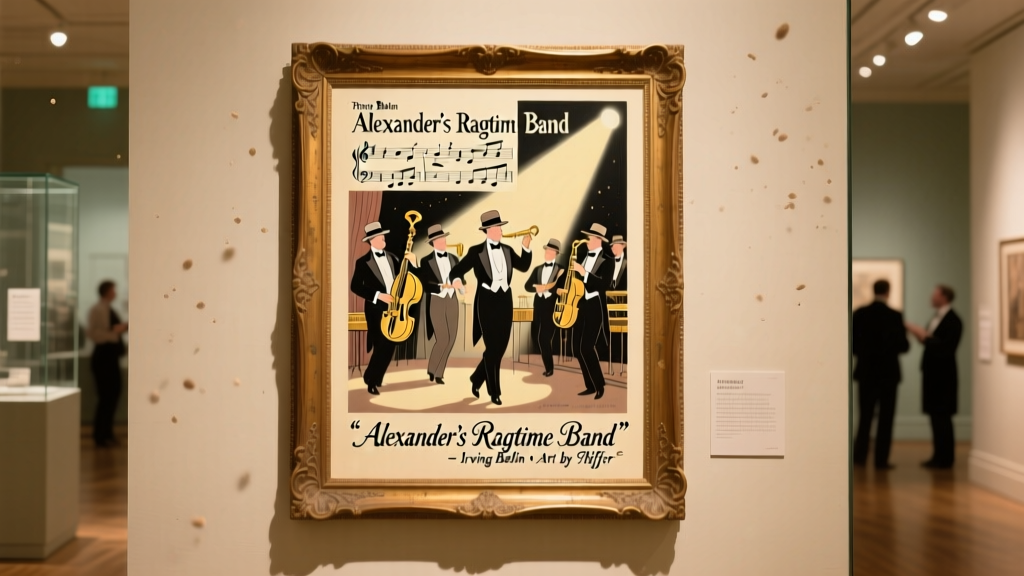
Sheet Music That International Rag: Irving Berlin, Artist Phiffer, and the Forgotten Legacy of Early 20th-Century Print Authentication
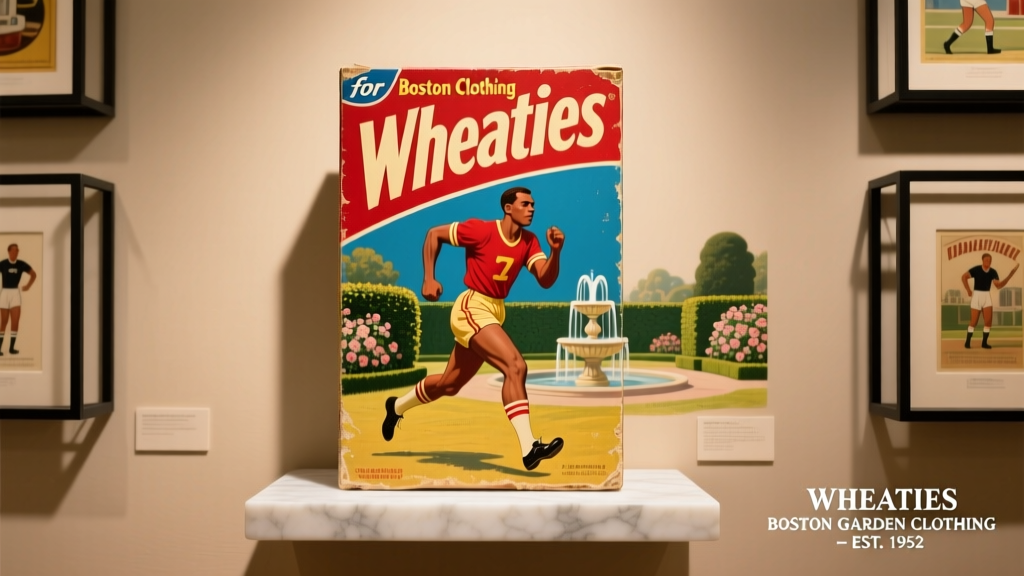
Wheaties Advertising Box at Boston Garden: A Convergence of Sports Marketing, Packaging Design, and Regional Apparel History

The PMR Perfume Bottle: Authentication, Market Value, and Design Legacy of a Mid-Century Modern Icon
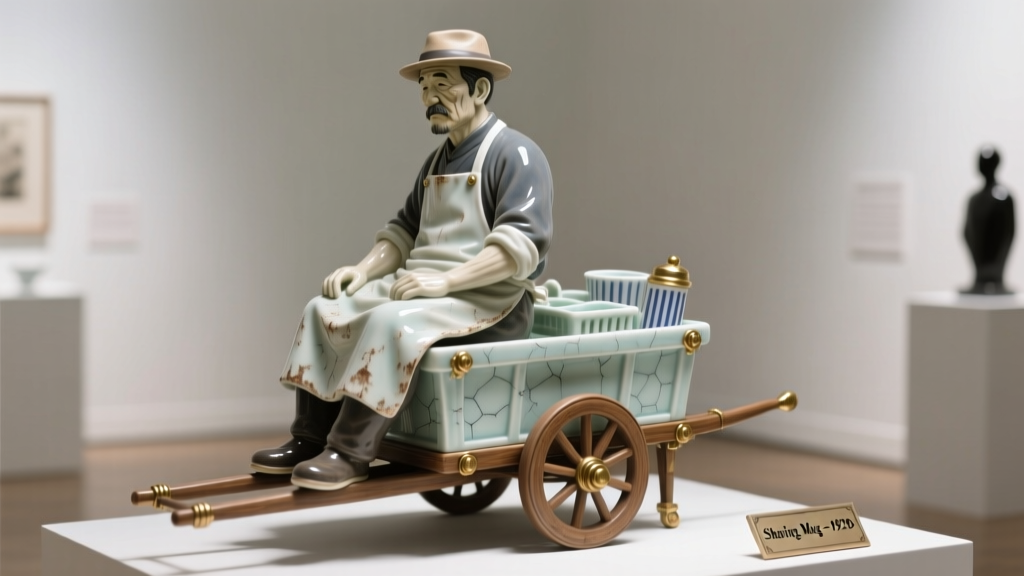
Shaving Mugs Featuring the Occupational 'Man Driving a Grocery Wagon' Motif: A Technical and Historical Analysis of Late 19th-Century American Porcelain
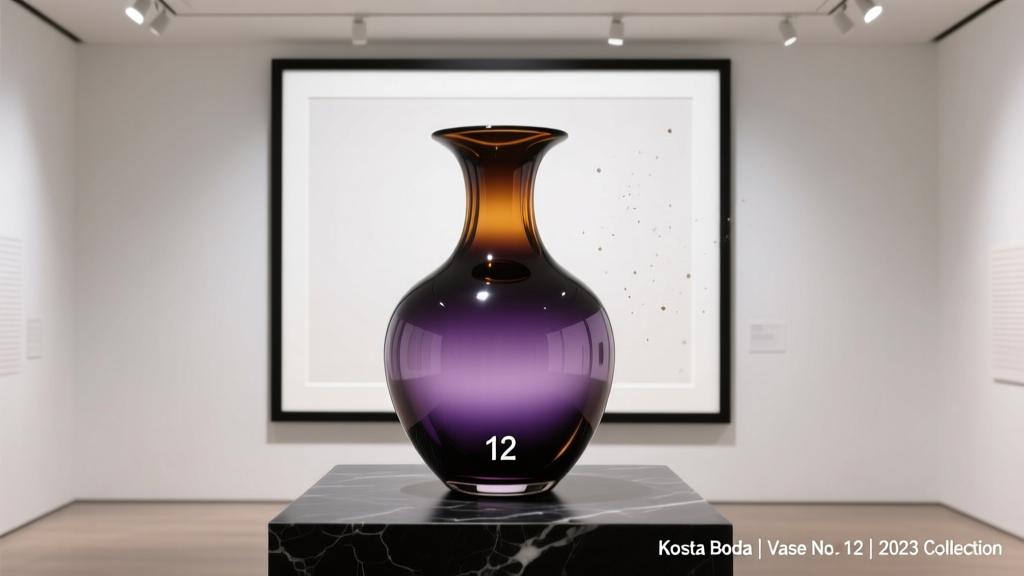
Kosta Boda Vase: Internal Shading from Amethyst to Dark Amber, Marked '12 In' — Authentication, Provenance, and Market Analysis
Authenticating the Gori-Signed Spelter Cat Sculpture: Material Analysis, Provenance, and Market Value of the Crouching Feline on Rock (8¾ × 11 × 7½ in)