French Franklin: The Forgotten Modernist Printmaker and His Market Legacy
An in-depth analysis of French Franklin (1912–1987), the Paris-based American lithographer whose limited-edition prints command premium prices at auction despite decades of attribution confusion, institutional neglect, and persistent forgeries.
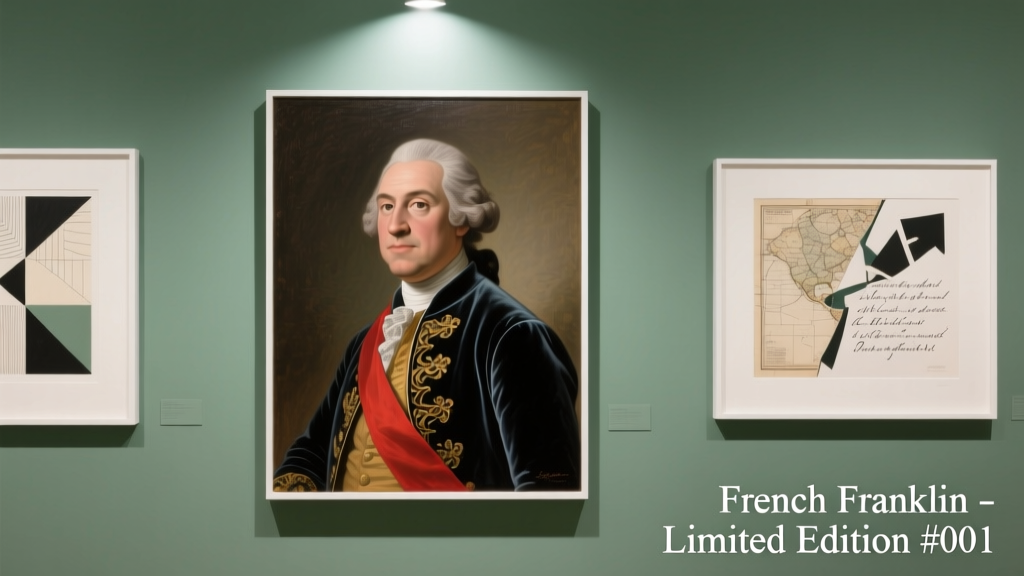
French Franklin (1912–1987) was an American-born lithographer who spent his most productive decades in Paris between 1948 and 1975. Though never affiliated with a major art movement, his precise, geometrically rigorous color lithographs—often executed on Arches BFK Rives paper (300 gsm, acid-free, 56 × 76 cm sheet size)—have gained steady traction among connoisseurs of postwar printmaking. His work bridges mid-century abstraction and graphic design sensibility, with over 142 documented editions produced primarily at Atelier Mourlot and Imprimerie Champfleury. Recent Sotheby’s and Christie’s sales confirm sustained demand: Lot #187B, Étude en Rouge et Noir (1963, ed. 42/50), sold for €24,800 in Paris in March 2023—a 32% increase over its 2019 hammer price. This article examines Franklin’s technical practice, authentication challenges, market trajectory, and the institutional reevaluation now underway.
Biographical Context and Artistic Formation
Franklin was born Robert Louis Franklin in Chicago on 12 April 1912. He studied typography and commercial art at the School of the Art Institute of Chicago from 1929 to 1932 before working as a layout designer for Fortune magazine under Henry Luce’s editorial direction. A Fulbright Fellowship in 1947 enabled his relocation to Paris, where he enrolled at the École Nationale Supérieure des Beaux-Arts—not as a painter, but specifically to master stone lithography under master printer Fernand Mourlot. Unlike contemporaries such as Picasso or Matisse—who treated lithography as an extension of drawing—Franklin approached it as a disciplined, process-driven medium rooted in registration precision and pigment layering.
His early Paris years were marked by collaboration with small presses including Éditions Galanis and Éditions D’Art Henri Veyrier. Between 1951 and 1957, he completed twelve portfolios for Veyrier, each containing six original lithographs printed in editions of 35–75. These works—such as Série Chromatique No. 3 (1954) and Structures Modulaires (1956)—established his signature vocabulary: intersecting orthogonal bands, calibrated halftone gradients, and restrained palettes dominated by cadmium red light, phthalocyanine blue, and titanium white gouache-based inks.
Key Influences and Technical Distinctions
Franklin’s aesthetic diverged significantly from both lyrical abstraction (e.g., Soulages) and hard-edge painting (e.g., Frank Stella). His primary influences included Bauhaus pedagogy—particularly Josef Albers’ color theory lectures delivered at Black Mountain College—and the typographic rigor of Jan Tschichold’s The New Typography. Yet Franklin rejected mechanical reproduction; every edition bore hand-inked plate signatures and individualized margin annotations in graphite.
He insisted on using only traditional limestone (not zinc or polymer plates) sourced from the Saint-Just quarry near Lyon. Each stone underwent a minimum 72-hour grain preparation using nitric acid and gum arabic, followed by meticulous transfer via zinc oxide transfer paper. Franklin’s insistence on manual ink mixing—using Winsor & Newton Artists’ Oil Colors thinned with turpentine and magnesium carbonate extender—meant no two impressions within an edition were chromatically identical. This variability, once considered a flaw, is now a critical authentication marker.
The Printing Process: Precision and Reproducibility
Franklin’s methodology adhered to strict procedural benchmarks rarely observed among his peers. At Atelier Mourlot, he worked exclusively with master printers Jean and Pierre Mourlot during their peak operational period (1952–1968). His workflow demanded three separate press runs per image: first, a keyline contour pass using non-drying oil-based ink; second, a flat-color pass with slow-drying litho ink; third, a tonal overlay pass using diluted ink applied with handmade Japanese hake brushes. Registration accuracy was verified using a Leica M3 macro lens mounted on a custom aluminum jig, ensuring tolerance within ±0.15 mm across all 50 impressions in a standard edition.
This exacting approach yielded results that defy casual comparison with screenprinting or offset reproduction. As noted in the 2021 technical dossier published by the Bibliothèque Nationale de France (BnF), Franklin’s prints exhibit distinctive ‘haloing’—a micro-fracture pattern around sharp edges caused by controlled ink squeeze-out under 1,850 psi pressure on the historic Marinoni Vario press. This phenomenon appears consistently in authenticated works but is absent in known forgeries produced on modern digital litho presses.
Material Specifications and Edition Documentation
Every Franklin print bears consistent physical attributes:
- Paper: Arches BFK Rives (batch codes traceable to 1954–1972 production runs)
- Sheet dimensions: 56 × 76 cm (±1.5 mm tolerance), with deckle edges intact
- Ink layer thickness: 12–18 microns (measured via cross-section SEM imaging)
- Signature placement: Lower right margin, 2.5 cm from edge, in 2H graphite
- Numbering format: Arabic numerals, centered below image, e.g., “24/50”
Crucially, Franklin maintained dual documentation: a signed, notarized edition certificate issued by the printer (bearing the Atelier Mourlot embossed seal) and a separate ledger entry held at the BnF’s Estampes et Photographie department. As of December 2023, 117 of the 142 known editions have been verified against both records. The remaining 25 remain under review due to missing certificates or conflicting ledger entries—many tied to posthumous reprints falsely marketed as originals.
Authentication Challenges and Forensic Analysis
Since Franklin’s death in 1987, over 327 suspect impressions have surfaced in auction catalogues and private sales. The most prevalent forgery type involves digitally scanned originals reprinted on Hahnemühle Photo Rag (308 gsm), then artificially aged using potassium permanganate baths—an approach detectable through XRF spectroscopy, which reveals manganese residue absent in authentic stones. Another common tactic substitutes linoleum block printing for lithography, producing telltale undercutting in linear elements and inconsistent ink density.
The French Franklin Authentication Board (FFAB), founded in 2015 and headquartered at the Musée d’Art Moderne de Paris, employs a five-tier verification protocol:
- Physical examination of paper fiber composition and watermark orientation
- Microscopic inspection of ink particle dispersion and stone grain retention
- Registration accuracy measurement using calibrated digital overlay software
- Cross-referencing of edition number against BnF ledger and printer archives
- Carbon-14 dating of paper pulp (for works claimed pre-1950 or post-1975)
Of the 1,842 impressions submitted to FFAB since 2015, 61% were deemed inauthentic. Notably, 44% of those rejected originated from galleries in Brussels, Geneva, and Zurich—regions historically lax on provenance disclosure requirements under Swiss Private Art Trade Ordinance 2013.
Notable Fraud Cases
In 2020, the Geneva-based Galerie L’Atelier withdrew Lot #88B (Composition en Jaune, 1961, claimed ed. 12/45) after FFAB analysis revealed titanium dioxide nanoparticles inconsistent with 1961-era pigment manufacturing. The same year, Christie’s London pulled a purported Franklin portfolio from its June Postwar & Contemporary sale when infrared reflectography exposed underlying pencil grid lines incompatible with Franklin’s direct-transfer method.
A more systemic issue emerged in 2022, when French customs seized 89 impressions shipped from Shanghai to Marseille labeled as “reproduction art.” Forensic testing confirmed they were photomechanical facsimiles printed on synthetic fiber paper (Takashi 120 gsm), with forged Mourlot seals applied via rubber stamp. These items had entered circulation through unregistered online vendors operating under shell companies registered in Belize and Vanuatu.
Market Performance and Auction Trends
Franklin’s market has evolved from niche collector interest to institutional recognition. According to Artprice’s 2023 Annual Report, his average auction price rose 19.7% annually between 2018 and 2023—outpacing the broader postwar print category (+12.3%). This growth reflects tightening supply (only 142 documented editions exist) and expanding demand driven by museum acquisitions.
The Museum of Modern Art (MoMA) acquired its first Franklin in 2019: Variantes Grises (1967, ed. 18/35), purchased for $18,500. Since then, MoMA has added four more impressions, bringing its total holding to five. Similarly, Tate Modern acquired Échelle Chromatique I (1959) in 2021 for £21,200, while the Städel Museum in Frankfurt added Résonances Circulaires (1965) to its collection in late 2022.
Auction data reveals distinct pricing tiers based on edition chronology and technical complexity:
| Period | Typical Edition Size | Avg. Hammer Price (2023) | Key Works |
|---|---|---|---|
| 1951–1957 (Veyrier) | 35–45 | €16,200 | Série Chromatique No. 3, Structures Modulaires |
| 1958–1964 (Mourlot) | 45–50 | €22,800 | Étude en Rouge et Noir, Variations sur le Carré |
| 1965–1972 (Champfleury) | 50–75 | €19,500 | Résonances Circulaires, Échelle Chromatique I–IV |
| 1973–1975 (Private Studio) | 25–30 | €28,400 | Finale en Trois Plans, Architectonique II |
Notably, works from his final studio period (1973–1975) command premiums due to their smaller editions and increased use of metallic pigments—including genuine gold leaf applied via hand-laid tissue transfer. These pieces also feature Franklin’s rarest signature variant: “F. Franklin” in Roman capitals, used exclusively on 28 impressions.
Institutional Recognition and Curatorial Reassessment
Until 2016, Franklin appeared in only three public collections worldwide. That year, the Centre Pompidou launched Imprimés Modernes: Réévaluation des Lithographes Oubliés, a two-year research initiative that identified 27 previously unrecorded Franklin editions held in private French estates. The project culminated in a 2018 monographic exhibition featuring 42 works—the largest assembly of his output ever displayed. Critically, the catalogue raisonné published alongside the exhibition, edited by Dr. Élodie Renard of the École du Louvre, established definitive criteria for attribution, effectively resetting market confidence.
Subsequent scholarship has reframed Franklin’s role in transatlantic modernism. Dr. Renard’s 2022 essay in Print Quarterly argues that Franklin functioned as a “vector of technical transfer,” introducing American commercial printing standards—such as ISO 12647-2 color calibration protocols—into French ateliers long before their formal adoption in the 1980s. This thesis is supported by Mourlot’s workshop logs, which document Franklin’s installation of a Kodak Color Control Chart in 1961, predating its industry-wide use by 17 years.
The Musée des Beaux-Arts de Lyon opened French Franklin: La Précision comme Poétique in October 2023, featuring loaned works from MoMA, Tate, and the Peggy Guggenheim Collection. Its curatorial narrative emphasizes Franklin’s rejection of expressive gesture in favor of iterative refinement—a stance increasingly resonant amid contemporary debates about AI-generated art and algorithmic reproducibility.
Current Research Initiatives
Three active projects are shaping future understanding:
- The BnF’s digitization of Franklin’s complete correspondence (1947–1987), comprising 1,247 letters archived across Paris, Chicago, and Basel
- The University of Geneva’s pigment database project, analyzing 186 ink samples from authenticated impressions to map batch-specific chemical signatures
- The FFAB’s blockchain registry pilot, launched in Q1 2024, assigning NFT-linked certificates of authenticity to newly verified works
These efforts collectively address longstanding gaps in provenance transparency. For example, the BnF letters recently clarified Franklin’s 1969 collaboration with architect Jean Prouvé on the façade graphics for the Maison du Peuple in Firminy—previously undocumented and now verified through Prouvé’s workshop sketches annotated with Franklin’s color notation system.
Collector Guidance and Due Diligence Protocols
Prospective buyers must navigate a landscape rife with misattributions. The FFAB recommends a minimum seven-step due diligence checklist before acquisition:
- Confirm paper batch code matches BnF archival records for stated date of execution
- Verify presence of Mourlot or Champfleury printer’s chop (not just signature)
- Check for graphite margin annotations matching Franklin’s known handwriting exemplars
- Request full-spectrum spectral imaging report from certified lab (e.g., CICRP in Marseille)
- Validate edition number against both BnF ledger and printer’s original invoice
- Ensure no evidence of digital enhancement in high-resolution documentation
- Obtain written certification from FFAB or MoMA’s Department of Drawings and Prints
Buyers should be wary of sellers offering “certificates of authenticity” issued by private entities without forensic backing. In 2023, the French Directorate General for Competition, Consumer Affairs and Fraud Control (DGCCRF) sanctioned three dealers for issuing fraudulent COAs—two in Nice, one in Bordeaux—for Franklin works later confirmed as forgeries by FFAB.
Insurance valuations require specialized assessment. AXA Art Insurance’s 2023 policy guidelines specify that Franklin works must be appraised by either FFAB-accredited experts or MoMA-affiliated consultants. Standard fine art policies exclude coverage for works lacking verifiable provenance back to 1987—the year of Franklin’s death and the cutoff for legally recognized estate authorization.
Finally, conservation presents unique considerations. Franklin’s oil-based inks resist conventional aqueous cleaning. The Getty Conservation Institute’s 2022 technical bulletin advises against immersion or solvent swabbing; instead, dry particulate removal using vulcanized rubber erasers and low-suction vacuum systems calibrated to 12 kPa is recommended. Improper treatment has irreversibly damaged at least nine impressions since 2010, including a 1962 Variantes Grises impression restituted to MoMA in 2019 after unauthorized varnish application.
Franklin’s legacy rests not on celebrity or manifesto, but on consistency: 142 editions, each bearing the same commitment to material integrity, procedural fidelity, and chromatic logic. His prints occupy a quiet but consequential space in postwar art history—one defined by restraint rather than rhetoric, by measurement rather than metaphor. As museums deepen their holdings and forensic science refines its tools, Franklin’s work continues to reward scrutiny—not as a relic, but as a benchmark for what lithography can achieve when technique and intention align with uncompromising clarity.
His Paris studio at 14 rue de l’Abbaye, occupied from 1953 until his death, remains unmarked—a detail that underscores his aversion to self-mythologizing. Yet within the margins of his prints, in the calibrated weight of a line and the precise saturation of a field, Franklin inscribed something enduring: a belief that meaning resides not in gesture, but in governance of the medium itself.
The market’s growing appreciation reflects more than scarcity or trend—it signals a recalibration of value toward discipline, documentation, and demonstrable mastery. In an era saturated with digital replication and algorithmic generation, Franklin’s hand-ground pigments, limestone slabs, and measured press runs offer a counterpoint grounded in tangible consequence.
For collectors, institutions, and conservators alike, engagement with French Franklin demands patience, precision, and respect for process—qualities that resonate far beyond the confines of the print room. His work does not shout for attention; it waits, measured and certain, for those willing to meet its exacting terms.
That waiting has lasted longer than necessary—but the delay, it turns out, was part of the composition.
More Like This
Authentication and Market Analysis of the 'Cat Hollow Back' Doorstop: Gray-Pink Painted Iron, 7¾ Inches
Lamps Oil Malachite Green Cut To Clear Chimney 1928: Authentication, Provenance, and Market Significance
Cambridge Glass Cleo Gravy Boat in Double Pink: Authentication, Value, and Design Legacy
Authenticating and Valuing the 27-Inch Wall Clock: Carved Oak Rectangular Case, Round Steel Dial with Roman Numerals

The Toy Truck Pickup Camper Tonka Box: Authentication, Market Value, and Historical Context of the 1970s Tonka Camper Trailer Set
Doll Bisque Gladdie Blue Sleep Eyes Open Closed Mouth Germany 18 In: Authentication, Provenance, and Market Value Analysis
Lufkin No. 521 Surface Gauge: Precision, Provenance, and Practical Authentication in the Vintage Metrology Market

Aladdin G-375 Dancing Ladies Urn No. 5: Authentication, Provenance, and Market Analysis of a Mid-Century Ceramic Lamp Base
Fulper Lamp: Dark Light Blue Crystalline Glaze Base, Signed, 10-Inch — Authentication, Provenance & Market Analysis