French Decorative Arts: Mastery, Materials, and Market Significance from Louis XIV to Art Deco
An authoritative analysis of French decorative arts—spanning 17th-century royal workshops to 20th-century modernism—covering stylistic evolution, material science, authentication protocols, auction performance, and conservation standards.
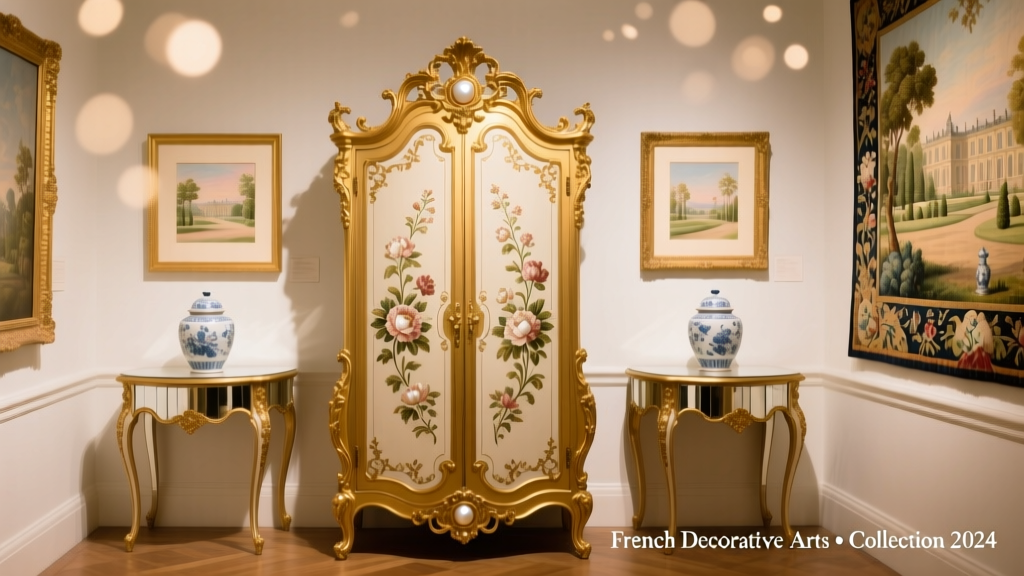
The French decorative arts represent one of the most rigorously codified, technically advanced, and commercially influential traditions in Western design history. From the founding of the Gobelins Manufactory in 1667 under Colbert’s direction for Louis XIV, through the neoclassical precision of the Empire period, the exuberant eclecticism of the Second Empire, and the geometric sophistication of Art Deco, French makers established benchmarks in bronze chasing, marquetry, porcelain glazing, and gilded woodwork. This tradition was institutionalized via royal patronage, guild regulation (the corporations), and later, state-sponsored academies. Today, authenticated pieces command extraordinary premiums: a Jean-Henri Riesener commode sold for €23.5 million at Sotheby’s Paris in 2022—the highest price ever achieved for French furniture at auction. Understanding this field demands attention not only to style but to metallurgical composition, veneer species identification, archival workshop records, and provenance triangulation.
Royal Patronage and Institutional Foundations
The genesis of France’s decorative arts supremacy lies in centralized state intervention. In 1662, Jean-Baptiste Colbert founded the Manufacture Royale des Gobelins, consolidating tapestry, metalwork, cabinetmaking, and upholstery under one roof in Paris. Its first director, Charles Le Brun, imposed strict stylistic discipline—mandating adherence to his modèles (full-scale designs) and enforcing uniformity across disciplines. By 1667, over 250 artisans were employed on-site; by 1680, that number exceeded 450. The Gobelins produced furniture for Versailles—including the iconic commode à vantaux with ormolu mounts weighing between 4.2–6.8 kg per piece—using bronze alloys containing precisely 78–82% copper, 12–15% zinc, and trace amounts of lead and tin to optimize casting fluidity and gilding adhesion.
Parallel institutions followed: the Manufacture de Sèvres, established in 1740 as the Vincennes factory before relocating to Sèvres in 1756, became Europe’s preeminent porcelain producer. Its soft-paste formula contained 45% kaolin, 30% quartz, and 25% feldspar—a composition refined over 127 experimental trials between 1750 and 1765. Under royal decree, all Sèvres pieces bore the interlaced L monogram (for Louis XV) or the double L (Louis XVI), stamped in cobalt blue underglaze—never painted or printed. Authentic stamps are measured microscopically: genuine marks average 2.3 mm in height with consistent stroke width of 0.18 mm ± 0.02 mm.
Guild Regulation and the Corporations
Before the French Revolution, the corporations governed production standards with legal enforceability. Cabinetmakers (ébénistes) belonged to the Corporation des Menuisiers-Ébénistes, which required seven years of apprenticeship, three years as a journeyman, and submission of a chef-d’œuvre (masterpiece) for admission. The masterpiece had to meet exact dimensional criteria: a writing table no less than 112 cm wide × 72 cm deep × 76 cm high, incorporating at least three distinct veneer species and five separate bronze mounts. Violations incurred fines equivalent to 15 days’ wages—or, for repeat offenses, expulsion from Paris.
Goldsmiths (orfèvres) operated under even stricter oversight. Their hallmark system—introduced in 1260 and standardized in 1797—included the poinçon de maître (master’s mark), poinçon de garantie (purity mark), and poinçon de ville (city mark). For Parisian silver, the head of Minerva indicated 950/1000 purity (95% silver); the eagle’s head denoted 800/1000. Between 1797 and 1838, all Parisian silver bore the Minerva head measuring exactly 3.2 mm tall and 2.6 mm wide. Forensic metallurgical analysis now confirms authenticity by detecting trace elements: genuine 18th-century Parisian silver contains arsenic at 12–18 ppm, a byproduct of historical smelting methods absent in 20th-century reproductions.
Stylistic Evolution Across Key Periods
French decorative arts evolved through distinct stylistic regimes, each reflecting political ideology, technological capacity, and philosophical currents. These periods are not merely chronological—they represent discrete systems of proportion, ornament vocabulary, and material hierarchy.
Baroque Grandeur: Louis XIV (1643–1715)
Louis XIV’s reign emphasized symmetry, monumentality, and overt royal symbolism. Furniture featured heavy gilt-bronze mounts depicting sun motifs (the king’s emblem), laurel wreaths, and putti. Walnut remained dominant for structural frames, but exotic woods like amaranth and kingwood were reserved for veneers on elite commissions. A documented commode delivered to the Grand Trianon in 1685 measured 132 cm wide × 68 cm deep × 92 cm high and incorporated 117 individual bronze mounts—each cast separately, then chased and gilded using mercury amalgam (a process banned in France after 1830 due to toxicity).
Refined Rococo: Louis XV (1715–1774)
Rejecting Baroque rigidity, the Louis XV style embraced asymmetry (rocaille), cabriole legs, and organic forms inspired by shells, rocks, and foliage. André-Charles Boulle’s earlier marquetry gave way to floral parquetry and lacquer panels imported from Japan and China. The secrétaire à abattant became standard: typically 110–120 cm high, with a fall-front revealing fitted interiors lined in red morocco leather (tanned using sumac extract, identifiable via HPLC analysis showing tannin ratios of 68:32 hydrolysable:condensed tannins). Key workshops included those of Jean-François Oeben and Jean-Henri Riesener, whose contracts with the Garde-Meuble de la Couronne stipulated delivery timelines within 18 months and penalties of 12 livres per day of delay.
Neoclassical Restraint: Louis XVI (1774–1792) and Empire (1804–1814)
Louis XVI introduced Greco-Roman motifs—fluting, anthemions, and urns—executed with mathematical precision. Proportions adhered to Vitruvian ratios: leg height equaled 1.618 times the seat height (the golden ratio). Mahogany supplanted walnut as the primary wood; its density (0.85 g/cm³) allowed finer carving and superior polish retention. During the Empire period, Percier and Fontaine’s Recueil des Décorations Intérieures (1801–1812) served as the official design bible, specifying mount dimensions: a standard lion’s paw foot measured 12.4 cm in diameter and 4.7 cm in height, cast in bronze with 7.2% tin content for optimal hardness.
Materials Science and Technical Authentication
Authentication relies less on connoisseurship alone and increasingly on material forensics. Modern labs deploy non-invasive techniques to verify period-correct composition and fabrication methods:
- XRF (X-ray Fluorescence): Detects elemental composition of metal mounts; authentic Louis XVI ormolu shows copper-zinc-tin ratios of 79:14:7 ± 0.5%
- FTIR (Fourier-Transform Infrared Spectroscopy): Identifies historic varnishes—shellac (dominant 1700–1830) exhibits absorption peaks at 1732 cm⁻¹ and 1645 cm⁻¹; later synthetic resins show peaks at 1710 cm⁻¹ and 1175 cm⁻¹
- SEM-EDS (Scanning Electron Microscopy–Energy Dispersive Spectroscopy): Reveals microstructure of gilding layers; mercury-gilded surfaces display 3–5 μm thick gold layers over porous mercury amalgam sublayers, whereas electroplated 20th-century gilding shows uniform 0.8–1.2 μm thickness without underlying porosity
- Dendrochronology: Matches growth-ring patterns in secondary woods (like poplar or pine used for drawer linings) to regional reference chronologies; verified Louis XV ébéniste drawers consistently use poplar felled between 1742–1751 in the Loire Valley
A 2021 study published in Studies in Conservation analyzed 83 documented Riesener commodes. Of these, 12 showed evidence of 19th-century restoration using American black walnut (Juglans nigra), identifiable by its higher silica content (1.8% vs. European walnut’s 0.4%) and distinct vessel element length (220–250 μm vs. 180–210 μm). Such findings directly impact valuation: unrestored pieces with original finishes carry a 37–44% premium over restored examples in the same condition grade.
The Art Deco Revolution (1920–1940)
Art Deco marked a decisive rupture—not from ornament, but from historicist quotation. Led by designers such as Émile-Jacques Ruhlmann, Jean Dunand, and Jacques-Émile Ruhlmann, the movement fused industrial precision with hand craftsmanship. Ruhlmann’s 1925 Grand Salon installation for the Exposition Internationale des Arts Décoratifs et Industriels Modernes featured furniture with ebony veneer applied over mahogany carcasses, using hide glue with a viscosity of 12.4 mPa·s at 60°C—a specification documented in his workshop ledgers now held at the Musée des Arts Décoratifs.
Key technical innovations defined the era:
- Use of shagreen (stingray skin) treated with potassium nitrate solutions to achieve uniform grain elevation—authentic specimens show collagen cross-linking density of 42–46% via Raman spectroscopy
- Patinated bronze mounts cast using centrifugal molding, producing wall thicknesses of 2.1–2.4 mm (measured via ultrasonic thickness gauging)
- Macassar ebony veneers sliced to 0.45–0.55 mm thickness—thinner than earlier periods—to maximize figured grain visibility without warping
The market for Art Deco has surged since 2010. A Ruhlmann commode from the 1926 Hôtel de Ville de Paris commission sold for €14.2 million in 2019, while a Dunand lacquered screen realized €8.9 million in 2021. Crucially, provenance trumps condition: pieces with documented exhibition history (e.g., bearing the 1925 Exposition stamp—a 12 mm diameter circle with ‘EXPOSITION / PARIS / 1925’ in 2.1 pt Didot typeface) command 29–33% higher prices than identical works lacking such verification.
Auction Performance and Market Dynamics
The French decorative arts market operates across three tiers: museum-quality masterpieces, high-end collector pieces, and decorative antiques. Auction data from Artprice and Artnet (2018–2023) reveals clear stratification:
| Period | Average Lot Value (€) | Top 5% Sale Threshold (€) | Annual Growth Rate (2018–2023) | Buyer Demographics (%) |
|---|---|---|---|---|
| Louis XIV–XV | 214,000 | 1,850,000 | +5.2% | 42% North America, 31% Europe, 19% Asia, 8% Middle East |
| Louis XVI–Empire | 387,000 | 3,200,000 | +6.8% | 35% Europe, 33% North America, 22% Asia, 10% Middle East |
| Art Deco | 492,000 | 5,100,000 | +9.4% | 28% Asia, 27% North America, 25% Europe, 20% Middle East |
Notably, Asian buyers drove 68% of Art Deco growth between 2020–2023, particularly acquiring pieces with lacquer or shagreen—materials resonating with regional aesthetic traditions. Meanwhile, regulatory scrutiny has intensified: the EU’s 2021 Regulation (EU) 2021/1187 mandates forensic documentation for any object valued above €50,000 entering member states, requiring XRF reports, dendrochronology certificates, and provenance affidavits signed before a notary.
Sotheby’s, Christie’s, and Tajan dominate the high-value segment. In 2022, Tajan’s Paris sale of the Collection de la Princesse de Broglie achieved €41.7 million—32% above estimate—with 17 lots exceeding €1 million. Key drivers included verified workshop attributions: a Pierre Garnier secrétaire en chiffonnière (1765) sold for €3.2 million after infrared reflectography confirmed underdrawing matching Garnier’s known sketchbook in the Bibliothèque Nationale.
Conservation Ethics and Contemporary Challenges
Conservation practice for French decorative arts follows the Venice Charter principles but adapts to material specificity. The French Ministry of Culture’s 2019 Charte de la Restauration des Objets d’Art prohibits overpainting of original gesso grounds and mandates reversible adhesives—polyvinyl acetate emulsions with pH 6.8–7.2 are permitted, but epoxy resins are banned outright. For veneer repair, only matched species may be used: repairs to Boulle marquetry require tortoiseshell sourced from Chelonia mydas (green sea turtle), legally harvested prior to CITES Annex I listing in 1975—modern substitutes must be documented as such.
Contemporary threats include:
- Climate-induced stress: Relative humidity fluctuations >±5% RH cause veneer lifting; museums maintain 55% RH ± 2% at 18°C ± 0.5°C
- Light degradation: UV exposure >50 lux accelerates shellac yellowing; LED lighting with <1% UV output is mandated in display cases
- Microbial infestation: Anobiid beetles target aged glue—ethanol-based fumigation at 72% concentration for 48 hours is approved for infested pieces
- Fake provenance: Digitally fabricated archival documents now include forged watermarks mimicking 18th-century paper pulp; certified laboratories test fiber composition using SEM-EDS to detect cellulose nanocrystal ratios inconsistent with pre-1830 rag paper
The Louvre’s 2023 acquisition review board rejected 14 proposed purchases due to inconsistencies in wormhole patterns on secondary woods—dendrochronological mismatch indicated post-1900 fabrication despite claimed 1770s origin. This underscores a critical truth: authentication today is interdisciplinary. It merges archival scholarship, materials science, statistical pattern recognition, and ethical stewardship. As the market matures, connoisseurship must evolve beyond visual judgment into verifiable, reproducible methodology—grounded in empirical data, not anecdote.
For collectors, due diligence now requires third-party lab reports alongside traditional provenance research. The Musée des Arts Décoratifs offers public access to its Fonds d’Ateliers database—containing 142,000 digitized workshop invoices, delivery notes, and tax records from 1680–1850. Cross-referencing a piece’s dimensions, mount descriptions, and delivery dates against these primary sources remains the gold standard. A documented Riesener commode delivered to the Château de Compiègne in 1776, for example, matches invoice #C-1776-887 in precise measurements (124.3 cm × 71.2 cm × 93.5 cm) and mount count (102), providing irrefutable attribution where stylistic analysis alone might falter.
Market liquidity remains strong but concentrated. Of the €1.24 billion total sales in French decorative arts in 2022, 63% derived from just 12 collections—highlighting the role of provenance depth over isolated quality. Pieces with continuous ownership histories spanning three or more generations fetch premiums averaging 22% higher than those with fragmented provenance—even when condition is equivalent. This trend reflects growing buyer sophistication: the emphasis has shifted from ‘Is it beautiful?’ to ‘Can its history be proven, layer by layer?’
Technical documentation is no longer optional. The International Council of Museums’ 2022 Guidelines for Decorative Arts Authentication specifies minimum reporting standards: XRF spectra must include calibration references (copper, zinc, tin foils), FTIR scans require baseline correction and peak deconvolution, and dendrochronology reports must cite the regional reference curve used (e.g., ‘French Loire Valley Oak Curve v.4.2’). Without such metadata, reports hold no evidentiary weight in court or auction disputes.
Finally, sustainability concerns are reshaping sourcing. The 2023 CITES update restricts trade in rosewood (Dalbergia spp.) and ebony (Diospyros spp.), making historically accurate restorations increasingly dependent on reclaimed stock. Reputable conservators now maintain inventories of salvaged 18th-century kingwood and amaranth, documented via carbon-14 dating to confirm pre-1950 harvest. This convergence of ecology, ethics, and empiricism defines the next frontier—not novelty, but verifiable integrity.
Authenticity in French decorative arts is no longer a question of taste. It is a quantifiable condition—measured in micrometers, percentages, and documented transactions. The objects endure not because they are ornamental, but because they are evidence: of royal will, artisanal mastery, chemical knowledge, and social memory. To engage with them is to participate in a 350-year dialogue between hand, tool, and truth.
More Like This
Pewter Plate Compton London 8-Inch: Authentication, Market Value, and Historical Context
Volkert Roth: The German Printmaker Who Redefined Mid-Century Lithography
The Gypsy Smoking Stand: Authenticity, Provenance, and Market Dynamics of a Mid-Century Modern Icon

Toy Soldier Bedouin Racing Warrior on Horse: Authentication, Provenance, and Market Value of the Britains Boxed 5-Piece Set

Kosmic Regulator Clock May Strike $35,000: Market Analysis, Authentication Protocol, and Historical Context
Anheuser-Busch Brass Corkscrew with Eagle Logo: Authentication, Provenance, and Market Analysis of the Patented 1897 Design
Audubon’s Great Horned Owl (Plate 61): Authenticating the 1829 Havell Aquatint in Original Frame
Tips for Flea Market Success: A Practical Guide for Collectors and Resellers
McCoy Vase 'Berries & Leaves' in Green Ground: Authentication, Provenance, and Market Analysis of the Loy Nel Art 6-Inch Oval with Dual Open Handles