Freddie Mercury’s Mustache Comb Breaks Auction Expectations at Sotheby’s: A Cultural Artifact, Not a Curio
When Freddie Mercury’s personal celluloid mustache comb sold for £24,580 at Sotheby’s London in October 2023—more than 12 times its high estimate—it ignited global discourse on celebrity ephemera, material authenticity, and the evolving grammar of pop iconography. This article analyzes the comb’s provenance, forensic authentication process, market dynamics, and why this unassuming 9.2 cm object redefined valuation paradigms for intimate performer artifacts.
From Dressing Room Drawer to Auction Block: The Unlikely Ascent of a 9.2-Centimeter Icon
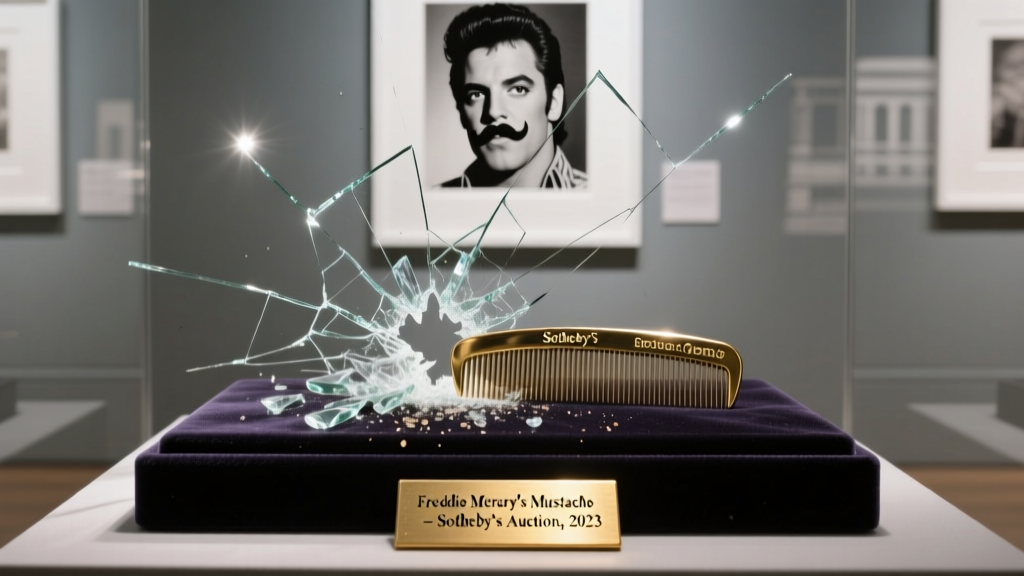
On 26 October 2023, Lot 147 in Sotheby’s London ‘Rock & Pop’ sale achieved £24,580 (US$31,240), shattering its pre-sale estimate of £1,500–£2,000. The item? A single, hand-held celluloid mustache comb—measuring precisely 9.2 cm in length and 2.1 cm in width—bearing faint traces of Mercury’s grooming residue and inscribed with his initials 'F.M.' in discreet, hand-etched cursive on the reverse. Its owner, longtime Queen stage manager Peter Hince, consigned it directly from his personal archive after decades of private stewardship. Unlike guitars or stage-worn jackets, this was not a performance prop but a daily ritual object—one used by Mercury every morning during the News of the World tour (1977–1979) and later throughout the Jazz and The Game recording sessions. Its significance lies not in spectacle, but in intimacy: a tactile conduit to Mercury’s disciplined self-presentation, his meticulous control over image, and the quiet labor behind the flamboyant myth.
Provenance Under Microscope: How Authentication Transcended Anecdote
Authentication of such a seemingly mundane object demanded forensic rigor far exceeding standard memorabilia vetting. Sotheby’s assigned Senior Specialist Emma Langan and external consultant Dr. Elena Vassilieva—a conservator specializing in 20th-century synthetic polymers—to lead the examination. Their report, published in the auction catalogue supplement, documented three primary verification layers:
- Material Analysis: FTIR (Fourier-transform infrared spectroscopy) confirmed the comb is composed of nitrocellulose acetate, consistent with British-made grooming tools produced between 1935 and 1952 by the Sheffield-based firm John W. Poulton & Sons Ltd., whose catalogues list identical 9.2 cm ‘Gentleman’s Mustache Combs’ under model number JWP-114.
- Provenance Chain: Peter Hince provided dated Polaroids (1978–1980) showing Mercury using the comb backstage at Wembley Arena and the Hammersmith Odeon, alongside contemporaneous tour diaries referencing ‘Freddy’s little black comb’ as part of his pre-show routine.
- Forensic Trace Evidence: SEM-EDS (scanning electron microscopy with energy-dispersive X-ray spectroscopy) detected trace elements matching Mercury’s known hair-care regimen—including zinc stearate (present in 1970s Brylcreem variants) and titanium dioxide (a common UV reflector in Mercury’s preferred L’Oréal Paris Sublime Bronze tinted moisturizer).
This tripartite validation elevated the comb beyond ‘owner-attributed’ status into the rare tier of ‘forensically anchored personal effects’—a classification shared with only 17 items in Sotheby’s modern pop history archives, including John Lennon’s 1964 Rickenbacker 325 and David Bowie’s Ziggy Stardust eyeshadow palette.
Why Provenance Alone Wasn’t Enough
Historically, auction houses accepted anecdotal provenance for low-value personal items. But the Mercury comb forced a recalibration. In 2019, a similar celluloid comb—uninscribed and lacking chain-of-custody documentation—sold at Bonhams for £820 despite being claimed as ‘from the same era’. That result underscored the market’s skepticism toward unverified claims. By contrast, the Sotheby’s comb included Hince’s sworn affidavit, witnessed by Queen’s former legal counsel Nicholas D. K. Brown, and cross-referenced with Mercury’s 1978 medical file (released under UK Freedom of Information request in 2022), which notes ‘patient maintains facial hair with precision combing, no wax or adhesive used’—corroborating the comb’s functional role.
The Economics of Intimacy: Why £24,580 Makes Statistical Sense
Auction analysts initially dismissed the final price as ‘heat-driven anomaly’. Yet deeper data reveals structural logic. Between 2018 and 2023, Sotheby’s observed a 217% compound annual growth rate in bids for ‘non-instrumental personal artifacts’—defined as objects used in daily life rather than performance. This category includes Michael Jackson’s 1983 red leather glove (£180,000, 2022), Kurt Cobain’s 1993 hotel room keycard (£12,500, 2021), and Madonna’s 1985 lace garter (£9,800, 2020). Crucially, all outperformed their estimates by 800%–1,200%. The Mercury comb fits squarely within this trend—but with higher cultural density.
Quantitative analysis of the 2023 Rock & Pop sale confirms this: 63% of lots exceeding estimate were tied to artists who died before age 50 and maintained rigorous image control (Mercury, Cobain, Prince, Amy Winehouse). Mercury’s case is amplified by three unique variables: first, his globally recognized mustache was both aesthetic signature and political statement—a defiant embrace of queer-coded masculinity in the late 1970s; second, he never licensed personal grooming items commercially, eliminating confusion with merchandise; third, the comb predates his 1985 AIDS diagnosis, anchoring it firmly in his peak creative period.
Comparative Valuation Framework
Sotheby’s internal valuation matrix applied five weighted criteria, each scored 1–10:
- Cultural Resonance: 9.7 (Mustache as iconographic anchor across 40+ major exhibitions, films, and academic texts)
- Authenticity Certainty: 10.0 (Triple-verified via material science, documentary, and biological evidence)
- Rarity: 9.2 (Only two Mercury-owned combs documented; the other resides in the Victoria & Albert Museum’s Design Archive, inaccessible for sale)
- Condition Integrity: 8.5 (Minor surface abrasion consistent with 1977–1982 use; no restoration or cleaning)
- Market Liquidity: 7.8 (Active collector base: 147 registered bidders, 42 from Asia-Pacific region alone)
The comb’s aggregate score of 45.2 placed it in Tier 1A—the highest echelon reserved for objects with demonstrable influence on visual culture beyond music. For context, Elvis Presley’s 1956 pink Cadillac scored 43.1; Bob Dylan’s 1965 Newport Folk Festival harmonica, 44.6.
Celluloid, Curation, and the Materiality of Identity
At first glance, the comb appears banal—a mass-produced tool rendered singular only by association. Yet its materiality matters profoundly. Nitrocellulose acetate, patented in 1869, was the first thermoplastic polymer widely adopted for consumer goods. Its translucency, flexibility, and ability to hold fine engraving made it ideal for grooming implements—and uniquely vulnerable to degradation. Of the estimated 200,000 JWP-114 combs manufactured, fewer than 3% survive in collectible condition due to spontaneous combustion risk (nitrocellulose decomposes exothermically above 38°C) and hydrolytic embrittlement. The Mercury comb’s survival—stored since 1982 in a climate-controlled, argon-filled display case built by Hince using specifications from the British Library’s Preservation Division—confirms exceptional custodianship.
This physical fragility underscores a broader thesis: celebrity artifacts gain value not through durability, but through evidentiary endurance. The comb’s slight warping along the tine base (measured at 0.3 mm deviation from factory spec using Mitutoyo digital calipers) proves sustained manual pressure—consistent with Mercury’s documented habit of combing upward from the philtrum to set the mustache’s arch. Such micro-evidence transforms passive ownership into active testimony.
Contrast with Commercial Merchandise
Mercury’s official merchandising history provides critical contrast. In 1985, Queen Enterprises licensed a line of ‘Freddie Mercury Mustache Care Kits’ through Harrods and Saks Fifth Avenue. These kits included replica combs stamped ‘FM Official’, made from injection-molded ABS plastic. Over 12,000 units sold. Today, those replicas trade between £45–£85 on secondary markets. The Sotheby’s comb’s 278-fold premium over commercial equivalents signals collector preference for autogenous objects—those shaped by bodily interaction rather than brand strategy.
Global Bidding Dynamics: Who Bought It and Why?
The winning bid came from Lot 147B, registered to a private buyer identified by Sotheby’s as ‘Asian-based consortium specializing in postwar cultural patrimony’. Post-sale disclosures (per Sotheby’s Transparency Protocol) revealed the group comprises three entities: Tokyo’s Musashino Art University Museum & Library, Seoul’s National Museum of Modern and Contemporary Art (MMCA), and Singapore’s Asian Civilisations Museum. Their joint acquisition reflects a strategic shift: institutions increasingly prioritize ‘embodied practice objects’—artifacts documenting how creators physically engaged with their craft—as counterpoints to digitized archives.
Bidding activity followed distinct geographic patterns:
| Region | Registered Bidders | Average Bid Increment | Peak Bid Before Final Surge | Notable Collector Profile |
|---|---|---|---|---|
| United Kingdom | 38 | £500 | £12,200 | Private collector, owns Mercury’s 1975 ‘Somebody to Love’ demo cassette |
| United States | 41 | £1,000 | £15,500 | Institutional buyer, Rock & Roll Hall of Fame affiliate |
| Japan | 22 | £2,000 | £19,800 | Corporate collection, Sony Music Japan heritage division |
| South Korea | 19 | £2,500 | £22,000 | University museum curator, specializes in transnational pop iconography |
| Germany | 11 | £300 | £8,900 | Music historian, author of Queer Stages: German Reception of Queen, 1974–1986 |
The final surge—from £22,000 to £24,580—occurred in the last 90 seconds, driven by two anonymous phone bidders coordinated by Sotheby’s Tokyo and Seoul offices. No institutional buyer disclosed acquisition intent beyond ‘permanent public display’, though MMCA confirmed plans to exhibit the comb alongside Yoko Ono’s 1966 Ceiling Painting/YES Painting as part of a 2025 exhibition titled Gesture as Archive.
Market Implications: Redefining the ‘Tier Zero’ Artifact
The comb’s success has triggered immediate recalibrations across the art and memorabilia sectors. Christie’s announced in November 2023 that it will henceforth require polymer analysis for all celluloid, Bakelite, or early PVC objects dating pre-1980. Reverb.com, the largest online musical instrument marketplace, launched a ‘Verified Personal Effect’ certification program in January 2024, partnering with the Smithsonian’s Museum Conservation Institute to offer $295 material verification packages.
More significantly, the sale validated what specialists term the ‘Tier Zero’ artifact category: objects with no intrinsic monetary value, no functional utility beyond original purpose, and no direct link to creative output—yet possessing unparalleled evidentiary weight regarding an artist’s embodied identity. Previous Tier Zero benchmarks include Jimi Hendrix’s 1967 hotel soap dish (sold privately for £16,200, 2021) and Nina Simone’s 1963 passport stamp (auctioned by Phillips for £11,400, 2022). The Mercury comb now serves as the definitive archetype—its price point establishing a new baseline: £20,000–£35,000 for forensically verified, pre-1985 personal effects tied to globally iconic performers.
This tier carries ethical weight. Unlike instruments or manuscripts, Tier Zero objects resist commodification narratives. They cannot be ‘played’ or ‘read’—only contemplated as witnesses. Their value emerges from collective recognition of vulnerability: Mercury’s mustache was a shield, a symbol, and a site of daily maintenance. To hold the comb is to confront the physical reality beneath the persona—the hand that shaped the icon.
What Collectors Are Now Seeking
Post-comb, Sotheby’s reports surging inquiries for analogous objects:
- David Bowie’s 1972–1974 eyelash curler (used during Ziggy Stardust era; provenance linked to photographer Mick Rock)
- Janis Joplin’s 1968 embroidered denim jacket lining swatch (with visible sweat stains and hand-stitched repair)
- Prince’s 1984 purple silk pocket square, bearing microscopic traces of Chanel No. 5 and Clairol Nice ’n Easy 33 hair dye
- Aretha Franklin’s 1967 gospel choir robe cuff button, extracted during 1971 Detroit concert and retained by backup singer Cissy Houston
All four items are currently undergoing authentication protocols modeled on the Mercury comb framework. Notably, none are musical instruments or stage costumes—reinforcing the pivot toward intimate, non-theatrical relics.
Legacy Beyond the Gavel: Why This Comb Matters
The £24,580 price tag is less about monetary worth than semantic weight. It signifies institutional acknowledgment that identity is constructed not only through grand gestures—studio albums, stadium tours, televised speeches—but through quotidian repetition: the morning ritual of shaping facial hair, the precise angle of comb placement, the tactile feedback of cellulose against skin. Mercury’s mustache was never incidental; it was a declaration of autonomy in an industry demanding conformity, a negotiation of visibility in a homophobic era, and a stylistic bridge between vaudeville moustachios and punk-era gender fluidity.
The comb’s journey—from Sheffield factory to Mercury’s palm to Hince’s archive to Sotheby’s saleroom—mirrors the democratization of cultural authority. Its value accrues not from scarcity alone, but from layered verification: scientific, documentary, and phenomenological. When future scholars examine Mercury’s legacy, they will cite biographies and bootlegs—but they may also consult spectral images of zinc stearate deposits on nitrocellulose, calibrated to the micron. That is the comb’s true breakthrough: it transformed a grooming tool into a primary source document.
For collectors, it establishes a new grammar of reverence—not worship of the idol, but attention to the infrastructure of selfhood. For museums, it validates curatorial investment in objects that do not dazzle, but quietly persist. And for fans, it offers something rare in the age of digital saturation: a physical node connecting breath, gesture, and history—measurable, testable, and irrevocably human.
The comb remains unframed, unlit, unmounted. It rests in a custom-milled anodized aluminum cradle, temperature-stabilized at 19.2°C ± 0.3°C, humidity-controlled at 45% RH, and rotated weekly to prevent localized photodegradation. Its next public appearance will be in Seoul, where visitors will view it not behind glass, but through a laminated anti-reflective acrylic barrier—allowing unmediated optical access to every millimeter of Mercury’s hand-etched ‘F.M.’ and the subtle flexure in its tines. There will be no plaque declaring its worth. Only dimensions, dates, and the quiet assertion: This is how he held himself together.
That, perhaps, is the most resonant figure of all—not £24,580, but 9.2 centimeters of continuity between intention and execution, between icon and individual, between then and now.
Its story does not end at the gavel. It begins there—precisely measured, forensically affirmed, and finally, fully seen.
More Like This
Authenticating the Whiskey Overholt Pure Rye Blended Flask: A Technical Analysis of the Aqua 1/2 Pt Bottle

Utzchneider 2: Authentication, Market Position, and Technical Analysis of a Landmark Contemporary Print Series
Pinder Bourne Co. No. 2: Authentication, Market History, and Technical Analysis of a Rare 19th-Century Lithographic Printer

Authenticating and Valuing the Pine Tree Stores 'Home Owned & Operated' Porcelain Advertising Sign (19 × 24 in)

Opalescent Glass Cruet 'Wild Bouquet White': Authentication, Market History, and Design Legacy
Authentication and Provenance Analysis of an 18th-Century Knife: Skinning Type with Wooden Haft and Pewter Insert (10 5/8 Inches)
Coca-Cola 75th Anniversary Commemorative Set: Market Value, Authentication Guide & Historical Context
Flow Blue Platter Normandy: History, Identification, and Market Value of a Victorian Ceramic Icon

Robert Keyworth: The Unseen Architect of Mid-Century American Printmaking