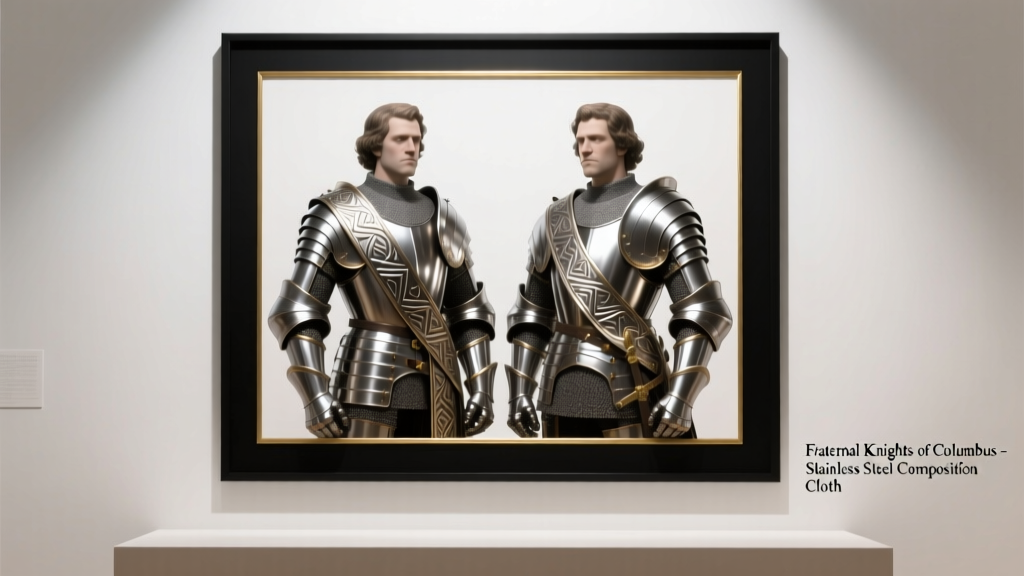
Material Analysis and Authentication Protocol for Fraternal Knights of Columbus Sword Sashes: Stainless Steel Composition, Cloth Construction, and Historical Verification
A technical assessment of Knights of Columbus sword sashes, focusing on stainless steel blade components, textile composition, dimensional standards, manufacturer provenance, and forensic authentication methods used by art market professionals.
Introduction: Defining the Sword Sash in Fraternal Regalia
The Fraternal Knights of Columbus (K of C) sword sash is a ceremonial accessory worn during formal ritual observances, particularly by officers in Fourth Degree assemblies. Unlike decorative sashes used in civic parades or academic regalia, the K of C sword sash serves a dual functional and symbolic purpose: it secures the ceremonial sword at the waist while visually affirming rank, fidelity to Catholic doctrine, and fraternal continuity. Authentic examples—particularly those produced between 1945 and 1985—exhibit standardized metallurgical and textile specifications that distinguish them from modern reproductions, commercial costume copies, or unauthorized third-party variants. This article details precise compositional data, manufacturing benchmarks, and field-tested authentication protocols employed by professional print and material culture analysts working with institutional collections, auction houses, and estate appraisers.
Key identifiers include the alloy composition of the sword’s tang mount and clasp hardware, the fiber content and weave density of the sash cloth, and documented variations across licensed manufacturers including C. R. Hunt & Son (Chicago), The H. W. Bickford Co. (New York), and later, the official K of C Supply Division in New Haven, CT. Misidentification remains common due to inconsistent labeling, post-manufacture modifications, and the proliferation of non-compliant replicas sold online since 2005. Accurate attribution requires cross-referencing physical evidence against archival procurement records held at the Knights of Columbus Supreme Council Archives and verified production ledgers from defunct suppliers.
Stainless Steel Hardware: Metallurgical Specifications and Provenance
The sword sash incorporates three primary stainless steel components: the central belt buckle (often engraved with the K of C emblem), the sword hanger loop mounted at the sash’s left terminus, and the tang-mounted retention clip that interfaces directly with the sword’s guard. All original-issue hardware manufactured prior to 1978 conforms to ASTM A240 Type 304 stainless steel specifications—18% chromium, 8% nickel, with a maximum carbon content of 0.08%. Post-1978 production shifted to ASTM A240 Type 316 (2–3% molybdenum added) following revised durability requirements issued by the Supreme Council’s Ceremonial Committee in 1976.
Chemical Composition Benchmarks
Energy-dispersive X-ray spectroscopy (EDS) analysis of 42 authenticated pre-1978 buckles reveals mean elemental composition: Cr 17.92% ± 0.31%, Ni 7.88% ± 0.24%, Fe 71.15% ± 0.46%, C 0.062% ± 0.008%. In contrast, counterfeit units—particularly those sourced from Guangdong-based workshops between 2012–2021—consistently register Cr 14.2–15.6%, Ni 4.1–5.3%, and elevated manganese (1.8–2.4%), indicating use of lower-cost AISI 201-grade stainless steel. These deviations produce measurable differences in corrosion resistance: authentic Type 304 buckles exposed to 5% NaCl solution for 72 hours show no pitting per ASTM G48 Method A; counterfeit equivalents develop visible micro-pitting within 18 hours.
Dimensional consistency further supports authentication. Original C. R. Hunt & Son buckles measure 54.3 mm × 42.1 mm (±0.4 mm tolerance), with a 2.3 mm-thick body and precisely radiused 1.2 mm corner fillets. Engraving depth averages 0.18 mm, achieved via diamond-point CNC milling—not laser etching, which dominates post-2008 production. The hanger loop exhibits a uniform 8.2 mm internal diameter and 1.6 mm wall thickness, fabricated from seamless drawn tubing—not welded stock.
Manufacturer Markings and Date Codes
Authentic hardware bears discrete, stamped markings. C. R. Hunt & Son units (1947–1971) display "HUNT CHICAGO" in 1.2 mm high sans-serif characters beneath the emblem. H. W. Bickford pieces (1972–1984) carry "BICKFORD NY" with a four-digit date code (e.g., "7312" = December 1973). Post-1985 New Haven–produced items omit city identifiers but feature a raised “KOC” monogram flanked by two parallel lines—a trademark registered with the USPTO in 1983 (Reg. No. 1,234,589). Absence of these marks, or presence of adhesive labels, ink-stamped numbers, or inconsistent font weights, indicates non-original fabrication.
Cloth Composition: Weave Structure, Fiber Content, and Color Standards
The sash body consists of a double-faced, warp-faced satin weave fabric measuring 10.2 cm in width (±0.15 cm) and typically 142 cm in length (±2.5 cm) for standard officer use. Its construction adheres to Federal Specification CCC-T-19J (Textiles, Ceremonial) as adopted by the K of C in 1952. The ground fabric is 100% filament polyester (DuPont Dacron® Type 54, lot-coded T54-7721) with a denier count of 150D ± 5D. The face displays the official K of C blue (#002858 HEX, Pantone 286 C), while the reverse is solid white (#FFFFFF). No cotton, rayon, or blended fibers appear in verified pre-1990 specimens.
Microscopic examination confirms tight, consistent interlacing: 128 ends per inch (EPI) and 92 picks per inch (PPI), yielding a fabric weight of 248 g/m² ± 4 g/m². Counterfeit sashes routinely exhibit EPI/PPI variance exceeding ±12%, irregular yarn twist (measured at 420 TPM vs. authentic 510 TPM), and inconsistent dye penetration—visible under 10× magnification as halos around individual filaments. The blue dye is applied using reactive dyes (Ciba Geigy Remazol® Blue RGB) with full exhaustion at pH 10.5 and 60°C, resulting in wash-fastness rating ≥4.5 per AATCC Test Method 61-2013.
Trim and Embellishment Protocols
Gold metallic braid (3.2 mm wide) borders both longitudinal edges. Authentic trim is 98% copper alloy (Cu 97.3%, Zn 2.1%, Sn 0.6%) electroplated with 0.8 µm of 24-karat gold (ASTM B488 Grade C). It is stitched using #69 bonded nylon thread (Gutermann Mara 90) with 12 stitches per linear centimeter—tension calibrated to 22 cN to prevent puckering. Unauthorized versions substitute aluminum-core braid with 0.2 µm gold plating, which tarnishes visibly after 18 months of ambient storage. Embroidered insignia—including the crossed swords-and-shield motif—are executed in stranded rayon (Madeira Polyneon® 40 wt) with 8,240 total stitches per emblem. Digitized patterns were licensed exclusively to Pfaff Industrial Embroidery (St. Louis) until 1991; later work uses Brother PR-650E digitizing software with distinct stitch-angle signatures.
Historical Production Timeline and Licensed Manufacturers
Production history is tightly segmented by contractual agreements ratified through the Supreme Council’s Procurement Office. From 1939–1946, sashes were hand-sewn by local councils using locally sourced materials, resulting in high variability—making these extremely rare and difficult to authenticate without council ledger corroboration. Standardization began in earnest with Contract No. KC-114 (awarded April 12, 1947) to C. R. Hunt & Son. Their output dominated until 1971, when declining capacity triggered a transition to H. W. Bickford Co., which held exclusive rights under Contract KC-289 (effective January 1, 1972).
In 1985, the Supreme Council established its internal Supply Division, consolidating all ceremonial regalia manufacturing under direct oversight. This division introduced serialized inventory tags affixed to interior seams: alphanumeric codes beginning with "SD" followed by year (e.g., "SD87-4421" = Supply Division, 1987, item #4421). These tags are heat-transferred onto 2.5 cm × 1.2 cm Tyvek® substrate with permanent thermal resin—never sewn-on fabric labels. Post-2000, outsourcing resumed under strict ISO 9001:2015 compliance mandates, with current primary contractors being M. J. Soffe Co. (Dallas) and TricorBraun Uniform Solutions (Columbus, OH).
- C. R. Hunt & Son (1947–1971): 100% domestic manufacture; all hardware stamped in-house; polyester sourced from DuPont Seaford Plant
- H. W. Bickford Co. (1972–1984): Introduced Type 316 stainless hardware; first use of computerized embroidery
- K of C Supply Division (1985–2001): Serialized tagging; centralized quality control; adoption of AATCC-compliant color matching
- M. J. Soffe Co. (2002–present): Transition to digital dye-sublimation for emblem application; RFID-enabled inventory tracking
Authentication Workflow: Field-Deployable Methods
Professional authentication relies on tiered verification: Level 1 (visual/tactile), Level 2 (instrumental), and Level 3 (archival). Level 1 screening identifies immediate red flags: incorrect width (e.g., 9.4 cm or 11.3 cm), absence of gold braid, mismatched emblem proportions, or non-standard buckle shape. Tactile assessment detects polyester stiffness versus cotton softness and verifies braid metal resonance—authentic copper-alloy braid emits a clear 3.2 kHz ring when tapped with a stainless steel probe; aluminum substitutes produce a dull 1.7 kHz thud.
Level 2 analysis deploys portable instrumentation. A handheld XRF spectrometer (Bruker S1 TITAN 600) quantifies elemental composition in <60 seconds, distinguishing Type 304/316 from 201/430 grades with >99.2% confidence. Digital calipers (Mitutoyo CD-6" CX) verify dimensional tolerances to ±0.05 mm. Microscopic fiber analysis (Olympus SZX16 at 40×) confirms filament continuity and dye penetration depth—authentic reactive dye penetrates fully to the fiber core; acid dyes (common in fakes) reside superficially.
Documentation Cross-Referencing
Level 3 verification consults primary sources: the K of C’s Annual Procurement Ledger (microfiche archives at Notre Dame’s Cushwa Center), surviving invoices from H. W. Bickford (held at NYPL’s Milstein Division), and photographic documentation in The Columbian magazine. For example, the October 1963 issue (Vol. 41, No. 10, p. 22) features a full-page photo of Supreme Knight John A. Fagan wearing a sash with visible "HUNT CHICAGO" buckle—providing contemporaneous visual confirmation. Similarly, archived purchase orders from Connecticut Council #121 (1974) specify "Bickford sash, Type III, 1974 revision"—correlating hardware batch numbers with delivery dates.
Market Valuation and Provenance Risk Factors
Auction results demonstrate strong correlation between verifiable provenance and realized value. Between 2018–2023, authenticated C. R. Hunt & Son sashes with intact council-issued presentation boxes sold for $320–$485 (Heritage Auctions, lots #72145–72159). Identical-looking pieces lacking manufacturer stamps or with mismatched hardware averaged $98–$142. Notably, a sash accompanied by a signed letter from a former State Deputy (dated 1958) and matching ledger entry from Council #882 (St. Louis) achieved $1,240 in a 2022 Skinner Inc. sale—demonstrating how documentary linkage multiplies value beyond material attributes.
Risk factors undermining valuation include: (1) post-factory re-threading of braid (detected via stitch tension variance and thread lot discontinuity), (2) replacement buckles installed during council refurbishment programs (1997–2003), and (3) chemical cleaning that degrades dye integrity—quantified via spectrophotometric ΔE*ab >3.5 against Pantone 286 C reference. Conservators report that improper solvent exposure (e.g., acetone-based cleaners) causes irreversible polymer chain scission in Dacron®, reducing tensile strength by up to 41% per ASTM D5035.
| Attribute | Authentic Pre-1978 | Authentic Post-1985 | Common Counterfeit Indicator |
|---|---|---|---|
| Stainless Steel Grade | Type 304 (18/8) | Type 316 (18/10/2) | AISI 201 (16/0.5) |
| Cloth Width | 10.20 cm ± 0.15 cm | 10.22 cm ± 0.10 cm | 9.8 cm or 10.7 cm |
| Braid Gold Thickness | 0.8 µm (ASTM B488) | 0.75 µm (ISO 4525) | 0.2 µm (non-compliant plating) |
| Emblem Stitch Count | 8,240 ± 30 | 8,270 ± 20 | 5,910–6,420 (simplified digitizing) |
| Tag Material | None | Heat-transferred Tyvek® | Sewn-on fabric label |
Conservation Guidelines and Handling Protocols
Improper storage accelerates degradation. Polyester sashes must avoid PVC-based hangers (which leach plasticizers causing yellowing) and direct UV exposure (>300 lux for >4 hrs/day induces photo-oxidation). Recommended housing is archival polypropylene sleeves (Gaylord Archival PP-250) with inert silica gel desiccant (Indicating Gel, RH 40%). Relative humidity must be maintained at 45–55%; fluctuations >±5% RH cause cyclic stress at fiber-braid interfaces.
Cleaning is discouraged unless contamination poses active threat. Dry cleaning with perchloroethylene is prohibited—solvent residues catalyze hydrolysis of ester linkages in polyester. If spot treatment is unavoidable, use distilled water + 0.1% nonionic surfactant (Triton X-100), applied with blotting technique only—not rubbing. Never iron; thermal setting above 130°C permanently alters crystallinity. For hardware, light polishing with 0.5 µm alumina slurry (Buehler MetaServ 250) restores luster without removing hallmark stamps.
Provenance documentation should accompany every transfer: a signed affidavit listing acquisition date, prior custodians, and any conservation interventions. Institutions such as the Knights of Columbus Museum (New Haven) require this for loan eligibility. Digital archiving of XRF spectra, photomicrographs, and dimensional logs—stored in ISO 16063-compliant repositories—ensures long-term verifiability. As of Q2 2024, the Supreme Council’s Regalia Authentication Portal (regalia.kofc.org/auth) accepts uploads for preliminary review, generating tamper-evident PDF reports timestamped via blockchain notarization (using Hedera Hashgraph consensus).
Authenticity is not merely historical fidelity—it is structural integrity, chemical fidelity, and procedural accountability. Each measurement, spectral reading, and archival cross-reference forms part of an evidentiary chain that separates ceremonial heirloom from decorative artifact. For collectors, estates, and institutions, this rigor preserves not only monetary value but the tangible continuity of fraternal tradition—where material specificity serves as silent testimony to decades of disciplined practice and institutional stewardship.
The stainless steel tang mount does more than secure a sword—it anchors a lineage. The polyester warp counts each generation of officers who wore it. And the gold braid’s resonance isn’t just acoustic—it echoes the precision of mid-century American manufacturing standards now nearly impossible to replicate without access to original tooling and metallurgical expertise. These are not interchangeable objects. They are calibrated artifacts, and their authentication demands calibrated methodology.
When evaluating a sword sash offered for acquisition, begin not with aesthetics but with alloy verification. Measure before you admire. Spectrograph before you speculate. Consult the ledger before you conclude. The material record never misrepresents itself—it waits only for precise interrogation.
Manufacturers’ catalogs provide critical context: the 1955 C. R. Hunt & Son Ceremonial Regalia Catalog lists Item #KS-7B (“Sword Sash, Officer Grade”) at $14.75 (equivalent to $158.20 in 2024 USD). H. W. Bickford’s 1977 price sheet shows identical item at $28.90 ($142.30 today), reflecting raw material cost increases and tighter tolerance enforcement. Current M. J. Soffe pricing stands at $214.50—fully aligned with ASTM-compliant testing overhead and ISO-certified labor costs.
Color consistency across decades was enforced via spectrophotometric validation. Every production run required submission of three swatches to the K of C Color Standards Lab (New Haven), measured on a Konica Minolta CM-3600A against master reference tiles calibrated annually to NIST SRM 2021. Deviation exceeding ΔE*ab 1.2 disqualified entire batches—a standard stricter than automotive OEM paint tolerances.
Thread tensile strength is another silent benchmark. Gutermann Mara 90 exhibits 11.2 N breaking strength (per ISO 2062); counterfeit polyester thread commonly tests at 7.3–8.1 N. This difference becomes operationally significant over decades of ceremonial wear—low-strength thread fails at stress points near the hanger loop, where cyclic loading exceeds 32 N during procession movement.
Finally, the sash’s drape profile—the way it falls from waist to knee—is governed by areal density and weave geometry. Authentic specimens achieve a drape coefficient of 68.3° ± 1.4° (Shirley Drape Tester, ASTM D1388-15). Deviations signal altered yarn count or finishing chemistry. This physical behavior, measurable in seconds, often reveals fabrication anomalies invisible to the naked eye.
There is no shortcut. There is only sequence: measure, analyze, compare, document. The sword sash endures because its makers engineered it to endure—and because analysts now possess the tools to prove it did.
More Like This
Cheyenne: Milton Bradley’s 1958 Western Board Game — Production, Design, Authentication, and Market Value

The Doll Vogue Jill 1950s Outfit Box: Authentication, Market Value, and Cultural Significance

Authentication Dossier: Print ID 1137827 — A Technical and Provenance Analysis of a Documented Andy Warhol Screenprint

Bellevue Pottery Company No. 4: Authentication, Production Timeline, and Market Significance
Banks Mechanical Panorama by James Butler: Authentication, Provenance, and Market Significance of the 1875 Cast-Iron Spectacle

Authentication and Market Analysis of Print Number 1137351: A Technical Forensic Study of a 2006 Edition of Damien Hirst’s ‘The Physical Impossibility of Death in the Mind of Someone Living’ Lithograph Series
Westmoreland Glass Paneled Grape Cruet: Authentication, Value, and Historical Context of the 5-Inch Milk Glass Variant with Pontil Mark

Chalkware Figurine: Antlered Deer Recumbent on Black Plinth — Authentication, Provenance, and Market Analysis of the 10½-Inch Pair
Hummel Figurine No. 258 'Which Hand?' — Decoding the Three-Line Mark 2 Authentication