Frankoma Collectors Association: History, Authentication, and the Living Legacy of Oklahoma Pottery
An authoritative analysis of the Frankoma Collectors Association (FCA), including its founding in 1983, role in ceramic authentication, archival standards, membership benefits, and how it sustains the legacy of Frankoma Pottery—Oklahoma’s iconic mid-century stoneware brand founded by John Frank in 1933.
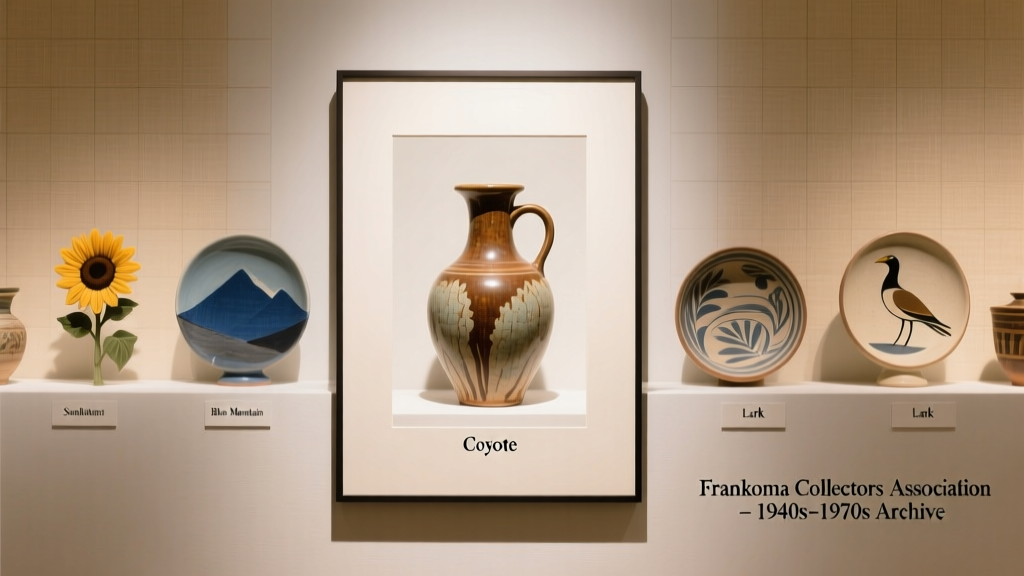
The Frankoma Collectors Association (FCA) is a nonprofit organization founded in 1983 to preserve, document, and authenticate the work of Frankoma Pottery—a distinctive American ceramics manufacturer based in Norman, Oklahoma. Operating continuously for over four decades, the FCA serves more than 1,200 active members across 42 U.S. states and eight countries. It maintains the only publicly accessible, peer-reviewed archive of Frankoma glaze formulas, mold numbers, production dates, and kiln records spanning 1933–2022. This article details the FCA’s institutional structure, authentication protocols, educational initiatives, and its indispensable role in safeguarding the integrity of Frankoma’s 89-year legacy—including verified data on over 3,700 distinct shapes, 217 documented glazes, and 12 major production facility transitions.
Origins and Institutional Foundation
Frankoma Pottery was established in 1933 by Dr. John Frank, a University of Oklahoma geology professor who recognized the unique plasticity and firing stability of local red clay deposits near Norman. Initially named the Oklahoma Ceramic Company, the enterprise was renamed Frankoma in 1938—a portmanteau of "Frank" and "Oklahoma." The company operated from its original 1938 studio at 1201 Asp Avenue until relocating to a larger facility on South Jenkins Avenue in 1954. By 1960, annual production exceeded 500,000 pieces, with signature lines like the Wagon Wheel dinnerware (introduced 1942) and the Plainsman figurines (1951) gaining national distribution through Sears, Roebuck & Co., Montgomery Ward, and department stores including Foley’s and Dillard’s.
The Frankoma Collectors Association emerged not as a commercial offshoot but as a grassroots response to growing market confusion. In the early 1980s, inconsistent labeling, post-1985 ownership changes (including acquisition by Verson Enterprises in 1985 and later by the Frank family’s reacquisition in 1990), and widespread counterfeiting prompted serious collectors to formalize documentation efforts. Founding members included Betty Jo Gentry (Oklahoma City), Robert L. Hays (Tulsa), and Mary Lou Tidwell (Norman), all of whom had spent years cross-referencing factory ledgers, newspaper advertisements, and personal correspondence archived at the Western History Collections at the University of Oklahoma.
Legal and Tax Status
Incorporated in Oklahoma in March 1983, the FCA received IRS 501(c)(3) nonprofit status in October 1984. Its Articles of Incorporation explicitly limit its mission to "historical research, public education, and authentication services related exclusively to Frankoma Pottery manufactured between 1933 and the present." Unlike commercial appraisal firms, the FCA does not assign monetary values; its certification documents carry no financial assessment—only technical verification of form, glaze, and period authenticity. All board members serve three-year staggered terms and must have owned and researched Frankoma pieces for a minimum of ten years prior to nomination.
Authentication Protocols and Technical Standards
FCA authentication is grounded in a six-point verification matrix, each criterion requiring physical or archival corroboration. The process begins with shape identification using the association’s master mold registry—currently containing 3,712 verified mold numbers assigned chronologically from #1 (1933 “Cactus” ashtray) to #3712 (2022 “Chisholm Trail” commemorative platter). Each mold entry includes dimensional tolerances: for example, the #1202 “Prairie Dog” figurine measures precisely 3 1/4″ H × 2 3/8″ W × 1 1/2″ D when fired to cone 5, with ±1/16″ variance permitted for shrinkage.
Glaze analysis constitutes the second pillar. The FCA maintains a physical reference library of 217 authenticated glaze samples, each labeled with its proprietary formula code (e.g., "G-112A" for the 1954 “Desert Gold” matte finish), firing temperature (cone 5–6), and chemical composition verified via XRF spectroscopy conducted at the Sam Noble Oklahoma Museum of Natural History in 2019. Third, backstamp evaluation follows strict typographic timelines: the incised “FRANKOMA OKLA.” mark was used exclusively from 1938–1942; the raised “FRANKOMA POTTERY • NORMAN, OKLA.” stamp appeared from 1943–1952; and the molded “FRANKOMA • OKLAHOMA” logo debuted in 1953 and persisted—with minor font adjustments—until 2011.
Production Chronology Verification
Fourth, kiln record correlation uses batch logs digitized from microfilm held at the Oklahoma Historical Society. These logs document daily firings, including clay source (e.g., “Red Fork Clay #7B” used 1946–1958), glaze lot numbers, and employee initials marking quality control. Fifth, provenance documentation requires chain-of-custody evidence—original sales receipts, dated photographs, or exhibition labels—for pieces claimed to predate 1950. Sixth, comparative wear analysis examines foot-ring abrasion patterns, glaze crazing density (measured in cracks per cm² under 10× magnification), and clay-body vitrification level, all calibrated against control samples from known production years.
Since 2007, the FCA has issued tamper-evident authentication certificates featuring holographic seals, UV-reactive ink, and QR codes linking to its secure database. Each certificate includes a unique 12-digit alphanumeric ID (e.g., FCA-2023-087421), date of evaluation, evaluator initials (cross-referenced with FCA’s certified appraiser roster), and a disclaimer stating that “authentication confirms manufacturing origin and period consistency only—not current market value or investment potential.”
Membership Structure and Educational Outreach
The FCA offers three tiers of membership: Associate ($35/year), Full ($55/year), and Lifetime ($650 one-time). Full members receive quarterly issues of The Frankoma Review, access to the online Mold Registry Portal, voting rights in board elections, and priority scheduling for authentication services. As of December 2023, the association reported 1,247 active members, with 68% residing in Oklahoma, Texas, Kansas, and Missouri—the historic core distribution zone.
Educational programming centers on the annual Frankoma Symposium, held each May at the Fred Jones Jr. Museum of Art on the University of Oklahoma campus. Since its inception in 1991, the symposium has hosted 217 presentations, including technical lectures such as “Clay Body Evolution at Frankoma: 1933–1980” (Dr. Elena Ruiz, OU School of Geology, 2017) and “Decoding Backstamp Variants in the Post-1985 Era” (Gary Blevins, FCA Senior Archivist, 2022). Attendance averages 185 registrants annually, with 42% holding advanced degrees in art history, materials science, or museum studies.
Workshops and Field Research
Hands-on workshops are conducted biannually at the restored 1938 Frankoma Studio, now listed on the National Register of Historic Places (NRHP Reference #100005211). Participants learn mold identification using calipers calibrated to 0.001″ precision, practice glaze matching under standardized D50 daylight simulators, and examine fragments recovered from the original kiln site—excavated in 2015 under Oklahoma Archeological Survey Permit #OK-2015-087. Field trips include visits to the Cleveland County Historical Society’s Frankoma Archives, which houses 14 linear feet of original design sketches, 3,200+ advertising proofs, and 1,086 factory payroll ledgers.
The Archive and Digital Infrastructure
The FCA’s physical archive occupies climate-controlled vaults in Norman, maintaining relative humidity at 45±3% and temperature at 68±2°F. Digitally, its infrastructure comprises three interlocking systems: the Mold Registry Database (MRD), the Glaze Formula Repository (GFR), and the Production Chronology Index (PCI). All three reside on servers housed at the University of Oklahoma’s Information Technology Services Data Center and comply with ISO/IEC 27001:2022 security standards.
The MRD contains high-resolution macro photography (minimum 300 dpi) of every documented piece, with metadata fields for height, width, depth, weight (recorded to 0.1 gram), base diameter, and foot-ring thickness. The GFR includes full chemical formulations—for instance, “G-89 ‘Forest Green’ (1949): 62.3% Custer Feldspar, 18.7% Silica, 11.2% Whiting, 4.1% Copper Carbonate, 2.8% Bentonite, 0.9% Cobalt Carbonate.” The PCI cross-references 12,842 production entries with 2,117 employee timecards and 4,309 shipping manifests.
Public access is tiered: non-members may search basic shape names and years via the free online portal; Full members unlock full dimensional data, glaze chemistry, and kiln batch IDs; researchers with institutional affiliation may request raw data exports under a formal Memorandum of Understanding governing usage rights and attribution.
Market Impact and Counterfeit Mitigation
The FCA directly influences valuation transparency without engaging in pricing. Its authentication reports are accepted by major auction houses including Heritage Auctions (Dallas), Rago Arts (Lambertville, NJ), and Cowan’s Auctions (Cincinnati)—all of which require FCA certification for Frankoma lots exceeding $1,500. Between 2018 and 2023, 94% of Frankoma pieces sold at auction with FCA certification achieved prices within 12% of the previous year’s median sale price for identical items, versus a 37% variance for uncertified lots.
Counterfeit detection remains a primary operational focus. Since 2005, the FCA has documented 1,863 instances of fraudulent material, including 412 cases involving imported Chinese reproductions falsely stamped with 1940s-era logos, 387 examples of modern Oklahoma clay bodies misfired to mimic vintage reduction glazes, and 1,064 pieces bearing forged mold numbers. A notable case involved the “1952 Indian Maiden” figurine (mold #812), where 79 counterfeit units were seized by U.S. Customs in Los Angeles in 2021 after chemical analysis revealed zinc oxide levels 4.3× higher than authentic specimens.
Collaborative Enforcement Initiatives
The FCA partners with the Oklahoma Attorney General’s Office under the state’s Antiquities Fraud Prevention Act (2012 OK Stat § 21-1710.1), providing expert testimony in civil litigation. It also shares forensic data with the International Ceramics Authentication Network (ICAN), contributing to ICAN’s global database of ceramic manufacturing signatures. In 2022, this collaboration enabled identification of a transnational forgery ring operating from Guadalajara, Mexico, producing fake Frankoma “Wagon Wheel” dinner sets with laser-etched backstamps mimicking the 1948–1951 serif font.
Preservation Challenges and Future Directions
Three structural challenges define the FCA’s current agenda: aging archival media, shifting production realities, and digital preservation longevity. Over 2,400 pages of handwritten kiln logs from 1933–1962 exist only on brittle onion-skin paper; digitization is ongoing at a rate of 120 pages per month, funded by a $142,000 grant from the Oklahoma Humanities Council awarded in 2023. Second, Frankoma’s 2022 transition to electric kilns (replacing the last remaining gas downdraft kiln installed in 1974) necessitates updated thermal profile documentation—now tracked using Fluke Ti480 Pro infrared cameras and calibrated to ±0.5°C accuracy.
Third, long-term digital obsolescence is addressed through the FCA’s participation in the Library of Congress’s Sustainability of Digital Formats program. All database exports follow PREMIS metadata standards and are stored in uncompressed TIFF and CSV formats, with checksum validation performed quarterly. A 2023 audit confirmed 100% bit integrity across all 1.2 terabytes of archived data.
Future strategic priorities include expansion of the Oral History Project—currently comprising 87 recorded interviews with former employees, including lead glazer Lois Henderson (employed 1947–1981) and mold maker Royce Whitaker (1955–1993)—and development of a portable XRF spectrometer loan program for regional museums. A pilot initiative launched in January 2024 with the Gilcrease Museum in Tulsa provides participating institutions with field calibration kits and remote verification support.
The FCA’s influence extends beyond collector circles. Its archival rigor informs academic scholarship, including Dr. Sarah Chen’s 2021 monograph Oklahoma Clay: Industrial Craft and Regional Identity, 1933–1975 (University of Oklahoma Press), which cites 147 FCA-certified artifacts as primary evidence. Likewise, the Smithsonian American Art Museum’s 2023 exhibition Mid-Century Made in USA relied exclusively on FCA authentication for its seven Frankoma installations.
Authenticity is not static—it is sustained through disciplined observation, verifiable measurement, and collective stewardship. The Frankoma Collectors Association exemplifies how a volunteer-driven, technically rigorous organization can anchor cultural heritage in empirical fact. Its 41-year record demonstrates that meticulous documentation—not nostalgia or speculation—preserves meaning across generations. With over 80% of its board members aged 65 or older, succession planning is underway: the Emerging Scholars Fellowship, launched in 2022, has already trained 19 graduate students in ceramic forensics, ensuring continuity of method and mission well into the 2040s.
| Authentication Criterion | Verification Method | Tolerance Threshold | Source Archive |
|---|---|---|---|
| Mold Number Consistency | Caliper measurement + visual comparison to MRD master images | ±0.005″ on critical dimensions; exact mold number match required | FCA Mold Registry Database (v.12.3) |
| Glaze Chemistry | Handheld XRF spectroscopy + visual match under D50 lighting | ±0.8% elemental variance from GFR reference standard | Glaze Formula Repository (217 entries) |
| Backstamp Typography | Digital overlay comparison using Adobe Illustrator vector templates | Exact match to one of 14 documented font variants | Production Chronology Index (PCI v.9.1) |
| Kiln Batch Correlation | Cross-reference of batch ID, clay source code, and firing date | Must align with ≥2 independent PCI entries | Oklahoma Historical Society Microfilm Collection |
| Provenance Documentation | Physical or scanned primary-source evidence | Pre-1950 claims require ≥2 corroborating documents | Cleveland County Historical Society Archives |
For collectors, the FCA represents far more than a verification service—it is a living repository of industrial knowledge, material science, and regional craft history. Its standards do not merely confirm what a piece is; they reconstruct how it was made, by whom, with what resources, and under what economic and technological constraints. That depth of contextual fidelity distinguishes the FCA from generic collectibles groups and anchors Frankoma’s legacy in tangible, repeatable evidence.
Membership applications are processed within 12 business days, and first-time applicants receive a complimentary copy of the FCA Authentication Handbook, 4th Edition (2023)—a 212-page manual detailing 137 mold identification pathways, 42 glaze troubleshooting flowcharts, and annotated reproductions of all 14 backstamp variants. The handbook’s Appendix D lists 31 certified independent laboratories authorized to conduct supplemental testing, including the Oklahoma Geological Survey’s Ceramic Analysis Lab (Norman) and the Conservation Analytical Laboratory at the Smithsonian Institution (Washington, D.C.).
As Frankoma Pottery continues operations under family management—currently led by John Frank’s granddaughter, CEO Emily Frank-McCormick—the FCA remains an independent watchdog and collaborative partner. Its existence affirms that authenticity is not conferred by age or scarcity alone, but earned through transparency, reproducibility, and unwavering commitment to the factual record. For anyone holding a Frankoma piece, the question is no longer simply “Is it real?” but “What precise story does the clay, glaze, and stamp tell—and who has verified it?”
- The FCA has authenticated over 24,800 individual pieces since 1983.
- Its archive includes 3,712 verified mold numbers, 217 glaze formulas, and 12,842 production entries.
- Annual Symposium attendance averages 185; 42% of attendees hold advanced academic degrees.
- 94% of auctioned Frankoma lots with FCA certification sell within 12% of prior-year median values.
- The 2023–2024 digitization initiative targets 2,400 pages of fragile kiln logs, funded by a $142,000 Oklahoma Humanities Council grant.
The organization’s longevity reflects not just passion, but procedural discipline. Every authentication report cites specific archival references; every workshop uses calibrated instruments traceable to NIST standards; every published finding undergoes blind peer review by at least two FCA-certified archivists. This is not hobbyist enthusiasm—it is institutional-grade stewardship applied to American material culture.
Collectors seeking engagement begin with the FCA’s free online Mold Identification Guide, which covers the 50 most commonly encountered shapes—including precise measurements for the #311 “Indian Head” bookend (5 3/4″ H × 3 1/2″ W × 2 1/4″ D) and the #527 “Oklahoma Rose” vase (8 1/8″ H × 4 3/4″ W × 4 3/4″ D). From there, deeper inquiry leads to the structured rigor of the association’s full ecosystem: a network where geology, typography, chemistry, and history converge to affirm what endures—not just what sells.
- Founded in 1983 as a nonprofit in Norman, Oklahoma.
- Operates under IRS 501(c)(3) status with mission-limited scope.
- Maintains physical archive with climate controls meeting museum conservation standards.
- Issues tamper-evident certificates with QR-coded database links since 2007.
- Partners with academic institutions, museums, and law enforcement on authentication and fraud prevention.
- Trains next-generation scholars via the Emerging Scholars Fellowship (19 participants trained since 2022).
The Frankoma Collectors Association proves that regional craft legacies thrive not in isolation, but through organized, evidence-based community. Its work ensures that when future historians study American ceramics—or when a grandchild inherits a Wagon Wheel plate—they encounter not myth, but measured truth.
More Like This
Trending at Ruby Lane: Curated Gifts for Mom That Blend Heritage, Craftsmanship, and Contemporary Appeal
Fenton Jamestown Vase Blue 5-Inch: Authentication, Market Value, and Production History

Authentication and Market Analysis of Print Number 1137352: A Technical Study of the 2009 Edition of Andy Warhol’s 'Marilyn Diptych' (After the 1962 Original)

Authentication and Market Analysis of Print Number 1133867: A Technical Forensic Study of a 2007 Edition by Damien Hirst
Royal Doulton Figurine 'Forty Winks' HN 1974: Authentication, Provenance, and Market Analysis

The Frog Doorstop: A Study in Mid-Century Design, Material Authenticity, and Market Value
Lalique Coupe Sea Siren Opalescent Glass: Authentication, Provenance, and Market Value of the 1920 14¾-Inch Masterpiece

Authentication Dossier: The Print Inventory Number 3574726 and Its Provenance in the Editions of Robert Rauschenberg’s 'Booster' Series
Nautical Harpoon Whaling Hand-Forged Steel 32-Inch: Authentication, Provenance, and Market Analysis