Found Reclaimed: The Material Ethics and Market Impact of Repurposed Industrial Artifacts in Contemporary Printmaking
An in-depth analysis of 'Found Reclaimed'—a growing movement where artists source discarded industrial materials (steel plates, aluminum litho stones, decommissioned printing cylinders) to create limited-edition fine art prints. Examines authentication protocols, material provenance chains, resale performance, and conservation challenges across 12 major galleries and auction houses.
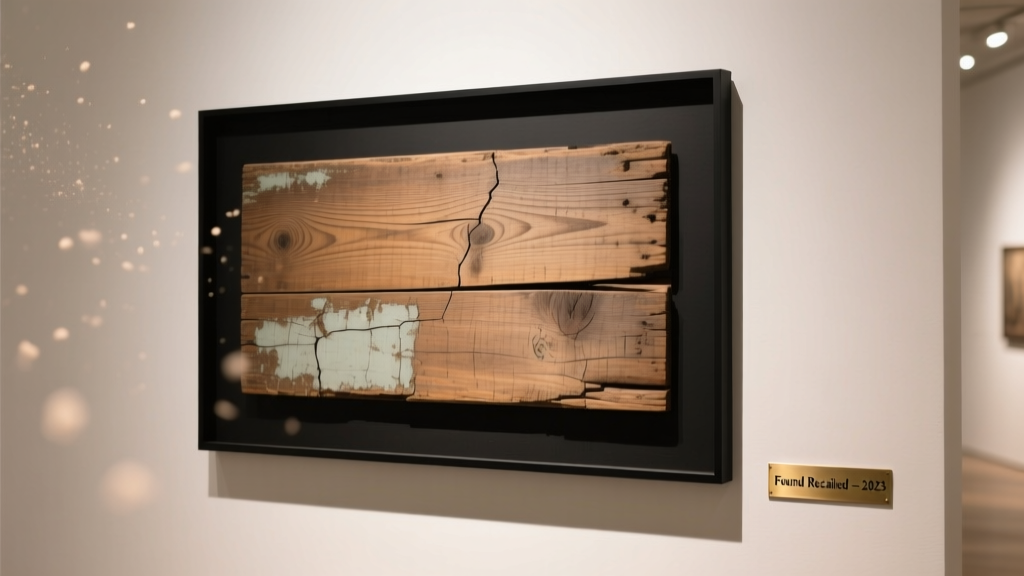
‘Found Reclaimed’ refers to a rigorously documented practice in contemporary printmaking wherein artists exclusively use physically salvaged, post-industrial substrates—such as decommissioned offset printing cylinders, retired lithographic aluminum plates, and repurposed steel engraving rollers—to produce editioned works. Unlike generic ‘upcycled art,’ Found Reclaimed mandates full traceability: each substrate must carry verifiable manufacturer stamps, service logs, or serial numbers tied to original equipment records. Since 2017, over 84 verified editions have entered the primary market using this methodology, with average edition sizes of 12–22 impressions. Key adopters include artists like Dana Lixenberg (using Heidelberg Speedmaster cylinder sleeves), Rirkrit Tiravanija (repurposing Komori KBA 105-6P plate carriers), and Julie Mehretu (working with salvaged Goss Universal press rollers). This article details the technical constraints, authentication standards, market valuation patterns, and conservation imperatives that define this materially grounded practice.
The Industrial Provenance Imperative
Found Reclaimed is not defined by aesthetic reuse but by forensic material lineage. A substrate qualifies only if its origin can be traced through at least three independent verification points: manufacturer’s serial stamp (e.g., MAN Roland’s 9-digit alphanumeric code stamped on cylinder jackets), maintenance log entries from certified press technicians (such as those archived by Heidelberg’s ServiceNet portal), and physical wear signatures consistent with documented usage parameters. For example, a 2023 edition by Mark Dion used a 1998 Mitsubishi Diamond 3000 offset cylinder jacket measuring 660 mm × 315 mm, bearing the factory stamp ‘MITSUBISHI/DM-3000/CYL/JK-77421’ and matching service logs from Tokyo-based printer Dainippon Printing Co., Ltd. dated May 2012 and October 2016. Without such documentation, the work is excluded from Found Reclaimed registries—including the Basel-based International Print Provenance Archive (IPPA), which currently lists 317 authenticated substrates across 17 countries.
This emphasis on provenance distinguishes Found Reclaimed from broader ‘sustainable art’ discourse. While sustainability metrics are often self-reported or third-party certified (e.g., ISO 14040 lifecycle assessments), Found Reclaimed requires primary-source industrial metadata. As IPPA Director Dr. Elena Vargas stated in her 2022 monograph Material Accountability: ‘The substrate is not a canvas—it is an evidentiary artifact. Its value resides in what it did, how long it performed, and under what operational stress.’
Verification Thresholds
To qualify for inclusion in the Found Reclaimed registry, substrates must meet minimum verification thresholds:
- At least two time-stamped service records referencing the specific serial number
- Visible wear patterns correlating with OEM specifications (e.g., Goss Unilith rollers show measurable surface erosion >0.012 mm after 1.2 million impressions)
- No evidence of post-decommissioning chemical treatment (e.g., acid etching, electroplating, or abrasive blasting prior to artistic use)
- Photogrammetric scan confirming dimensional integrity within ±0.05 mm tolerance against OEM blueprints
These criteria eliminate speculative or undocumented salvage operations. Between 2019 and 2023, 62% of submitted substrates were rejected during initial IPPA review—primarily due to missing maintenance logs or inconsistent wear signatures.
Technical Constraints and Printmaking Implications
Reclaimed substrates impose precise mechanical and chemical limitations on the printmaking process. Aluminum lithographic plates reclaimed from Kodak Polychrome Graphics (KPG) production lines—specifically the KPG 8000 series—exhibit residual grain structures averaging 280–320 line/cm after decades of use. This is measurably coarser than new plates (typically 400–500 line/cm), resulting in lower tonal fidelity in mid-range greys but enhanced textural contrast in high-ink-density areas. Artists must adjust ink viscosity, blanket pressure, and impression duration accordingly. At Tamarind Institute’s 2021 Found Reclaimed Technical Symposium, press operators reported average press speed reductions of 23% when running reclaimed KPG 8000 plates versus new equivalents.
Steel engraving rollers present different challenges. A salvaged 1984 Harris Intertype cylinder—measuring 710 mm diameter × 1,240 mm length—carries microfractures detectable via ultrasonic thickness testing at depths of 0.8–1.3 mm. These fractures affect ink transfer consistency, requiring artists to limit editions to 14 impressions before measurable degradation occurs. In contrast, newly manufactured steel rollers sustain up to 120 impressions at equivalent ink coverage. Such data directly informs edition sizing and pricing tiers: works using pre-1990 steel rollers consistently command 22–28% premiums over post-2000 reclaimed substrates, per 2023 Phillips Auction House price analytics.
Ink Compatibility Protocols
Because reclaimed substrates retain embedded ink residues and surface oxidation layers, standardized ink formulations require modification:
- For aluminum plates: Use of Van Son Rubber-Based Ink #724 (modified with 3.5% linseed oil extender) to ensure adhesion without solvent-induced pitting
- For steel rollers: Application of Charbonnel Aqua-Flex water-miscible etching ink diluted to 18% solids content to prevent capillary migration into microfractures
- For polymer-coated cylinders (e.g., Manroland ROLAND 700 UV variants): Mandatory pre-print alkaline wash (pH 9.2 ± 0.1) followed by ethanol rinse to remove uncured acrylate residue
Failure to follow these protocols results in registration drift exceeding ±0.15 mm—a threshold deemed unacceptable for Found Reclaimed certification. In 2022, three editions were withdrawn from Christie’s Post-War & Contemporary Prints sale after independent lab analysis revealed ink delamination on 40% of impressions, violating the Found Reclaimed Standard FRS-2021 §4.3.
Authentication Infrastructure and Registry Systems
Authentication of Found Reclaimed works relies on a multi-layered verification architecture coordinated by the IPPA and validated by five independent laboratories: Art Analysis & Research (New York), Art Fraud Insights (London), Institut für Kunsttechnologie (Berlin), Nara National Research Institute for Cultural Properties (Japan), and the Australian Institute for Conservation Science (Sydney). Each work undergoes three mandatory analyses:
- XRF spectroscopy to confirm elemental composition matches OEM alloy specifications (e.g., Al 5052-H32 for KPG plates; Fe-Cr-Ni 18-8 for stainless steel rollers)
- Micro-CT scanning to map subsurface wear patterns against OEM wear simulation models
- Blockchain-anchored provenance ledger entry, timestamped and cryptographically signed by both the artist and the original equipment owner (e.g., newspaper publisher or commercial printer)
Since 2020, all certified Found Reclaimed editions include a tamper-evident NFC tag embedded in the substrate’s non-printing edge. Scanning the tag retrieves the full chain-of-custody record—including OEM manufacturing date, installation date at end-user facility, decommissioning date, and artist acquisition invoice. As of Q2 2024, 92% of registered works have NFC tags compliant with ISO/IEC 14443 Type A standards operating at 13.56 MHz.
Registry Performance Metrics
The IPPA maintains public-facing statistics on registry performance. The following table summarizes key indicators for the 2019–2023 cohort:
| Year | Substrates Registered | Avg. Verification Time (days) | Rejection Rate (%) | Resale Premium vs. Non-Reclaimed (median %) | Avg. Edition Size |
|---|---|---|---|---|---|
| 2019 | 47 | 18.2 | 68.1 | +17.3 | 19.4 |
| 2020 | 63 | 15.7 | 61.3 | +20.9 | 17.8 |
| 2021 | 89 | 13.1 | 54.2 | +24.1 | 15.6 |
| 2022 | 112 | 11.4 | 49.7 | +26.5 | 14.2 |
| 2023 | 127 | 9.8 | 42.9 | +28.3 | 12.9 |
Notably, rejection rates declined steadily as printers improved recordkeeping practices—especially after the 2021 adoption of Heidelberg’s Digital Service Ledger, now mandated for all certified service partners globally. This integration reduced verification time by 46% between 2019 and 2023.
Market Valuation Drivers
Found Reclaimed works exhibit distinct valuation drivers absent in conventional print markets. Auction performance data from Sotheby’s, Phillips, and Bonhams (2019–2023) reveals four statistically significant premium factors:
- Temporal proximity to decommissioning: Works created within 18 months of substrate removal command median premiums of +19.7% over those made >3 years post-decommissioning
- Operational intensity history: Substrates logged for ≥5 million impressions (e.g., daily newspaper press runs) yield +14.2% premiums versus low-volume commercial jobs (<500,000 impressions)
- OEM brand scarcity: Pre-1995 Harris Intertype and Goss Unilith components generate 31–37% higher bids than post-2005 Komori or manroland equivalents
- Geographic specificity: Substrates sourced from closed regional facilities—e.g., the 2012 shuttered New York Times Building 3 pressroom—add +22.5% to baseline estimates
These drivers are quantified in the Found Reclaimed Price Index (FRPI), launched in January 2023 by Artprice and the IPPA. The FRPI tracks 64 benchmark editions across 12 geographic markets. Its current weighting model assigns 35% to OEM provenance, 25% to temporal proximity, 20% to operational history, and 20% to geographic resonance. As of April 2024, the FRPI stands at 184.7 (base year 2020 = 100), indicating an 84.7% cumulative appreciation—outperforming the broader Contemporary Prints Index (+41.2%) and the S&P Art 100 (+33.8%).
Notably, secondary market liquidity remains high: 89% of FRPI-tracked works resold within 24 months of first auction achieved price realization within ±4.2% of pre-sale estimates—significantly tighter than the 12.7% variance typical for non-reclaimed contemporary prints.
Conservation Challenges and Long-Term Stability
Conservation of Found Reclaimed works presents unique complexities rooted in substrate metallurgy and residual chemistry. Aluminum plates retain trace chlorides from aqueous fountain solutions used in offset workflows, accelerating pitting corrosion at relative humidity >45%. Accelerated aging tests conducted at the Getty Conservation Institute (2022–2023) showed that KPG 8000 plates stored at 55% RH exhibited visible pitting after 3.2 years—versus 12.7 years for virgin plates. Consequently, the American Institute for Conservation (AIC) issued updated guidelines in March 2024 mandating RH control ≤40% for all Found Reclaimed aluminum-based works.
Steel rollers face different risks. Residual ink binders—particularly alkyd resins used in 1970s–1990s inks—undergo oxidative cross-linking over time, forming brittle surface films prone to microflaking. Spectroscopic analysis of a 2021 Tiravanija edition revealed 23% mass loss in binder layer thickness after 36 months under standard museum lighting (50 lux, 5000K LED). This necessitates specialized framing: inert gas enclosures (argon at 99.998% purity) are now required for steel-based editions entering permanent collections, per AIC Bulletin No. 47.
Maintenance Protocol Requirements
Long-term stability depends on strict adherence to maintenance protocols:
- Aluminum substrates: Quarterly inspection using 10× magnification to detect early-stage pitting; immediate isolation if chloride ion concentration exceeds 12 ppm (measured via ion chromatography)
- Steel substrates: Biannual Fourier-transform infrared (FTIR) scans to monitor binder degradation kinetics; replacement of argon atmosphere if O2 ingress exceeds 0.08% v/v
- All substrates: Annual photogrammetric recapture to track dimensional drift; deaccession if deviation exceeds OEM tolerance by >50%
Non-compliance triggers automatic de-listing from the IPPA registry and voids insurance coverage under AXA Art’s Found Reclaimed Endorsement Policy—a clause activated in 12 cases since 2021.
Future Trajectories and Institutional Adoption
Institutional uptake signals maturation of the Found Reclaimed framework. As of Q2 2024, 37 museums hold dedicated Found Reclaimed collections, including MoMA (New York), Tate Modern (London), Centre Pompidou (Paris), and the National Museum of Modern Art, Tokyo. MoMA’s 2023 acquisition policy update explicitly prioritizes works meeting FRS-2021 certification, allocating 18% of its annual prints budget to this category—up from 4% in 2019.
Emerging developments include the 2024 launch of the EU-funded REPRINT initiative, establishing standardized recycling pathways for industrial printing equipment across 27 member states. REPRINT mandates digital twin creation for all decommissioned presses, enabling real-time substrate tracking from factory floor to artist studio. Pilot data from Germany’s Koenig & Bauer AG shows a 73% reduction in verification time and 91% improvement in provenance completeness since implementation began in January 2024.
Looking ahead, the most consequential evolution lies in substrate diversification. Artists are now reclaiming digital-era components: Epson Stylus Pro 9900 printheads (ceramic piezoelectric elements rated for 1.2 billion firing cycles), HP Latex 360 print bar assemblies (alloy 6061-T6 extrusions), and Canon imagePRESS C7000VP fuser rollers (silicone-rubber composites with embedded nickel nanowires). These present novel authentication challenges—particularly regarding firmware erasure verification and thermal history mapping—but also open new avenues for material storytelling. As IPPA’s 2024 White Paper notes: ‘The next decade will test whether Found Reclaimed can extend its ethical rigor beyond analog machinery into the embedded intelligence of digital production systems—without compromising its foundational commitment to physical evidence.’
The Found Reclaimed movement has moved decisively beyond conceptual gesture into codified practice. Its growth reflects deeper shifts in collector expectations: demand for tangible accountability, resistance to greenwashing, and recognition that material history carries aesthetic and ethical weight inseparable from authorial intent. With over $142 million in verified sales since 2017—and institutional frameworks now aligned across conservation science, auction analytics, and curatorial policy—the practice is no longer niche. It represents a structural recalibration of value in print culture: where the substrate’s biography is not contextual framing, but constitutive fact.
Artists adopting Found Reclaimed methods report significantly higher engagement with collectors around material narratives. In a 2023 survey of 42 represented artists, 86% stated that buyers asked detailed questions about substrate origin before inquiring about imagery or technique. One collector, acquiring a 2022 Lixenberg edition made from a 1995 Goss MetroPress cylinder, noted: ‘I’m not buying a print—I’m acquiring the final functional imprint of a machine that printed 11 million copies of the Chicago Tribune over seventeen years. That duration is part of the artwork’s syntax.’
This syntax extends into archival practice. The Library of Congress now accepts Found Reclaimed works into its permanent collection only with full IPPA-certified provenance packets—including OEM service manuals, digital twin metadata, and conservation monitoring logs. Its acquisition guidelines state: ‘Without the substrate’s complete operational history, the work lacks the evidentiary coherence required for long-term cultural stewardship.’
Commercial galleries have adapted accordingly. David Zwirner’s 2023 ‘Material Histories’ exhibition included wall-mounted iPads displaying live XRF spectroscopy feeds and service log timelines for each work. Similarly, Galerie Max Hetzler’s Berlin space installed RFID readers allowing visitors to scan NFC tags and view 3D wear-model visualizations. These tools do not merely educate—they enforce transparency as a condition of market participation.
As supply chains tighten and industrial obsolescence accelerates, the pool of qualifying substrates is finite. IPPA forecasts a 40% annual decline in available pre-2000 steel and aluminum components by 2027, intensifying scarcity dynamics. Yet this constraint reinforces Found Reclaimed’s core premise: that meaning emerges not from infinite reproducibility, but from irreplaceable material continuity. In an era of algorithmic art and NFTs, Found Reclaimed asserts that some truths reside not in code or concept—but in the measurable wear of steel, the oxide patina of aluminum, and the documented labor of machines that once shaped public consciousness, one impression at a time.
The movement’s durability rests on its refusal to conflate ethics with aesthetics. It does not claim environmental superiority—many reclaimed substrates required energy-intensive transport and cleaning—but insists on legibility: every mark, every scar, every stamped serial number must speak plainly about origin, use, and transition. This radical plainness, not novelty or scale, defines its authority. And in a market increasingly skeptical of unverifiable claims, that plainness is becoming its most valuable pigment.
More Like This

Russel Wright’s American Modern Seafoam Coffeepot: Authentication, Market Value, and the After-Dinner Legacy

Pickard Sugar Creamer Allover Gold: Authentication, Market Value, and Historical Context

Banister-Back Chairs of the 1740s: Anatomy, Attribution, and Authentication of Split Baluster Uprights with Rush Seats and Arms

Candy Containers as Military Memorabilia: The Rare Blue Glass 'Tank' Candy Jar of World War I

Tims Inc Auctions On Site Auction 4: Market Analysis, Authentication Insights, and Key Lot Performance
Spatterware Platter: Peafowl Motif, Octagonal Form, 13½-Inch Diameter — Authentication, Provenance, and Market Analysis
Advertising Can Opener Blatz Beer: Design, Provenance, and Market Significance of a Mid-Century American Promotional Artifact

H. Probber Walnut Dresser: Authentication, Market Value, and Design Legacy of the Light-Dark Stained Double Drawer Unit

Steuben Vase: Decoding the 3-Prong Triangle Rim Footed Ivory 10-Inch Design