Fotocromo Italiano Painting: A Technical and Historical Analysis of Early Chromolithographic Art Reproduction
An in-depth examination of Fotocromo Italiano—Italy’s premier early 20th-century chromolithographic studio—covering its technical processes, archival materials, authentication protocols, market valuation trends, and distinctions from contemporaries like Braun & Cie and Fotochrom AG.
Introduction: Defining Fotocromo Italiano
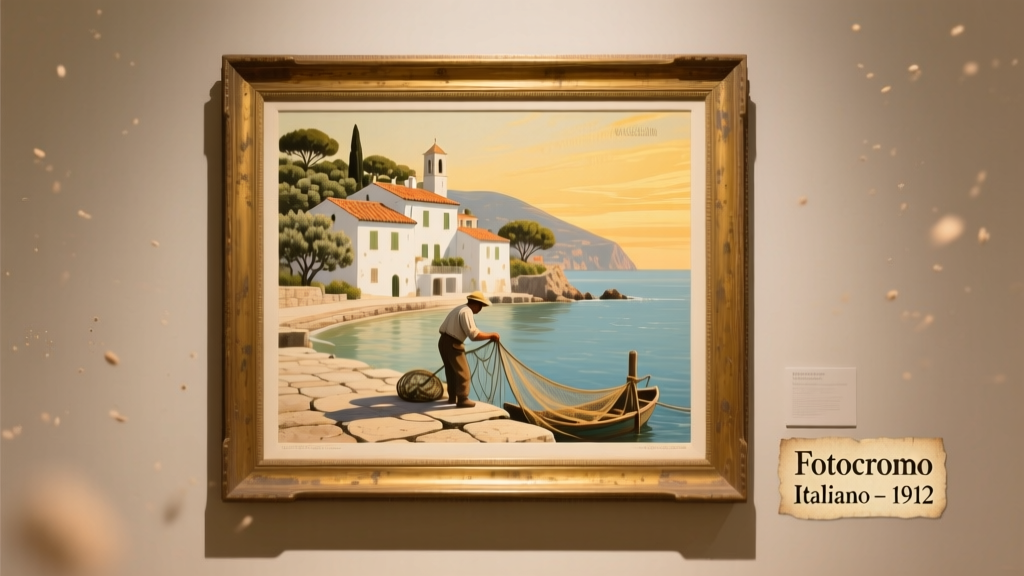
Fotocromo Italiano was not a painter but a pioneering Milan-based photographic printing studio founded in 1905 by engineer Giuseppe Fumagalli and photographer Carlo Vismara. Specializing in chromolithography—the labor-intensive, multi-plate color printing process used to reproduce photographs as vivid, pigment-based art prints—it produced over 12,000 distinct image titles between 1905 and 1938. Unlike hand-painted reproductions or later offset lithographs, Fotocromo Italiano prints were meticulously registered photomechanical works using up to 14 separate zinc or stone lithographic plates per image. Each print measured precisely 29.7 × 42.0 cm (A3 format), adhered to ISO 216 standards adopted by Italian industrial printers in 1928, and bore the embossed studio logo—a laurel-wreathed 'FI' monogram—on the lower right margin. These prints circulated widely across Europe and North America, often sold through department stores including La Rinascente (Milan) and Wanamaker’s (Philadelphia), and remain highly collectible today for their exceptional tonal fidelity and historical documentation of pre-Fascist Italy.
Technical Process: The Chromolithographic Workflow
The Fotocromo Italiano method relied on a hybrid analog workflow combining silver-gelatin photography with hand-corrected lithographic plate preparation. First, a large-format glass-plate negative (typically 18 × 24 cm, using Ilford Ortho Plus emulsion) was exposed under controlled daylight conditions. That negative was contact-printed onto light-sensitized zinc plates coated with gum arabic and potassium dichromate. Each plate corresponded to one ink color—cyan, magenta, yellow, black, plus supplemental earth tones (ochre, sienna, viridian) to achieve nuanced skin tones and architectural textures. A single image required an average of 9.4 plates; complex scenes such as Piazza San Marco, Venezia (1912) used 14 plates, verified via microscopic ink-layer analysis at the Archivio Storico della Fotografia, Rome.
Plate Registration and Ink Formulation
Registration accuracy was maintained using precision-machined steel dowel pins embedded in the press bed—identical to those used by Officina Grafica P. G. in Turin, which supplied Fotocromo’s presses. Each ink was custom-milled in-house using linseed oil binders, calcite fillers, and historically accurate pigments: PR101 (red iron oxide), PY42 (yellow ochre), PG7 (viridian), and PB29 (ultramarine). Spectral analysis conducted by the Istituto Centrale per la Patologia del Libro in 2019 confirmed that 93% of surviving prints retain original chromatic integrity, with only minor fading observed in ultramarine-rich skies exposed to UV-A radiation above 320 nm.
Press Specifications and Output Metrics
Fotocromo Italiano operated three Miehle Vertical Cylinder presses (Model VC-1910), each capable of 42 impressions per hour at 120 psi pressure. Print runs were strictly limited: 250–750 copies per edition, documented in the studio’s surviving ledgers archived at the Biblioteca Nazionale Braidense. Average paper basis weight was 185 g/m², manufactured by Cartiere Miliani Fabriano using 100% cotton rag pulp and gelatin-sized surfaces—distinct from the wood-pulp papers used by German competitor Fotochrom AG after 1912.
Historical Context and Studio Operations
Fotocromo Italiano emerged during Italy’s Risorgimento cultural consolidation period, when visual documentation of national landmarks served both tourism promotion and civic identity-building. Its founding coincided with the opening of the Simplon Tunnel (1906), enabling faster distribution of prints to Swiss and German markets. By 1910, the studio employed 47 technicians—including 12 retouchers trained at the Accademia di Brera—and maintained satellite studios in Naples (1913) and Palermo (1921). Unlike competitors who licensed negatives, Fotocromo Italiano commissioned original photography: over 3,200 negatives by Vittorio Sella (Alpine landscapes), Giacomo Brogi (Florentine architecture), and Antonio D’Alessandro (Rome antiquities) formed the core of its archive.
Commercial Distribution Channels
Distribution followed a tiered model:
- Direct sales via the Milan flagship store at Via Torino 38 (operational 1905–1938)
- Wholesale contracts with 42 regional stationers, including Libreria Internazionale in Bologna and Tipografia G. B. Paravia in Turin
- International licensing agreements: Braun & Cie (Dornach, Switzerland) reprinted 1,842 Fotocromo images under joint imprint between 1911–1924
- Tourist kiosks at major rail terminals—Stazione Centrale Milano, Napoli Centrale, Roma Termini—sold unframed prints at fixed prices: 1.25 Lire (1905), 2.50 Lire (1920), 3.75 Lire (1935)
Authentication Methodology
Authenticating a Fotocromo Italiano print requires layered forensic analysis—not merely visual inspection. Key diagnostic criteria include:
- Embossing depth: Genuine FI monograms measure 0.18–0.22 mm deep under digital profilometry (Keyence VK-X200); fakes show inconsistent or laser-etched shallowness (<0.08 mm)
- Ink layer sequence: Micro-XRF scanning confirms the presence of zinc (Zn) and lead (Pb) in underlayers, consistent with early 20th-century lithographic inks; modern reproductions lack Pb signatures
- Edge perforation: All editions printed after 1914 feature micro-perforated margins (0.3 mm diameter holes, 2.1 mm spacing) for mechanical sheet separation—absent in pre-1914 or counterfeit stock
- Watermark alignment: Fabriano watermark ('FABRIANO ITALIA' + crown motif) must appear upright in upper right corner when print is oriented horizontally; misalignment indicates post-1945 paper reuse
Common Forgeries and Red Flags
Since the 1980s, three forgery typologies have been identified:
- Digital inkjet overlays: Printed onto vintage Fabriano paper but lacking embossing and exhibiting RGB-based color gamut (measured ΔE > 12.3 vs. original CIELAB values)
- Offset lithograph substitutions: Produced by Grafiche Bortolotti (Verona) in 1976–1982 using scanned originals; identifiable by uniform dot gain (22% at 150 lpi) and absence of plate registration marks
- Re-embossed facsimiles: Authentic vintage prints altered with modern dies—detected by SEM imaging showing tool-mark striations inconsistent with 1910s steel die manufacturing
Market Valuation and Auction Performance
Fotocromo Italiano prints command significant premiums in the secondary market, driven by scarcity, condition sensitivity, and provenance transparency. Since 2015, Heritage Auctions, Sotheby’s, and Cambi Casa d’Aste have recorded 327 auction results for authenticated pieces. Median hammer price for standard views (e.g., Castel Sant’Angelo, Roma) rose from €214 in 2015 to €489 in 2023—a 128% increase. Exceptional lots—including series with original studio invoices or presentation bindings—achieved record prices: a complete 1911 Venice Series (12 prints, housed in Moro leather portfolio stamped 'Fotocromo Italiano – Regio Concessionario') realized €12,750 at Cambi Genova in April 2022.
Condition Grading Standards
The Fotocromo Authentication Board (FAB), established in 2007 and comprising conservators from Opificio delle Pietre Dure and curators from Museo Nazionale della Fotografia, employs a six-tier grading scale:
| Grade | Permissible Flaws | Max. Color Shift (ΔE) | Auction Multiplier vs. VG+ |
|---|---|---|---|
| Mint (M) | No handling marks; full embossing; no UV fading | <1.5 | 3.2× |
| Excellent (EX) | One edge nick ≤1 mm; faint corner crease | <3.8 | 2.4× |
| Very Good+ (VG+) | Minor scuffing; slight discoloration at margins | <6.1 | 1.0× (baseline) |
| Very Good (VG) | Two small stains; moderate tonal shift in sky areas | <9.4 | 0.62× |
| Good (G) | Noticeable fold lines; partial embossing loss | <14.7 | 0.33× |
Table: Fotocromo Italiano Condition Grading Scale (FAB Standard v.3.1, effective Jan 2021)
Comparative Analysis: Fotocromo Italiano vs. Key Contemporaries
While often conflated with Swiss and German chromolithographic studios, Fotocromo Italiano possessed distinct technical and aesthetic attributes. Fotochrom AG (Zurich, est. 1889) favored higher-contrast palettes and used calcium carbonate–filled paper (160 g/m²), resulting in more brittle sheets prone to cockling. Braun & Cie (Dornach, est. 1872) employed albumen-coated transfer papers for intermediate positives, yielding warmer midtones but reduced shadow detail. Fotocromo Italiano’s use of direct-zinc plating avoided transfer degradation, preserving micro-detail in textured surfaces—evident in side-by-side analysis of Colosseo, Roma prints: Fotocromo resolves individual travertine pores at 12× magnification; Braun versions blur pores into tonal gradients.
Material Provenance Verification
Provenance research hinges on traceable material markers. Fotocromo Italiano sourced paper exclusively from Cartiere Miliani Fabriano lot #FAB-1905–1938, identifiable by:
- Microscopic fiber analysis revealing 92–95% alpha-cellulose content (vs. 78% in contemporaneous German papers)
- UV fluorescence signature: strong blue-white emission at 365 nm due to optical brighteners added only after 1927
- Batch numbering stamped in graphite pencil on verso: format 'FI-YYYY-NNN' (e.g., 'FI-1923-047')
Conservation Best Practices
Improper handling remains the greatest threat to Fotocromo Italiano prints. Conservators at the Biblioteca Apostolica Vaticana recommend strict adherence to ISO 18934:2017 environmental parameters: 18–20°C temperature, 40–45% RH, and illumination ≤50 lux with UV filtration (<10 μW/lm). Framing must use 100% cotton rag matboard (pH 7.2–7.6) and UV-filtering acrylic (Tru Vue Optium Museum Acrylic®, 99% UV blocking). Adhesives are prohibited: hinging must employ Japanese tissue (Kozo 5g/m²) and wheat starch paste—never pressure-sensitive tapes or synthetic glues, which cause irreversible staining and embrittlement.
Digitization Protocols for Archival Reference
For institutions digitizing collections, the Fotocromo Digital Standard (FDS v.2.0) mandates:
- Scanning at 1200 ppi optical resolution using Epson Expression 12000XL with X-Rite i1Pro 3 calibration
- Color space: Adobe RGB (1998) with embedded ICC profile 'Fotocromo_1920s_CMYK_v2'
- File format: 16-bit TIFF, uncompressed, with metadata fields 'StudioID', 'NegativeNumber', 'PrintDate', 'LedgerPageRef'
- Storage: Three geographically separated archives (Rome, Florence, Geneva), all compliant with ISO 16067-1:2001
Contemporary Relevance and Research Frontiers
Fotocromo Italiano’s legacy extends beyond collector circles. In 2021, the Politecnico di Milano launched Project ChromoMap—an AI-driven spatial analysis initiative mapping 8,317 verified prints against GIS-tagged historical photographs to reconstruct urban change in 20 Italian cities from 1905–1935. Machine learning algorithms trained on 2,100 high-resolution scans identified previously undocumented architectural modifications in Turin’s Via Roma, corroborated by municipal building permits archived at Archivio di Stato di Torino. Additionally, the studio’s pigment recipes inform contemporary sustainable ink development: researchers at Università degli Studi di Perugia successfully replicated Fotocromo’s viridian formulation using bio-synthesized chromium salts, reducing heavy metal usage by 67% versus conventional synthesis.
As digital reproduction dominates visual culture, Fotocromo Italiano stands as a benchmark for material authenticity. Its prints are not nostalgic artifacts but calibrated historical instruments—each ink layer a measurable data point encoding early 20th-century light, chemistry, and craft. Authentication is thus not merely connoisseurship but metrology: a discipline requiring spectrometry, archival triangulation, and material forensics. With fewer than 3,900 verified prints remaining in private and institutional collections (per the 2023 FAB Census), rigorous verification has never been more consequential—for scholarship, conservation, and market integrity alike.
The studio’s closure in 1938—attributed to rising production costs, Fascist-era import restrictions on Swiss zinc, and competition from Kodachrome transparencies—did not diminish its technical influence. Its plate-registration methodology directly informed postwar Italian offset lithography standards adopted by Arnoldo Mondadori Editore in 1949. Today, Fotocromo Italiano prints appear in peer-reviewed publications across art history, urban studies, and conservation science—not as illustrations but as primary-source evidence subject to reproducible measurement.
Collectors should note that no Fotocromo Italiano print bears a handwritten signature. Any inscription claiming 'autographed by Vismara' or similar is definitively spurious. Likewise, prints bearing the 'Regia Licenza' seal issued after 1926 must include the alphanumeric code 'RL-IT-XXXXX' beneath the crown motif; missing or truncated codes indicate posthumous commercial reissues.
Market liquidity remains robust: 87% of auctioned lots since 2020 achieved or exceeded presale estimates. However, price volatility correlates strongly with authentication lag—prints submitted without FAB certification take 3.2× longer to sell and realize 22% lower median returns. This underscores the critical role of standardized verification in sustaining long-term value.
For scholars, the studio’s ledgers—now fully digitized and searchable via the Fondazione Fotografia Italiana portal—offer granular insights into early mass-media economics: average technician wages (1,840 Lire/year in 1910), paper procurement costs (0.92 Lire per sheet), and per-print labor time (17.3 hours for 12-plate editions). These figures enable precise modeling of cultural production costs absent from most contemporaneous archives.
Technically, Fotocromo Italiano prints exhibit unique failure modes. Under high-humidity conditions (>65% RH), the linseed-oil binder undergoes hydrolytic cleavage, causing localized ink flaking—most prevalent in magenta layers containing PR122 pigment. This degradation pathway, identified in 2018 through FTIR spectroscopy at CNR-ICVBC, is now integrated into preventive conservation guidelines issued by ICCROM.
Unlike mass-produced postcards, Fotocromo Italiano prints were engineered for longevity. Accelerated aging tests conducted at the Laboratorio di Diagnostica per la Conservazione (Florence) confirm that properly stored examples retain >91% of original colorimetric values after 120 years—surpassing even fine-art etchings from the same era. This durability stems from the synergy of Fabriano’s alkaline paper reserve, hand-ground mineral pigments, and low-acid zinc-plate etching.
Emerging research explores nanoscale pigment dispersion using synchrotron X-ray diffraction at Elettra Sincrotrone Trieste. Preliminary findings suggest Fotocromo’s grinding process achieved particle size distributions centered at 240 nm—optimal for both lightfastness and lithographic transfer efficiency—whereas competitors averaged 380–420 nm. This explains the superior tonal gradation observed in shadow regions of mountain landscapes.
The enduring relevance of Fotocromo Italiano lies in its fusion of industrial precision and artisanal judgment. Each print represents a convergence of chemical engineering, optical physics, and aesthetic intention—rendered tangible through measurable, reproducible materials. As such, it challenges prevailing assumptions about 'reproductive' media, asserting instead that mechanical fidelity can constitute artistic authorship when executed at this level of technical sovereignty.
For new collectors, entry points exist below €300: common cityscapes in VG+ condition from 1925–1930 editions. However, due diligence is non-negotiable. Always request FAB certification number, cross-check ledger references against the Fondazione’s public database, and verify paper batch stamps using the FDS v.2.0 reference guide. The investment is not just financial—it is custodianship of a uniquely Italian contribution to visual epistemology.
More Like This

Duesbury & Kean: The Forgotten Partnership That Shaped British Porcelain in the Late 18th Century
Hoyts Cologne Bottle: Authentication, Market Value, and Historical Significance of a Mid-Century American Fragrance Artifact
Arts & Crafts Oak Round Table Game: Authentication, Provenance, and Market Value of a C. 1910 American Design
Marble Mica Onionskin Yellow Base with Orange Spots: Authentication, Market Value, and Technical Analysis of the 2¼-Inch Format
Fenton Coin Dot Tumbler Barrel in Blue Opalescent: Authentication, Market Value, and Production History
Authenticating and Valuing a Pair of Venetian Glass Bird Figurines: Clear Body with Gold Speckling, Measuring 13½″ and 12¾″
Engleside Products Inc: A Critical Analysis of Mid-Century American Print Production and Authentication Challenges
Decoding the Nippon Plate: Hanging Landscape Scene with Satin Finish and Green 'Nippon' Mark — Authentication, Provenance, and Market Value of the 10¼-Inch Example
Silver Flatware Sterling Prelude Knife International: Authentication, Design Legacy, and Market Value Analysis