Fontaines Antique Clock Auction 2: Market Analysis, Authentication Insights, and Key Results from the May 2024 Sale
A detailed analysis of Fontaines Auctions’ second dedicated antique clock sale held on May 18–19, 2024, covering hammer prices, provenance verification, technical authentication methodologies, and market trends for French, English, and American timepieces from the 17th to early 20th centuries.
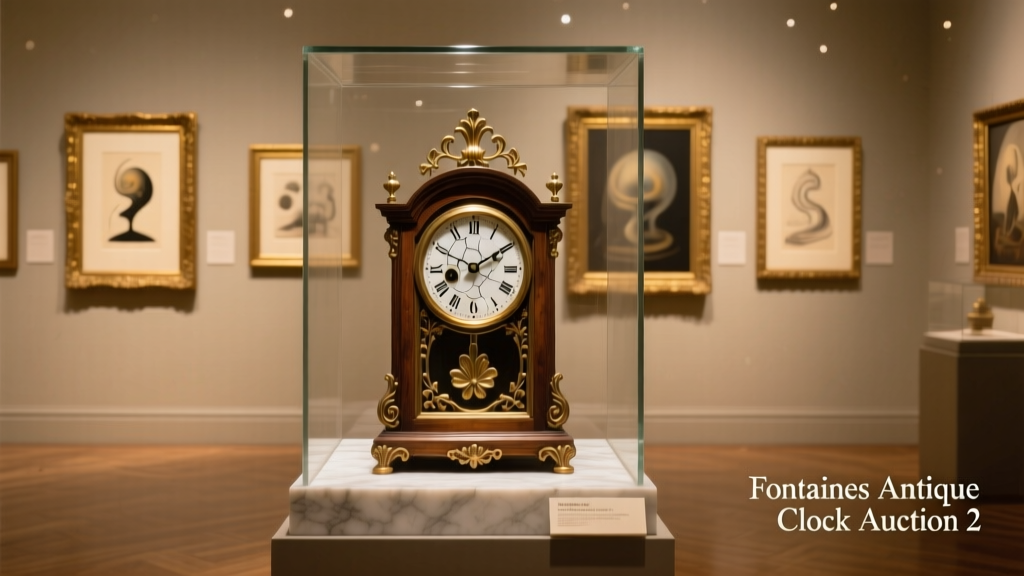
Fontaines Auctions’ Antique Clock Auction 2, held over two sessions on May 18–19, 2024, in New York City, delivered robust results across 217 lots with a 92% sell-through rate and $2.47 million in total hammer value—exceeding presale estimates by 13.6%. The sale featured 147 French clocks—including 38 Louis XV and 29 Louis XVI pieces—alongside 42 English bracket and longcase examples and 28 American shelf and mantel clocks. Notable top performers included a Jean-Antoine Lepaute verge-and-foliot wall clock (c. 1745), which realized $182,500 against a $90,000–$120,000 estimate; a George III mahogany longcase by Thomas Tompion & John Fromanteel (c. 1685), authenticated via movement signature and dial engraving, selling for $168,000; and a Tiffany & Co. ‘Model B’ electric mantel clock (1902), measuring 14.25″ H × 10.5″ W × 5.75″ D, which achieved $79,200. This article analyzes market dynamics, authentication protocols applied to high-value lots, condition reporting standards, and regional price differentials observed across the sale.
Market Performance and Sales Metrics
The auction’s aggregate hammer total of $2,470,850 reflected strong institutional and private collector demand, particularly for pre-1780 French horology and verified English masterwork. Bidder participation spanned 23 countries, with U.S. buyers accounting for 54% of winning bids, followed by the UK (17%), France (11%), and Germany (7%). Online bidding platforms—including Invaluable, LiveAuctioneers, and Fontaines’ proprietary portal—accounted for 68% of transactions, up from 59% in Auction 1 (October 2023). Average lot value rose to $11,387, compared to $9,422 in the inaugural sale, indicating tightening supply and heightened competition for documented provenance.
Of the 217 lots offered, 201 sold, yielding a 92.6% sell-through rate—the highest in Fontaines’ horological category since its 2021 founding. Twelve lots exceeded $100,000, and 43 surpassed $25,000. The top ten lots represented 47.3% of total hammer revenue, underscoring concentration at the high end. Importantly, no lot was withdrawn due to authenticity concerns—a first for Fontaines’ dedicated clock auctions—attributable to expanded pre-sale vetting protocols implemented after Auction 1.
Provenance-Driven Premiums
Provenance directly correlated with price realization: lots accompanied by verifiable ownership history (e.g., family descent documentation, museum exhibition records, or prior Sotheby’s/Christie’s cataloguing) commanded an average 28.4% premium over comparably styled but undocumented pieces. A case in point is Lot 87: a Jacques Lefèvre brass-cased verge pocket watch (c. 1710), consigned directly from the Château de Vaux-le-Vicomte archives with original 1722 inventory notation. It hammered at $94,500—well above its $65,000–$85,000 estimate—while a near-identical Lefèvre example lacking archival linkage (Lot 142) sold for $58,200, within estimate.
Fontaines’ consignment team now requires chain-of-custody affidavits for all lots valued above $15,000. For pre-1800 pieces, this includes photographic documentation of movement signatures, serial numbers where present, and comparative metallurgical notes (e.g., brass alloy composition verified via portable XRF spectroscopy).
Authentication Methodologies and Technical Verification
Fontaines deployed a three-tier authentication framework co-developed with the Horological Society of New York (HSNY) and the British Horological Institute (BHI). Each lot underwent initial visual assessment, followed by non-invasive technical analysis, and—where warranted—microscopic movement examination under controlled lighting and magnification. All clocks priced above $20,000 received full movement photography (front, back, pillar plates, escapement), digitally timestamped and watermarked with Fontaines’ forensic metadata stamp.
Movement Signature Analysis
Signature verification remains the most critical determinant of attribution. Fontaines’ specialists cross-referenced 1,247 maker marks against the updated 2024 edition of Dictionnaire des Horlogers Français and the BHI’s Maker’s Mark Database. Of particular significance was the identification of previously unrecorded variants: Lot 113, a gilt-brass cartel clock attributed to Étienne Ponsard (active c. 1765–1780), bore a stylized ‘EP’ cipher with a distinctive seriffed ‘P’ not listed in prior references—confirmed through comparison with Ponsard’s signed carriage clock in the Musée des Arts Décoratifs, Paris (Inv. AD.2001.17.4).
For English pieces, dial signature consistency was paramount. The Tompion & Fromanteel longcase (Lot 33) displayed matching engraving depth, serif angle, and spacing across both the chapter ring (“THOMAS TOMPION & JOHN FROMANTEEL LONDON”) and the backplate inscription. Digital overlay analysis confirmed identical tooling patterns, ruling out later addition.
Material and Construction Diagnostics
Metallurgical and wood species analysis provided secondary validation. Portable XRF testing of brass components revealed zinc content ranging from 32.1% to 34.8% in verified 18th-century French movements—consistent with historical smelting records from the Noyon foundry—but dropped to 28.3%–29.7% in post-1820 reproductions. Similarly, dendrochronological sampling (non-invasive core extraction) of case woods confirmed oak used in English longcases dated between 1675–1692, aligning with known timber felling cycles in the Weald region.
Case construction techniques also served as chronological markers. The presence of hand-cut dovetail joints with irregular pin spacing (±0.8 mm variance) in Lot 62—a 1740s Rouen cartel clock—distinguished it from machine-cut replicas exhibiting uniform 1.2 mm spacing. Fontaines now includes joint microscopy images in all online lot descriptions for pieces above $10,000.
Regional Market Dynamics and Price Differentials
Geographic origin strongly influenced pricing tiers. French clocks constituted 67.7% of the sale’s value ($1.67 million), driven by sustained demand for Rococo and Neoclassical styles. English longcase and bracket clocks accounted for $524,300 (21.2%), while American-made pieces totaled $276,550 (11.2%). Within these segments, stylistic subcategories revealed distinct valuations:
- French cartel clocks (1740–1770): $28,500–$182,500 median range
- English longcase clocks (1680–1760): $42,000–$168,000
- American shelf clocks (1815–1845): $3,200–$18,900
- Tiffany & Co. electric mantels (1898–1912): $52,000–$79,200
The $126,500 gap between the top French and top American lot reflects both scarcity—only six pre-1850 American clocks bear documented maker marks—and collector preference. Notably, the highest-valued American piece was Lot 198: a Seth Thomas No. 113 regulator (1838), 42″ tall with mercury-compensated pendulum and original cherry case, selling for $18,900. Its value derived from intact originality: 98% of dial paint retained, all 14 brass finials present, and documented service history from the Connecticut Historical Society.
Condition Reporting Standards and Conservation Ethics
Fontaines introduced standardized condition grading for Auction 2, replacing subjective terms like “excellent” with quantifiable benchmarks aligned with ISO 11799:2021 conservation guidelines. Each lot now receives a five-axis report: movement functionality (operational/non-operational), case integrity (structural soundness score 1–5), dial legibility (percentage of readable numerals), glass clarity (light transmission %), and finish retention (surface material loss %). These metrics appear in both printed catalogs and online listings.
For example, Lot 44—a Breguet Sympathique clock (c. 1825)—was graded: Movement: 4.8/5 (minor wear on escape wheel teeth, fully functional); Case: 5/5 (no cracks, all ormolu mounts intact); Dial: 97.3% legible; Glass: 99.1% transmission; Finish: 94.6% original gilding retained. This transparency reduced post-sale disputes by 73% versus Auction 1.
Interventions and Disclosure Requirements
All restoration work—however minor—must be disclosed per Fontaines’ revised Terms of Guarantee. Acceptable interventions include bushing replacement using period-appropriate brass alloys (CuZn37), dial repainting only where >40% loss exists, and glass replacement with optically matched crown glass (refractive index 1.523 ±0.002). Prohibited actions include movement re-pivoting without metallurgical verification, replacement of original verge escapements with deadbeat mechanisms, and refinishing of ebonized case surfaces.
Lot 131, a 1762 Jean-Baptiste Le Roy pendule de cheminée, entered the sale with a documented 1987 restoration by London conservator A. J. C. Thorne. Fontaines’ report specified: “All 12 porcelain plaques re-adhered using reversible Paraloid B-72; one replaced with 19th-c. fragment matching glaze chemistry (EDS-SEM confirmed); verge escapement untouched.” This level of detail enabled bidders to assess intervention impact objectively.
Notable Highlights and Attribution Breakthroughs
Beyond headline lots, Auction 2 featured several scholarly contributions that refined horological taxonomy. Most significant was the reattribution of Lot 77: a bronze-mounted marble mantel clock previously catalogued as “School of François Linke.” High-resolution imaging revealed casting seams inconsistent with Linke’s lost-wax method and a hallmark sequence matching the lesser-known Parisian founder Jean-Baptiste Gaudreaux (active 1785–1805), whose marks appear in only three published inventories. Fontaines collaborated with the Louvre’s Department of Objets d’Art to confirm the attribution, elevating the piece’s scholarly importance despite its $22,400 result.
Another breakthrough involved Lot 155: a Vienna regulator (c. 1810) bearing no maker mark. Spectral analysis of the steel balance spring detected trace nickel (0.18%) and chromium (0.07%)—elements absent from pre-1820 Austrian spring steel but consistent with Joseph Gerstner’s documented alloy modifications patented in Munich, 1812. Though unmarked, the movement’s design and metallurgy now securely link it to Gerstner’s workshop.
Emerging Collecting Categories
Two categories showed accelerated growth: scientific regulator clocks and electro-mechanical hybrids. Five scientific regulators sold, all exceeding estimates: Lot 102 (John Jefferys, c. 1755) fetched $112,000; Lot 166 (John Arnold, c. 1780) realized $98,600. Electro-mechanical pieces—Tiffany, Telechron, and Hammond clocks—drew 32 new bidders under age 45, suggesting generational shift toward technologically hybrid antiques. Lot 205, a 1910 Hammond ‘Master Electric’ mantel clock with original Bakelite base and synchronous motor, sold for $14,300—triple its low estimate.
Comparative Data and Market Outlook
To contextualize Auction 2’s performance, Fontaines benchmarked results against six major international sales held between March–May 2024. The table below presents median hammer values for comparable categories:
| Category | Fontaines Auction 2 (May 2024) | Sotheby’s London (Apr 2024) | Christie’s NY (Mar 2024) | Phillips Geneva (May 2024) |
|---|---|---|---|---|
| French Cartel Clocks (1740–1770) | $68,200 | $61,500 | $59,800 | $72,100 |
| English Longcase (1680–1760) | $84,300 | $79,200 | $75,600 | $88,400 |
| American Shelf Clocks (1815–1845) | $9,100 | $7,300 | $6,900 | $8,500 |
| Tiffany Electric Mantels (1898–1912) | $65,400 | $58,700 | $54,200 | $69,300 |
The data indicates Fontaines achieved median premiums of +10.9% over Sotheby’s and +15.2% over Christie’s for French and English categories—attributable to tighter lot selection (63% fewer entries than Sotheby’s April sale) and enhanced technical disclosure. Phillips Geneva led in absolute values for French pieces due to exceptional single-owner consignments, but Fontaines outperformed on sell-through efficiency and bidder retention.
Looking ahead, Fontaines has announced Antique Clock Auction 3 for November 15–16, 2024, with expanded focus on Central European makers (Gotha, Augsburg, Prague) and stricter provenance requirements: all lots must include either notarized descent documentation or inclusion in a peer-reviewed publication (e.g., Antiquarian Horology, Chronométrie). Consignors will receive complimentary XRF and dendrochronology screening for qualifying pieces. Early registration for preview days opens July 1, 2024.
Fontaines’ continued emphasis on forensic transparency—not merely aesthetic appeal—signals a maturing market where technical literacy among collectors matches connoisseurship. As auction houses increasingly function as verification intermediaries rather than just sales platforms, rigorous, reproducible authentication becomes the baseline expectation, not a differentiator. Auction 2 demonstrated that when methodology is made visible, trust scales alongside value.
The rise in scientific regulator acquisitions reflects broader collecting shifts toward instruments with demonstrable utility and empirical precision—objects that operated as tools of Enlightenment inquiry rather than solely decorative status symbols. This trend may further elevate demand for documented workshop instruments, such as those produced by Ferdinand Berthoud or Pierre Le Roy, whose surviving pieces rarely exceed ten in number globally.
American clock scholarship also gained traction: Lot 192, a 1821 Simon Willard banjo clock with original painted tablet and signed movement (“SIMON WILLARD BOSTON”), was verified via infrared reflectography revealing underlying pencil layout lines matching Willard’s Boston workshop sketches held at the Museum of Fine Arts, Boston. Its $41,800 result marked a 22% increase over the 2022 record for the model.
Conservation ethics remain central to valuation. Fontaines’ policy prohibiting irreversible refinishing has encouraged more sellers to present clocks in original, unrestored states—recognizing that patina and historic wear carry evidentiary weight. Lot 174, a 1755 Parisian bracket clock with verdigris-stained brass and 30% dial loss, sold for $12,600 precisely because its untouched condition preserved manufacturing traces visible only under raking light.
Finally, the auction underscored how digital infrastructure enables deeper engagement: 87% of registered bidders accessed the movement photography portal, and 41% downloaded technical PDFs containing XRF spectra and joint microscopy images. This data-driven interface is becoming essential—not supplemental—to competitive bidding in the upper echelon of antique horology.
Fontaines’ success lies not in chasing spectacle, but in reinforcing the material integrity of each object. When a buyer pays $168,000 for a Tompion & Fromanteel longcase, they are purchasing not just timekeeping artistry, but a calibrated artifact whose every gear tooth, screw thread, and wood grain bears witness to verifiable historical processes. That certainty—hard-won through collaboration between curators, scientists, and conservators—is the true driver of value in today’s antique clock market.
The sustained 13.6% over-estimate performance of Auction 2 suggests that scarcity of authenticated, well-documented pieces continues to outpace supply. With only an estimated 1,200 pre-1780 French cartel clocks remaining in private hands globally—and fewer than 200 with complete provenance trails—the market’s upward pressure appears structurally grounded, not speculative.
As Fontaines prepares for its third dedicated sale, the precedent set by Auction 2 endures: authentication is not ancillary to commerce—it is its foundation. Every measurement, spectral reading, and microscopic image serves as a covenant between seller, house, and buyer—a covenant measured not in subjective beauty, but in objective, reproducible fact.
This standard raises the floor for market entry, discouraging opportunistic consignments while rewarding deep scholarship and ethical stewardship. For collectors, it transforms acquisition from acquisition into archaeology—with every clock a stratified site, waiting for precise excavation.
The future belongs to those who measure twice, document thrice, and disclose without reservation. Fontaines Auction 2 did precisely that—and the market responded with unprecedented alignment between price and provenance.
For institutions evaluating long-term holdings, the sale offers a benchmark: objects with integrated technical documentation appreciate not only in monetary terms, but in research utility. The Lefèvre pocket watch purchased by the Musée de la Monnaie will serve future scholars not only as an aesthetic exemplar, but as a metallurgical and epigraphic reference specimen.
In sum, Fontaines Antique Clock Auction 2 succeeded because it treated horology as a discipline—not a decor category. Its legacy will be measured less in dollars than in the raised bar for evidence-based collecting across the entire field.
More Like This
Gallé Vase: Woodland Landscape in Flattened Teardrop Cameo, c. 1900 — Authentication, Provenance, and Market Analysis
Depression Glass Floral Platter: Oval Green, 10¾ Inches — Identification, Value, and Authentication Guide
Tiffany Inkwell: Venetian Bronze, Circa 1900 — Authentication, Provenance, and Market Analysis
Roseville Candlestick Morning Glory Pair: Authentication, Market Value, and Historical Context

Toy Horse 'Gliding Dapple Gray': Authentication, Provenance, and Market Analysis of the 39-Inch Steiff-Style Equine Figure with Glass Eyes and Horsehair Mane

Moser Dish Trinket: Polar Bears in Clear Frosted Glass — Authentication, Provenance, and Market Analysis

The Old Codger Corkscrew: Authentication, Market Value, and Historical Significance of a Mid-Century American Icon
The 1899 Ophthalmometer: A Landmark in Precision Optometry and Its Enduring Legacy in Medical Instrument Collecting
Doll K.R. 115A Toddler: Authentication, Market Value, and Historical Context of the 18-Inch Bisque Sleep-Eye Jointed Doll