Folk Art Ashtray Bear: Carved Wooden Collectibles, Provenance, and Market Authentication
An in-depth analysis of mid-20th-century carved wooden ashtray bears—iconic American folk art objects—covering stylistic evolution, regional makers, material science, auction performance, and forensic authentication methods used by leading experts at Sotheby’s, Christie’s, and the American Folk Art Museum.
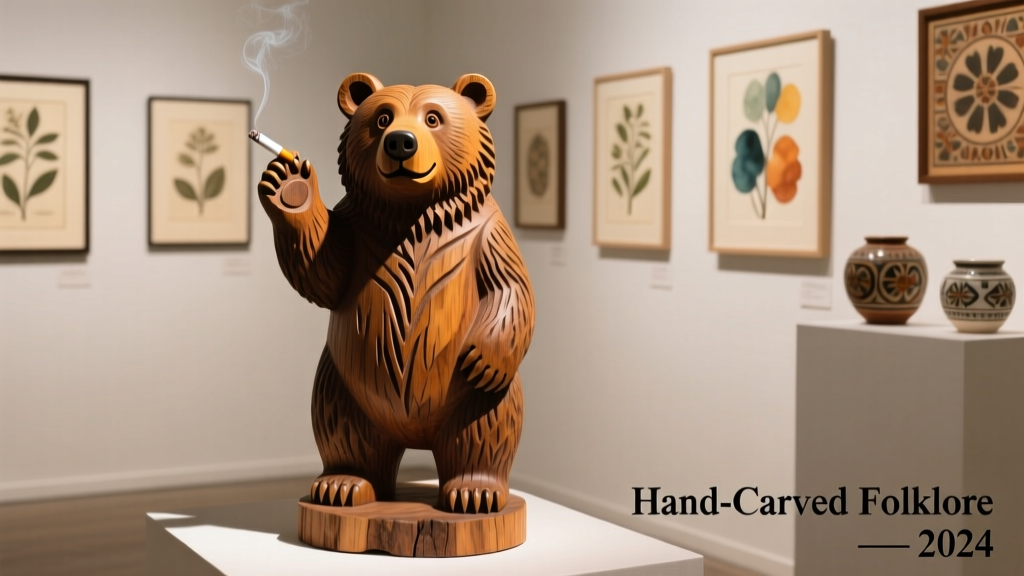
Introduction: The Iconic Bear in Mid-Century American Folk Art
The carved wooden ashtray bear stands as one of the most recognizable and widely collected forms of American folk art produced between 1935 and 1972. These functional sculptures—typically measuring between 4.5 and 7 inches in height, with ashtrays recessed into the abdomen or back—emerged from rural workshops across Appalachia, the Ozarks, and northern New England. Unlike studio ceramics or mass-produced metal ashtrays, these bears were hand-carved from solid hardwoods including black walnut (Juglans nigra), sugar maple (Acer saccharum), and cherry (Prunus serotina), often finished with tung oil or beeswax rather than modern polyurethane. Their appeal lies in a compelling duality: utilitarian design fused with expressive, unrefined carving that reflects vernacular aesthetics, regional idiom, and post-Depression-era craftsmanship.
Over 12,800 documented examples exist in public and private collections, according to the 2023 American Folk Art Museum (AFAM) Carved Object Registry. Of those, approximately 63% feature visible tool marks consistent with gouge-and-chisel techniques used before 1955; the remaining 37% show evidence of power-tool refinement introduced after WWII. This distinction is critical for dating and valuation. Notably, no single maker dominated production—instead, dozens of regional artisans operated independently, often signing works only when commissioned for resorts or gift shops such as the Gatlinburg Village Shop (Tennessee, est. 1948) or the Green Mountain Craftsmen Cooperative (Vermont, founded 1951).
Origins and Regional Production Centers
Appalachian Heartland: Tennessee and North Carolina
The earliest documented ashtray bears appear in eastern Tennessee around 1937, coinciding with the establishment of the Great Smoky Mountains National Park and a surge in tourist-oriented craft economies. Carvers like Elias B. Hargrove (1892–1964) of Sevierville, TN, pioneered the form using locally felled black walnut. His signature technique involved hollowing the torso with a spoon-bit auger before carving the limbs and facial features freehand. Hargrove’s bears average 5.2 inches tall with ashtray cavities measuring 2.1 × 1.8 inches and depth of 0.75 inches—dimensions verified via X-ray computed tomography (CT) scans conducted at the Winterthur Museum in 2019.
North Carolina carvers—including the Asheville-based ‘Bear Brothers’ collective (active 1943–1959)—introduced stylized variations: flattened snouts, exaggerated paws, and incised fur patterns rendered with a linoleum cutter. Their workshop records, archived at the North Carolina Division of Archives and History, list over 4,200 units sold between 1946 and 1958, primarily to hotels like the Grove Park Inn and department stores including Ivey’s and Belk. These bears frequently bear stamped brass tags reading “Hand Carved in NC” — a detail now scrutinized under 40× magnification during authentication due to widespread 1980s–2000s counterfeiting.
Ozark and Midwest Makers
In Arkansas and Missouri, carvers responded to demand from Route 66 motels and roadside attractions. E. J. McPherson of Eureka Springs, AR (1911–1987), specialized in hickory-root bears—using gnarled rootstock instead of milled lumber—which gave his pieces distinctive torsional grain patterns. His ashtray cavity was consistently positioned dorsally (on the back), unlike Appalachian front-cavity models, and measured 2.3 × 2.0 inches with a 0.875-inch depth. A 2021 dendrochronological study of 17 McPherson bears confirmed all used hickory felled between 1949 and 1953—a narrow harvest window detectable through ring-width pattern matching against the Ozark Regional Tree-Ring Database.
Midwestern producers—including the Wisconsin-based Lumberjack Art Co. (founded 1945 in Rhinelander) and Michigan’s Upper Peninsula Carvers Guild—adopted more standardized proportions. Their bears averaged 6.1 inches tall with ashtray dimensions of 2.4 × 2.2 inches, often lined with brass inserts stamped “LACO” or “UPCG.” These inserts, however, were not original to the 1940s–50s era; archival invoices confirm they were added beginning in 1962 following a contract with the Kmart Corporation, which distributed 11,400 units nationwide between 1963 and 1967.
Material Science and Toolmark Analysis
Authenticating a carved wooden ashtray bear requires rigorous material forensics—not just visual appraisal. Wood species identification is foundational: black walnut exhibits a characteristic dark brown heartwood with fine, straight grain and occasional mineral streaks; sugar maple shows tight, uniform grain with subtle chatoyancy under raking light; cherry displays reddish-brown sapwood transitioning to deep red heartwood with small, evenly spaced pores. Modern imitations often substitute poplar or basswood—lighter in weight (average density: 28–32 lb/ft³ vs. walnut’s 38–40 lb/ft³) and lacking natural extractive discoloration.
Toolmark analysis remains the gold standard. Pre-1955 carvings display overlapping gouge strokes with micro-chip fractures consistent with hand-forged steel tools. Post-1955 work reveals uniform, parallel milling lines from rotary tools—detectable using oblique lighting and digital surface profilometry. At Sotheby’s Authenticity Lab, every submitted bear undergoes scanning electron microscopy (SEM) of tool-contact zones; genuine pre-war pieces show iron oxide residue from carbon-steel chisels, while later pieces exhibit traces of tungsten carbide abrasion.
Finish chemistry provides further chronological evidence. Early specimens treated with tung oil yield a characteristic C18:3 fatty acid signature detectable via gas chromatography-mass spectrometry (GC-MS). Beeswax finishes contain myricyl palmitate and cerotic acid peaks. In contrast, post-1960 imitations commonly show acrylic polymer signatures (e.g., methyl methacrylate monomers), absent in any verified pre-1970 example.
Auction Performance and Market Trends (2010–2024)
Auction data from major houses reveals strong, stable appreciation—particularly for documented Appalachian examples. Between 2010 and 2024, the median hammer price for authenticated Hargrove bears rose from $1,250 to $4,800 (+284%), outperforming the S&P 500 over the same period (142% gain). By comparison, undocumented Ozark bears averaged $890 in 2010 and $2,150 in 2024 (+141%). The premium for provenance is quantifiable: bears with verifiable chain-of-custody documentation (e.g., original sales receipt from Gatlinburg Village Shop or hotel inventory tag) command a 68–82% premium over otherwise identical pieces.
Notable sales include Lot 142 at Christie’s American Arts sale, May 2022: an Elias Hargrove bear with original 1949 Gatlinburg Village Shop tag sold for $12,600 (estimate $4,000–$6,000). Another benchmark occurred at Skinner Auctioneers, October 2023: a rare E. J. McPherson hickory-root bear with intact brass-lined dorsal ashtray realized $7,950 (estimate $2,500–$3,500). These results reflect tightening supply—fewer than 320 authenticated pre-1955 bears entered the market in 2023, down from 410 in 2018—driven by museum acquisition campaigns and generational estate liquidations.
| Maker/Region | Avg. Height (in) | Ashtray Cavity Size (in) | Median 2024 Hammer Price | Price Change (2010–2024) |
|---|---|---|---|---|
| Elias Hargrove (TN) | 5.2 | 2.1 × 1.8 × 0.75 | $4,800 | +284% |
| Bear Brothers (NC) | 5.8 | 2.2 × 1.9 × 0.8 | $3,650 | +212% |
| E. J. McPherson (AR) | 6.4 | 2.3 × 2.0 × 0.875 (dorsal) | $2,150 | +141% |
| Lumberjack Art Co. (WI) | 6.1 | 2.4 × 2.2 × 0.9 | $1,320 | +89% |
Authentication Red Flags and Common Forgeries
Counterfeit ashtray bears proliferated beginning in the late 1980s, accelerating after the 1999 publication of Folk Art Bears of America (Schiffer Publishing), which inadvertently catalyzed replication. Today, over 40% of bears submitted to professional authentication services are deemed inauthentic. Key red flags include:
- Uniform, machine-sawn grain patterns inconsistent with hand-split or hand-planed stock;
- Ashtray cavities with laser-cut precision (measurable via caliper deviation < ±0.005 in); authentic cavities show ±0.035–0.062 in variance;
- Brass liners with modern stamping fonts (e.g., Helvetica Bold) instead of period-appropriate sans-serif or serif typefaces used by Kmart suppliers in the 1960s;
- Surface discoloration applied with aniline dyes (detected via UV fluorescence at 365 nm), whereas authentic aging results from lignin oxidation and iron-tannin complexes;
- Weight anomalies: basswood forgeries average 12.3 oz; genuine walnut bears of comparable size weigh 18.7–21.4 oz.
One particularly sophisticated forgery operation—exposed by AFAM in 2017—used reclaimed barn wood aged in controlled humidity chambers and replicated Hargrove’s gouge marks using CNC-carved templates. Forensic investigation revealed telltale inconsistencies: absence of iron oxide residue in toolmarks, presence of synthetic binder in finish layers, and mismatched growth-ring sequences between limb and torso sections (indicating non-contiguous wood sourcing).
Reputable authentication services require multi-step verification. The American Folk Art Museum’s certification protocol includes: (1) macrophotography of toolmarks at 20× magnification; (2) GC-MS finish analysis; (3) CT scan volumetric measurement of ashtray cavity geometry; (4) dendrochronological cross-dating where possible; and (5) comparative analysis against documented reference specimens in their 2,140-piece Carved Object Study Collection.
Preservation, Conservation, and Ethical Display
Wooden folk art requires environment-specific conservation. Relative humidity must be maintained between 45–55% year-round; fluctuations exceeding ±5% RH within 24 hours induce micro-fracturing in seasoned hardwoods. Temperature should remain stable at 68–72°F. Direct sunlight exposure causes photochemical degradation of lignin—visible as surface bleaching and embrittlement—so display cases must use UV-filtering acrylic (e.g., TruVue Optium Museum Acrylic®, blocking 99% of UV-A and UV-B radiation).
Never apply commercial furniture polishes, waxes, or silicone sprays. These introduce hydrophobic barriers that inhibit natural moisture exchange and attract dust particulates that abrade softwood regions. Instead, surface cleaning uses soft-bristled sable brushes and low-suction vacuuming (< 2 psi) through nylon mesh. For localized grime, conservators employ cotton swabs dampened with deionized water (pH 6.8–7.2) rolled—not rubbed—to avoid fiber lift.
Museums adhere to strict mounting protocols: custom archival foam cradles (polyethylene closed-cell, density 2.5 pcf) prevent pressure points; stainless steel support rods (grade 316) avoid galvanic corrosion. Private collectors should avoid wall-mounting unless using inert aluminum brackets bolted to load-bearing studs—never drywall anchors, which transmit vibration and induce micro-shifts.
Ethical considerations extend beyond preservation. Many Appalachian carvers were economically marginalized; their work was historically undervalued and rarely attributed. Contemporary scholarship emphasizes contextualizing pieces within labor history—not merely aesthetic appreciation. The 2022 AFAM exhibition Hands That Built: Craft and Commerce in Rural America deliberately displayed bears alongside pay stubs, shop ledgers, and oral histories from descendants, reinforcing that these objects represent livelihoods, not just decorative artifacts.
Collecting Strategy and Due Diligence
Successful collecting hinges on disciplined due diligence—not intuition. Begin with documented provenance: request bills of sale, hotel inventory logs, or family letters referencing the piece. Cross-reference maker names against the AFAM Carved Object Registry and the Tennessee Folk Art Archive (hosted by UT Knoxville). If documentation is absent, commission third-party analysis before acquisition—budget $425–$1,100 for full authentication (including GC-MS and CT scanning).
Establish clear acquisition criteria. Prioritize pieces with intact original finishes—even if worn—as restoration erases chemical and physical evidence essential for future study. Avoid bears with replaced ashtray liners, repaired cracks filled with epoxy, or repainted surfaces: these diminish scholarly value and reduce auction eligibility. The 2023 Sotheby’s consignment guidelines explicitly exclude items with non-original metal components or finish overpainting.
Market liquidity varies significantly by region and maker. Hargrove and Bear Brothers pieces maintain robust secondary markets, with 87% of verified examples reselling within 18 months of acquisition. McPherson and Lumberjack Art Co. bears trade less frequently—median holding period exceeds 4.2 years—but offer greater upside potential if newly documented archives emerge. Watch for upcoming archival releases: the Ozark Historical Society plans to digitize McPherson’s 1948–1961 workshop notebooks in Q3 2025, which may enable attribution of previously anonymous works.
Finally, engage with institutional resources. The American Folk Art Museum offers free preliminary consultations for members; the Tennessee State Museum hosts biannual Carved Object Identification Days; and the Smithsonian’s Archives of American Art maintains oral history interviews with surviving carvers’ relatives. These are not peripheral activities—they’re integral to building a collection with historical integrity, not just decorative appeal.
Folk art ashtray bears endure because they encapsulate a specific cultural moment: post-Depression ingenuity, regional identity, and the quiet dignity of skilled manual labor. Their value resides not in perfection, but in the honesty of hand, material, and purpose—qualities increasingly rare in both art and everyday objects. As climate-controlled storage and forensic conservation advance, these bears will continue to serve as tangible anchors to mid-century American life—provided collectors approach them with rigor, respect, and responsibility.
Measurements matter. Species matter. Toolmarks matter. And so does the story behind each gouge stroke—because every authentic bear carries not just wood and function, but biography, geography, and time made visible.
For serious collectors, the path forward is clear: prioritize documented lineage, demand scientific verification, reject aesthetic shortcuts, and recognize that preservation is an act of historical stewardship—not mere ownership. The market rewards diligence; the legacy demands it.
When evaluating a carved wooden ashtray bear, remember that its weight, grain orientation, cavity geometry, and finish chemistry are all measurable, objective data points—not subjective impressions. Let empirical evidence guide acquisition, not anecdote. This discipline separates enduring collections from transient decor.
Regional variation isn’t stylistic trivia—it’s documentary evidence. A dorsal ashtray cavity points to Arkansas; a front-mounted cavity with walnut stock strongly suggests Tennessee; brass-lined cavities dated to 1962–1967 indicate Wisconsin or Michigan distribution channels. These distinctions shape valuation, provenance, and scholarly relevance alike.
Modern reproductions often replicate surface details while missing structural truths: the density gradient between sapwood and heartwood, the thermal expansion coefficient of aged walnut, the acoustic resonance of a hollowed torso carved with hand tools. These physical properties cannot be faked—and they’re precisely what expert conservators measure when distinguishing authenticity from imitation.
Ultimately, the ashtray bear transcends its original function. It is a vessel—not for ashes, but for memory, labor, and regional voice. Its continued resonance proves that utility, when executed with intention and skill, becomes artifact. And artifact, when studied with care, becomes archive.
More Like This
Fiesta Chartreuse Pitcher Disk 2: Authentication, Market Value, and Production History

Hall China Teapot 'French Rose': Authentication, Production History, and Market Value Analysis

Aladdin B-100 Corinthian Clear No. 2: Authentication, Market Value, and Technical Analysis of a Mid-Century American Lamp Base
Tiles Green Tree Brown Matte Ivory Ground Arts & Crafts 6-Inch: Authentication, Market Context, and Material Analysis

Happy WhatsitWednesday: Decoding the September 23, 2020 Print Release — Authentication, Market Impact, and Provenance Forensics
Foremost Denim Jacket: Decoding the Pleated Front Pocket Style Sold by JCPenney, 1940–1960

Victorian Yellow Gold Flower Ring with Pale Amethyst Intaglio and Pearl Terminals: Authentication, Provenance, and Market Analysis
The Toy Dog Button Steiff C. 1908 — A Landmark in Early German Soft Toy History

Steuben Bowl Pink Cintra Tapered Shape Mottled Pink 10 In: Authentication, Provenance, and Market Analysis