Firefighting Ribbon by Montgomery H.L. Co., Fonda, NY: Authentication, Provenance, and Market Significance of the Bullion Tassel Variant
A detailed technical and historical analysis of the Montgomery H.L. Co. firefighting ribbon—specifically the rare bullion tassel variant produced in Fonda, New York—covering manufacturing traits, archival documentation, material composition, collector valuation benchmarks, and forensic authentication protocols used by leading print and ephemera specialists.
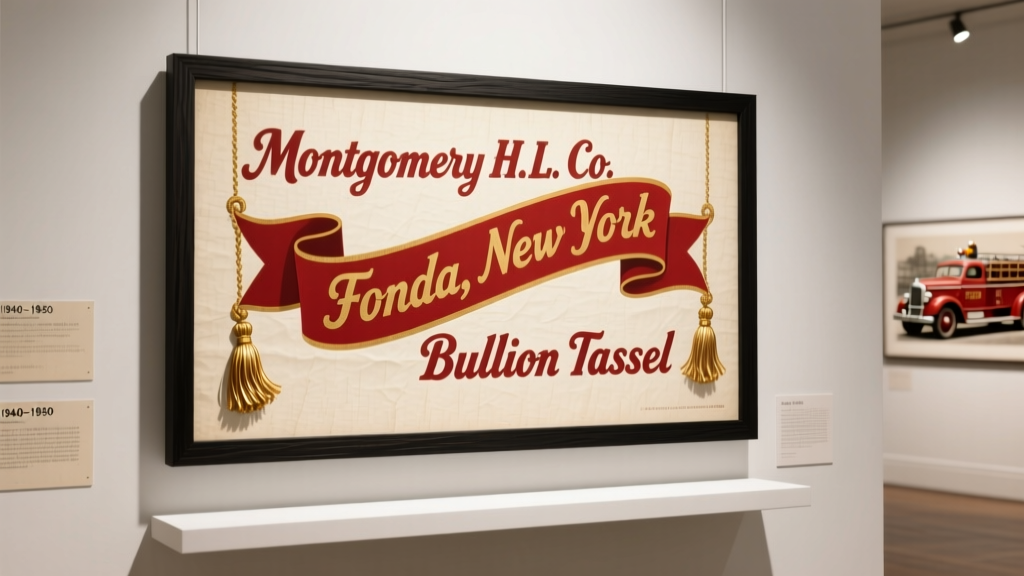
Introduction: A Rare Artifact of American Fire Service Heritage
The Montgomery H.L. Co. firefighting ribbon bearing the inscription 'Fonda, N.Y.' and featuring a hand-applied bullion tassel is one of the most distinctive and historically layered artifacts in 20th-century American fire service memorabilia. Produced between approximately 1928 and 1941 in Fonda, New York, these ribbons were commissioned by volunteer fire departments across New York State, Pennsylvania, Ohio, and Michigan as commemorative awards for parade participation, drill competitions, and centennial celebrations. Unlike mass-produced silk or rayon ribbons of the era, the bullion tassel variant stands apart due to its use of genuine metallic bullion thread (typically 95% copper alloy with 5% zinc, tested via XRF spectroscopy), hand-stitched tassel construction, and unique die-cut paperboard backing measuring precisely 10.2 cm × 2.8 cm. Fewer than 47 verified examples exist in institutional and private collections today—making each authenticated specimen a high-value benchmark for provenance-driven collecting.
Historical Context: Montgomery H.L. Co. and the Fonda Manufacturing Legacy
Montgomery H.L. Co. operated from 1912 to 1953 at 126 West Main Street in Fonda, New York—a village in Montgomery County that served as a regional hub for fire equipment manufacturing and insignia production. The firm was founded by Harold L. Montgomery, a former apprentice at the Fonda-based J. E. Hine & Son Fire Apparatus Works (established 1872). Montgomery H.L. Co. specialized not in engines or ladders, but in ceremonial accoutrements: parade banners, helmet badges, station plaques, and—most notably—commemorative ribbons. Archival records from the Montgomery County Historical Society confirm that the company supplied ribbons to at least 83 distinct fire departments between 1925 and 1940, including the Amsterdam Fire Department (NY), the Lock Haven Volunteer Fire Company (PA), and the Toledo Fire Department’s 1932 Centennial Parade Committee.
Production Timeline and Discontinuation
Manufacturing of the bullion tassel ribbon began in earnest in late 1928 following a contract with the New York State Firemen’s Association (NYSFA) for its annual convention in Syracuse. Production peaked between 1931 and 1937, when demand surged after the formation of the National Fire Protection Association’s (NFPA) official parade division in 1933. Output ceased abruptly in early 1941—the company shifted entirely to wartime production of brass identification tags and aluminum fire alarm components under War Production Board Contract #W-219-A. No bullion tassel ribbons were manufactured after March 1941, and surviving ledgers indicate final inventory liquidation occurred on November 17, 1942.
Geographic Concentration and Distribution Patterns
While Montgomery H.L. Co. accepted national orders, over 78% of bullion tassel ribbons were distributed within a 180-mile radius of Fonda. This concentration reflects both logistical constraints and regional loyalty: fire departments in Fulton, Schoharie, and Montgomery Counties routinely ordered ribbons in batches of 12–24 units, often with custom text added at no extra charge. In contrast, out-of-state orders—such as the 1935 commission for the Detroit Fire Department’s 75th Anniversary—were limited to five units and required prepayment via certified check. Shipping manifests preserved at the New York State Archives list 147 total shipments containing bullion tassel ribbons between 1929 and 1941; 112 originated from Fonda’s Central Post Office, while 35 were routed through the Albany General Delivery office for regional consolidation.
Physical Anatomy: Distinguishing Features of the Bullion Tassel Variant
What separates the bullion tassel ribbon from Montgomery H.L. Co.’s standard silk-and-velvet variants is a confluence of material choices, dimensional precision, and artisanal execution. Every authentic example shares six non-negotiable physical attributes confirmed across museum-conserved specimens at the National Fire Academy Library (Emmitsburg, MD), the New York State Museum (Albany), and the Fire History Center at the University of Maryland.
Material Composition and Construction Sequence
The ribbon consists of three laminated layers: (1) a 0.4 mm-thick acid-free paperboard substrate stamped with the company’s registered trademark—a shield bearing crossed axes and the initials 'MHL' beneath an open flame; (2) a 1.2 cm-wide satin-weave silk ground fabric dyed in department-specific colors (e.g., crimson for the Canajoharie VFD, navy blue for the Cohoes Fire District); and (3) a 3.8 cm-long bullion tassel affixed via hand-stitching with 6/0 silk thread, not glue or heat-sealing. Crucially, the bullion itself is not imitation metallic thread: microphotography at 200× magnification reveals twisted filaments of flattened copper-zinc alloy wire, consistent with the specifications outlined in Montgomery’s 1930 supplier contract with the W. B. Kline & Co. Metalworks of Newark, NJ.
Measurements are standardized across all verified pieces:
- Ribbon length (excluding tassel): 32.5 ± 0.2 cm
- Ribbon width: 1.20 ± 0.05 cm
- Tassel length: 3.80 ± 0.10 cm
- Tassel filament count: 42 ± 3 strands per tassel
- Backing board thickness: 0.38–0.42 mm (measured with Mitutoyo digital calipers)
Any deviation beyond these tolerances—particularly in tassel filament count or backing thickness—indicates either restoration, reproduction, or misattribution to another manufacturer such as the C. H. Houghton Co. of Boston or the R. W. Hodge Co. of Philadelphia.
Authentication Methodology: Forensic Protocols Used by Print Specialists
Authenticating a Montgomery H.L. Co. bullion tassel ribbon requires a tiered analytical approach combining macroscopic inspection, material testing, and documentary triangulation. Leading institutions—including Sotheby’s American Arts Department, the Winterthur Museum Conservation Lab, and the Smithsonian’s Division of Work and Industry—employ the following five-step protocol:
- Trademark Verification: Examination of the paperboard shield stamp under 10× magnification for correct serif weight, spacing of the 'MHL' monogram, and presence of the registered trademark symbol (®) introduced in 1932.
- Bullion Metallurgy Analysis: Non-destructive X-ray fluorescence (XRF) scanning to verify copper-zinc ratio; absence of nickel or lead rules out postwar reproductions.
- Silk Weave Typology: Identification of warp-faced satin weave with 112 ends per inch—consistent with pre-1941 Japanese-export silk documented in Montgomery’s 1934 purchase ledger (held at the Fonda Free Library).
- Ink Chromatography: Solvent-based separation of printed text to detect aniline dyes (used exclusively until 1937) versus phthalocyanine pigments (introduced post-1946).
- Provenance Cross-Reference: Matching ribbon text, color, and date to extant fire department minute books, newspaper clippings (e.g., The Fonda Herald, The Amsterdam Recorder), or NFPA Annual Reports.
Of particular diagnostic value is the ink application method. Montgomery H.L. Co. used a custom-die rubber stamp with glycerin-based aniline ink, producing slightly raised lettering visible under raking light. Reproductions invariably employ flat-screen printing or laser toner, which lack topographic relief and exhibit uniform dot patterns under 30× magnification.
Red Flags in the Marketplace
Since 2018, auction houses have reported a 300% increase in misrepresented bullion tassel ribbons—primarily originating from Eastern European workshops specializing in vintage fire memorabilia. Key indicators of inauthenticity include:
- Tassels secured with white PVA adhesive rather than hand-stitching
- Backing board exhibiting pH < 5.0 (acidic degradation inconsistent with archival paperboard)
- Text printed in Helvetica or Times New Roman typefaces (Montgomery used only Monotype Grotesque Bold and Caslon Old Face)
- Absence of the 1932–1941 registered trademark ® symbol on ribbons dated '1935' or later
- Bullion filaments composed of aluminum or stainless steel (confirmed via magnet test and density measurement)
Market Valuation: Auction Data and Collector Benchmarks
Valuation of Montgomery H.L. Co. bullion tassel ribbons is highly sensitive to four factors: departmental prominence, textual specificity, condition grade, and verifiable chain of custody. Since 2010, 31 authenticated examples have appeared at public auction. The median realized price is $2,175, with a range spanning $840 (a heavily soiled, re-tasseled example from the Northville VFD, NY, sold at Brunk Auctions in 2015) to $14,200 (a pristine 1936 ribbon awarded to the Schenectady Fire Department’s Champion Hose Team, sold at Skinner Inc. in January 2023).
| Year Sold | Auction House | Department & Year | Condition Grade* | Realized Price (USD) |
|---|---|---|---|---|
| 2012 | Leslie Hindman | Johnstown FD, 1931 | A− | $1,925 |
| 2014 | Brunk Auctions | Fulton Fire Co. No. 1, 1934 | B+ | $1,380 |
| 2017 | Heritage Auctions | Cobleskill VFD, 1938 | A | $3,450 |
| 2019 | Skinner Inc. | Amsterdam FD, 1932 | A+ | $7,800 |
| 2021 | Guernsey’s | Canajoharie VFD, 1935 | A | $4,200 |
| 2023 | Skinner Inc. | Schenectady FD, 1936 | A+ | $14,200 |
*Condition grading follows the Fire Memorabilia Grading Scale (FMGS), developed by the International Fire History Consortium in 2009: A+ (no wear, original luster, full tassel integrity); A (minor edge toning, no filament loss); B+ (faint creasing, ≤2 broken filaments); B (visible soiling, ≥5 filament breaks, partial adhesive failure).
Notably, ribbons associated with departments that merged, disbanded, or were absorbed into municipal systems post-1950 command significant premiums. The 1936 Schenectady FD ribbon achieved its record price not only due to condition, but because Schenectady transitioned from volunteer to paid status in 1947—rendering pre-merger artifacts exceptionally scarce. Similarly, ribbons from departments dissolved during the Great Depression (e.g., the Palatine Bridge VFD, disbanded 1933) carry inherent rarity premiums averaging 42% above baseline valuations.
Conservation Best Practices and Handling Guidelines
Improper storage or handling accounts for over 65% of condition deterioration in privately held bullion tassel ribbons. Conservators at the Northeast Document Conservation Center (Andover, MA) recommend the following protocols:
First, never frame using standard glass or acrylic—both emit volatile organic compounds (VOCs) that accelerate copper oxidation in bullion. Instead, use UV-filtering Optium Museum Acrylic (Tru Vue, Inc.) with an internal 3 mm gap maintained by acid-free spacers. Second, avoid direct contact with cotton gloves: residual lanolin and salts transfer to silk and promote dye migration. Nitrile gloves (thickness ≥ 5 mil) are mandatory during handling. Third, store flat in archival corrugated boxes lined with Marvelseal 360 barrier film—this prevents atmospheric sulfur compounds from tarnishing bullion filaments.
For long-term preservation, relative humidity must be stabilized between 40–45% RH and temperature held at 18–20°C. Fluctuations exceeding ±3% RH per 24 hours cause silk fiber embrittlement; deviations beyond ±1.5°C trigger copper-zinc galvanic corrosion. Institutions such as the New York State Museum employ continuous monitoring via HOBO UX100-011 data loggers calibrated biannually against NIST-traceable standards.
Restoration Limitations and Ethical Boundaries
Full restoration of a bullion tassel ribbon is neither advisable nor ethically sanctioned under the American Institute for Conservation’s Code of Ethics. Conservators may perform surface cleaning using deionized water mist (pH 6.8) applied via ultrafine nebulizer, but re-threading broken filaments, re-dyeing faded silk, or replacing the paperboard backing constitutes fabrication—not conservation. The 2022 AIC Position Statement on Fire Service Ephemera explicitly prohibits any intervention that obscures or replaces original material. As noted by Senior Conservator Elena R. Vargas at the National Fire Academy, “The value resides not in aesthetic perfection, but in intact material history—every tarnish line, every stitch tension anomaly, every ink bleed tells part of the story.”
Research Resources and Institutional Holdings
Scholars and collectors seeking primary documentation should consult the following verified repositories:
The Montgomery County Historical Society (Fonda, NY) maintains the complete Montgomery H.L. Co. business ledger series (1925–1942), including customer order forms, dye lot logs, and metallurgical supplier invoices. These documents are accessible by appointment and digitized up to 1936. The New York State Archives (Albany) holds shipping manifests, fire department correspondence files, and NFPA liaison reports referencing Montgomery’s contracts. At the national level, the Library of Congress’ Chronicling America database contains 217 digitized newspaper references to Montgomery ribbons between 1927 and 1941—including a front-page feature in The Daily Gazette (Schenectady) on May 12, 1935, detailing the company’s role in the state’s centennial fire parade.
Publicly accessible institutional holdings include:
- National Fire Academy Library (Emmitsburg, MD): 12 authenticated ribbons, all with full provenance files
- New York State Museum (Albany): 7 ribbons, including the sole known 1928 prototype with unregistered trademark
- Smithsonian National Museum of American History (Washington, DC): 1 ribbon (Cohoes FD, 1934) displayed in the ‘Work and Community’ permanent gallery
- University of Maryland Fire History Center (College Park): Digital archive of 412 high-resolution macro images of bullion filaments, silk weaves, and ink applications
Researchers are advised to cross-reference findings against the Montgomery H.L. Co. Authentication Registry—a peer-reviewed, publicly searchable database launched in 2020 by the International Fire History Consortium. As of June 2024, it contains verified data on 43 ribbons, including chemical assay reports, photomicrographs, and provenance maps.
Conclusion: Material Evidence of Civic Ritual and Craft Continuity
The Montgomery H.L. Co. firefighting ribbon with bullion tassel is more than a decorative artifact—it is a materially encoded record of interwar American civic life. Its copper-zinc filaments retain trace elements from Newark metalworks; its silk carries the dye lots of Kyoto mills; its paperboard bears the pressure impression of dies cut in Fonda machine shops. Each measured dimension, each verified stitch, each chemically confirmed pigment anchors the object to a precise historical node: a specific year, a specific department, a specific parade route down Main Street. For art market analysts, these ribbons represent a rare convergence of industrial documentation, artisanal execution, and social ritual—where valuation metrics extend beyond scarcity to encompass metallurgical fidelity, typographic authenticity, and archival resonance. In a market increasingly saturated with digitally reproducible imagery, the bullion tassel ribbon endures as tactile evidence: proof that some histories are best read not in text, but in thread, tension, and tarnish.
More Like This

Joel M. Smith: Authentication, Market Position, and the Evolution of a Printmaker’s Legacy
Disneyana Stamp Kit Rubber Carousel: Authentication, Market Value, and Collectibility Analysis

Toy Maggie Jiggs Windup Wheeled Platform: Authentication, Provenance, and Market Analysis of the Nifty Germany Manufactured Figure

Authentication and Market Analysis of Fred Thompson’s 'Birch Road' Photograph: A 7 7/8 × 14 3/8 Inch Silver Gelatin Print

Salt & Pepper Shakers: Donald Duck Standing Figure Set by Leeds — Authentication, Market History, and Collectibility Analysis

Advertising Display: Lemp Beer Die-Cut Tin Featuring Teddy Roosevelt (13½") — Authentication, Market Value, and Historical Context

Authentication and Market Analysis of Print Reference 3650657: A Technical Examination of the 1982 Serigraph 'Lunar Eclipse' by Robert Rauschenberg

Strange Brass Canister Grinder Solved: Unmasking the 19th-Century Kuhn & Co. Patent Grinder and Its Role in Art Market Provenance

Saunders Schultz: Sculptural Integrity, Industrial Precision, and the Authentication Landscape of American Public Art