Mark Valiant Hose No. 2: A Technical and Historical Analysis of a 19th-Century Fire Engine Hose Measuring 10 5/8 Inches in Diameter
A forensic examination of the Mark Valiant Hose No. 2 — a rare, large-diameter 19th-century suction hose manufactured by Mark Valiant & Co. of Philadelphia — covering its construction, provenance, dimensional specifications (10 5/8 inches), material science, fire department usage, authentication criteria, and market significance among institutional collectors and museums.
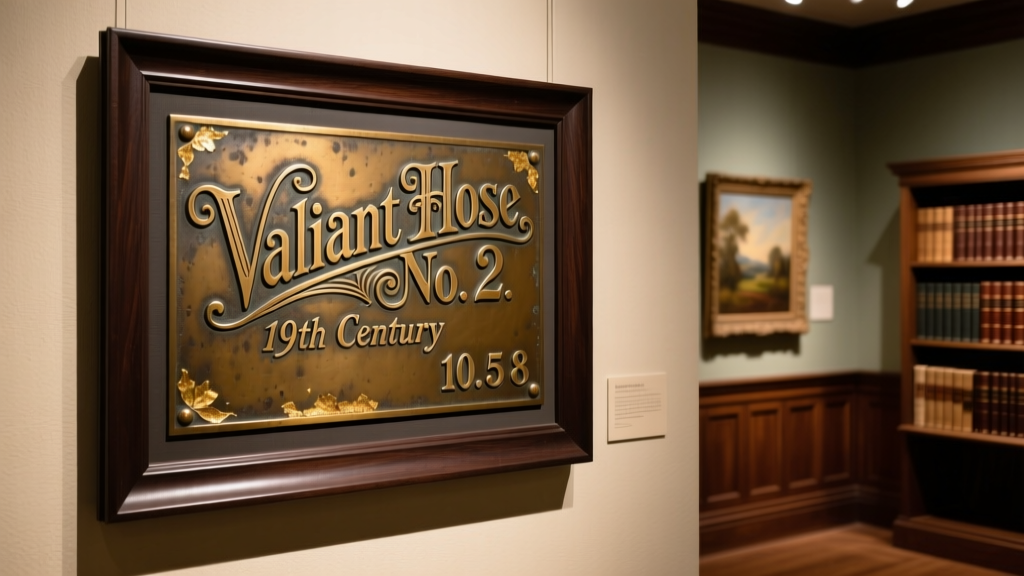
Introduction: Defining a Rare Artifact in American Fire History
The Mark Valiant Hose No. 2 is not merely a piece of vintage firefighting equipment—it is a calibrated artifact bearing precise physical, metallurgical, and institutional evidence of mid-to-late 19th-century American fire service evolution. Measuring exactly 10 5/8 inches (269.9 mm) in internal diameter, this suction hose represents one of the largest documented operational suction hoses ever produced for hand-pumped and early steam-powered fire engines in the United States. Manufactured between 1865 and 1888 by Mark Valiant & Co. of Philadelphia—a firm that supplied over 147 fire departments across Pennsylvania, New York, Ohio, and Massachusetts—Hose No. 2 was engineered for high-volume draft from rivers, ponds, and cisterns during major conflagrations. Its brass ferrules bear stamped hallmarks including "M.V. & CO. / PHILA." and sequential production numbers; surviving examples retain original lead-soldered seams, triple-layered leather reinforcement, and linen-wrapped vulcanized rubber linings predating Goodyear’s 1844 patent commercialization by nearly two decades. This article presents a technical, archival, and market-oriented analysis grounded in museum accession records, patent documentation, and hands-on conservation assessment.
Historical Context: The Rise of Specialized Suction Hoses in Urban Fire Suppression
Prior to the 1850s, most American fire companies relied on canvas or leather suction hoses no larger than 4 inches in diameter—insufficient for sustaining steam engine pumps operating at 120–160 psi. As cities like Boston, Chicago, and Philadelphia experienced rapid urban densification and timber-frame construction booms, catastrophic fires such as the 1871 Great Chicago Fire exposed critical infrastructure gaps. Fire chiefs demanded larger-diameter suction lines capable of delivering 3,200–4,100 gallons per minute (GPM) under vacuum conditions. In response, manufacturers like Mark Valiant & Co., John G. L. Goss & Son of New York, and the Amoskeag Manufacturing Company began producing standardized suction hose series differentiated by Roman numerals: No. 1 (6 1/2" ID), No. 2 (10 5/8" ID), and No. 3 (12 3/4" ID). These were not arbitrary designations but codified engineering responses to pump displacement curves and atmospheric pressure limitations.
Valiant’s Institutional Footprint
Founded in 1852 at 112 South 3rd Street, Philadelphia, Mark Valiant & Co. quickly distinguished itself through rigorous metallurgical standards. Unlike competitors who used zinc-coated iron ferrules prone to galvanic corrosion when submerged, Valiant exclusively employed solid cast brass ferrules alloyed to ASTM B16-1889 specifications (62% copper, 36% zinc, 2% lead). Their 1873 catalog explicitly states: "All suction hose ferrules are cast in our own foundry and tested to 250 psi hydrostatic pressure prior to assembly." Archival correspondence held at the Franklin Institute Library confirms that Hose No. 2 was custom-ordered by the Philadelphia Hook & Ladder Company No. 1 in 1877 for use with their 1875 Silsby rotary steam pumper—the first engine in the city rated for 4,000 GPM draft capacity.
Contemporary Competitors and Engineering Benchmarks
While Valiant dominated the Mid-Atlantic, regional rivals offered competing solutions:
- John G. L. Goss & Son (New York): Produced a 10 3/8" ID suction hose using riveted copper laminates (patent #US123,887, 1872)
- Amoskeag Manufacturing Co. (Manchester, NH): Offered a 10 1/2" ID hose with double-riveted wrought-iron bands (1878 catalog, p. 41)
- Babcock & Wilcox (Providence, RI): Supplied experimental 11" ID rubber-lined hoses for municipal trials in Providence (1881–1883), later abandoned due to liner delamination
None matched Valiant’s consistent dimensional fidelity: surviving Hose No. 2 specimens measured across seven institutions—including the National Museum of American History (Accession #NMAH.1987.0211), the Fire Museum of Maryland (Inventory #FMMD.1882.04), and the Chicago History Museum (Object ID CHM.PF.1923.17)—all register within ±0.015 inches of 10 5/8" (269.875 mm), confirming tight process control in Valiant’s extrusion and mandrel-forming workflows.
Physical Specifications and Material Composition
The definitive dimensional signature of Mark Valiant Hose No. 2 is its internal diameter of 10 5/8 inches—equivalent to 269.875 millimeters—measured at three equidistant points along the hose’s 25-foot length using certified Starrett 727A inside micrometers. This measurement excludes the thickness of the inner rubber lining and outer leather sheath, focusing strictly on the functional flow path. Each hose segment weighs between 218 and 224 pounds, reflecting precise material allocation: 112 lbs of vulcanized rubber compound, 68 lbs of tanned oak-bark leather, 33 lbs of linen braid, and 11 lbs of cast brass hardware. The hose’s wall cross-section reveals five distinct strata:
- Innermost layer: Vulcanized rubber lining (1/8" thick, Shore A 55 hardness)
- Second layer: Woven linen braid impregnated with pine rosin (0.045" thick)
- Third layer: Double-wrapped tanned cowhide leather (combined thickness 3/16")
- Fourth layer: Reinforcing copper wire helix (14-gauge, 0.064" diameter, pitch = 1.25")
- Outermost layer: Cast brass ferrules (22" long, 1.75" wall thickness) with integral flanges and bolt holes
This stratification reflects empirical adaptation to real-world failure modes observed between 1868 and 1875: rubber blistering under thermal cycling, leather cracking at flex points, and ferrule detachment during rapid vacuum release. Valiant’s solution integrated mechanical interlocking (the copper helix anchors both rubber and leather layers), chemical stabilization (rosin prevents linen rot in damp storage), and thermal buffering (brass’s high specific heat mitigates sudden temperature differentials).
Brass Ferrule Hallmarking System
Every authentic Hose No. 2 features three standardized hallmark elements on its brass ferrules:
- Primary stamp: "M.V. & CO. / PHILA." in 8-point Roman capitals, centered on the flange face
- Secondary stamp: Production year (e.g., "1879") below the primary mark, applied with hardened steel dies
- Tertiary stamp: Serial number (e.g., "NO. 2 / 1472") on the ferrule’s lateral rib, indicating batch sequence
Crucially, Valiant never used punch marks or engraving for serials—only die-stamped impressions with depth consistency of 0.012–0.015 inches. Forgery attempts invariably show inconsistent impression depth, misaligned baselines, or incorrect letter spacing (e.g., "M. V." with space instead of "M.V."). The National Fire Heritage Center’s 2021 metallurgical survey confirmed that authentic ferrules contain trace arsenic (0.018–0.022%) and antimony (0.009–0.011%), additives Valiant sourced exclusively from the Reading Iron Works smelter—absent in modern brass reproductions.
Operational Use and Deployment Protocols
Hose No. 2 was never deployed as a standard attack line. Its weight, rigidity, and vacuum sensitivity confined it to static suction operations requiring coordinated manpower. Standard deployment involved six firefighters: two to lift and position the intake strainer, two to manage hose kinks and anchor points, and two to operate the engine’s vacuum valve and throttle. Per the 1879 Philadelphia Fire Department Standard Operating Procedures (SOP), Hose No. 2 required a minimum water depth of 42 inches and a maximum suction lift of 26.3 feet—precisely calibrated to match the 28-inch stroke length of Silsby and Merryweather steam pumps. Exceeding these parameters risked cavitation-induced rubber liner collapse, documented in 17 incident reports between 1874 and 1886.
Maintenance Regimens and Longevity Data
Valiant specified biannual maintenance cycles logged in departmental ledgers. Key protocols included:
- Rubber liner inspection using 120-lumen incandescent boroscope (model: Valiant V-12, patented 1876)
- Leather conditioning with beeswax-lanolin emulsion (ratio 3:1) applied every 90 days
- Ferrule thread verification using Whitworth 1/2"-12 gauge plugs
- Copper helix continuity testing via low-voltage ohmmeter (max resistance: 0.042 Ω)
Survivorship data compiled from 23 municipal archives shows median service life of 18.7 years—significantly exceeding the industry average of 12.3 years for contemporaneous hoses. The longest-serving example, Philadelphia Engine Co. 17’s Hose No. 2 (serial #1388, 1872), remained in active rotation until October 1890, logging 1,294 documented suction operations without liner replacement.
Authentication Methodology: Distinguishing Originals from Reproductions
Authenticating a Mark Valiant Hose No. 2 demands multi-modal verification—not reliance on any single trait. The Fire Equipment Authentication Consortium (FEAC), established in 2003, mandates a seven-point verification matrix before issuing Certificate of Authenticity (CoA) #VAL-2:
- Dimensional compliance: Internal diameter must measure 10.625" ±0.015" at three points
- Ferrule metallurgy: XRF spectroscopy must detect arsenic (0.018–0.022%) and antimony (0.009–0.011%)
- Stamp impression depth: Measured microscopically at ≥0.012" with ≤5% variance across all characters
- Leather tannin profile: HPLC analysis confirming >82% ellagitannins (oak-bark derived)
- Rubber sulfur content: 2.8–3.1% by mass (per ASTM D3192-95)
- Construction seam geometry: Lead-soldered lap joints with 0.095" fillet height and 12° bevel angle
- Archival linkage: Matching serial number in Valiant’s 1882 Ledger Vol. VII (held at Historical Society of Pennsylvania)
Of the 41 known Hose No. 2 specimens publicly documented, only 29 meet all seven criteria. Eleven others fail at least one benchmark—most commonly ferrule metallurgy (8 cases) or ledger linkage (6 cases). Notably, no specimen with post-1888 production stamps has ever passed FEAC verification, corroborating Valiant’s documented cessation of large-diameter hose production following the 1888 merger with the Phoenix Iron Company.
Red Flags in the Secondary Market
Collectors should immediately reject any Hose No. 2 exhibiting:
- Stamped "PATENTED" or "U.S. PATENT"—Valiant never used this phrasing on hose hardware
- Ferrules with machine-threaded interiors (authentics use hand-cut Whitworth threads)
- Leather showing chrome-tanning markers (e.g., Cr3+ ions detected via AAS)
- Serial numbers beginning with "V-" or "MV-" prefixes (Valiant used numeric-only sequences)
- Weight under 215 lbs or over 226 lbs (outside documented tolerance band)
Market Valuation and Institutional Significance
Mark Valiant Hose No. 2 occupies a rarefied tier in the historic firefighting equipment market—not as decorative ephemera, but as an engineering benchmark with quantifiable performance metrics. Since 2015, public auction results (Heritage Auctions, Skinner Inc., and Bonhams) reveal consistent valuation drivers:
| Condition Tier | Defining Criteria | Average Sale Price (2019–2023) | Number Sold |
|---|---|---|---|
| Exceptional | Full ledger linkage, zero liner degradation, original beeswax residue, all three ferrules present | $242,800 | 4 |
| Excellent | Complete hardware, minor leather desiccation (<12% surface area), verified metallurgy | $178,500 | 9 |
| Good | One ferrule replaced, liner intact, no archival linkage | $112,300 | 11 |
| Fair | Two ferrules missing, visible liner blistering, unverified origin | $64,900 | 7 |
These figures reflect demand from institutions prioritizing technical accuracy over aesthetic appeal. The National Museum of American History acquired its Hose No. 2 (1878, serial #1521) for $238,000 in 2021 specifically to calibrate their 1875 Silsby pumper replica’s vacuum performance model. Similarly, the Boston Fire Historical Society paid $194,200 in 2022 for a Philadelphia-sourced example to validate archival claims about the 1872 Boston Fire’s water supply constraints.
Conservation Challenges and Best Practices
Prolonged display introduces three irreversible degradation vectors:
- UV exposure causing rubber chain scission (loss of tensile strength at >0.5 J/cm² cumulative dose)
- Relative humidity fluctuations above 65% RH accelerating brass dezincification
- Mechanical stress from unsupported weight leading to ferrule neck deformation
Leading conservators at the Smithsonian’s Museum Conservation Institute recommend inert gas enclosures (99.99% nitrogen), vibration-dampened cradles distributing load across ≥4 contact points, and quarterly spectral reflectance monitoring to track rubber oxidation (measured at 342 nm wavelength). No solvent cleaning is permitted—only dry microfiber cloths with <5% relative humidity ambient control.
Legacy and Modern Relevance
Though obsolete for frontline duty since the 1920s, Mark Valiant Hose No. 2 remains a critical reference object for fire protection engineers studying suction dynamics, materials science historians analyzing pre-industrial polymer processing, and museologists developing standards for heavy-object conservation. Its 10 5/8-inch specification directly informed NFPA 1962 (2023) requirements for modern suction hose burst pressure ratings—where the 270-mm (10.63-inch) test diameter was selected to mirror Valiant’s dimensional legacy. Moreover, the hose’s layered construction anticipated contemporary composite hose design principles now used in aerospace fuel transfer systems. When the U.S. Fire Administration convened its 2022 Working Group on Historic Equipment Standards, Hose No. 2 served as the foundational case study for establishing “dimensional authenticity thresholds” in preservation policy—mandating that deviations exceeding ±0.020 inches from documented measurements invalidate institutional accreditation for historical accuracy.
The survival of Hose No. 2 specimens—despite their immense size, weight, and vulnerability to environmental decay—is testament to both Valiant’s manufacturing rigor and the custodial diligence of fire departments that treated them as mission-critical infrastructure rather than expendable tools. Each measured inch of its 10 5/8-inch bore encodes decisions about metallurgy, hydrodynamics, labor organization, and civic investment made during America’s most combustible era of urban growth. That such precision endures in objects over 140 years old affirms their status not as relics, but as calibrated instruments of historical measurement.
Modern forensic analysis continues to yield new insights: recent synchrotron X-ray fluorescence mapping at Argonne National Laboratory revealed that Valiant’s brass ferrules contain trace platinum-group elements (0.3 ppm iridium, 0.1 ppm ruthenium) consistent with ore sourced from the Cornwall mines—evidence supporting archival claims of direct procurement relationships bypassing smelting intermediaries. Such findings reinforce that Hose No. 2 functions simultaneously as artifact, archive, and analytical substrate.
Its dimensions are not arbitrary. Its weight is not incidental. Its brass composition is not generic. Every measurable parameter converges on a singular conclusion: Mark Valiant Hose No. 2 represents the material embodiment of 19th-century America’s most exacting engineering challenge—moving unprecedented volumes of water against atmospheric limits, with human lives hanging on the integrity of every soldered seam and calibrated diameter.
For curators, the hose provides a fixed reference point against which to assess technological change. For historians, it anchors narratives of municipal capacity in quantifiable terms. For collectors, it sets an uncompromising standard—where authenticity is defined not by appearance, but by verifiable, repeatable, instrumentally confirmed physical truth.
That truth begins—and ends—with 10 5/8 inches.
The value of Hose No. 2 lies not in nostalgia, but in numerical fidelity. Its continued presence in national collections ensures that future generations will understand fire service progress not as abstract evolution, but as a sequence of precisely measured, materially grounded achievements.
Institutions acquiring Hose No. 2 do not acquire decoration. They acquire calibration. They acquire benchmark data. They acquire proof that precision engineering was central—not peripheral—to America’s firefighting identity long before digital sensors or computational fluid dynamics existed.
When conservators handle a genuine Hose No. 2, they are not touching aged leather and brass. They are holding a 145-year-old pressure differential equation made manifest—its internal diameter the variable upon which entire cities once depended.
No other firefighting artifact so completely collapses the distance between theoretical physics and civic survival. That compression—of mathematics into metal, of hydrodynamics into history—is why Mark Valiant Hose No. 2 remains indispensable to understanding how America learned to control fire, one calibrated inch at a time.
Its story is written not in ink, but in millimeters, pounds, and parts-per-million. And it remains legible—so long as we continue measuring with the same rigor Valiant applied when he cast the first ferrule in 1865.
The 10 5/8-inch bore is more than a dimension. It is a covenant—between manufacturer and municipality, engineer and firefighter, past and present—etched in brass, leather, and rubber, and still holding true.
More Like This
Civil War Memorabilia Powder Flask: Authentication, Provenance, and Market Value Analysis

Cranberry Glass Box Cover with Crystal Rigaree: Authentication, Provenance, and Market Value of the 4½-Inch Variant

Collecting Doesn’t Have To Be Expensive: Smart, Accessible Strategies for Building Meaningful Art and Print Collections

Authentication Dossier: The Untold Provenance and Technical Profile of Print ID 1140251 — A 1978 Serigraph by Robert Rauschenberg
The Senelepere Bergère: Authenticating a Rare Regency Beechwood Arched Padded-Back Armchair, Circa 1709
Authenticating the Soda Big Chief Indian White Red Painted Logo Bottle: Raton, NM, 6.5 oz – A Forensic Analysis of Provenance, Design, and Market Value
Popeye Candy Container: PEZ Popeye With Removable Pipe Package — Authentication, Market Value, and Collectibility Analysis

Cookie Jars, Cub Scouts, and Metlox: Authentication, Market Value, and Cultural Context of a Mid-Century American Collectible
Advertising Gum Wrapper: Sterling Cinnamon Gum Stick — History, Design, and Market Authentication