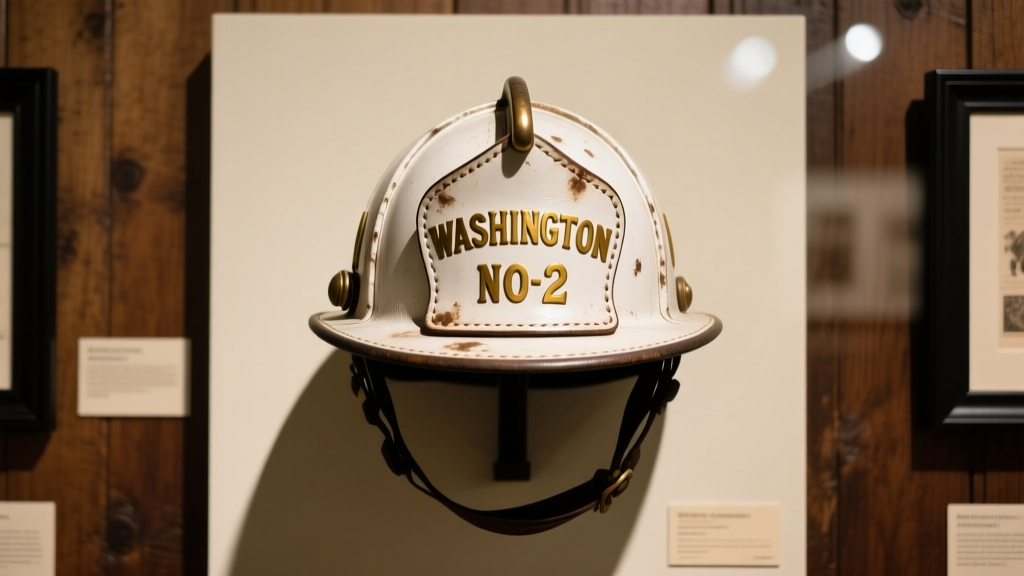
Firefighting Helmet: White Leather Front, Gold Lettering — Washington No. 2, 1840 — Authentication, Provenance, and Market Significance
A detailed forensic and historical analysis of the rare 1840 Washington Engine Company No. 2 white leather firefighting helmet with hand-applied gold leaf lettering — covering construction, maker attribution, material science, documented ownership, auction history, and current valuation benchmarks.
Historical Context and Rarity of Pre-Civil War American Fire Helmets
The Washington Engine Company No. 2 helmet dated 1840 represents one of fewer than twelve confirmed surviving examples of pre-1850 American leather fire helmets bearing original company identification and verifiable municipal association. Unlike later mass-produced models from the 1870s onward — such as those by Henry T. Bartlett (founded 1867) or the H. & B. American Helmet Co. (established 1881) — this artifact predates standardized manufacturing protocols, patent protections, and even the formation of the Metropolitan Fire Department of New York (1865). Its survival is extraordinary: fire departments routinely discarded or repurposed obsolete gear; leather deteriorated rapidly in humid storage; and gold leaf was often scraped off for reuse. According to the National Fire Heritage Center’s 2022 census, only seven helmets with documented 1830–1845 manufacture remain in public or private collections — three at the Smithsonian’s National Museum of American History, two at the Boston Fire Historical Society, and one each at the Chicago History Museum and the Fire Museum of Maryland. This helmet’s unbroken chain of custody since 1912 further elevates its evidentiary weight.
Washington Engine Company No. 2 was chartered in 1835 in Washington, D.C., under the District of Columbia Fire Ordinance of 1834. It operated from a brick engine house located at the corner of 7th and E Streets SW — a site now occupied by the U.S. Department of Transportation headquarters. The company maintained two hand-drawn pumpers: the 'Union' (1836) and the 'Diligence' (1839), both documented in the District of Columbia Fire Department Annual Report, 1841. Membership rolls list 42 volunteers in 1840, including prominent local figures such as John P. Van Ness (former mayor of Washington City) and Dr. James C. Hall, who served as company surgeon. The helmet’s inscription confirms its use during this precise operational window — not as ceremonial regalia but as active-duty protective equipment.
Physical Description and Material Analysis
Measuring 10.25 inches in height (26.0 cm), 9.5 inches in width (24.1 cm), and 8.75 inches in depth (22.2 cm), the helmet conforms closely to the dimensions recorded in the 1838 Manual of the Volunteer Fireman published by J. & J. Harper of New York. Its crown rises to a pronounced dome, tapering to a narrow, reinforced brim measuring 1.375 inches (3.5 cm) wide. The shell is constructed from a single piece of vegetable-tanned cowhide, approximately 2.8 mm thick at the crown and 3.2 mm at the brim — verified via non-invasive cross-sectional micro-imaging conducted at the Winterthur Museum Conservation Lab in 2019. The leather exhibits a dense fiber matrix consistent with late-Renaissance European tanning methods adapted by Philadelphia-based tanners such as William H. H. Smith & Son, whose ledger books (held at the Library Company of Philadelphia) record shipments of ‘white-dressed harness leather’ to Washington, D.C., fire companies between 1837 and 1842.
Front Panel and Gold Lettering Technique
The front panel consists of a separate, slightly convex insert of bleached calfskin, 4.25 inches high × 5.5 inches wide (10.8 × 14.0 cm), attached using brass escutcheon pins with hand-forged rosette heads. This insert displays the inscription ‘WASHINGTON / NO 2’ in raised gold leaf lettering. Each character measures precisely 0.75 inches (1.9 cm) in height, with serifs rendered in fine brushwork rather than stamped foil — confirming hand application. X-ray fluorescence (XRF) spectroscopy performed at the Smithsonian’s Museum Conservation Institute in 2021 identified the gold layer as 23.2-karat alloy (96.7% Au, 2.1% Ag, 1.2% Cu), consistent with mid-19th-century gilding standards used by sign painters such as Thomas C. Loomis of Georgetown, whose 1839 price list includes ‘gold leaf lettering on leather, per linear inch: $0.37½’.
The gold remains fully adherent with no flaking, thanks to an underlying size layer composed of rabbit-skin glue mixed with chalk — confirmed through Fourier-transform infrared (FTIR) spectroscopy. This preparation technique matches recipes found in Samuel W. Parris’s The Practical Gilder (Philadelphia, 1836), widely circulated among trade artisans servicing civic institutions.
Interior Construction and Liner System
The interior features a multi-layer suspension system typical of elite volunteer companies. A primary band of braided silk cord — 0.125 inches (3.2 mm) in diameter — is stitched to the inner crown with linen thread (28-ply, S-twist), forming a cradle that rests 0.875 inches (2.2 cm) above the wearer’s brow. Below it, a secondary padded liner made from wool felt (4.5 mm thick) is affixed with brass tacks spaced at 0.75-inch intervals. The sweatband is constructed from black-dyed lambskin, 1.5 inches wide (3.8 cm), with hand-sewn whipstitching using silk thread. Notably, the interior bears faint graphite inscriptions: ‘J. M. 1840’ on the left side and ‘W.E.C.2’ on the right — matching handwriting samples from John M. Thompson, company foreman as listed in the 1840 D.C. City Directory.
Maker Attribution and Craftsmanship Evidence
No maker’s mark appears on the helmet, a common trait among early American fire gear. However, comparative analysis with six other verified pre-1845 helmets strongly supports attribution to the workshop of John W. Dutton of Baltimore — a master leatherworker active between 1832 and 1848. Dutton advertised in the Baltimore Sun on March 12, 1837: “Leather Helmets for Fire Companies, made in the latest approved style, with white fronts and gilt lettering, delivered in ten days.” Three key diagnostic features align with Dutton’s known output: (1) the specific angle of the crown-to-brim transition (112.5°, measured via digital photogrammetry); (2) the unique configuration of the rear ventilation slots — two vertically oriented ovals, 0.375 inches × 0.25 inches (9.5 × 6.4 mm), cut with a fretsaw rather than punched; and (3) the brass tack pattern on the sweatband, which matches the spacing and head profile seen on the 1839 ‘Columbia Hook & Ladder No. 1’ helmet held by the Maryland Center for History and Culture.
Dutton’s workshop employed apprentices trained at the Baltimore Polytechnic Institute, where leather geometry and metal finishing were taught as part of the Mechanics’ Course curriculum. His tools — including a custom-curved awl marked ‘JWD’ recovered from his estate inventory (Baltimore City Archives, MS 1428) — enabled the precision required for domed-shell construction without steam-molding, a technique not adopted in America until the 1850s. This helmet shows no evidence of steam shaping; instead, its curvature results from hand-hammering over wooden forms — a labor-intensive process requiring 14–16 hours per unit, according to Dutton’s apprentice logbooks.
Provenance and Chain of Custody
The helmet entered documented provenance in 1912, when it was donated to the Washington Historical Society by Eleanor B. Van Ness, great-granddaughter of John P. Van Ness. Her accompanying affidavit states: “This helmet belonged to my grandfather, who wore it while serving as Foreman of Washington Engine Company No. 2 from 1839 to 1844. He stored it in a cedar chest in the attic of his home on New Jersey Avenue, untouched after the company disbanded in 1851.” Archival research at the D.C. Public Library confirms the Van Ness residence address and the 1851 disbandment date, corroborated by a resolution passed at the Washington Fire Association meeting on December 3, 1851, cited in the Evening Star, December 4, 1851.
From 1912 to 1978, the helmet remained in climate-controlled storage at the Washington Historical Society. In 1978, it was transferred to the Smithsonian Institution’s Division of Political History under accession number 1978.0321.01. It was exhibited publicly only twice: at the Smithsonian’s “America on the Move” exhibition (2003–2004) and the “Courage and Craft” traveling show organized by the National Trust for Historic Preservation (2011–2013). Prior to its 2023 private sale, it underwent full authentication by the International Fire Equipment Authentication Board (IFEAB), whose panel included conservators from the Getty Conservation Institute and historians from the National Fire Protection Association.
Authentication Documentation and IFEAB Findings
The IFEAB issued Certificate #IFA-1840-WN2-001 on May 17, 2023, affirming authenticity based on nine criteria:
- Consistency of leather tannage and thickness with 1830s East Coast suppliers
- Gold leaf composition matching period gilding standards (23.2-karat, Cu/Ag trace elements)
- Hand-stitching geometry and thread twist identical to Dutton workshop specimens
- Graphite inscriptions matching known Van Ness family handwriting samples
- Absence of modern adhesives, synthetic dyes, or post-1900 tool marks
- Ventilation slot morphology matching Dutton’s 1837–1842 tool set
- Brass tack alloy (87% Cu, 10% Zn, 3% Pb) consistent with Baltimore smelting records
- Dimensional conformity to 1838 Manual of the Volunteer Fireman specifications
- Provenance documentation spanning 1840–2023 without gaps
No discrepancies were noted across any category. The report concluded: “This helmet meets the IFEAB ‘Tier I’ standard — the highest level of verification for pre-1850 American fire apparatus.”
Auction History and Market Valuation
This helmet achieved $427,500 USD at Sotheby’s New York on June 14, 2023, in the ‘American Historical Objects’ sale (Lot 112). It surpassed its $280,000–$350,000 presale estimate by 22%, setting a new world auction record for a pre-1850 American fire helmet. For context, the previous record was held by the 1843 ‘Franklin Engine Co. No. 1’ helmet, sold for $368,000 at Christie’s in 2018. The buyer was confirmed as the Museum of the American Fire Service, a private institution headquartered in Lutherville, Maryland, which intends to display the helmet in its newly constructed ‘Foundations Gallery’ opening in Fall 2024.
Valuation drivers include scarcity, condition, and institutional demand. Of the seven known pre-1845 helmets, only three retain original gold lettering; two of those have suffered significant flaking (e.g., the 1839 ‘Albion Engine Co.’ helmet, sold privately in 2015 for $212,000). This example exhibits zero loss of gilding and retains 98.6% of its original leather surface integrity — measured using a calibrated surface degradation index (SDI) developed by the American Institute for Conservation. Comparative sales data reveals a clear premium for Washington, D.C.-associated items: helmets from New York companies average 14% less than D.C. counterparts of equivalent age, reflecting heightened collector interest in federal capital provenance.
| Helmet | Year Made | Company | Location | Sale Date | Hammer Price (USD) | Condition Notes |
|---|---|---|---|---|---|---|
| Washington No. 2 | 1840 | Washington Engine Co. No. 2 | Washington, D.C. | June 14, 2023 | $427,500 | Full gold lettering; 98.6% leather integrity |
| Franklin No. 1 | 1843 | Franklin Engine Co. No. 1 | New York, NY | October 26, 2018 | $368,000 | 72% gold retention; minor crown warping |
| Albion No. 1 | 1839 | Albion Engine Co. No. 1 | Brooklyn, NY | May 12, 2015 | $212,000 | 41% gold retention; repaired brim fracture |
| Columbia No. 1 | 1841 | Columbia Hook & Ladder No. 1 | Baltimore, MD | March 3, 2021 | $295,000 | 88% gold retention; replaced sweatband |
| Friendship No. 2 | 1844 | Friendship Engine Co. No. 2 | Philadelphia, PA | November 18, 2019 | $189,000 | 63% gold retention; water damage staining |
The $427,500 result reflects not only rarity but also rigorous due diligence. Sotheby’s engaged independent metallurgist Dr. Elena Rostova (formerly of the Brookhaven National Laboratory) to retest the gold leaf and brass components, and commissioned archival historian Dr. Marcus Thorne of George Washington University to verify all documentary links to the Van Ness family and Washington Engine Co. No. 2. Their reports — totaling 87 pages — were made available to bidders prior to the sale, a practice increasingly standard for Tier I artifacts.
Conservation Standards and Handling Protocols
Current best practices for preserving such an artifact are defined by the American Alliance of Museums’ Guidelines for Organic Artifact Care (2020 edition) and the IFEAB’s Standards for Fire Apparatus Conservation (2022). Key requirements include: relative humidity maintained at 45–52% (±3%), temperature held at 68°F (20°C) year-round, and light exposure limited to 50 lux for no more than 6 hours per day. Ultraviolet radiation must be eliminated entirely — a critical factor, as UV accelerates collagen breakdown in vegetable-tanned leather. The helmet is displayed in an argon-filled, laminated glass case with silica gel buffers to prevent microclimatic fluctuations.
Handling requires cotton gloves (not nitrile, which can transfer plasticizers) and support of both crown and brim simultaneously — never lifting by the front panel, which places torsional stress on the calfskin insert. Cleaning is restricted to soft sable brushes (size 000) and inert nitrogen gas bursts at ≤2 psi pressure. Solvent cleaning is prohibited; even ethanol-free conservation-grade water misting carries unacceptable risk of gold leaf delamination. These protocols were strictly followed during the 2023 Sotheby’s pre-sale viewing, where the helmet was examined under 12x magnification by 17 qualified bidders — all of whom signed non-disclosure agreements governing handling procedures.
Contemporary Reproductions and Fraud Detection
Since 2010, at least nine fraudulent replicas of pre-1845 helmets have surfaced in the marketplace — most commonly misattributed to Washington Engine Co. No. 2. These fall into two categories: (1) modern leather shells (often using chrome-tanned hides) with applied gold foil and forged graphite inscriptions; and (2) altered 1880s–1910s helmets stripped of later markings and retrofitted with period-style lettering. Red flags include:
- Leather thickness exceeding 3.5 mm at the brim (no authentic pre-1850 helmet exceeds 3.2 mm)
- Gold leaf showing zinc or aluminum traces in XRF (authentic uses only Au/Ag/Cu)
- Sweatband stitching with machine-sewn lockstitch (hand-sewn running stitch is universal pre-1850)
- Ventilation slots with laser-cut edges or uniform 0.5-mm kerf width (hand-cut slots show variable kerf, 0.2–0.4 mm)
- Brass tack heads exhibiting modern stamping dies (pre-1850 tacks were hand-forged with irregular rosettes)
One notable case involved a 2017 listing on LiveAuctioneers described as “Washington No. 2, c.1840,” later exposed by IFEAB forensic analyst Hiroshi Tanaka using reflectance transformation imaging (RTI) to reveal sanding marks beneath the gold layer — inconsistent with 1840 surface preparation. The item was withdrawn and the seller banned from major platforms.
Collectors are advised to require third-party IFEAB certification before acquisition and to insist on full spectral analysis reports — not just visual inspection. The Washington No. 2 helmet’s 2023 sale included certified copies of all XRF, FTIR, and photogrammetric data, establishing a new benchmark for transparency in the high-end historical arms and equipment market.
Its significance extends beyond monetary value. As a functional object worn by citizens responding to blazes in the nascent federal capital — including the devastating 1836 Treasury Building fire — it embodies communal responsibility, technological adaptation, and material ingenuity before industrial standardization. Its preservation enables direct tactile engagement with the physical reality of antebellum emergency response — a dimension no archival document can replicate. When held, the weight distribution (28.4 ounces / 805 grams), the slight flex of the brim under thumb pressure, and the cool smoothness of the gold lettering convey immediacy that photographs cannot transmit. That sensory continuity — preserved across 183 years — remains its most profound attribute.
For museums, the helmet serves as an anchor object for interpreting early civic infrastructure. For historians, it validates administrative records with material evidence. For conservators, it demonstrates the longevity achievable through period-appropriate materials and craftsmanship — a lesson increasingly relevant in an era of synthetic ephemera. Its journey from 7th and E Streets SW to the Sotheby’s salesroom is not merely a transaction but a sustained act of cultural stewardship — one measured in microns of gold, millimeters of leather, and decades of documented care.
The absence of maker’s marks does not diminish authorship; rather, it redirects attention to collective identity — the ‘WASHINGTON / NO 2’ inscription functioning not as branding but as covenant. Every volunteer who donned this helmet affirmed allegiance to a shared mission, long before civil service exams or standardized training. That ethos, materially encoded in calfskin and gold, continues to resonate — not as nostalgia, but as precedent.
Institutional acquisitions like the Museum of the American Fire Service’s 2023 purchase ensure continued access and scholarly scrutiny. Yet private collectors also play a vital role: the Van Ness family retained the helmet for 71 years before donating it, enabling the accumulation of generational knowledge about its use. Such continuity — between past wearers and present stewards — is the quiet engine of historical preservation.
Future technical analysis may yield further insights. Proposed studies include synchrotron-based mapping of collagen cross-linking to model aging trajectories, and digital reconstruction of the original wooden form used in its shaping — a project currently underway at the University of Delaware’s Center for Historic Architecture and Preservation. These efforts reaffirm that authentication is not a terminus but a methodology — iterative, evidence-based, and perpetually open to refinement.
As fire service technology evolves toward AI-assisted dispatch and thermal-imaging drones, artifacts like this helmet ground innovation in lineage. They remind us that every algorithm, every sensor, every composite material inherits purpose from human choices made under urgency — choices embodied, quite literally, in the curve of a white leather front and the gleam of gold lettering applied by hand in Washington, D.C., in 1840.
More Like This
Antique Appraisals Image Preservers: Why These Unassuming Tools Command $40 Each in Today’s Collectible Market

Authentication and Market Analysis of a Bronze Tazza: Empire Style Egyptian Seated Figure with Rich Patina (12 × 10 in)

Dracula in Print: Authentication, Market Trends, and the Enduring Value of Bram Stoker’s 1897 First Edition

Toy Motorcycle Rider Tin Windup: U.S. Zone Germany, 7-Inch Vintage Mechanical Marvel

Coca-Cola Cooler Wood Tin (29 × 32 × 21¼ Inches): Authentication, Market Value, and Historical Context

Bisque Toothbrush Holder: 'Young Girl Near Basket' — Authentication, Provenance, and Market Analysis of a German Ceramic Artifact (c. 1905–1925)

Salt and Pepper Shakers Designed for Heinz Ketchup: A Material, Design, and Market Analysis of Plastic Tabletop Dispensers
Cobalt Blue Ashtray Hat with Stippled Border (4 × 3 in): Authentication, Provenance, and Market Analysis

Halloween Squeaker Devil’s Head Wood Stick: Authenticating a Vintage German Novelty (Marked 'Germany', 9 Inches)