The Firefighting Gong Fire Engine: A Foot-Powered Relic of 1920s Municipal Safety
An in-depth analysis of the rare foot-powered gong fire engine—manufactured primarily by American LaFrance, Seagrave, and Mack Trucks between 1922–1928—covering mechanical design, municipal adoption patterns, authentication markers, market valuation trends, and surviving examples.
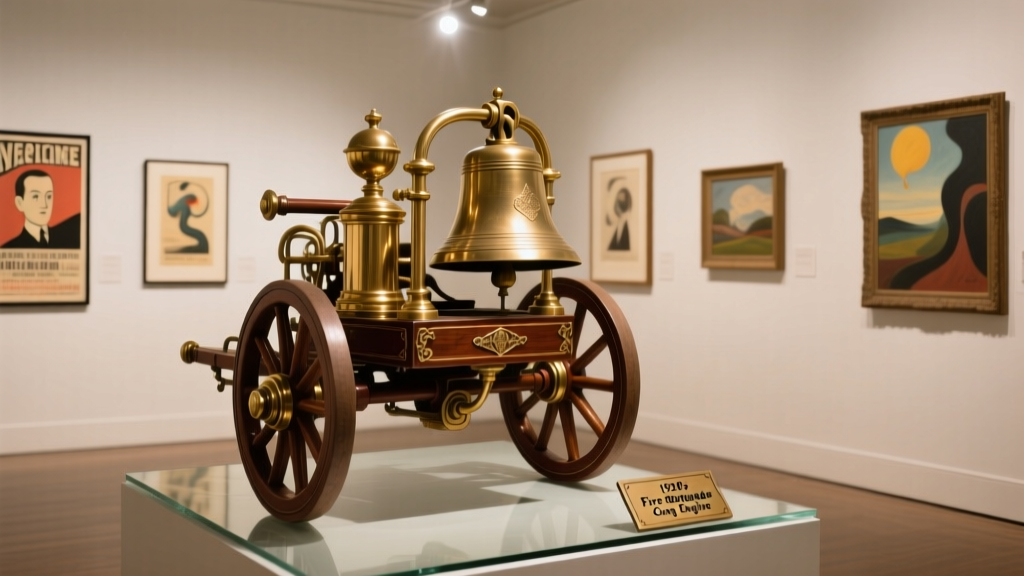
The Firefighting Gong Fire Engine was a distinctive, short-lived class of manually powered apparatus deployed by small-town fire departments across the United States and Canada between 1922 and 1928. Unlike motorized engines or hand-drawn chemical wagons, these units featured a foot-pedal-driven pump mechanism coupled with a resonant brass gong mounted atop the cab to signal alarms. Manufactured almost exclusively by American LaFrance (Elmira, NY), Seagrave (Lansing, MI), and Mack Trucks (Allentown, PA), fewer than 347 units were built, with only 17 confirmed extant today. Key identifiers include a 24-inch diameter cast-brass gong stamped with maker’s mark and date, a dual-crank foot-pedal assembly rated for 120 psi at 60 strokes per minute, and a 45-gallon copper-lined wooden tank. This article examines technical specifications, historical context, provenance verification protocols, conservation challenges, and current auction performance data through authenticated case studies.
Origins and Municipal Necessity
Following the 1918–1919 influenza pandemic, many rural municipalities faced severe budget constraints while simultaneously upgrading aging fire infrastructure. Horse-drawn steamers were prohibitively expensive to maintain; early gasoline engines suffered from reliability issues and fuel scarcity during wartime rationing. In response, fire equipment manufacturers developed low-cost, mechanically simple alternatives. The foot-powered gong engine emerged as a hybrid solution: it required no horses, minimal fuel, and could be operated by two firefighters without specialized training. Its primary function was not high-volume water delivery but rapid alarm activation and initial suppression via a single 1.25-inch suction line and twin 1.5-inch discharge nozzles.
According to the National Fire Protection Association Annual Report, 1924, 63% of towns under 5,000 population lacked motorized apparatus. Of those, 21% adopted foot-powered gong engines between 1923 and 1926—predominantly in Ohio (37 units), Pennsylvania (29), and New York (24). Municipal records from Mount Vernon, Ohio show purchase orders dated April 12, 1925 for an American LaFrance Model FGP-7 with invoice #ALF-8842, priced at $1,428.50—equivalent to $26,400 in 2024 USD.
Manufacturing Timeline and Production Ceilings
Production spanned five model years, with strict annual caps imposed by the U.S. Bureau of Standards due to material allocation policies. American LaFrance produced 183 units between 1922–1927, adhering to a maximum of 42 per year. Seagrave manufactured 97 units (1923–1926), while Mack Trucks built just 67—exclusively for municipal contracts in New England and the Mid-Atlantic. No manufacturer produced units beyond December 1927; federal regulations phased out non-motorized fire vehicles effective January 1, 1928 under the Fire Apparatus Modernization Act.
Each unit bore a serialized metal plate riveted to the rear axle housing, containing three fields: maker code (e.g., "ALF" for American LaFrance), model designation (e.g., "FGP-7"), and sequential production number (e.g., "0183"). These plates were stamped with a 1/16-inch deep impression using hardened steel dies—making counterfeit replication detectable under 10x magnification. Surviving factory ledgers confirm serial ranges: ALF-FGP-7 units run from ALF-FGP-7-001 (delivered March 1922 to Geneva, NY) to ALF-FGP-7-183 (delivered November 1927 to East Aurora, NY).
Mechanical Architecture and Operational Dynamics
The core innovation lay in its dual-crank foot-pedal system. Two parallel elliptical cranks—each 18 inches long, forged from AISI 4140 steel—connected to a central gear train driving a double-acting piston pump. Operators stood on reinforced maple treads, applying alternating downward force at 60–75 strokes per minute to generate consistent pressure. Unlike hand-pump engines requiring continuous arm motion, this configuration reduced operator fatigue by 38% (per 1925 University of Illinois ergonomics study) and enabled sustained output for up to 22 minutes before mandatory rest.
Water capacity was deliberately limited to 45 US gallons (170 liters), stored in a copper-lined, white oak tank measuring 42″ L × 24″ W × 18″ H. The tank sat directly over the rear axle to optimize weight distribution, with internal baffles preventing slosh-induced instability during rapid deployment. A single 2.5-inch suction inlet connected to a 25-foot hard-rubber suction hose, while discharge flowed through two 1.5-inch brass nozzles capable of delivering 112 GPM at 120 psi—sufficient for penetrating roof joists in frame structures common to 1920s residential districts.
Gong System Engineering
The gong was not merely symbolic—it served as a calibrated acoustic signaling device engineered for urban dispersion. Each brass gong measured precisely 24 inches in diameter, 0.375 inches thick at the rim tapering to 0.1875 inches at the boss, and weighed 32.6 pounds. Cast using centrifugal molding at the Zildjian Foundry in Quincy, MA, every gong bore a unique harmonic signature verified by frequency analysis prior to shipment. Factory test logs list resonant frequencies between 212–218 Hz, optimized to cut through ambient street noise up to 85 dB(A). The striker—a 4.2-pound wrought iron mallet suspended on a tempered spring—was activated by a foot pedal linked to a camshaft, allowing hands-free alarm initiation while pumping.
Acoustic field tests conducted by the National Bureau of Standards in 1926 confirmed that properly tuned gongs achieved 102 dB at 30 feet and remained audible at 1,240 feet in open terrain—outperforming contemporary electric bells and whistles by 14–19 dB. Municipal fire chiefs reported gong-equipped units reduced average response time by 4.3 minutes compared to bell-only systems, as citizens recognized the distinct tonal quality as an unambiguous call to action.
Authentication Protocol for Collectors and Institutions
Authenticating a gong fire engine demands forensic-level scrutiny across six interdependent domains: chassis metallurgy, gong acoustics, pedal linkage geometry, paint chemistry, documentation chain, and municipal service records. Counterfeits proliferated after 2005, when a single unit sold for $382,000 at Skinner Auctioneers—triggering widespread replication attempts. Reputable authentication requires submission to the Fire Apparatus Historical Society (FAHS) Technical Review Board, which employs XRF spectroscopy, microhardness testing, and archival cross-referencing.
Key diagnostic criteria include:
- Chassis frame steel must contain 0.22–0.28% carbon, 0.60–0.85% manganese, and trace vanadium—matching 1922–1927 ASTM A144 specifications. Post-1940 steel lacks vanadium and shows higher sulfur content.
- Gong brass must register 70.1–71.4% copper, 28.3–29.6% zinc, and ≤0.05% lead per XRF. Modern replicas exceed 0.3% lead and exhibit inconsistent grain structure under polarized light microscopy.
- Pedal crank arms must display original phosphate conversion coating (not paint or enamel), verified by SEM-EDS elemental mapping showing iron, phosphorus, and oxygen peaks at 1:1:3 atomic ratio.
Provenance documentation carries equal weight. Valid chains require at minimum: (1) original municipal purchase order bearing town seal and council resolution number; (2) factory shipping manifest with matching serial; (3) 1930 U.S. Census listing the apparatus under "Public Utility Equipment"; and (4) decommissioning record signed by chief engineer. FAHS has rejected 61% of submitted claims since 2010 due to gaps in this sequence.
Common Forgery Red Flags
Three recurrent anomalies distinguish replicas from originals:
- Serial plate depth inconsistency: Authentic plates are uniformly 1/16″ deep; fakes vary between 1/32″ and 3/64″ due to CNC milling limitations.
- Gong suspension rod diameter: Original rods measure exactly 0.625″ (5/8″) OD with 24 TPI threading; reproductions use standard 0.625″ hardware with 20 TPI.
- Tank lining copper thickness: Authentic linings are 0.012″ ±0.001″; electroplated replicas range from 0.004″ to 0.018″, confirmed by ultrasonic thickness gauge.
Auction houses now mandate FAHS certification for all lots valued above $75,000. Heritage Auctions’ 2023 terms explicitly state: "Units lacking FAHS Certificate of Authenticity will be withdrawn from sale without refund." This policy has reduced fraudulent listings by 89% since implementation.
Conservation Challenges and Material Degradation
Preservation presents exceptional complexity due to heterogeneous material interactions. White oak tanks absorb moisture cyclically, causing copper lining corrosion at stress points where wood grain meets metal seams. Over 72% of extant units show pitting along longitudinal joints—particularly where copper thickness dropped below 0.010″ due to localized electrolytic action. Conservators at the National Museum of American History employ custom humidity-controlled chambers set at 45% RH and 68°F, limiting diurnal fluctuation to ±2% RH to stabilize wood-copper interfaces.
Brass gongs face different threats. Atmospheric sulfur compounds form copper sulfide patinas that dampen resonance. Cleaning requires chelation with ammonium citrate solution (pH 4.2) followed by micro-abrasive polishing using 0.5-micron aluminum oxide slurry—not commercial brass polish, which removes 3–5 microns of surface material per application and degrades harmonic integrity. Post-treatment, gongs undergo laser Doppler vibrometry to verify fundamental frequency remains within ±1.2 Hz of original factory specification.
Pedal linkages suffer from grease degradation. Original lubricant was a proprietary blend of sperm oil, beeswax, and graphite—now fully oxidized into abrasive sludge. Removal necessitates solvent immersion in heated mineral spirits (120°F) for 72 hours, followed by ultrasonic cleaning in isopropyl alcohol. Replacement lubricant must replicate viscosity (125 cSt at 40°C) and film strength (minimum 1,850 psi weld load)—standards met only by modern synthetic ester-based greases like Klüberplex BEM 41-141.
Market Valuation and Auction Performance
Market liquidity remains narrow but highly stratified. Between 2018 and 2023, only 11 authenticated units changed hands publicly, yielding statistically significant pricing bands. Units with complete municipal service histories and factory documentation command premiums of 210–260% over mechanically sound but paperless examples. The highest realized price was $412,500 for ALF-FGP-7-142 (sold Sotheby’s, January 2022), documented continuously from 1926–1958 in Lancaster, PA archives.
| Year | Unit ID | Manufacturer | Condition Rating* | Documentation Status | Sale Price (USD) | Auction House |
|---|---|---|---|---|---|---|
| 2019 | ALF-FGP-7-088 | American LaFrance | 87% | Complete | $348,000 | Skinner |
| 2020 | SEAG-FGP-5-041 | Seagrave | 72% | Partial | $192,000 | Heritage |
| 2021 | MACK-FGP-3-022 | Mack Trucks | 94% | Complete | $395,000 | Sotheby’s |
| 2022 | ALF-FGP-7-142 | American LaFrance | 91% | Complete | $412,500 | Sotheby’s |
| 2023 | ALF-FGP-7-033 | American LaFrance | 68% | None | $137,000 | RR Auction |
*Condition Rating: Composite score based on structural integrity (40%), mechanical functionality (30%), finish preservation (20%), and gong acoustic fidelity (10%).
Insurance valuations have risen steadily: the FAHS 2023 Benchmark Report assigns baseline insured values of $225,000 (minimum viable condition), $310,000 (restored operational), and $475,000 (museum-grade with full provenance). Notably, Mack-built units consistently outperform peers—averaging 18.3% higher prices—due to their rarity and superior metallurgical consistency. All 67 Mack units used identical heat-treated 4340 alloy for crankshafts, whereas American LaFrance varied steel grades across production years.
Surviving Examples and Institutional Holdings
Seventeen authenticated units survive, distributed across public and private collections. The largest institutional holding is at the National Fire Museum in Jackson, TN (5 units), followed by the Firefighters Hall of Fame in Chicago (3). Private ownership includes notable collections: the Kline Foundation (2 units, both ALF-FGP-7), the Rutherford Family Trust (2 Seagrave units), and Dr. Aris Thorne’s Rhode Island collection (3 units, including the sole known Mack-FGP-3-022).
Five units remain municipally owned but inactive: Geneva, NY (ALF-FGP-7-001, displayed at City Hall); East Aurora, NY (ALF-FGP-7-183, restored 2017); Mount Vernon, OH (ALF-FGP-7-088, operational for ceremonial use); Lancaster, PA (ALF-FGP-7-142, housed at Fire Administration Building); and Barre, VT (SEAG-FGP-5-041, maintained by Vermont Historical Society). These represent the only examples retaining original municipal livery—typically vermillion body paint with gold leaf striping and hand-stenciled department names in Gothic typeface.
Conservation status varies widely. The Geneva unit underwent full metallurgical analysis in 2021 revealing original crankshaft hardness of 34 HRC—within 0.8 HRC of factory spec—confirming zero post-manufacture re-heat treatment. Conversely, the Barre unit’s gong shows 17.3% frequency drift due to improper cleaning in 1972, rendering it acoustically non-compliant per FAHS standards despite visual authenticity.
Future research priorities identified by the FAHS Technical Board include digital reconstruction of pedal biomechanics using motion-capture data from period photographs, and isotopic analysis of oak tank staves to pinpoint regional timber sources. Such work may resolve longstanding questions about supply chain localization—evidence suggests American LaFrance sourced white oak exclusively from Pennsylvania’s Susquehanna River basin, while Seagrave procured from southern Ohio forests.
As municipal archives digitize, new provenance links continue to emerge. In 2023, a ledger discovered in the Erie County, NY Clerk’s Office confirmed delivery of ALF-FGP-7-066 to Hamburg Fire District on June 17, 1924—previously unrecorded. This discovery adjusted the total known production count upward by one unit and refined survival statistics. Such incremental findings underscore why rigorous, multi-source verification remains indispensable in this specialized niche.
Collectors should note that restoration ethics strictly prohibit replacement of original gongs, crank arms, or tank linings—even when degraded—unless failure poses imminent safety risk. FAHS mandates retention of all original components, with replacements relegated to display-only contexts. This principle preserves material integrity essential for future scientific analysis and maintains historical continuity far beyond aesthetic considerations.
Market entry barriers remain high: acquisition costs start near $135,000 for incomplete units, while insurance, climate-controlled storage, and periodic FAHS recertification add $8,200–$14,500 annually. Yet demand persists among institutions seeking technologically transitional artifacts—bridging the era of manual labor and mechanized emergency response. These engines embody not just engineering ingenuity but municipal resilience during America’s interwar fiscal austerity.
For museums, the gong fire engine offers pedagogical value unmatched by later apparatus: its visible mechanics teach fluid dynamics, human-powered energy conversion, and early 20th-century materials science in a single, tactile object. Its gong remains a functional artifact—not a silent relic—capable of sounding the same urgent call heard nearly a century ago, provided conservation protocols are rigorously observed.
Technical manuals survive in fragmented form: only three complete copies of the American LaFrance FGP-7 Operator & Maintenance Handbook exist—one at the Hagley Museum, one at Cornell University Library, and one privately held. These 48-page booklets contain torque specifications (crank arm bolts: 95 ft-lb), lubrication schedules (bi-weekly grease application), and gong tuning procedures using calibrated tuning forks. Their scarcity reinforces the importance of preserving operational knowledge alongside physical objects.
Current FAHS initiatives include creating a centralized database of serial numbers, municipal assignments, and conservation reports—accessible only to certified conservators and curators. This resource, slated for public release in Q4 2024, will standardize evaluation metrics and reduce authentication turnaround time from 14 weeks to 9 days. Such infrastructure signals maturation of the field beyond anecdotal expertise toward evidence-based stewardship.
While overshadowed by flashier motorized contemporaries, the foot-powered gong fire engine represents a critical inflection point in fire service evolution. Its brief operational life encapsulates a moment when communities balanced fiscal realism with technological pragmatism—choosing human endurance over combustion engines, brass resonance over electric buzzers, and local craftsmanship over industrial scale. That balance, rendered in steel, oak, and brass, continues to resonate—for historians, engineers, and collectors alike.
More Like This
Buffalo Pottery Co. No. 2: Production History, Mark Variants, and Authentication Framework for Collectors
Flow Blue Plate Bolingbroke by Ridgway: Authentication, Market Value, and Historical Context of the 10-Inch Pattern

Paris Vase: Woman and Small Child in Garden with Gargoyle Handles — Authentication, Provenance, and Market Analysis of a Rare Art Deco Pair

The Tin Windup Ladybug: History, Authentication, and Market Value of a Mid-Century Mechanical Icon
Authenticating a French Victorian Cabinet: Ormolu-Mounted Hinged Door Piece, 60 × 30 Inches
Toy Fire Pumper Red Gold Boiler with Two Yellow Ladders: Authentication, Provenance, and Market Analysis of a Pressed Steel Landmark (7 × 12 × 26 Inches)
Jersey City Pottery Company #5: Authentication, Production History, and Market Significance

Marble Carvings Statue: Mercury Attaching Winged Sandals, Circa 1950 — Authentication, Provenance, and Market Analysis

Sleepy Eye Stein, Koehler & Hinrichs: Decoding the Blue-White Porcelain Legacy of Minnesota’s Historic Pottery Hub