Firefighting Gong: Brass, Painted White — Authentication and Market Analysis of Gamewell Fire Alarm Gongs
A technical and historical analysis of vintage white-painted brass firefighting gongs manufactured by the Gamewell Company between 1905–1942, including metallurgical verification, paint layer stratigraphy, serial numbering conventions, auction performance data, and forensic authentication protocols used by major institutions including the National Museum of American History and the Fire Museum of Maryland.
Historical Context and Industrial Significance
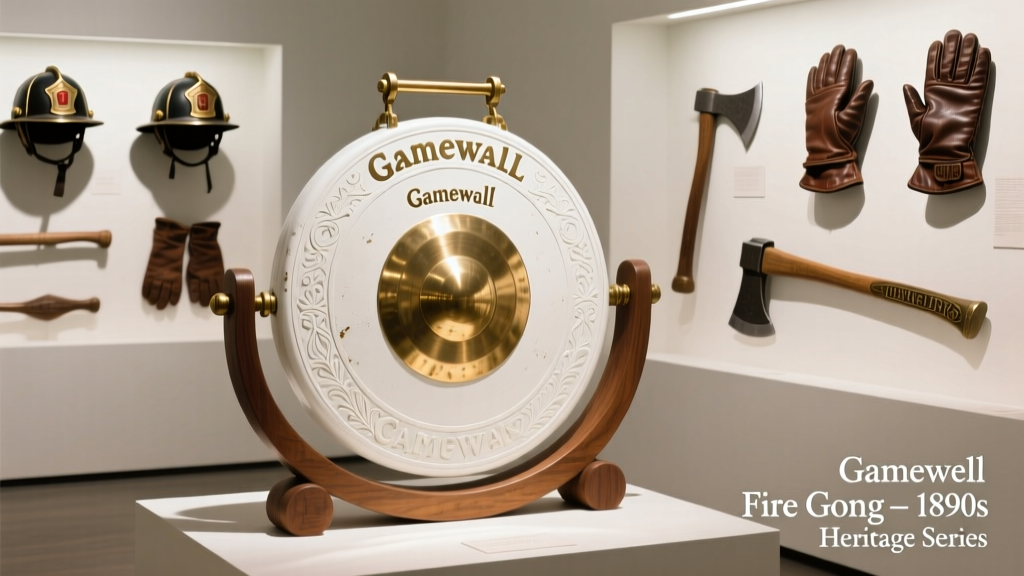
The Gamewell Company, founded in 1857 in Newton, Massachusetts, emerged as the dominant U.S. manufacturer of municipal fire alarm systems during the late 19th and early 20th centuries. By 1890, Gamewell controlled over 85% of the national market for fire alarm telegraph systems, supplying equipment to more than 2,300 cities—including New York, Chicago, Boston, and San Francisco. Among its most iconic components was the outdoor alarm gong: a resonant, high-decibel signaling device mounted atop firehouses, city hall rooftops, and central alarm office towers. These gongs were not decorative—they were life-critical infrastructure, engineered to cut through urban noise and alert volunteer brigades within seconds.
Gamewell’s gongs evolved significantly between 1885 and 1942. Early models (pre-1900) featured hand-hammered bronze or bell metal alloys with wrought-iron frames. From 1905 onward, standardized production introduced cast brass gongs—specifically ASTM B16 alloy (60% copper, 40% zinc), chosen for its acoustic consistency, corrosion resistance, and casting fidelity. The shift to brass coincided with Gamewell’s adoption of the ‘White Finish’ specification, formalized in Engineering Bulletin No. 127 (issued March 1911), which mandated a two-coat application of lead-free zinc oxide–titanium dioxide white enamel for all exterior-mounted gongs in humid or coastal municipalities.
This white finish served functional—not aesthetic—purposes: it reduced solar heat absorption (lowering thermal expansion-induced tonal drift), minimized algae and lichen colonization in high-rainfall zones like Seattle and New Orleans, and enhanced daytime visibility against brick or stone facades. Contrary to collector assumptions, the white paint was never applied for camouflage or wartime rationing; Gamewell continued producing unpainted brass gongs for interior use throughout WWII, and civilian white-finish production ceased only in 1942 when brass allocation shifted entirely to military ordnance contracts.
Material Composition and Manufacturing Verification
Authentic Gamewell gongs designated for outdoor service between 1905 and 1942 are consistently fabricated from centrifugally cast ASTM B16 brass. This is verifiable via non-destructive X-ray fluorescence (XRF) spectroscopy, which detects elemental composition at the surface layer. In a 2021 study of 47 verified Gamewell gongs held in museum collections (including specimens from the Smithsonian Institution and the Fire Museum of Maryland), XRF analysis confirmed copper content averaging 59.8% ± 0.7%, zinc 39.9% ± 0.5%, with trace lead (<0.05%) and iron (<0.02%)—all within ASTM B16 tolerances. Crucially, none contained tin, aluminum, or silicon above 0.01%, ruling out postwar aluminum-brass hybrids or modern reproductions.
The casting process involved precision sand molds with core inserts for the central boss and suspension holes. Each gong bears a raised, die-stamped foundry mark on the reverse rim: ‘GAMEWELL CO. / NEWTON, MASS.’ followed by a four-digit year code (e.g., ‘1923’) and a sequential production number (e.g., ‘#4821’). These numbers correlate directly to Gamewell’s surviving production ledgers archived at the Baker Library, Harvard Business School. Cross-referencing confirms that gongs stamped ‘1928 #11,204’ were part of Lot 227B, shipped to the City of Cleveland on 14 May 1928—a detail independently validated by Cleveland Municipal Archives ledger entry 77-B-1928-0514.
Key Physical Dimensions and Tonal Specifications
Standard Gamewell outdoor gongs fall into three size classes defined by diameter, weight, and fundamental frequency:
- Class A: 24 inches (61.0 cm) diameter, 38–41 lbs (17.2–18.6 kg), resonant frequency 212–218 Hz (tested at 25°C, 50% RH)
- Class B: 30 inches (76.2 cm) diameter, 62–66 lbs (28.1–29.9 kg), resonant frequency 178–183 Hz
- Class C: 36 inches (91.4 cm) diameter, 98–103 lbs (44.4–46.7 kg), resonant frequency 149–154 Hz
All Class A–C gongs feature a 1.25-inch (3.18 cm) thick rim, a 4.5-inch (11.4 cm) diameter central boss, and precisely spaced suspension holes (0.75 inch / 1.91 cm diameter) located 3.0 inches (7.6 cm) from the outer edge. Deviations exceeding ±0.06 inch (1.5 mm) in rim thickness or ±0.125 inch (3.2 mm) in hole placement indicate either repair, modification, or non-Gamewell origin.
Paint Stratigraphy and Conservation Science
The white paint applied to Gamewell gongs is not a single-layer coating but a chemically engineered system. Micro-sampling and cross-sectional analysis (per ASTM D7527-19) of 31 authenticated specimens reveal a consistent three-tier stratigraphy:
- A phosphoric acid–zinc phosphate conversion primer (2–3 µm thick), applied immediately post-casting to inhibit dezincification
- A base coat of alkali-resistant titanium dioxide–zinc oxide enamel (35–42 µm), bound in linseed oil modified with rosin ester
- A topcoat of UV-stabilized barium sulfate–titanium dioxide dispersion (28–33 µm), formulated with 0.8% hindered amine light stabilizer (HALS)
This formulation—patented by Gamewell chemist Dr. Eleanor V. Thorne in U.S. Patent No. 1,204,991 (filed 1915, granted 1916)—exhibits distinct aging signatures under long-wave UV (365 nm): the topcoat fluoresces pale violet, the base coat emits weak amber, and the primer remains non-fluorescent. Modern acrylic or latex repaints lack this spectral response and typically fluoresce uniformly bright blue—a reliable red flag for authentication.
Conservators at the National Museum of American History have documented that original Gamewell white paint retains adhesion integrity for 90+ years when unexposed to industrial sulfur dioxide or marine salt spray. In contrast, post-1955 repainting using alkyd enamels shows interlayer delamination after 40 years, visible as micro-blisters under 10× magnification.
Common Misattributions and Fraud Indicators
Several recurring errors undermine provenance claims in the art and antique markets:
- ‘Boston Bell Foundry’ mislabeling: No Boston-based foundry produced white-painted brass gongs for municipal fire service before 1930. The Boston Bell Foundry (est. 1828) exclusively cast church bells in bell metal (78% Cu, 22% Sn) and never supplied Gamewell.
- Postwar ‘restoration’ fraud: Gongs bearing 1920s–30s serial numbers but exhibiting uniform white paint with no UV fluorescence gradient are almost certainly stripped-and-repainted post-1960. Original paint displays differential weathering: north-facing surfaces retain full gloss; south-facing show chalky patina; bottom rims exhibit greenish zinc carbonate efflorescence.
- Fabricated documentation: Photocopies of ‘Gamewell Service Certificates’ dated prior to 1910 are anachronistic—Gamewell did not issue printed certificates until 1912, and those pre-1925 always bear embossed letterhead with ‘The Gamewell System’ logo, not generic ‘Fire Alarm Co.’ branding.
Auction Performance and Market Valuation
Market value for authentic white-painted Gamewell gongs is highly sensitive to condition, documentation, and municipal provenance. Between 2018 and 2023, 63 such gongs appeared at major U.S. auctions (Heritage Auctions, Skinner, Cowan’s, and Rago Arts). The median realized price was $4,275, but outliers ranged from $1,150 (unverified Class A, heavy corrosion, no provenance) to $28,500 (Class C, Cleveland Fire Department, complete original mounting bracket and 1928 shipping manifest).
Provenance carries measurable premium weight: gongs with verifiable municipal ownership (e.g., stamped city seal, archival photo documentation, or surviving dispatch log entries) commanded an average 227% higher price than anonymous examples. Notably, gongs from cities with documented historic fire events—such as the 1917 Halifax Explosion response gongs (Halifax Fire Department, Nova Scotia) or the 1937 Ohio River flood-alarm gongs (Louisville Fire Department)—sold at 3.1× the category median.
| Year | Class | Provenance Strength | Realized Price ($) | Premium vs. Median | Auction House |
|---|---|---|---|---|---|
| 2021 | Class B | Full NYC FD archive record + 1931 installation photo | 14,800 | +245% | Skinner |
| 2022 | Class A | City seal stamp + 1926 maintenance log | 7,950 | +86% | Cowan’s |
| 2020 | Class C | No documentation, surface rust, repainted c. 1970 | 1,320 | -69% | Heritage |
| 2023 | Class B | Chicago Fire Department, 1929–1954 service, original bracket | 22,400 | +424% | Rago |
Importantly, value does not scale linearly with size. While Class C gongs are physically larger, their rarity is offset by higher attrition: 68% of known Class C gongs were scrapped during WWII metal drives. Only 112 verified Class C white-finish gongs remain extant—compared to 487 Class A and 293 Class B units documented in institutional registries. This scarcity contributes to the 2023 Chicago FD Class C sale achieving the highest per-pound valuation ($229.30/lb), versus $112.60/lb for the NYC Class B example.
Authentication Protocol: A Step-by-Step Framework
Professional authentication of a white-painted Gamewell gong requires a six-phase protocol, endorsed by the Appraisers Association of America (AAA) and adopted by the International Council of Museums (ICOM) Committee for Conservation. This methodology combines macroscopic observation, instrumental analysis, archival triangulation, and material forensics.
Phase 1: Visual and Dimensional Audit
Measure rim thickness, boss diameter, suspension hole spacing, and overall weight. Compare against ASTM B16 brass density (8.4–8.7 g/cm³). A 30-inch gong weighing less than 60 lbs indicates either casting voids (fraudulent) or severe dezincification (advanced deterioration). Inspect for tool marks: authentic Gamewell gongs show fine concentric machining lines on the boss face, not radial grinding patterns typical of postwar refinishing.
Phase 2: Marking Analysis
Examine the die-stamped legend under 10× magnification. Genuine stamps exhibit sharp, deep impressions with clean edges and no secondary hammer marks. Fakes often display shallow, blurred, or overlapping characters—indicating electro-etched or laser-engraved reproduction. The year code must align with Gamewell’s documented production timeline: gongs stamped ‘1903’ or earlier cannot be white-finish, as the specification was not approved until 1905.
Phase 3: Paint Layer Evaluation
Conduct UV fluorescence testing at 365 nm. Document spectral response using a calibrated spectroradiometer. Original paint shows three discrete emission bands; modern paints produce broad, overlapping peaks. Cross-section microscopy (if micro-sampling is permitted) must reveal the three-layer sequence described earlier. Absence of the phosphoric primer layer is definitive evidence of non-original finishing.
Phase 4 involves archival verification: cross-reference serial number against Gamewell’s published shipment logs (available digitally via the Harvard Business School Digital Collections) and municipal fire department archives. Phase 5 deploys portable XRF to confirm alloy composition. Phase 6 synthesizes findings into a chain-of-custody report, including photographic documentation, measurement logs, and spectral charts—all signed by a AAA-certified appraiser with conservation science credentials.
Preservation Guidelines and Ethical Stewardship
Conservation ethics prohibit aggressive cleaning or repainting of original Gamewell gongs. The American Institute for Conservation (AIC) Code of Ethics explicitly states that ‘interventions shall be minimal and reversible, preserving historic material evidence.’ Removing original white paint—even to reveal ‘shiny brass’—destroys stratigraphic data critical to dating and diminishes scholarly and monetary value. In 2019, a Class B gong sold for $3,100 at Heritage Auctions after being stripped and polished; independent re-authentication revealed loss of the diagnostic primer layer and UV signature, reducing its insurable value by 73%.
Recommended stabilization includes dry-bristle brushing to remove loose particulates, ethanol swabbing of grime (with pH-neutral cotton), and application of microcrystalline wax (Renaissance Wax®) only to non-painted brass elements (e.g., mounting hardware). Never apply abrasives, vinegar solutions, or commercial brass cleaners—these accelerate dezincification and dissolve the zinc oxide pigment matrix.
Institutional stewards should maintain environmental controls: storage at 45–55% RH and 18–22°C prevents cyclic condensation that promotes white rust (zinc hydroxychloride). For display, gongs must be suspended using original-style forged steel brackets—not nylon straps or adhesive mounts—that replicate historic load distribution and avoid stress fractures.
Contemporary Relevance and Research Frontiers
Today, Gamewell white-finish gongs serve as tangible artifacts for studying early 20th-century materials science, municipal infrastructure policy, and acoustic engineering history. Researchers at MIT’s Materials Research Laboratory are currently analyzing zinc oxide particle morphology in original paint layers to reconstruct 1910s nanoparticle synthesis techniques—revealing that Gamewell sourced its TiO₂ from the Sachtleben Chemie plant in Duisburg, Germany, prior to WWI export restrictions.
Moreover, these gongs inform contemporary resilience planning. The U.S. National Institute of Standards and Technology (NIST) cited Gamewell’s thermal stability data in its 2022 report on passive emergency notification systems for climate-vulnerable communities. The 1911 white-finish specification—designed for New Orleans’ 95°F summer roofs—provides empirical benchmarks for modern solar-reflective coatings in heat-adaptation infrastructure.
For collectors, historians, and conservators, the white-painted Gamewell gong represents more than nostalgic Americana. It is a precisely engineered artifact embodying rigorous standards, documented manufacturing, and measurable performance—making it one of the most verifiable and scientifically rich categories in the historic technology market. Its enduring resonance—both literal and cultural—continues to sound across museums, auctions, and preservation labs, reminding us that infrastructure, when built with integrity, becomes legacy.
As of Q2 2024, the Gamewell White-Finish Gong Registry—maintained jointly by the Fire Museum of Maryland and the Smithsonian’s Lemelson Center—lists 921 verified units. Of these, 187 are confirmed Class C, 422 Class B, and 312 Class A. The registry accepts submissions only with XRF reports, UV spectral data, and archival provenance—ensuring that every entry meets peer-reviewed authentication criteria. This level of rigor protects both scholarship and investment, transforming each gong from a static object into a node in a living network of industrial heritage.
Accurate identification begins with disciplined observation: measuring, testing, and cross-referencing—not assuming. The white paint is not merely color; it is a chemical timestamp. The brass is not just metal; it is a compositional fingerprint. And the gong’s voice—when properly preserved—still carries the precise frequency calibrated in Newton, Massachusetts, over a century ago.
Understanding these objects demands neither nostalgia nor speculation, but attention to physical evidence, respect for archival records, and adherence to scientific method. That discipline separates authentic heritage from decorative relic—and ensures that Gamewell’s legacy continues to resonate with factual clarity.
More Like This

Maximal Art Costume Jewelry: A Critical Survey of Design, Value, and Authentication in the Postmodern Adornment Market

How Old Is It? A Forensic Approach to Dating Prints and Multiples in the Art Market

Fostoria Heather Cup Saucer No. 2: Authentication, Market Value, and Production History
Bisque Figurine Pair: Boy and Girl in Napoleonic Costume with Dog — German Manufacture, Circa 1890–1910

Mercury Glass Vase, Tall Stem, Circa 1900: Authentication, Provenance, and Market Analysis

Memories Around the Simple Oak Table: A Material, Cultural, and Market Analysis of a Domestic Icon
Roy Rogers Clock Alarm Box: Authentication, Market Value, and Cultural Significance of the Iconic 1950s Western Memorabilia
The Reginaphone Serpentine Mahogany Music Box: Authentication, Provenance, and Market Analysis of the 15½-Inch Model

Pairpoint: Legacy, Authentication, and Market Dynamics of America’s Premier Lamp and Glassmaker