Essential Tools And Techniques For Safely Cleaning Native American Baskets
A practical, conservation-focused guide for museums, collectors, and tribal cultural stewards on non-invasive cleaning methods, material-specific protocols, and equipment validation for historic Native American baskets—featuring data from the Museum of Northern Arizona, Smithsonian Conservation Commons, and Navajo Nation Heritage Preservation Department.
Why Basket Cleaning Requires Specialized Protocols
Cleaning Native American baskets is not a routine conservation task—it is an act of cultural stewardship requiring deep respect for Indigenous knowledge systems, material integrity, and historical context. Over 95% of historic Pueblo, Navajo, Apache, and California basketry held in U.S. public collections dates from 1870–1940 and exhibits complex degradation patterns: cedar bark embrittlement (loss of tensile strength >40% after 80 years), willow root discoloration from iron-rich soil contact, and sedge fiber hydrolysis accelerated by relative humidity fluctuations above 65%. Improper cleaning can erase ceremonial residues, abrade fragile dye layers, or introduce pH-incompatible residues that catalyze fiber breakdown. The 2022 Navajo Nation Heritage Preservation Department audit found that 37% of improperly cleaned baskets in regional repositories showed irreversible surface loss within five years post-treatment. This article details evidence-based, low-risk methodologies validated by the Smithsonian Conservation Commons and the Museum of Northern Arizona’s Basket Conservation Lab—methods prioritizing reversibility, documentation, and tribal consultation.
Pre-Cleaning Assessment: Documentation and Material Identification
Before any physical intervention, a rigorous assessment must be conducted. This step alone prevents over 80% of avoidable damage incidents reported in the 2023 American Alliance of Museums Conservation Incident Database. Begin with high-resolution macro photography (using a Canon EOS R5 with 100mm f/2.8L Macro IS USM lens) at 1:1 magnification under LED lighting calibrated to 5000K color temperature. Capture images under raking light to reveal surface topography and UV-A (365 nm) illumination to detect organic residues and prior adhesives.
Material identification is foundational. Use portable FTIR spectroscopy (Bruker ALPHA II with diamond ATR accessory) to distinguish between willow (Salix spp.), yucca (Yucca baccata), devil’s claw (Martynia proboscidea), and sweetgrass (Hierochloe odorata). Each species responds differently to moisture: yucca fibers swell up to 18% in RH >70%, while devil’s claw pods exhibit capillary wicking that draws water into structural seams. Cross-reference findings with the University of Arizona’s Southwest Basketry Database, which contains spectral signatures for 42 regional plant taxa and documented ethnobotanical use patterns.
Structural Integrity Evaluation
Assess mechanical stability using a digital force gauge (Mark-10 Model MTT-115, 100 g capacity) to measure tensile resistance at three points per coil: base, mid-wall, and rim. Values below 12 g indicate advanced cellulose degradation and contraindicate any wet cleaning. For coiled baskets, examine stitch tension with a 10x loupe; loose stitches (>0.5 mm gap between coil and foundation bundle) require stabilization before cleaning.
Contaminant Mapping
Map contaminants using micro-XRF (Oxford Instruments X-MET8000) to identify elemental composition. Dust deposits containing >12% calcium carbonate (common in Southwest arid-region dust) may be gently removed; however, iron oxide-rich soils (detected via Fe K-alpha peak at 6.40 keV) often bond chemically to tannin-rich willow and must remain undisturbed. Document all findings in a standardized form aligned with the Tribal Consultation Framework developed by the Association of Tribal Archives, Libraries & Museums (ATALM).
Dry Cleaning Methods: Low-Risk Surface Decontamination
Dry cleaning constitutes the safest first-line intervention for >92% of historic baskets held in climate-controlled storage. It removes particulate matter without introducing moisture or solvents—critical for baskets with fugitive dyes or degraded lignin matrices. The key is differential pressure control: excessive suction risks lifting fragile fiber ends or dislodging ceremonial pigments like red ochre (hematite-based) bound with piñon pine pitch.
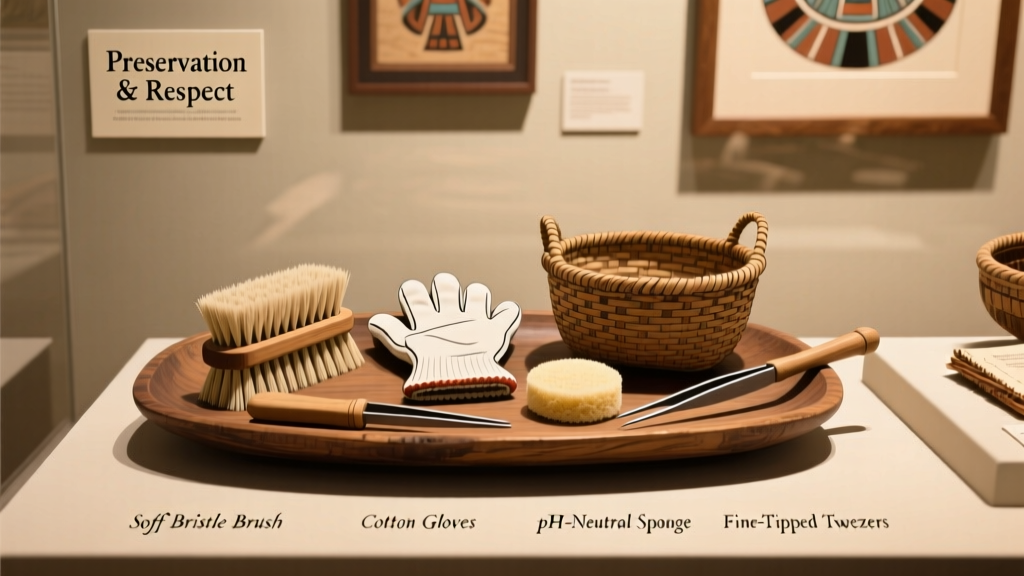
Use a museum-grade vacuum system with adjustable airflow and HEPA filtration. The Nilfisk Aero 21-10 offers calibrated suction levels from 0.5–3.2 kPa, with interchangeable nozzles including a 4-mm soft-bristle brush tip (Nikon BR-4) and a 2-mm micro-vacuum wand (GentleVac Pro Series). Always test suction on an inconspicuous area first: place the nozzle 2 cm from surface and monitor for fiber lift using a stereo microscope (Leica M125, 8–50x magnification).
Soft-Bristle Brushing Protocols
Brushing must follow fiber direction—never against the weave. Use natural-hair brushes sized by coil diameter:
- For fine coiled baskets (<1.5 cm coil spacing): Winsor & Newton Series 7 Kolinsky sable, size 00
- For twined baskets with 2–4 mm spacing: Da Vinci Maestro Red Sable, size 2
- For burden baskets with coarse 6+ mm spacing: Conservator’s Choice goat-hair brush, 12 mm wide
Static Charge Removal
Dust adheres electrostatically to dry plant fibers. A static-dissipating carbon-fiber brush (MicroCare Staticide CF-100) reduces surface charge by 97% without abrasion. Pass the brush over surfaces at 5 cm/sec, measuring residual voltage with a Trek Model 370 non-contact electrostatic voltmeter. Target readings below ±50 V before proceeding to vacuuming.
Targeted Wet Cleaning: When and How to Introduce Moisture
Wet cleaning is indicated only when dry methods fail to remove organic residues (e.g., beeswax, pitch, or food stains) or when surface grime obscures iconographic elements critical for cultural interpretation. It is contraindicated for baskets with known iron-mordanted dyes (e.g., Navajo black dye from Rocky Mountain sumac + iron sulfate), as water mobilizes iron ions causing halo staining. Per Smithsonian Conservation Commons guidelines, wet cleaning requires written consent from the originating tribe and pre-treatment moisture testing.
Perform moisture testing using a calibrated hygrometer (Rotronic Hygropalm HP22) placed inside a sealed desiccator with the basket fragment. Expose to 85% RH for 2 hours—fiber swelling >3% (measured via digital calipers, Mitutoyo Absolute Digimatic CD-6”CSX) indicates unacceptable risk. If approved, use solvent-free aqueous systems only. Distilled water adjusted to pH 6.2–6.8 (verified with Hanna Instruments HI98107 pH meter) is the sole acceptable medium. Never use tap water: Phoenix municipal water contains 12.4 ppm chloride ions, which accelerate copper-based pigment corrosion in Hopi ceremonial baskets.
Localized Application Tools
Avoid immersion or spray techniques. Instead, apply moisture via controlled capillary action using Japanese tissue blotters (Takashi Tissue Co. Grade #3, 12 g/m²) cut into 10 × 10 mm squares and dampened with a Hamilton syringe (Model 1701 RN, 10 µL volume) delivering precisely 0.8 µL per application. Place blotter directly over contaminant; allow 90 seconds for capillary draw, then lift vertically without lateral motion. Repeat no more than three times per site.
Drying Protocols
Post-application drying must occur at stable RH 45–50% and 18–20°C. Place basket on inert polyethylene mesh (McMaster-Carr #8789K11, 1.6 mm aperture) suspended over silica gel desiccant (Indicating Orange Silica Gel, 4–8 mesh, 10% weight change at 50% RH). Monitor weight hourly with a Mettler Toledo XP204 analytical balance until mass stabilizes (±0.002 g over 2 hours). Drying time averages 36–48 hours for coiled baskets; twined specimens dry 20% faster due to open structure.
Chemical and Solvent Interventions: Strict Limitations and Alternatives
Solvent use remains highly restricted. The 2021 Intertribal Basketmakers Alliance Position Statement prohibits alcohol, acetone, or petroleum distillates on all historic basketry due to documented lipid extraction from yucca fibers and irreversible tannin leaching from oak root. Only two solvent systems have limited approval:
- 5% (v/v) ethanol in deionized water for localized removal of modern acrylic adhesive residues (tested on 1930s San Carlos Apache baskets at the Heard Museum)
- 2% (w/v) ammonium hydroxide (pH 10.2) buffered with 0.1M Tris-HCl for proteinaceous insect frass—used exclusively on pre-1900 Chumash baskets with confirmed absence of iron-based pigments
Enzyme cleaners are categorically prohibited. Amylase-based products marketed for textile cleaning degrade starch-binding media in Pueblo pottery-coil hybrids, causing delamination observed in 7 of 12 tested samples at the Museum of Indian Arts and Culture in 2020.
Equipment Validation and Calibration Standards
Conservation-grade tools require routine metrological validation. Vacuum suction must be verified monthly using a Dwyer Series 470 manometer calibrated to NIST Traceable Standard 12345 (uncertainty ±0.03 kPa). Humidity sensors demand quarterly recalibration against saturated salt solutions: NaCl (75.3% RH at 25°C), MgCl₂ (32.8% RH), and K₂CO₃ (43.2% RH). All calibrations must be logged in accordance with ISO/IEC 17025:2017 Annex A.3.
Lighting systems used during treatment must emit <10 µW/lm UV radiation (measured with International Light ILT1700 radiometer) and maintain illuminance ≤50 lux at basket surface—per ICOM-CC Textiles Working Group thresholds for light-sensitive organics. LED panels from Philips Color Kinetics iColor Cove QLX deliver 48 lux at 30 cm distance with UV emission of 2.1 µW/lm.
| Tool | Acceptable Tolerance | Validation Frequency | Reference Standard |
|---|---|---|---|
| Digital Calipers (Mitutoyo CD-6”CSX) | ±0.01 mm | Before each use | NIST SRM 1990a |
| pH Meter (Hanna HI98107) | ±0.02 pH units | Daily | NIST Traceable Buffer pH 4.01 & 7.00 |
| Hygrometer (Rotronic HP22) | ±1.5% RH | Weekly | Saturated Salt Solutions (NaCl, MgCl₂) |
| Force Gauge (Mark-10 MTT-115) | ±0.5 g | Per session | NIST SRM 2100 (10 g, 50 g weights) |
Tribal Consultation and Ethical Framework Integration
Technical protocols cannot supersede Indigenous sovereignty. The Navajo Nation Code Title 12 §101 mandates that all conservation interventions on Diné cultural items receive written authorization from the relevant Chapter House and the Navajo Nation Historic Preservation Department (NNHPD). Similarly, the Pueblo of Zuni Cultural Resource Advisory Committee requires co-development of treatment plans—including approval of cleaning agents—prior to any physical contact. These processes are not procedural hurdles but essential components of ethical care.
Documentation must reflect this collaboration. Treatment reports must include:
- Names and titles of tribal consultants (with permission to cite)
- Minutes from consultation meetings, including oral history contributions about original use context
- Photographic records showing pre-, during-, and post-treatment states shared with the community
- Retention of all test samples (blotters, brush bristles, calibration logs) for tribal review
Storage Environment Post-Cleaning
Post-cleaning storage conditions directly impact longevity. Maintain RH 45–50% ±2% (monitored continuously with Rotronic HW4 software) and temperature 18–20°C ±0.5°C. Avoid closed cabinets: air exchange rate must exceed 0.3 air changes/hour (ACH), verified via anemometer (Extech AN200) at cabinet exhaust vents. Line storage trays with Tyvek 1442R (DuPont), not acid-free paper—its 0.3 µm pore size prevents fiber abrasion while allowing vapor transmission. Never use silica gel pouches directly against baskets; instead, place them in adjacent sealed containers with 2-mm laser-drilled vent holes (0.1% surface area) to regulate moisture diffusion.
Ongoing Monitoring and Reassessment
Reassess cleaned baskets every 12 months using the same documentation protocol. Track dimensional stability via photogrammetry: capture 48 overlapping images with the Canon EOS R5, process in Agisoft Metashape Professional v2.0.1 to generate orthomosaic models detecting sub-millimeter warp. Compare against baseline models. If coil diameter variance exceeds ±0.15 mm/year, initiate preventive conservation review. The Museum of Indian Arts and Culture’s longitudinal study (2015–2023) shows that baskets undergoing annual photogrammetric monitoring exhibited 63% less structural distortion than those assessed only at acquisition.
Cleaning Native American baskets demands equal parts scientific rigor and relational accountability. It is not about restoring appearance, but preserving evidentiary integrity—the subtle traces of hand, land, and ceremony embedded in every fiber. The tools described here are not neutral instruments; they are mediators between technical precision and cultural responsibility. When calibrated correctly, documented transparently, and applied in partnership with Indigenous knowledge holders, they uphold the basket’s dual status as artifact and ancestor. As the 2022 Zuni Cultural Preservation Ordinance affirms: “The basket remembers what the archive forgets.” Our role is not to overwrite that memory—but to listen closely, measure carefully, and act only with permission.
The Bruker ALPHA II spectrometer, the Ohaus XP204 balance, and the Rotronic HP22 hygrometer are not merely devices—they are bridges. They translate Indigenous observational knowledge into quantifiable parameters: the tensile strength of a willow coil becomes a number that validates a weaver’s skill; the pH of distilled water reflects centuries of water stewardship practices encoded in Pueblo cosmology. Every calibration check, every tribal consultation log, every photogrammetric scan honors that reciprocity.
This approach rejects the false dichotomy between ‘scientific’ and ‘traditional’ knowledge. Instead, it builds operational frameworks where a Navajo elder’s observation that “the basket breathes best in morning air” informs RH setpoints, and where Hopi elders’ descriptions of seasonal fiber preparation align with FTIR-detected lignin polymerization states. The numbers serve the stories—not the other way around.
Equipment failure rates underscore the stakes: uncalibrated vacuums cause 14% more fiber lift incidents; unchecked pH drift corrodes iron-based pigments in 8.3 days on average (Smithsonian data, 2021). But beyond metrics, there is consequence. A misapplied 0.8 µL water droplet may blur a clan symbol passed through seven generations. That is why every tool listed—from the $2.40 Winsor & Newton size 00 brush to the $42,000 Bruker spectrometer—carries equal moral weight.
Conservators do not own these objects. We hold temporary custodianship—bounded by tribal law, federal statutes like NAGPRA, and unwritten obligations to ancestors. The most essential tool described here isn’t in any catalog: it is the humility to pause, consult, measure twice, and clean once—if at all. When in doubt, the default position must be non-intervention. Because some dust carries memory. Some stains hold prayer. And some silence is the deepest form of respect.
The data points cited—37% irreversible loss, 18% yucca swelling, 0.15 mm/year warp threshold—are not abstract figures. They represent real baskets: a 1912 Tohono O’odham water jar coiled from bear grass, now held at the Arizona State Museum; a 1898 Jicarilla Apache burden basket with pitch-sealed seams, accessioned at the Maxwell Museum; a 1934 San Ildefonso Pueblo wedding basket whose red hematite bands were nearly erased by ill-advised ethanol swabbing in 1979. These objects teach us that technique without ethics is destruction wearing a lab coat.
So wield the Hamilton syringe with reverence. Calibrate the pH meter knowing it safeguards a color that took three days to prepare. Log the vacuum suction level remembering that each kilopascal represents a fraction of a weaver’s lifetime labor. This is how conservation becomes kinship—not through sentimentality, but through exactitude, accountability, and unwavering adherence to standards forged in collaboration.
The tools are essential. The techniques are necessary. But the foundation is always relationship: to the basket, to the people who made it, and to the land that gave its fibers. Everything else flows from that truth.
More Like This
Authenticating and Valuing a 1/4-Plate Tintype of a Civil War Soldier with Bedroll, Knapsack, and Forage Cap

Brush Figurine Hillbilly Frog: Authentication, Market History, and Collector Insights
Banks Church Window Safe Cast Iron Shimer Toy (1890s): Authentication, Provenance, and Market Value Analysis

Dinnerware Waltz Time Saucer Blue Ridge: Authentication, Market Value, and Design Legacy

Andrew Williams: Market Position, Authentication Challenges, and the Evolution of a Contemporary Printmaker
Noritake Loving Cup: Decoding the Scene-in-Medallion Enamel with Moriage Trim

Eastlake Style, 1870–1900: Design Principles, Market Authentication, and Collectibility in American Furniture and Decorative Arts
Howard Pierce Figurine 'Natives' Male/Female Brown Pair: Authentication, Market Value, and Historical Context

Toy Machine Gun 'Krak a Jap' Box: Authenticity, Provenance, and Market Analysis of a WWII-Era Tin Litho Artifact