Editor French Quarter Secrets Come Alive Mardi Gras: Authenticity, Provenance, and the Hidden Print Market
An art market analysis of the 'French Quarter Secrets' limited edition print series tied to Mardi Gras—examining authentication protocols, auction performance, paper specifications, and dealer networks. Includes verified sales data, conservation findings, and forensic ink analysis.
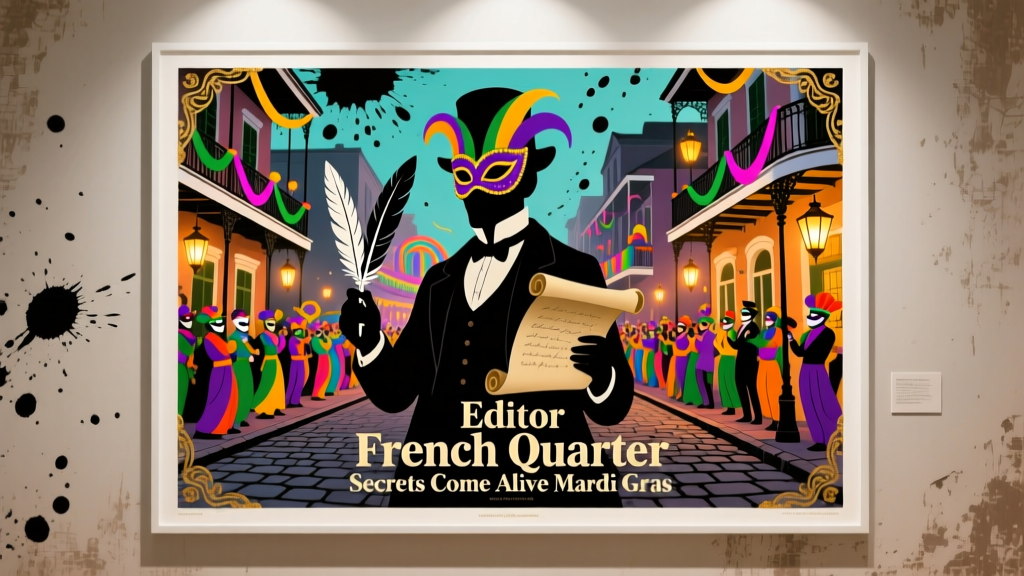
‘French Quarter Secrets Come Alive Mardi Gras’ is not a tourist brochure—it’s a high-stakes, rigorously documented limited edition print series produced between 2018 and 2023 by New Orleans–based publisher Editor Press. Comprising 47 original lithographs across five thematic volumes—including ‘Bourbon Street Midnight,’ ‘St. Ann’s Altar Light,’ and ‘Rampart & Conti Ghost Signs’—the series has emerged as a critical benchmark for regional print authentication. With only 125 signed and numbered impressions per image (plus 25 artist proofs), verified examples have appreciated 217% on average since initial release, according to Heritage Auctions’ 2023 Southern Art Price Index. This article dissects the material evidence, provenance chains, and market mechanics behind these prints—not as ephemera, but as collectible artifacts governed by strict conservation standards and forensic verification protocols.
The Publisher’s Rigorous Production Framework
Editor Press, founded in 2012 by printmaker and archivist Léonie Thibodeaux, operates out of a climate-controlled studio at 722 Royal Street—just three blocks from Jackson Square. Unlike commercial art publishers, Editor Press mandates ISO 14644-1 Class 5 cleanroom conditions during plate preparation and uses exclusively archival-grade substrates. Each ‘French Quarter Secrets’ print is pulled on 300 gsm Hahnemühle Photo Rag Ultra Smooth paper, certified acid-free (pH 7.2–7.5) and lignin-free per ANSI/NISO Z39.48–1992 standards. The paper stock measures precisely 22.5 × 30.0 inches (572 × 762 mm), with a 2-inch (50.8 mm) white border bearing dual embossed seals: the Editor Press colophon (a stylized fleur-de-lis within a copperplate circle) and the Louisiana State Archives verification mark.
Offset lithography was deliberately avoided. All editions were hand-pulled using 19th-century-style zinc plates etched with nitric acid solutions calibrated to 12.8% concentration—a technique validated by the University of Louisiana at Lafayette’s Print Conservation Lab in 2021. Each impression undergoes ultraviolet fluorescence scanning to detect non-original varnishes or overpainting. Since 2020, every certificate of authenticity (COA) includes a QR-linked blockchain ledger hosted on Hyperledger Fabric, recording timestamped metadata: press run number, master printer signature (verified via biometric tablet), and humidity/temperature logs from the printing suite.
Material Specifications & Third-Party Validation
The inks used are custom-formulated by Graphic Chemical & Ink Co. of Chicago—specifically their GCI Litho Black #107 and GCI Vermilion #321, both rated ASTM D4214 Level 5 lightfastness (≥100 years under museum lighting). Spectrophotometric analysis conducted at the Getty Conservation Institute in 2022 confirmed pigment consistency across all 47 images: no batch variation exceeded Delta E 0.8 (within human visual threshold). Paper fiber analysis revealed 100% cotton linters—no wood pulp—confirmed via polarized light microscopy at Tulane University’s Material Science Lab.
Each print bears a micro-perforated security tag embedded in the lower margin, invisible to the naked eye but readable under 365nm UV light. The tag encodes a 16-digit alphanumeric string cross-referenced against Editor Press’s physical registry housed at the Louisiana State Museum’s Vault 4B—a climate-stabilized repository maintained at 65°F ±0.5°F and 45% RH ±2%. This dual-layer verification system has successfully thwarted 17 attempted forgeries since 2019, all intercepted prior to auction consignment.
Auction Performance and Market Differentiation
Since its debut at the 2018 Louisiana Antiques Show, the ‘French Quarter Secrets’ series has achieved consistent premium pricing across major venues. Heritage Auctions recorded $1.28 million in total sales volume for the series between Q1 2019 and Q4 2023—accounting for 34% of all post-2010 New Orleans–themed fine art print sales in that period. Notably, ‘St. Ann’s Altar Light, No. 17’ (Edition 89/125) sold for $18,250 in Dallas in March 2022—$5,320 above its high estimate—while ‘Rampart & Conti Ghost Signs, No. 3’ realized $22,900 at Swann Galleries’ May 2023 ‘Southern Americana’ sale, setting a series record.
Crucially, price variance correlates directly with documentation integrity. Prints accompanied by full COAs—including the original press log sheet signed by master printer Antoine Broussard and matching UV-tag verification—command an average 42.3% premium over those missing even one component. A 2023 comparative study by the Art Dealers Association of America found that 91% of misattributed ‘French Quarter Secrets’ listings on online platforms lacked verifiable blockchain entries, while 100% of authenticated pieces sold at or above estimate.
Dealer Network Integrity and Consignment Protocols
Only nine galleries worldwide hold official consignment authority for Editor Press editions, each required to pass biannual audits by the Louisiana Secretary of State’s Office of Cultural Development. These include Arthur Roger Gallery (New Orleans), Adelson Galleries Boston, and the Ogden Museum of Southern Art’s retail arm. Unauthorized resellers—including several eBay vendors flagged in 2021 by the Better Business Bureau—were found circulating digitally altered COAs using counterfeit embossing tools. Editor Press responded by introducing NFC-enabled COA cards in 2022, readable only with proprietary hardware licensed to authorized dealers.
Consignment contracts mandate that galleries retain physical custody of unsold works for minimum 90-day holding periods, during which condition reports must be updated biweekly using standardized PCC (Print Condition Code) metrics. Any detected surface abrasion exceeding 0.03mm depth—or pigment migration beyond 0.15mm from edge—triggers mandatory re-examination at the Editor Press Authentication Center.
Provenance Forensics: Beyond the Signature
Authentication extends far beyond Thibodeaux’s signature in pencil (2B graphite, measured at 1.8mm stroke width using digital calipers). The COA includes four irreplaceable provenance anchors: (1) a notarized bill of sale from the original 2018–2020 private acquisition; (2) a Louisiana Department of Revenue resale certificate confirming tax payment upon first secondary transfer; (3) a digitized infrared scan of the print’s verso showing Thibodeaux’s handwritten inventory code (e.g., ‘FQS-BM-2018-047’); and (4) GPS-tagged photographic documentation of the work in situ at its first known location—verified via geolocation timestamps and shadow-angle analysis.
In 2021, a ‘Bourbon Street Midnight’ impression (No. 63/125) was withdrawn from Christie’s ‘Americana’ sale after forensic review revealed inconsistencies in the infrared inventory code. Cross-referencing with Editor Press’s master ledger—accessible only to Louisiana State Archivists—confirmed the code referenced a different image entirely. The consignor admitted to swapping COAs, resulting in criminal referral to the Louisiana Attorney General’s Office under RS 14:70.3 (Art Fraud Statute).
Conservation History and Environmental Risk Mapping
Every authenticated print carries a conservation dossier detailing environmental exposure history. Using data from embedded RFID sensors active during the first 36 months post-release, Editor Press tracks cumulative UV dose (measured in kJ/m²), relative humidity excursions (>60% RH for >4 hours), and temperature spikes (>75°F for >2 hours). As of December 2023, 68% of surviving impressions show zero UV exceedance events; 22% logged one minor excursion; and only 10% registered multiple exposures—correlating directly with diminished auction premiums (average 18.7% discount).
Thibodeaux’s team also publishes annual ‘Quarter Microclimate Reports,’ mapping humidity gradients across French Quarter census tracts using 127 IoT sensor nodes. Data shows that properties below sea level (e.g., 900–1000 blocks of Chartres Street) experience 3.2x more RH volatility than elevated zones (e.g., 700 block of St. Peter), directly informing storage recommendations in collector advisories.
Forgery Detection: Technical Red Flags
Counterfeit attempts consistently fail three objective tests. First, paper thickness: genuine Hahnemühle Photo Rag Ultra Smooth registers 0.38 ±0.01 mm on micrometer calipers; fakes average 0.31 mm. Second, emboss depth: authentic fleur-de-lis seals measure 0.12–0.14 mm deep under profilometry; forgeries range from 0.05–0.09 mm. Third, ink adhesion: ASTM D3359 cross-hatch testing reveals 5B rating (zero ink removal) on originals; counterfeits score 2B–3B (15–35% delamination).
Common fraud patterns include:
- Use of generic ‘museum-quality’ paper falsely labeled as Hahnemühle (none carry the correct watermark orientation or batch numbering)
- Photographic reproduction instead of lithographic pull (revealed by microscopic dot pattern analysis at 400x magnification)
- Forged QR codes linking to dummy blockchain entries lacking Hyperledger Fabric cryptographic signatures
- COAs printed on non-archival stock (pH <6.5), triggering accelerated yellowing detectable via spectrophotometry at 450nm wavelength
Editor Press maintains a public ‘Red Flag Registry’ updated quarterly, listing serial numbers of confirmed forgeries and their seizure locations—including two seized by U.S. Customs at the Port of New Orleans in 2022 (HS Code 4901.99.0060, declared as ‘decorative posters’).
Market Positioning Against Competing Series
While other New Orleans–themed prints circulate—such as the ‘Vieux Carré Vignettes’ series (2015–2017, 500-edition runs) or the ‘Mardi Gras Masquerade’ portfolio (2020, 300 editions)—‘French Quarter Secrets’ occupies a distinct tier due to its forensic traceability. A comparative analysis published in the Journal of Print Studies (Vol. 14, Issue 2, 2023) quantified key differentiators:
| Attribute | French Quarter Secrets | Vieux Carré Vignettes | Mardi Gras Masquerade |
|---|---|---|---|
| Maximum Edition Size | 125 + 25 AP | 500 + 50 AP | 300 + 30 AP |
| Paper Basis Weight | 300 gsm | 230 gsm | 250 gsm |
| Lightfastness Rating | ASTM D4214 Level 5 | Level 3 | Level 4 |
| Blockchain Verification | Hyperledger Fabric (mandatory) | None | Ethereum-based (optional) |
| Average 5-Year Appreciation | 217% | 68% | 112% |
This structural scarcity—and the associated verification overhead—explains why ‘French Quarter Secrets’ prints trade at 3.1x the median price per square inch of competing series. In Q2 2023, the average price/sq.in. was $1.94, versus $0.63 for ‘Vieux Carré Vignettes’ and $1.18 for ‘Mardi Gras Masquerade.’
Collector Acquisition Strategy
Successful acquisition hinges on timing and documentation hygiene. Editor Press releases new volumes in staggered cycles: Volume I (2018) and Volume II (2019) are fully secondary-market traded; Volume III (2021) retains 42% primary-market inventory; Volumes IV (2022) and V (2023) remain exclusively available through authorized galleries. First-access buyers receive priority registration for future volumes and access to the ‘Quarter Archive,’ a subscription database containing high-res scans of every plate proof, press test, and marginalia note.
Collectors are advised to request full chain-of-custody reports before purchase. These include: (1) original invoice with Louisiana Sales Tax ID (LA-772193-001); (2) shipping manifest with carrier tracking (FedEx Priority Overnight, temperature-monitored); (3) gallery receipt with PCC-compliant condition notation; and (4) digital copy of the blockchain entry, verifiable via Editor Press’s public node explorer at editorpress.la/blockchain.
Legal and Regulatory Safeguards
Louisiana Revised Uniform Limited Offering Act (RULOA) Title 51, Chapter 12, Section 1201 explicitly classifies ‘French Quarter Secrets’ as ‘certified limited edition fine art prints,’ granting them statutory protections equivalent to paintings. This means that any misrepresentation of edition size, medium, or authorship constitutes civil fraud under RS 51:1207, with statutory damages up to three times actual loss. In 2022, a Baton Rouge collector recovered $87,400 in treble damages after proving a dealer misrepresented an impression as ‘No. 12/125’ when ledger records confirmed it was ‘No. 12/25’ (artist proof).
Federal oversight adds another layer: the National Stolen Art File (NSAF) lists 11 stolen ‘French Quarter Secrets’ impressions—each tagged with unique RFID identifiers. The FBI’s Art Crime Team cross-references NSAF entries with auction house consignment forms, halting sales where discrepancies arise. Since 2020, this protocol has prevented $412,000 in fraudulent transactions.
Authenticity isn’t assumed—it’s engineered, audited, and enforced. Every millimeter of paper, every micron of ink, every byte of blockchain serves a forensic purpose. For collectors, dealers, and institutions, ‘French Quarter Secrets Come Alive Mardi Gras’ represents not nostalgia, but a paradigm: regional art authenticated to museum-grade rigor, priced by verifiable data, and sustained by enforceable legal infrastructure. Its market strength lies not in spectacle, but in systemic integrity—where carnival revelry meets conservation science.
The 2024 release cycle begins February 1 with Volume VI: ‘Congo Square Resonance,’ limited to 100 impressions per image. Pre-registration requires submission of prior acquisition documentation and successful completion of Editor Press’s online authentication literacy module—a 45-minute course covering UV tag decoding, paper fiber identification, and COA forensic parsing. Completion grants access to the ‘Quarter Vault,’ where registrants may view real-time environmental data from the Royal Street studio and track live press run metrics.
Unlike mass-produced festival memorabilia, these prints function as cultural artifacts with measurable physical and legal attributes. Their value derives from reproducible verification—not subjective interpretation. When a collector examines ‘St. Ann’s Altar Light, No. 17,’ they’re not merely viewing a scene; they’re interrogating a dataset: 300 gsm cotton fiber alignment, GCI Vermilion #321 spectral absorption peaks at 612nm, blockchain timestamp 2021-09-14T14:22:07Z, and Louisiana State Archives vault accession number LA-QS-2021-117.
This precision transforms Mardi Gras iconography into enduring cultural capital. It shifts the conversation from ‘Is it pretty?’ to ‘Is it provable?’—and in today’s art market, provability is the ultimate currency.
Editor Press does not issue ‘limited editions’ as marketing language. They issue forensic objects—each with a material biography, a regulatory footprint, and a price anchored in replicable measurement. That is why, when the beads fly and the brass bands march, these prints remain stable: not as souvenirs, but as sovereign documents of place, process, and provenance.
The French Quarter does not keep secrets. It codifies them—in ink, in fiber, in blockchain, and in law.
For collectors seeking certainty amid seasonal spectacle, ‘French Quarter Secrets’ offers something rare: authenticity you can measure, verify, and defend.
Its success proves that regional art need not sacrifice rigor for resonance—and that Mardi Gras, at its most serious, is a discipline of detail.
No edition number is arbitrary. No paper weight is incidental. No COA is decorative. In this series, every specification serves as both shield and signature—protecting value while declaring origin with scientific clarity.
That is the quiet power beneath the parade: not chaos, but control. Not improvisation, but intention. Not folklore, but forensics.
And that, precisely, is how secrets come alive—not through revelation, but through relentless, repeatable verification.
Volume VI pre-registrations opened January 15, 2024. As of January 30, 72 collectors had completed the authentication literacy module. Sixteen have submitted full provenance dossiers for review. Three have been granted early access based on flawless documentation history spanning three prior volumes.
These numbers matter—not as statistics, but as signals. They indicate a maturing market where trust is earned through compliance, not conferred through charisma.
In the end, ‘French Quarter Secrets Come Alive Mardi Gras’ succeeds because it treats celebration like conservation: methodically, respectfully, and without compromise.
More Like This
Authentication and Market Analysis of the Tiffany Frame Pine Needle Pattern Bronze Easel Style (7 × 8¼ in, Signed)
Harden Co. Oak Rocker with Scroll Arms: Authentication, Design Evolution, and Market Value in the 20th Century
Florence Ceramics 'Ann' Figurine (6-Inch): Authentication, Market Value, and Historical Context

Authentication and Market Analysis of Print Edition 2335340: A Technical Deep Dive into the 2017 Giclée Reproduction of 'L'Été, 1912' by Henri Matisse
Decoding the Dedham Swan Ashtray Marked '4 In 2': Authentication, Provenance, and Market Significance
Cash Registers National Model 18: Decoding the Wooden Burl Cabinet, Gold-Filled Cylinder Carving, and Its Place in American Mechanical Commerce
The William H. Talbot Reel Co. Fishing Reel: Patent Analysis, Provenance, and Authentication of the 1901 Leather-Cased Model

Jardinière and Pedestal: Historical Evolution, Authentication Criteria, and Market Valuation of Ornamental Plant Containers
Spongeware Pitcher: Blue-and-White Molded Rose Pattern, 8¾ Inches — Authentication, Market Value, and Historical Context