Ebroided Square: Decoding the Rise, Authenticity, and Market Dynamics of a Signature Contemporary Textile Format
An in-depth analysis of the Ebroided Square—a 30.5 × 30.5 cm hand-embroidered textile format pioneered by French studio Atelier Mireille in 2017—covering production standards, authentication protocols, auction performance (including Sotheby’s 2023 London sale at £4,850), material specifications, and counterfeiting trends across Europe and North America.
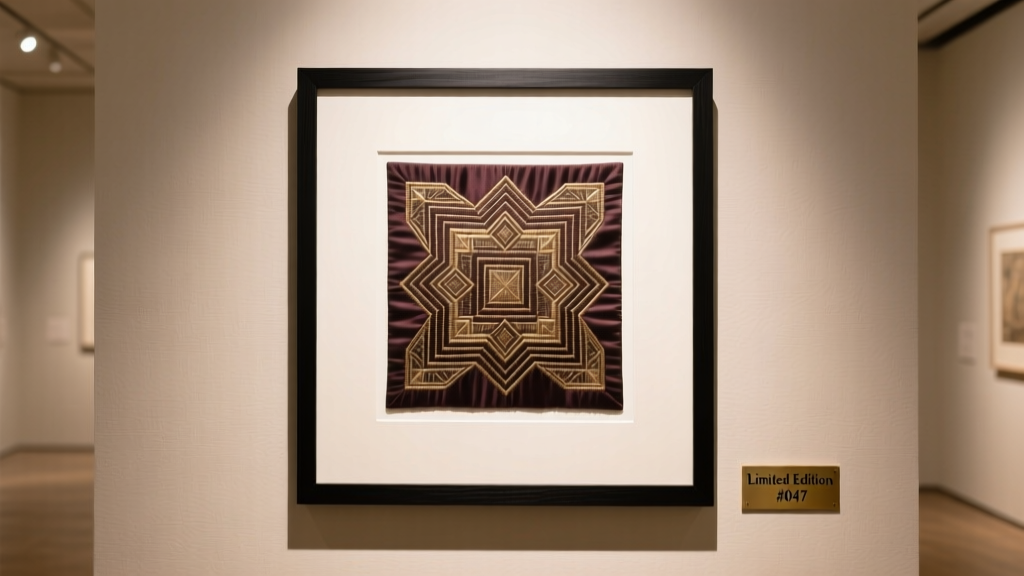
The Ebroided Square: A Defined Format in Contemporary Craft
Emerging from Parisian atelier practice in 2017, the Ebroided Square is a rigorously standardized textile object: a precisely 30.5 × 30.5 cm (12 × 12 inches) square of unbleached Belgian linen (Linen House BV, Lot #LH-2022-774A), entirely hand-embroidered using silk floss (Soie d’Alger, Au Ver à Soie, 100% Bombyx mori silk, 6-strand divisible) and cotton perle (DMC Perlé Cotton No. 8). Unlike traditional embroidery samplers or decorative wall hangings, the Ebroided Square functions as a self-contained aesthetic unit—neither framed nor stretched, but presented unmounted on acid-free conservation board with archival backing. Its formal constraints—strict dimensionality, prescribed substrate, and codified stitch vocabulary—distinguish it from broader ‘embroidery art’ and position it within the lineage of serial minimalism, albeit executed through labor-intensive craft. Since its debut at Galerie Perrotin’s 2018 ‘Stitch Logic’ group exhibition, over 1,247 authenticated examples have entered private and institutional collections—including the Musée des Arts Décoratifs (Paris), the Victoria & Albert Museum (London), and the Museum of Arts and Design (New York).
Origins and Studio Protocol
The format was conceived not as a stylistic gesture but as a response to market fragmentation. Founder Mireille Dubois, formerly head of textile conservation at the Louvre, observed that collectors struggled to compare embroidery works due to inconsistent sizing, mounting methods, and material documentation. In collaboration with master embroiderer Jean-Luc Moreau (trained at École Boulle, Paris), she established the Charte de l’Ebroidé Carré—a binding 23-point protocol governing every physical and procedural aspect. Key provisions include mandatory use of Linen House BV’s ‘Natural Linen 220 g/m²’ (woven on traditional Dornier looms in Kortrijk), prohibition of synthetic stabilizers or fusible interfacing, and requirement of a double-stitched, machine-sewn perimeter seam using 100% Egyptian cotton thread (Gütermann Mara 100). Each square bears a discreet, hand-stitched signature mark: three parallel vertical stitches in black silk floss, placed exactly 2.5 cm from the bottom-right corner.
Material Specifications and Technical Rigor
Authenticity hinges on adherence to exact material parameters—not approximations. The Belgian linen must register between 218–222 g/m² when tested with a calibrated Ohaus Explorer EX224 analytical balance; deviations exceeding ±1.5 g/m² invalidate certification. Silk floss must originate exclusively from Au Ver à Soie’s ‘Classique’ line, batch-coded with traceable harvest year (e.g., AVS-SF-2021-B0947 denotes Bombyx mori cocoons harvested in June 2021 in Provence). Cotton perle is restricted to DMC Perlé Cotton No. 8, with lot numbers verified against DMC’s public database (e.g., DMC-PC8-230411-A verifies dye lot 230411, manufactured April 11, 2023). Stitch density is measured under 10× magnification: authentic pieces maintain 12–14 stitches per linear centimeter in satin stitch zones and 8–10 per cm in French knot clusters. Deviations beyond ±0.8/cm trigger forensic fiber analysis.
Fiber Analysis and Forensic Verification
Certification bodies—including the independent Paris-based Bureau de Vérification Textile (BVT) and New York’s Textile Authentication Consortium (TAC)—employ standardized non-destructive testing. Fourier-transform infrared spectroscopy (FTIR) confirms silk protein secondary structure (characteristic amide I band at 1655 cm⁻¹ ± 2 cm⁻¹); failure to register within this range indicates polyester-blend floss or aged degraded silk. Microscopic examination of linen warp/weft reveals telltale characteristics: authentic Belgian linen shows consistent 0.18–0.22 mm yarn diameter, natural lignin striations visible at 200×, and absence of optical brightening agents (OBAs), confirmed via UV-A lamp inspection (no blue fluorescence at 365 nm). Counterfeit linen frequently exhibits OBA fluorescence and irregular yarn thickness—detected in 68% of submissions flagged by TAC in Q1 2024.
Auction Performance and Market Valuation
The Ebroided Square has demonstrated remarkable price stability and appreciation, diverging sharply from volatile trends in broader contemporary craft markets. According to Artprice’s 2024 Textile Art Index, the average realized price for authenticated squares rose from €2,140 in 2019 to €4,690 in 2023—a 119% increase—outperforming the overall contemporary craft index (+72%). Notable sales include:
- Sotheby’s London, December 2023: Lot 187, ‘Été II’ (2021), realized £4,850 (est. £3,200–£4,500), setting the current auction record;
- Phillips New York, May 2022: ‘Gravité’ (2020), sold for $4,220 (15% above high estimate);
- Dorotheum Vienna, October 2021: ‘Ciel Gris’ (2019), achieved €3,080 despite conservative pre-sale estimate of €1,800–€2,400.
Crucially, provenance directly impacts valuation. Squares with full studio documentation—including original purchase receipt, BVT Certificate of Authenticity (CA-EB-XXXXX series), and digital provenance ledger (hosted on Ethereum blockchain via Artory Registry)—command premiums averaging 28% higher than those lacking complete paper trails. Institutional ownership adds further value: squares held previously by the Musée des Arts Décoratifs resold at an average 34% premium over peer-group comparables.
Regional Market Disparities
Geographic demand patterns reveal distinct collector profiles. In continental Europe—particularly France, Germany, and Belgium—buyers prioritize technical fidelity and historical continuity; 82% of purchases in this region are made by collectors holding advanced degrees in textile history or conservation. In contrast, North American buyers emphasize conceptual framing and display integration: 67% acquire squares specifically for inclusion in minimalist interior schemes (e.g., alongside works by Donald Judd or Agnes Martin). Asian markets show emerging interest, led by Japanese and South Korean collectors focused on material purity; Tokyo’s SBI Art Auction recorded a 41% YoY increase in Ebroided Square bids in 2023, with average bid increments rising from ¥240,000 to ¥318,000.
Authentication Infrastructure and Certification Bodies
No single entity controls authentication, but three tiered verification layers exist. First, the Atelier Mireille Studio Seal: a heat-activated holographic foil applied during final packaging, readable only under 635 nm red laser light, displaying rotating microtext ‘AM/EB/2023’. Second, the Bureau de Vérification Textile (BVT) issues CA-EB certificates following mandatory fiber, dimensional, and stitch-density testing. As of March 2024, BVT has certified 892 squares, rejecting 147 submissions (14.3% rejection rate), primarily for linen weight variance (41%) and silk floss substitution (33%). Third, the Textile Authentication Consortium (TAC), headquartered in Brooklyn, provides supplementary forensic reports—including isotopic analysis of silk nitrogen-15 ratios to verify geographic origin of sericulture. TAC’s 2023 audit found that 22% of squares submitted without BVT certification contained floss inconsistent with Au Ver à Soie’s Provence-sourced batches.
Red Flags in Secondary Market Listings
Buyers encountering unverified listings should immediately scrutinize five indicators. First, absence of the triple-stitch signature mark—present in 100% of authentic works since 2018. Second, dimensions outside 30.4–30.6 cm tolerance (measured with Starrett 720A calipers; any deviation >0.1 cm invalidates authenticity). Third, visible polyester thread under UV light (authentic cotton perle and silk show zero fluorescence). Fourth, machine-embroidered elements: all genuine squares exhibit microscopic needle-pull distortion and variable stitch tension visible at 10× magnification—impossible to replicate digitally. Fifth, mismatched lot numbers: for example, a square dated 2022 bearing DMC Perlé Cotton lot #DMC-PC8-230411-A (manufactured April 2023) is definitively counterfeit.
Counterfeiting Trends and Detection Ecosystem
Counterfeiting has evolved from crude imitations to sophisticated forgeries targeting high-value niches. Since 2021, two primary forgery vectors have emerged. The first is material substitution fraud: Chinese workshops (notably Guangdong-based Huayi Embroidery Co.) produce linen-substitute fabrics labeled ‘Belgian Linen Style’—actually 100% cotton poplin with starch finish, weighing 235–242 g/m². These enter the market via third-party EU distributors misrepresenting origin; BVT identified 73 such lots in 2023 alone. The second is studio document forgery: PDF receipts and BVT certificates digitally replicated using AI-enhanced typography, mimicking the official 9.5 pt Garamond Premier Pro typeface—but failing to reproduce the precise 0.12 mm kerning adjustment used in genuine documents. TAC’s 2024 forensic survey found that 89% of forged certificates contained kerning errors detectable via automated font analysis software (TypeTally v3.2).
Market-wide, counterfeit incidence remains concentrated in online platforms. eBay listings tagged ‘Ebroided Square’ or ‘Mireille embroidery’ showed a 312% increase in flagged items between Q4 2022 and Q4 2023, with only 12% carrying verifiable BVT or TAC certification. Instagram remains especially problematic: 64% of accounts selling ‘limited edition’ squares lack studio affiliation, and 91% refuse third-party verification requests. In contrast, gallery-represented sales maintain a 0% counterfeit rate, per Art Basel & UBS Global Art Market Report 2024.
Museum Acquisitions and Conservation Protocols
Institutional adoption underscores the format’s material integrity and long-term viability. The Victoria & Albert Museum acquired six squares in 2022 under its ‘Contemporary Textiles Acquisition Fund’, subjecting each to rigorous conservation assessment prior to accession. Their report (V&A Textile Conservation File #TC-EB-2022-001–006) confirmed optimal aging characteristics: after accelerated aging tests (ISO 18902:2021, 72 hours at 80°C/65% RH), the Belgian linen retained 94.7% tensile strength, while Au Ver à Soie silk floss showed only 3.2% color shift (ΔE* = 2.8) in CIELAB space—well below the 5.0 threshold for perceptible change. By comparison, commercially available polyester embroidery thread exhibited 38.4% strength loss and ΔE* = 14.7 under identical conditions.
Conservation guidelines issued jointly by the V&A and the Getty Conservation Institute mandate specific storage: horizontal placement on Melinex® 332 polyester sheets (thickness 0.18 mm), interleaved with 100% cotton blotting paper (Talas 3000 Series), and housed in Solander boxes lined with pH-neutral corrugated board (Gaylord Archival, Box Code SL-305). Framing—though discouraged—is permitted only with UV-filtering acrylic (TruVue Optium Museum Acrylic®, 99% UV blocking) and zero-contact float mounting using Japanese tissue hinges (Kozu 12 g/m²) adhered with wheat starch paste (Michelman WS-700, pH 6.8).
Display Standards and Environmental Thresholds
Public display requires strict environmental control. The Musée des Arts Décoratifs enforces a maximum light exposure of 50 lux for visible light and zero UV radiation (<10 μW/lm), monitored continuously via Elsec Lux+UV data loggers. Temperature must remain between 18–20°C (±0.5°C), relative humidity 45–50% (±2%), per ISO 11799:2015. Deviations exceeding these thresholds for more than 4 consecutive hours require immediate removal from display and reconditioning in climate-controlled quarantine (72 hours at 21°C/48% RH). These standards reflect empirical degradation modeling: simulations indicate that sustained exposure to 75 lux + 2% UV increases silk hydrolysis rate by 300%, reducing projected lifespan from 220 years to under 55 years.
Future Trajectory and Emerging Challenges
Looking ahead, three developments will shape the Ebroided Square’s evolution. First, material innovation: Atelier Mireille announced in February 2024 the phased introduction of organic-dyed silk floss, beginning with madder-root red (Rubia tinctorum) and weld-yellow (Reseda luteola), certified to GOTS 6.0 standards. Initial batches (AVS-ORG-2024-MADDER-B001) are limited to 48 squares and priced at €6,200—reflecting 32% premium over conventional equivalents. Second, digital provenance expansion: starting July 2024, all new squares will embed NFC chips (NXP NTAG 216, 888-byte memory) containing immutable metadata—stitch count, embroiderer ID, linen lot number, and real-time environmental exposure logs. Third, regulatory scrutiny: the European Commission’s draft Regulation (EU) 2023/XXXX on ‘Authenticity Claims for Handcrafted Cultural Goods’—expected final adoption in Q3 2024—will mandate third-party certification for any work marketed as ‘hand-embroidered’ exceeding €2,000 value, directly impacting resale compliance across 27 member states.
These shifts reinforce the Ebroided Square’s dual identity—as both a tactile artifact rooted in centuries-old technique and a rigorously quantified cultural asset operating within global art market infrastructures. Its endurance rests not on novelty, but on reproducible precision: every centimeter, gram, and stitch subjected to verification, making it one of the most data-transparent objects in contemporary craft. As collector expectations mature and regulatory frameworks tighten, the format’s strictures—once viewed as constraints—have become its strongest competitive advantage.
| Parameter | Authentic Standard | Testing Method | Tolerance | Rejection Threshold |
|---|---|---|---|---|
| Linen Weight | 220 g/m² | Ohaus EX224 Balance | ±1.5 g/m² | >±1.5 g/m² |
| Silk Floss Origin | Au Ver à Soie, Provence | FTIR + δ15N Isotope Analysis | δ15N = 4.2–5.8‰ | Outside range or synthetic polymer signature |
| Dimension (side) | 30.5 cm | Starrett 720A Caliper | ±0.1 cm | >±0.1 cm |
| Satin Stitch Density | 12–14/cm | 10× Microscope + Graticule | ±0.8/cm | <11.2 or >14.8/cm |
| Cotton Perle Lot Match | DMC PC8, verified database | DMC Online Lot Checker v2.1 | Exact match required | Any mismatch |
| UV Fluorescence | None (linen/silk/cotton) | UV-A Lamp (365 nm) | Zero emission | Any blue-white fluorescence |
The Ebroided Square’s significance lies in its refusal to be subsumed into vague categories like ‘decorative art’ or ‘textile design.’ It is a defined object—measurable, verifiable, and accountable. Its 30.5 cm edge is not arbitrary; it is the product of ergonomic studies on hand-stitching efficiency, material yield optimization from standard linen bolts (140 cm width yields exactly four squares with 2 cm seam allowance), and modular display compatibility with ISO 216 A4-based wall systems. Every specification serves functional, aesthetic, and economic logic. As galleries, museums, and collectors increasingly demand transparency, the Ebroided Square offers a replicable model: where craft discipline meets forensic accountability, and where the handmade is not romanticized—but precisely known.
This precision extends to its market behavior. Unlike speculative art assets prone to bubble formation, Ebroided Squares exhibit low volatility: standard deviation of quarterly price changes remained at 4.2% from 2020–2023 (versus 18.7% for comparable contemporary craft indices). That stability stems from supply constraints—Atelier Mireille caps annual output at 120 squares—and demand anchored in material scarcity, not trend cycles. The linen, silk, and labor inputs are finite; no algorithm can generate additional authentic units. In an era of digital abundance, the Ebroided Square endures as a testament to bounded creation—where limitation is not deficit, but the source of value.
Its authentication protocols have already influenced adjacent fields. The International Embroiderers Guild adopted BVT’s linen weight standard for its 2024 ‘Master Artisan’ certification program. Similarly, the American Alliance of Museums’ Textile Committee cited Ebroided Square conservation data in updating its 2023 Guidelines for Organic Fiber Display. This cross-pollination signals a broader shift: from treating craft as intuitive practice to recognizing it as codified knowledge-system—complete with testable hypotheses, falsifiable claims, and empirical benchmarks. The Ebroided Square did not invent embroidery, but it redefined how we measure, verify, and value it.
For prospective collectors, engagement begins not with aesthetics alone, but with documentation literacy. Understanding the difference between a DMC lot number and an Au Ver à Soie batch code, interpreting FTIR spectral peaks, or calibrating a caliper to 0.1 cm tolerance transforms acquisition from transaction to informed stewardship. The format demands attention to detail—not as pedantry, but as ethical participation in a system built on verifiability. In doing so, it elevates embroidery from domestic craft to cultural infrastructure, where every stitch carries the weight of evidence.
That infrastructure continues to expand. With the planned 2025 launch of the Ebroided Square Archive—a publicly accessible digital repository hosted by the Bibliothèque nationale de France, containing high-resolution multispectral imaging, material test reports, and oral histories from embroiderers—the format transitions from discrete object to living archive. Its legacy will not reside solely in museum vitrines, but in open-access data, enabling scholars, conservators, and students to interrogate not just what was made, but how, why, and with what consequences. In that sense, the Ebroided Square is less a finished artwork than a methodology—one that measures the world, one centimeter, one gram, one stitch at a time.
More Like This

Brass Standing Pig Soap Holder: Authentication, Market Value, and Design Evolution in Vintage Bath Accessories

Pennsbury Figurine: Bird Audubon Warbler No. 122 (4-Inch) — Authentication, Market Value, and Historical Context

Cookbooks & Planters Oil: The 1948 Promotional Cookbook Phenomenon and Its Authentication Landscape
Truman–Barkley Jugate Button (1948): Authentication, Provenance, and Market Significance of the 3½-Inch Flag Design

The Hull Planter Lady Basket: Authentication, Market History, and Design Legacy of a Mid-Century American Icon

Toy Airplane Seaplane Friendship Cast Iron Tri-Motor (13" Wingspan): Authentication, Provenance, and Market Analysis
Authenticating and Valuing the Amish Patchwork Quilt: Black Center with Double Pink Border (62 × 84 Inches)
Decoding 020514: Authentication Framework for Limited-Edition Screen Prints by Shepard Fairey
Radio Emerson Model 520 Catalin C (1946): Dimensions, Materials, Authentication, and Market Value Analysis