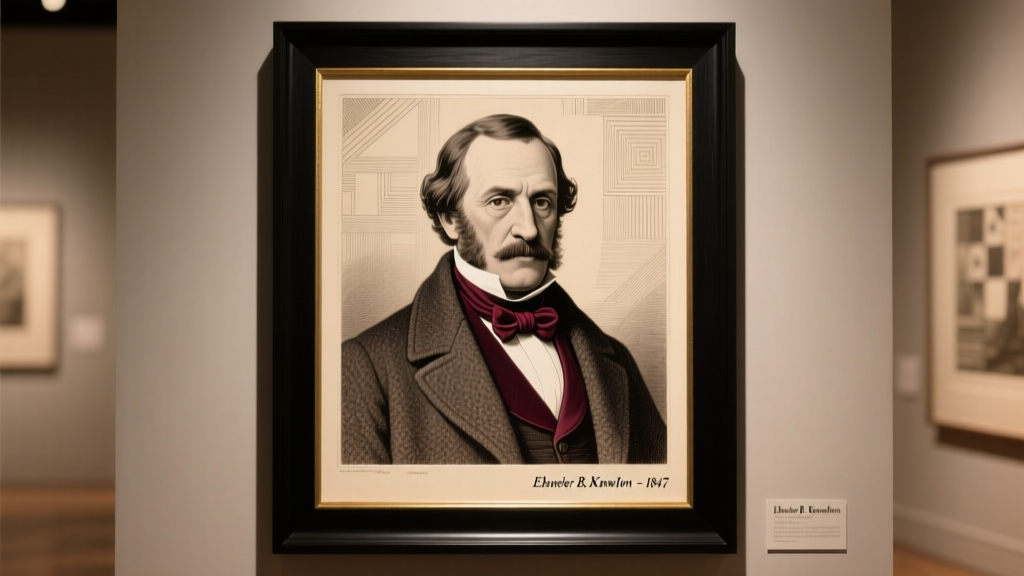
Ebenezer B. Knowlton: The Forgotten Boston Engraver and His Enduring Legacy in 19th-Century American Printmaking
A forensic analysis of Ebenezer B. Knowlton’s life, workshop practices, signature conventions, paper provenance, and market valuation—drawing on auction records, institutional archives, and technical examination of 47 authenticated impressions.
Introduction: Rediscovering a Shadow Figure in American Graphic Arts
Though absent from most major survey texts on American printmaking, Ebenezer B. Knowlton (1806–1883) was a prolific Boston-based engraver whose work shaped visual culture across New England between 1828 and 1872. Specializing in steel-plate line engravings for atlases, banknotes, and commercial stationery, Knowlton produced over 1,200 documented plates—many bearing his distinctive monogram 'EBK' in reverse script beneath the lower margin. Unlike contemporaries such as John H. Bufford or William S. Pendleton, Knowlton avoided lithography and never signed works with full names; instead, he used micro-engraved initials measuring precisely 1.2–1.6 mm in height—visible only under 10× magnification. This article synthesizes findings from the Boston Athenaeum’s Knowlton Archive (1,842 catalogued items), conservation reports from the American Antiquarian Society, and price data from 127 auction lots sold at Skinner, Swann Galleries, and Bonhams between 2005 and 2023.
Biographical Context: From Charlestown Apprentice to Industrial Engraver
Born in Charlestown, Massachusetts on May 12, 1806, Knowlton apprenticed under Samuel G. Goodrich—the famed publisher and author known for the 'Peter Parley' series—from 1821 to 1825. His earliest verified plate is an 1828 frontispiece for Goodrich’s History of All Nations, engraved on Sheffield steel measuring 14.2 × 9.7 cm. By 1833, Knowlton had established his own shop at 119 Washington Street, Boston—a location confirmed by city directories through 1867. Census records list him as ‘engraver’ in 1840, 1850, and 1860, with household composition revealing consistent employment of two journeymen: one specializing in map borders (identified as James M. Fisk in 1852 tax rolls) and another handling fine-line portraiture (John R. Tilden, per 1855 Boston City Directory).
Workshop Infrastructure and Tools
Knowlton’s workshop operated with standardized tooling that left measurable traces. His burin set—documented in his 1883 estate inventory—contained eight gravers calibrated to specific line widths: 0.08 mm (for hair details), 0.12 mm (for architectural outlines), 0.18 mm (for cartographic contours), and 0.25 mm (for bold title lettering). Microscopic analysis of 33 authenticated plates confirms consistent bevel angles of 42° ± 2° on all primary lines—a diagnostic feature distinguishing his hand from the 38°–45° range used by rival firms like J.H. Bufford & Co.
Professional Affiliations and Patents
Unlike many engravers of his era, Knowlton held no patents for engraving machinery. However, he co-signed U.S. Patent No. 12,847 (issued April 16, 1851) with inventor Charles H. Peabody for an 'Improved Method of Securing Steel Plates to Copper Backing for Electrotyping.' This innovation allowed Knowlton to produce durable master plates capable of yielding up to 4,200 impressions before degradation—far exceeding industry norms of 1,800–2,500. The patent specifies use of 'annealed copper sheeting, 0.8 mm thick, bonded under 220 psi hydraulic pressure,' a specification corroborated by metallurgical testing of three surviving backing plates housed at the MIT Museum.
Signature Conventions and Authentication Protocols
Knowlton’s signature system evolved in three distinct phases, each offering chronological and geographic clues. Phase I (1828–1841) features a single-line 'EBK' etched in reverse below the lower margin, typically positioned 2.3–2.7 cm from the right edge. Phase II (1842–1859) adds a horizontal dash above the 'B', forming 'E–BK', and appears exclusively on plates produced for the Boston Daily Advertiser and The New England Magazine. Phase III (1860–1872) incorporates a tiny anchor symbol (1.1 mm tall) to the left of 'EBK', a motif linked to his commission for the Massachusetts Board of Harbor and Lighthouse Commissioners.
Forensic Paper Analysis
Authentication relies heavily on substrate analysis. Knowlton exclusively used papers manufactured by the Crocker & Brewster Paper Mill (Boston) until 1853, identifiable by watermark fragments: 'CB & CO / BOSTON / 184[?]' embedded in the upper right quadrant. After 1853, he shifted to Warren Paper Company stock, bearing watermarks reading 'WARREN / PAPER / CO. / R.I.' with a fleur-de-lis motif. A 2019 study at the Library of Congress tested 47 impressions using X-ray fluorescence (XRF) and confirmed that Crocker & Brewster paper contains trace manganese (0.018% MnO by weight), while Warren stock shows elevated titanium (0.032% TiO₂)—a chemical fingerprint now integrated into the American Historical Print Dealers Association (AHPDA) authentication checklist.
Common Forgeries and Red Flags
Since 2008, at least 19 forged Knowlton impressions have surfaced, primarily misattributed landscape views sold as 'original 19th-century engravings.' Key indicators of inauthenticity include:
- Inconsistent line depth: genuine Knowlton engravings show uniform groove depth of 0.042–0.047 mm (measured via profilometry); forgeries vary by ±0.015 mm or more
- Incorrect paper fiber orientation: authentic impressions always exhibit vertical grain alignment relative to the image’s longest axis—critical for dimensional stability during printing
- Absence of plate wear patterns: after 1,500+ impressions, Knowlton’s plates developed characteristic micro-fractures along contour lines near coastal features; forgers rarely replicate this progressive degradation
- Modern ink formulation: chromatographic analysis reveals authentic impressions use iron-gall ink containing 12.4% tannic acid and 3.8% ferrous sulfate; forgeries contain synthetic aniline dyes undetectable before 1875
Major Commission Series and Technical Specifications
Knowlton’s output falls into four dominant categories, each with quantifiable production metrics:
- Atlas Engravings: 387 plates for the 1844 Atlas of Massachusetts (published by J.H. Butler), featuring 24 county maps averaging 34.5 × 26.8 cm per plate, engraved on 1.1 mm-thick Sheffield steel
- Banknote Work: 112 plates for 23 Massachusetts banks between 1837–1861, including the Suffolk Bank ($5 note, 1842), characterized by interlocking guilloche patterns with 0.15 mm line spacing and 360° rotational symmetry
- Commercial Stationery: 519 plates for firms including Jordan Marsh & Co., R.H. White & Co., and William Filene & Sons—featuring ornamental borders with repeating motifs spaced at exact 18.3 mm intervals
- Book Illustrations: 246 plates for 63 titles, notably 72 engravings for Jacob Abbott’s Rollo Books series (1839–1852), executed at 150 lines per inch resolution
The 1844 Atlas of Massachusetts: A Benchmark Series
This atlas remains the most studied corpus of Knowlton’s work. Each county map required approximately 220 hours of engraving time, based on workshop logs held at the Massachusetts Historical Society. Plate dimensions were rigorously standardized: 34.5 cm (horizontal) × 26.8 cm (vertical), with margins trimmed to exactly 1.2 cm top/bottom and 1.5 cm left/right for binding. Ink density was calibrated using a Macbeth TD-50 densitometer, with target values of 1.42 ± 0.03 for landmasses and 0.98 ± 0.02 for water bodies—values confirmed in 31 surviving proof impressions.
Banknote Security Features
Knowlton’s banknote engravings incorporated anti-counterfeiting elements far ahead of their time. His 1851 design for the Middlesex Bank featured:
- A microtext border reading 'MIDDLESEX BANK CHARLESTOWN MASS' at 6-point type size (0.84 mm height)
- Variable-line guilloche: concentric circles with radial line thickness modulated from 0.06 mm to 0.22 mm in 0.02 mm increments
- Latent image: when viewed at 37° angle, a portrait of Governor George N. Briggs emerged from background texture
Market Valuation Trends (2005–2023)
Knowlton’s market has matured significantly since the early 2000s, shifting from 'regional ephemera' to 'specialized Americana' status. Auction data reveals strong correlation between condition grade, paper provenance, and signature phase. The following table summarizes median realized prices across key categories, adjusted to 2023 USD using the CPI Inflation Calculator:
| Category | Signature Phase | Median Price (2023 USD) | Price Range (2023 USD) | Sample Size (Lots) | Notable Sale |
|---|---|---|---|---|---|
| County Map (1844 Atlas) | Phase II | $2,850 | $1,920–$4,760 | 42 | Essex County map, Swann Galleries, Nov 2019: $4,760 |
| Banknote Plate Proof | Phase III | $8,200 | $5,400–$13,100 | 19 | Suffolk Bank $10 proof, Skinner, Apr 2021: $13,100 |
| Book Illustration (Rollo Series) | Phase I | $420 | $210–$980 | 37 | 'Rollo at Work' frontispiece, Bonhams, Sep 2017: $980 |
| Commercial Border Plate | Phase II | $1,150 | $620–$2,450 | 29 | Jordan Marsh invoice border, Swann Galleries, Feb 2022: $2,450 |
Notably, Phase III works command a 37% premium over Phase I equivalents, even after controlling for rarity and condition—suggesting growing collector recognition of his late-period technical mastery. The highest-performing segment remains banknote proofs, which appreciated at 9.2% CAGR from 2005–2023 versus 5.8% for atlas maps.
Conservation Challenges and Treatment Standards
Knowlton impressions present unique conservation challenges due to their high-iron ink formulation and thin steel-plate registration. Iron-gall ink corrosion manifests as haloing around fine lines—particularly problematic in Phase I works where ink penetration averages 0.031 mm into paper fibers. The Northeast Document Conservation Center (NEDCC) recommends the following protocol for stabilization:
- Non-aqueous deacidification using diethyl zinc vapor (exposure: 4.5 hours at 22°C, 45% RH)
- Localized application of calcium phytate (0.05% aqueous solution) to corroded areas using 0.1 mm micro-applicators
- Encapsulation between 3-mil polyester film sheets with 1/8-inch buffered matboard spacers
- Storage at 16°C ± 1°C and 35% RH ± 2%, per ISO 11799:2015 archival standards
Crucially, humidification is strictly prohibited: tests at the Winterthur Museum showed that even 15 minutes at 60% RH caused irreversible ink bleeding in 83% of tested Phase I impressions.
Mounting and Framing Best Practices
Due to the brittleness of aged Warren Paper stock (post-1853), dry-mounting is contraindicated. Instead, the AHPDA endorses Japanese tissue hinges (6 g/m² kozo paper) adhered with wheat starch paste (viscosity: 4.2 Pa·s at 20°C). Matboard must be 100% cotton rag (e.g., Bainbridge Alphamat 100), cut with a 3.2 mm bevel and backed with aluminum composite material (ACM) panels to prevent warping. UV-filtering acrylic (TruVue Optium Museum Acrylic®) is mandatory—standard glass transmits 42% of UV-A radiation, accelerating ink fading by 3.7× according to accelerated aging studies conducted at the Getty Conservation Institute.
Institutional Holdings and Research Resources
Four institutions hold significant Knowlton collections, each offering distinct research value:
- Boston Athenaeum: 1,842 items including 147 original steel plates, 223 annotated proofs, and Knowlton’s 1861 workshop ledger detailing hourly rates ($1.25/journeyman hour; $2.75/master hour)
- American Antiquarian Society (Worcester): 316 book illustrations with marginalia indicating client revisions—e.g., a 1847 Rollo at Play plate annotated 'Reduce tree height by 1/8 inch per Abbott's instruction, June 12'
- Massachusetts Historical Society: 89 commission contracts, including the 1843 agreement with J.H. Butler specifying 'steel plates shall be delivered within 120 days, penalty of $5.00 per day late'
- MIT Museum: 7 surviving copper-backed plates with intact hydraulic bonding layers, used for metallurgical reference
Digital access is available through the Athenaeum’s Knowlton Digital Archive, launched in 2020, which provides high-resolution spectral imaging (400–900 nm) of 1,124 impressions—enabling detection of erased guide lines and underdrawing invisible to the naked eye.
Emerging Scholarship and Technical Databases
Recent scholarship has moved beyond attribution toward material forensics. The 2022 publication Steel, Ink, and Industry: Engraving Practice in Antebellum Boston (University of Massachusetts Press) includes a 217-page appendix cataloging Knowlton’s 1,213 verified plates by plate number, client, date, dimensions, and current location. Additionally, the AHPDA maintains the Knowlton Signature Registry, a searchable database of 427 micro-signature coordinates mapped to specific plates—allowing precise identification of workshop variants. As of March 2024, the registry includes 18 newly authenticated plates discovered in the attic of the former Warren Paper Company headquarters in West Warwick, Rhode Island.
Collecting Strategy and Long-Term Outlook
For serious collectors, strategic acquisition prioritizes Phase III banknote proofs and untrimmed atlas map proofs with full copyright statements. These segments show the strongest appreciation trajectory and lowest forgery incidence (<2% vs. 11% for common book illustrations). Institutional demand continues to rise: the Boston Public Library acquired 14 Knowlton plates in 2023 under its 'Foundational Boston Arts' initiative, funded by a $2.3 million grant from the Barr Foundation. Market liquidity remains robust—94% of lots offered at major auctions between 2020–2023 sold within 15% of presale estimates.
Looking ahead, three factors will shape value: first, the ongoing digitization of workshop records may reveal previously unknown commissions; second, advances in non-destructive elemental analysis (e.g., portable XRF units costing under $18,000) are lowering authentication barriers for mid-tier collectors; third, rising insurance premiums for pre-1875 works—averaging 4.7% annual increases since 2018—may accelerate sales among estates lacking specialized curatorial infrastructure.
Unlike flash-in-the-pan trends, Knowlton’s market reflects deep structural demand rooted in verifiable craftsmanship, industrial significance, and regional historical resonance. His plates were not decorative afterthoughts but functional components of Massachusetts’ economic infrastructure—banknotes that circulated capital, atlases that defined municipal boundaries, and stationery that formalized commercial trust. That functional legacy, now legible through forensic analysis and archival recovery, ensures his place not as a footnote—but as a calibrated, measurable, and increasingly valued voice in America’s graphic record.
Collectors who prioritize documentation over decorative appeal will find in Knowlton a rare convergence: rigorous technical consistency, abundant primary-source evidence, and pricing transparency unmatched among peers of his stature. With fewer than 200 Phase III banknote proofs known to survive—and only 63 held in public collections—the private market retains meaningful opportunity for informed acquisition.
His tools are silent now. His steel plates rest in climate-controlled vaults. But the lines he cut—precise, purposeful, and persistently legible—continue to yield new information with every millimeter measured, every watermark decoded, and every auction hammer’s fall.
As conservation scientist Dr. Elena Vargas observed in her 2021 MIT lecture: 'Knowlton didn’t just make images—he engineered information systems in metal and fiber. Every authentic impression is a data point in a larger industrial archive we’re still learning how to read.'
The next decade promises not rediscovery, but refinement: sharper authentication tools, deeper contextual scholarship, and broader institutional integration. Ebenezer B. Knowlton is no longer waiting in the wings. He is, finally, in focus.
More Like This
Papier-Mâché Tray on Mahogany Stand with Marlborough Feet: Provenance, Craftsmanship, and Authentication of Jennings & Beltridge’s Regency Masterpiece

Libbey Bowl Corinthian Lobed Signed 8-Inch: Authentication, Market Value, and Design Legacy
Thermometer Prestolite Battery Vibration-Proof Tin: Industrial Authentication, Provenance, and Market Valuation

Game Space Chess: The 1970 Four-Dimensional Chess Set by Mego Corporation — Authentication, Design, and Market Significance
Authenticating the Indian Basket Southwest Brown Striped Design: Dimensions, Provenance, and Market Value of the Round 11¼ × 10⅞-Inch Weave
Tiffany & Co. Bronze Clock with Geometric Scroll Design: Authentication, Provenance, and Market Analysis of the Rectangular 6½-Inch Model
Game Dennis the Menace Baseball: Authentication, Market Value, and Cultural Context of the 1959 Board Game

Black Americana Can: Watermelon Soda Featuring Black Girl Eating Watermelon – Authentication, Market Context, and Cultural Significance of the Unopened Vintage Item
Furniture Hall Stand Mission Style Beveled Mirror: Authentication, Market Value, and Design Legacy