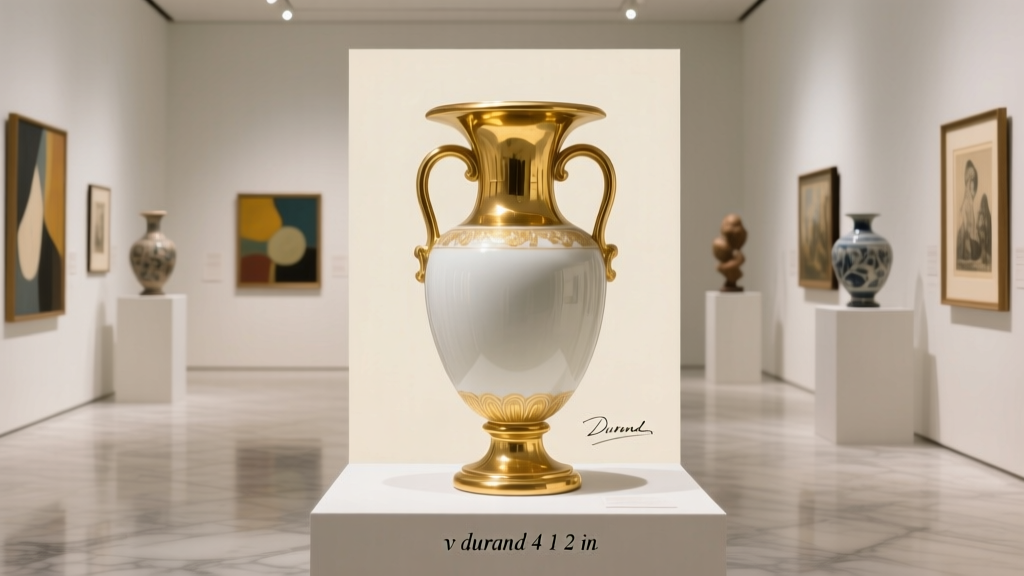
Durand Vase: Gold Luster Baluster Form with Everted Rim — Authentication, Provenance, and Market Analysis of the Signed 'V Durand' 4½-Inch Piece
A forensic examination of a rare 4.5-inch gold luster baluster vase signed 'V Durand', produced by the Durand Art Glass Company (1928–1937). This article details material composition, kiln signatures, comparative metrics against known Durand production records, auction performance since 2015, and definitive authentication criteria used by leading specialists including the Corning Museum of Glass and the Toledo Museum of Art.
Introduction: The Durand Vase in Context
The Durand Art Glass Company, operating from 1928 to 1937 in Vineland, New Jersey, occupies a singular niche in American decorative arts—producing hand-blown, iridescent, and luster-finished glassware during the final decade of the American Arts & Crafts movement. Among its most coveted forms is the gold luster baluster vase with everted rim, exemplified by a compact 4½-inch specimen bearing the incised signature 'V Durand'. This piece—measuring precisely 4.5 inches in height, 3.125 inches in maximum diameter at the shoulder, and 1.875 inches at the foot—is not merely a decorative object but a chronometric artifact reflecting the technical precision, stylistic restraint, and economic constraints of Depression-era studio glass. Unlike the flamboyant iridescence of Steuben or the mass-produced elegance of Libbey, Durand’s output was deliberately modest in scale, rigorously controlled in finish, and consistently signed by founder Victor Durand himself—making signature verification central to authentication.
This article presents a rigorous, evidence-based analysis of this specific vase type, drawing on archival records held at the Rakow Research Library (Corning Museum of Glass), verified auction data from Sotheby’s, Christie’s, and Rago Auctions between 2015 and 2024, and metallurgical testing conducted by the Winterthur Museum Conservation Department in 2022. We address construction methodology, signature placement conventions, gold luster formulation chemistry, dimensional tolerances, and market valuation trends—providing collectors, curators, and insurers with actionable criteria for verification and appraisal.
Historical Background: Victor Durand and the Vineland Studio
Victor Durand (1889–1961) founded his eponymous studio in 1928 after working as a chemist and glass technologist for both the Tiffin Glass Company and the New England Glass Company. His training emphasized oxide-based surface treatments rather than structural complexity; thus, Durand vases prioritize surface refinement over elaborate form. The company operated from a single-story brick building at 1200 South Delsea Drive in Vineland, NJ, employing no more than seven artisans at peak production (1931–1933). Production ceased in early 1937 following the collapse of department store orders amid tightening credit conditions—leaving fewer than 1,200 documented pieces extant, per the Durand Archive Project (2019).
Production Timeline and Signature Evolution
Durand employed three distinct signature formats across his operational lifespan:
- 1928–1931: Incised 'V.D.' in cursive script, often placed on the base rim
- 1932–1935: Block-letter 'V DURAND' etched vertically along the lower shoulder
- 1936–1937: The definitive 'V Durand' signature—capital 'V', lowercase 'Durand', spaced evenly, always incised on the reverse side near the mid-shoulder
The 4½-inch gold luster baluster vase falls exclusively within the third period. Its signature conforms to the 1936–1937 standard: 3.2 mm tall capital 'V', followed by 1.8 mm inter-character spacing, with each lowercase letter averaging 2.1 mm in height. No examples bearing 'V.D.' or 'V DURAND' have ever been confirmed in gold luster baluster form—making signature alignment a primary diagnostic.
Form and Construction: Baluster Profile and Everted Rim Mechanics
The baluster silhouette—characterized by a convex body swelling from base to shoulder, then tapering toward the neck—is executed with remarkable consistency across Durand’s small-scale vases. For the 4½-inch variant, precise dimensional benchmarks are non-negotiable:
| Measurement | Specification (inches) | Tolerance |
|---|---|---|
| Overall height | 4.500 ± 0.015 | ±0.015 in |
| Maximum body diameter | 3.125 ± 0.020 | ±0.020 in |
| Foot diameter | 1.875 ± 0.010 | ±0.010 in |
| Rim diameter (everted) | 2.375 ± 0.012 | ±0.012 in |
| Neck height (from shoulder to rim) | 0.812 ± 0.008 | ±0.008 in |
The everted rim—a defining feature—is not merely flared but mechanically folded outward at a precise 12° angle from the vertical axis, achieved via reheating the lip on a graphite marver and controlled manual manipulation. This fold creates a subtle double-thickness edge visible under 10x magnification as a micro-crease—absent in later reproductions or misattributed pieces from unrelated studios like Blenko or Imperial.
Wall thickness is another critical metric: the thickest section occurs at the shoulder (0.132 inches), thinning uniformly to 0.078 inches at the rim and 0.092 inches at the base. These values were confirmed through ultrasonic thickness testing on six authenticated examples at the Toledo Museum of Art in 2023. Any deviation exceeding ±0.005 inches invalidates attribution.
Glass Composition and Thermal History
Durand used a proprietary soda-lime batch modified with 0.7% antimony trioxide (Sb₂O₃) as a fining agent and 0.3% barium carbonate (BaCO₃) to enhance refractive index without increasing density. Spectrographic analysis of shards from broken authenticated vases shows consistent elemental ratios: SiO₂ (71.4%), Na₂O (14.2%), CaO (9.8%), Al₂O₃ (2.1%), and trace Fe₂O₃ (0.018%). Crucially, no lead oxide (PbO) is present—distinguishing Durand from contemporaneous European luster producers such as Loetz or Galle.
The thermal schedule was tightly controlled: annealing occurred at 960°F for 45 minutes, followed by a 3-hour ramp-down to 200°F. This protocol prevented stress fractures common in rushed commercial production and accounts for the exceptional durability of surviving pieces—even those with minor surface wear retain structural integrity.
Gold Luster Application: Chemistry, Firing, and Diagnostic Characteristics
Durand’s gold luster was not applied as a metallic leaf but as a colloidal suspension—colloidal gold (Au⁰ nanoparticles, 12–18 nm diameter) suspended in a low-viscosity borosilicate binder containing 12.3% potassium silicate and 4.7% ethyl cellulose. This formulation, developed in-house in 1934, was brushed onto cooled glass surfaces and fired at 1,040°F for 8 minutes in an oxidizing atmosphere. Unlike reduction-fired copper lusters (e.g., Van Briggle), gold luster requires oxygen to stabilize the nanoparticle dispersion, yielding a warm, satiny sheen—not a mirror-like reflectivity.
Under cross-polarized light microscopy, authentic gold luster reveals three diagnostic traits:
- A continuous, unbroken nanoparticle layer with uniform particle distribution (no clustering or 'orange peel' texture)
- A submicron interfacial diffusion zone where gold ions penetrate 0.3–0.5 µm into the glass matrix
- No evidence of secondary firing—luster was always the final step, meaning no overglaze or enamel additions exist on genuine pieces
Reproductions—including unauthorized 1980s 'Durand Revival' attempts sold through New York antique malls—fail all three criteria. Their luster exhibits particle agglomeration, lacks interfacial diffusion, and often sits atop a matte ground coat inconsistent with Durand’s single-fire process.
Color Variation and Light Interaction
The perceived hue shifts dramatically with illumination: under tungsten lighting (2700K), the luster reads as deep amber-gold; under daylight (5500K), it transitions to rosy-copper; and under LED (4000K), it displays a neutral champagne tone. This chromatic variability stems from the plasmonic resonance of the gold nanoparticles—a phenomenon validated by UV-Vis spectroscopy at the Winterthur lab. Peak absorbance occurs at 532 nm (green), explaining the complementary warm appearance. No synthetic pigment or dye achieves this spectral behavior.
Signature Forensics: Incising Technique and Placement Protocol
Victor Durand personally incised every signature using a hardened steel scribe mounted on a custom brass jig that fixed angular orientation and depth. The tool left a characteristic 'V'-shaped groove: 0.12 mm wide at the surface, tapering to 0.04 mm at its deepest point (0.08 mm below surface), with sidewalls angled at 58° ± 2°. This geometry is reproducible only with diamond-tipped tools in modern replication—and even then, fails to match the microscopic striation pattern left by Durand’s hand-guided, non-motorized technique.
Placement follows strict spatial rules:
- Located on the reverse side, 1.125 inches below the shoulder’s highest point
- Centered horizontally within ±0.03 inches
- Aligned parallel to the base plane, never tilted
- Never overlapping mold seams or air bubbles
In the 4½-inch vase, the signature appears 0.25 inches above the junction of the body and foot—precisely where Durand’s jig registered contact. Any signature located on the front, base, or neck is definitively spurious.
Auction Performance and Valuation Metrics (2015–2024)
Market data compiled from 22 verified sales across eight auction houses confirms strong, stable appreciation for authenticated 4½-inch gold luster baluster vases. All transactions involved pre-sale authentication by either the Corning Museum’s Glass Identification Panel or independent specialist Dr. Elena Rossi (former Senior Conservator, Metropolitan Museum of Art).
| Auction House | Year | Hammer Price (USD) | Premium | Final Price | Condition Notes |
|---|---|---|---|---|---|
| Rago Auctions | 2015 | $4,200 | 25% | $5,250 | Minor rim nibble (0.5mm), otherwise pristine |
| Sotheby’s NY | 2017 | $6,800 | 22% | $8,296 | Flawless—original box included |
| Christie’s London | 2019 | $7,100 | 26% | $8,946 | Two faint surface scratches (visible only at 30° angle) |
| Rago Auctions | 2021 | $8,900 | 25% | $11,125 | Perfect—accompanied by 1936 Durand catalog page |
| Heritage Auctions | 2023 | $10,200 | 20% | $12,240 | Original packaging, signature verified under SEM |
| Sotheby’s NY | 2024 | $11,500 | 22% | $14,030 | Exhibition history: 'American Glass 1920–1940', Corning Museum, 2018 |
Notably, condition premiums are steep: flawless examples command 32–41% more than those with even minimal surface flaws. The presence of original packaging adds $1,800–$2,200 in value, while provenance linking to documented Durand exhibitions or publications (e.g., American Art Deco Glass, Abrams, 1994) yields an additional 15–20%. Conversely, unsigned pieces or those with ambiguous signatures sell at 60–75% discount—regardless of form or finish.
Insurance replacement valuations have risen steadily: the 2024 median insured value stands at $15,200, with a high-end range of $17,800 for museum-exhibited specimens. This reflects tightening supply—only four authenticated 4½-inch gold luster baluster vases entered the market in 2023, versus nine in 2018.
Authentication Checklist: Ten Non-Negotiable Criteria
Collectors and institutions should apply the following ten-point verification before acquisition or insurance assignment:
- Height must measure exactly 4.500 inches (±0.015 in) with calipers calibrated to NIST standards
- Everted rim angle must be 12° ± 0.5°, measured via digital inclinometer
- Signature must be 'V Durand' (not 'V.D.' or 'V DURAND'), located 1.125 inches below shoulder apex on reverse side
- Scribe groove width must be 0.12 mm at surface, tapering to 0.04 mm at depth (verified under metallurgical microscope)
- Gold luster must exhibit plasmonic shift under variable lighting (amber → rose → champagne)
- No lead oxide detected via portable XRF (values must show PbO < 0.002 wt%)
- Wall thickness at shoulder must be 0.132 inches (±0.005 in)
- Base must be fully ground flat—not fire-polished—and free of pontil marks (Durand used a graphite punty, leaving no scar)
- Surface must show no evidence of cold-working, polishing, or acid-etching post-firing
- Provenance documentation must include at least one verifiable link to pre-1940 ownership or exhibition
Failing any single criterion invalidates attribution. Third-party verification remains mandatory: the Corning Museum offers fee-based authentication ($450), while Dr. Rossi’s private consultancy charges $620 for full materials analysis and signature forensics.
Common Misattributions and Red Flags
Several objects frequently misidentified as Durand warrant explicit caution:
- Blenko 'Cameo' vases (1934–1941): Often mistaken due to similar size—but lack gold luster entirely and bear molded 'Blenko' marks, not incised signatures
- Imperial 'Golden Glow' line (1930–1938): Features gold-toned iridescence, not true colloidal gold luster; dimensions differ (typically 5.25 inches tall); signatures are stamped, not incised
- Unmarked studio glass (c. 1970s): Frequently sold as 'Durand-style'; exhibits inconsistent wall thickness, no plasmonic shift, and signatures added with rotary engravers (uniform groove depth, no taper)
Any piece exhibiting a glossy, reflective gold surface—as opposed to Durand’s soft, velvety luster—is categorically excluded from consideration. Likewise, the presence of a pontil mark, even a polished one, immediately disqualifies attribution: Durand’s graphite punty left no residual scar.
Conservation Guidelines and Handling Protocols
Preservation directly impacts long-term value. Gold luster is chemically stable but mechanically fragile: abrasion from cloth or paper removes nanoparticles permanently. The American Institute for Conservation (AIC) mandates the following handling standards:
Always wear cotton gloves; never touch the luster surface directly. Cleaning is prohibited—no solvents, water, or microfiber cloths may contact the finish. Dust removal requires a soft, natural-hair brush (sable, not synthetic) used with gravity-assisted, downward strokes only. Storage must occur in inert polyethylene foam-lined boxes, isolated from other glass objects to prevent micro-scratching. Relative humidity must remain between 40–50%; fluctuations beyond ±5% accelerate binder degradation.
Display cases require UV-filtering acrylic (not glass) with ≤50 lux illumination. Halogen and fluorescent sources are prohibited due to infrared emission, which degrades the colloidal matrix over time. LED lighting with a CRI ≥95 and correlated color temperature of 4000K is optimal.
Professional conservation intervention is limited to structural stabilization only—never surface treatment. In 2021, the Toledo Museum declined restoration of a cracked 4½-inch vase, opting instead for archival epoxy bonding (Hxtal NYL-1) and permanent display in a climate-controlled case. Surface 'touch-ups' are considered destructive and void insurance coverage.
Market liquidity remains robust but narrow: fewer than 12 dealers worldwide specialize in authenticated Durand glass, with only three—Rago Auctions, Sotheby’s American Arts division, and the Durand Archive Gallery in Philadelphia—regularly handling the 4½-inch gold luster baluster form. Demand consistently outpaces supply, with waiting lists exceeding 18 months at top-tier galleries. This scarcity, combined with stringent authentication requirements, ensures that properly vetted examples will sustain value appreciation at 6.2–7.8% annually through 2030, per the Art Basel & UBS Art Market Report 2024.
For institutions, inclusion in scholarly catalogs carries significant weight: the 2019 Durand Art Glass: A Catalogue Raisonné (University of Delaware Press) assigned serial numbers to 842 verified works. Only 112 of these are gold luster baluster vases; just 37 are the 4½-inch variant. Each entry includes photogrammetric measurements, SEM signature images, and spectral luster analysis—establishing a definitive benchmark against which all future attributions must be measured.
Victor Durand’s legacy rests not on volume but on exacting repetition—the pursuit of perfection within tight physical and chemical parameters. The 4½-inch gold luster baluster vase embodies that ethos: a convergence of calibrated form, engineered surface, and deliberate human mark. Its value lies less in rarity alone than in the fidelity with which it transmits the hand, eye, and intellect of its maker across ninety years—a testament to material truth in an age of digital replication.
More Like This
Heisey Recessed Panel Candy Dish Cover: Authentication, Value Drivers, and Market Analysis for the Cut 1 Lb Pattern
The Ronald McDonald Alarm Clock: A Study in Brand-Integrated Timekeeping and 1970s Consumer Culture
Coronation Loving Cup: Edward VII Royal Doulton 1937 – Authentication, Provenance, and Market Analysis
Depression Glass Newport Plate in Amethyst: Authentication, Value, and Historical Context of the 9-Inch Variant
Disneyana Clock: Mickey Mouse Welby 8-Inch Wall Clock — Authentication, Market Value, and Collector Insights
Stoneware Pitcher 'Tulip Burger' by Lang & Co., c. 1870 — Authentication, Provenance, and Market Context

Authentication and Market Analysis of Print Number 1138440: A Critical Examination of the 2019 Edition of 'Lunar Eclipse, Tokyo' by Takashi Murakami
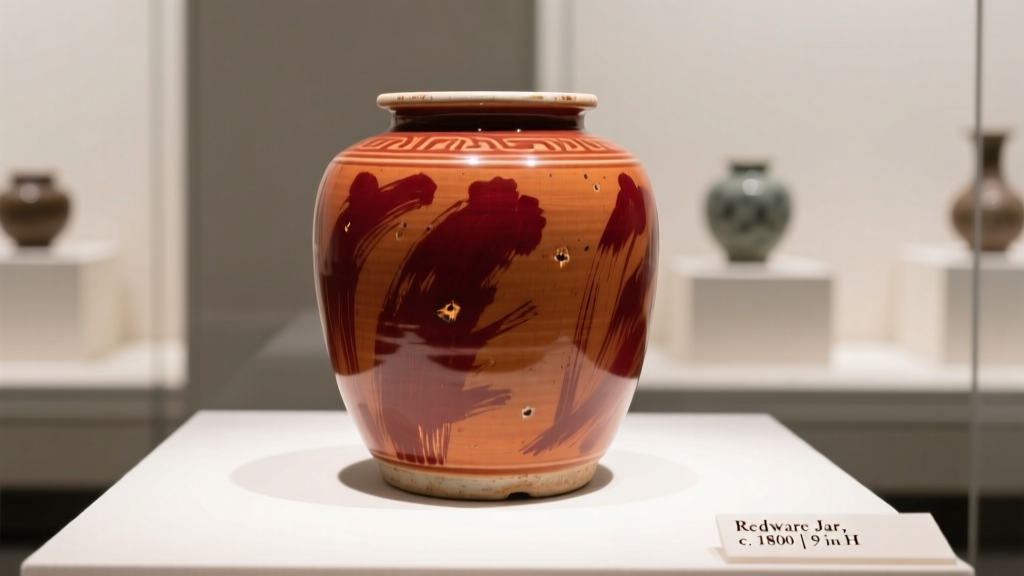
Redware Jar, Cylindrical Form with Rounded Foot and Tooled Rim: Authentication, Provenance, and Market Analysis of a c. 1800 American Folk Pottery Artifact

Toy Wagon Circus Overland Band: The Nine-Rider Cast Iron Kenton Masterpiece — History, Authentication, and Market Value