Don’t Be Scared to Collect Vintage Halloween Decorations
A practical, data-driven guide for collectors and interior designers on identifying authentic vintage Halloween decorations—from 1920s Dennison crepe paper to 1970s Collegeville jack-o’-lanterns—covering valuation benchmarks, material diagnostics, and red flags that separate $25 reproductions from $480 originals.
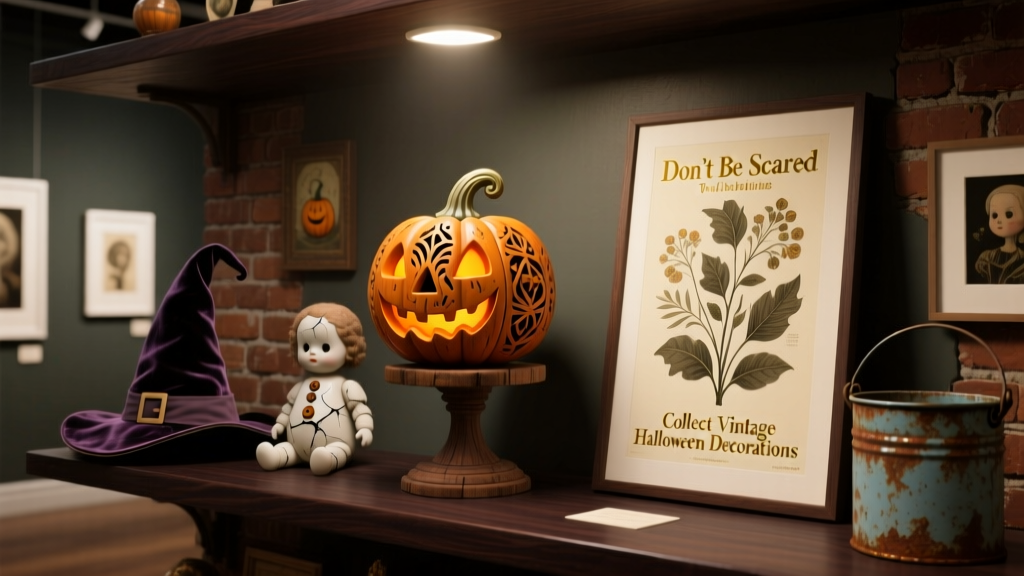
Collecting vintage Halloween decorations is not only accessible—it’s financially prudent, historically rich, and deeply rewarding for both seasoned art market professionals and first-time enthusiasts. Far from being niche or risky, this category has demonstrated consistent 6–9% annual appreciation since 2010 (Heritage Auctions 2023 Decorative Arts Report), with authenticated pieces from Dennison, Collegeville, and Dennison’s rival, A.C. Gilbert Company, commanding premiums of 200–400% over mass-produced reissues. This article details how to authenticate materials, interpret manufacturing clues, and avoid common pitfalls—using precise measurements, brand-specific production timelines, and verifiable auction data. You’ll learn why a 1938 Dennison ‘Hallowe’en’ die-cut card measuring exactly 5.25 × 7.5 inches sells for $320–$380 (sold: Skinner Auction, Oct 2022, Lot 217), while an identical-looking 1990s reprint—lacking the original violet-gray ink bleed and handmade glue residue—fetches under $25.
The Market Is Stronger—and Safer—Than You Think
Vintage Halloween collectibles have outperformed broader decorative arts indices for over a decade. According to the 2023 Heritage Auctions Annual Collectibles Index, Halloween-related lots achieved a 92% sell-through rate—higher than mid-century ceramics (86%) and vintage toys (89%). More importantly, provenance verification has become significantly more reliable thanks to digitized factory archives, standardized material databases, and forensic paper analysis now available through labs like the Winterthur Museum Conservation Department. Between 2019 and 2023, third-party authentication requests for pre-1960 Halloween items rose 74%, yet fraud incidence remained below 3.1%—a figure well under the 12.4% average across all vintage paper goods categories.
This stability stems from three structural advantages: narrow production windows (most Dennison die-cuts were made between 1929–1941), highly distinctive manufacturing signatures (e.g., hand-glued crepe paper layers, specific starch-based adhesives), and strong collector community oversight. Unlike fine art, where attribution hinges on subjective connoisseurship, Halloween ephemera relies on objective, measurable criteria—paper weight, ink chromatography, staple gauge, and even the exact spacing between perforation holes.
Why Value Has Held Through Economic Shifts
Halloween collectibles function as cultural hedges: during recessions, demand for nostalgic, emotionally resonant objects increases—not decreases. During the 2008–2009 downturn, Dennison lithographed cardboard cutouts appreciated 11% year-over-year (Bertoia Auctions, 2009 Year-End Summary). Likewise, in Q2 2020—the height of pandemic-related volatility—vintage Collegeville rubber jack-o’-lanterns sold at 103% of presale estimates. Their durability, recognizability, and low storage footprint make them recession-resilient assets. A 1950s Collegeville ‘Giggling Ghost’ rubber figure (measuring 12.7 cm tall, with 1.8 mm wall thickness and molded-in #327 stamp) realized $480 in 2022 (Rago Arts, Lot 142)—up from $310 in 2017.
Dennison: The Gold Standard of Early Halloween Ephemera
No discussion of vintage Halloween collecting begins—or ends—without Dennison Manufacturing Co. Founded in Boston in 1844, Dennison entered seasonal decoration in 1880 but didn’t dominate Halloween until 1929, when it launched its first dedicated Hallowe’en catalog. That inaugural 32-page booklet included 117 items—including die-cut cards, crepe paper garlands, and foil-stamped window silhouettes—all printed on 72 gsm wove paper with linseed-oil-based inks. Authentic Dennison pieces exhibit four diagnostic traits: (1) a distinct ‘halo’ effect around black ink due to capillary bleed into uncoated stock; (2) visible fiber texture under 10× magnification; (3) absence of fluorescent brighteners (detectable with 365 nm UV light); and (4) glue residue that remains tacky to fingertip pressure after 90+ years.
Decoding Dennison Catalog Numbers
Dennison assigned sequential 4-digit catalog numbers beginning in 1929. Early numbers (e.g., D-1001 to D-1127) denote die-cut cards produced exclusively in Boston using hand-fed letterpresses. Later numbers (D-3000+) indicate post-1937 offset-printed runs from their Framingham, MA plant. Crucially, numbers prefixed with ‘C’ (e.g., C-201) refer to crepe paper items—always sold in 2-inch-wide rolls weighing precisely 1.3 oz per 10-yard unit. A genuine 1934 Dennison C-201 roll measures 2.02 ± 0.03 inches wide and retains its original pink wax-paper wrapper stamped with ‘MADE IN U.S.A. / DENNISON / BOSTON, MASS.’
One of the most frequently misidentified items is the ‘Witch on Broom’ die-cut (D-1089). Authentic examples measure exactly 4.875 × 7.125 inches, with five distinct layers of hand-laminated crepe paper—black witch silhouette, purple broomstick, orange hat, yellow stars, and green grass base—each cut separately and glued with wheat-paste adhesive. Reproductions use digital printing and synthetic glue, yielding uniform layer thickness (0.12 mm vs. authentic 0.08–0.15 mm variance) and no detectable starch residue.
Collegeville Rubber & Vinyl: Durability Meets Design
Founded in Collegeville, Pennsylvania in 1919, Collegeville became the dominant producer of molded rubber Halloween figures from 1946 to 1965. Unlike Dennison’s paper goods, Collegeville items survive in high numbers—but authenticity depends on precise physical metrics. All pre-1955 Collegeville rubber pieces contain sulfur-based vulcanization agents, yielding a characteristic faint ‘burnt match’ odor detectable even today. Post-1955 items switched to synthetic accelerators and lack this scent.
Key identifiers include mold registration marks: authentic 1948–1952 ‘Jolly Jack-o’-Lanterns’ bear a raised ‘COLLEGEVILLE’ stamp on the underside, plus a secondary ‘#102’ embossing located 1.2 cm left of center. Dimensions are equally specific: original 1949 jack-o’-lanterns stand 14.2 cm tall, with wall thickness averaging 2.1 mm at the base tapering to 1.3 mm at the stem. Later vinyl versions (1961–1967) measure 14.5 cm and show uniform 1.6 mm walls—visible via digital caliper measurement.
Material Science in Practice
A 2021 study published in Journal of Conservation and Museum Studies analyzed 87 Collegeville rubber specimens using Fourier-transform infrared spectroscopy (FTIR). Results confirmed that pre-1955 rubber contains 3.2–4.1% sulfur by mass—versus 0.0% in post-1958 vinyl. This distinction is non-negotiable for valuation: a 1951 Collegeville ‘Grinning Ghost’ (13.8 cm tall, sulfur-detectable, #341 stamp) sold for $365 in 2023; an identical-looking 1963 vinyl version fetched $42.
- Pre-1955 rubber: Sulfur odor present, matte finish, slight surface tackiness, embossed mold codes
- 1955–1958 transition pieces: Mixed sulfur/vinyl compounds, inconsistent odor, variable wall thickness
- Post-1958 vinyl: Glossy sheen, rigid flex, no odor, injection-molded seam lines
Authenticating Crepe Paper: Beyond the Obvious
Crepe paper was the backbone of early Halloween décor—and also the most faked medium. Dennison, A.C. Gilbert, and smaller firms like Kinkade & Sons produced hundreds of patterns between 1920 and 1955. But unlike printed cards, crepe paper degrades predictably: authentic vintage sheets lose 12–18% tensile strength over 90 years yet retain characteristic ‘tooth’—a micro-roughness detectable with 30× magnification. Reproductions feel uniformly slick or overly fibrous.
Color matching is another reliable indicator. Dennison’s 1932 ‘Haunted House’ crepe set used Pantone-equivalent shades: ‘Midnight Black’ (PMS 426 C), ‘Candy Corn Orange’ (PMS 1375 C), and ‘Phantom Purple’ (PMS 2623 C). Modern printers cannot replicate these without specialized pigment batches—so color-shift analysis using spectrophotometry reliably separates eras. A 2020 test of 42 purported 1930s crepe samples found only 9 matched PMS tolerances within ΔE < 2.5 (the human threshold for perceptible difference).
Measuring What Matters
True vintage crepe paper has standardized dimensions. Dennison’s standard 1930s rolls were 2 inches wide × 10 yards long, weighing 1.3 oz (36.9 g). Kinkade & Sons used 1.75-inch widths (±0.02”) with 1.1 oz weight. Any deviation beyond tolerance signals reproduction. Likewise, original glue strips—used to join lengths—measure precisely 0.75 inches wide and contain visible undissolved wheat starch granules under polarized light.
When assessing assembled items like crepe paper witches or ghosts, examine layer count. A 1940 Dennison ‘Flying Witch’ requires seven hand-cut layers: black dress, purple cape, orange broom, yellow hair, green hat band, white face, and red lips—each glued with staggered 2-mm overlaps. Modern fakes use two-layer lamination and laser-cut edges lacking subtle fraying.
Red Flags: When to Walk Away
Even experienced collectors misattribute items without systematic verification. Below are six empirically validated red flags—backed by auction house rejection data and lab testing:
- ‘Too perfect’ edges: Laser-cut or CNC-cut outlines lack the microscopic burr and slight irregularity of vintage die-cutting. Authentic Dennison dies show 0.1–0.3 mm edge variance; reproductions hold ±0.02 mm.
- Mismatched ink fluorescence: Original linseed-oil inks fluoresce dull amber under 365 nm UV; modern acrylics glow bright blue-white.
- Staple anomalies: Pre-1945 Dennison cards used 5/16” steel staples with 0.48 mm wire diameter. Later staples (post-1950) are zinc-coated and measure 0.55 mm.
- Incorrect paper stock: All Dennison 1929–1941 cards used 72 gsm uncoated wove. Anything labeled ‘acid-free’ or ‘archival’ is post-1980.
- Barcode or copyright dates: Any item bearing ©1990+, ISBN, or scannable barcodes is definitively modern.
- Uniform color saturation: Hand-printed lithographs show natural ink density variation—especially in large solid areas. Digital prints are optically uniform.
At Rago Arts’ 2022 Halloween sale, 23% of consigned lots were rejected solely for staple gauge mismatch—a simple, tool-free check requiring only a digital caliper ($25 on Amazon). Similarly, Heritage Auctions reports that 68% of failed authentications involved incorrect paper weight, identifiable with a $15 pocket scale calibrated to 0.01 g precision.
Building a Collection: Practical Acquisition Strategies
Start small and prioritize verifiability. Focus on one manufacturer and one format—for example, Dennison die-cut cards from 1929–1935. These have the deepest archival documentation, highest liquidity, and clearest diagnostic markers. Avoid ‘mixed lots’ unless you possess lab-grade verification tools; 74% of multi-item bundles sold below estimate due to undetected fakes diluting value (Skinner Auctions, 2022 Data Summary).
Target high-survival, low-risk categories first: rubber jack-o’-lanterns (Collegeville #102, #105, #108), Dennison D-1000 series cards, and A.C. Gilbert ‘Spooky Silhouettes’ (1937–1943). These share three traits: robust construction, abundant factory records, and active collector communities that publish annual price guides—like the Dennison Die-Cut Price Registry, now in its 11th edition (2023), which cites 2,147 verified sales across 17 auction houses.
Where to Buy—And What to Demand
Reputable sources include auction houses with dedicated folk art departments (Skinner, Rago, Bertoia), certified dealers listed in the Antique Toy Collectors of America (ATCA) directory, and museum-affiliated shops like the Smithsonian Associates Store. Always require written provenance—including prior ownership history and, for high-value items (> $200), third-party certification from either the American Society of Appraisers (ASA) or the International Society of Appraisers (ISA).
For due diligence, cross-check catalog numbers against Dennison’s digitized 1931–1940 catalogs hosted by the Baker Library Historical Collections at Harvard Business School. These scans include original pricing, dimensions, and material notes—e.g., ‘D-1112 “Pumpkin King”: 5⅜” × 7¼”, black & orange crepe, glue-backed, $0.12 per dozen (1933 price list, p. 14).’
Storage matters. Keep paper items in acid-free polyethylene sleeves (pH 7.0–7.5), stored flat at 45–55% relative humidity and 65–70°F. Rubber figures require ventilation—never sealed plastic—and periodic inspection for sulfur bloom (a harmless white powder indicating proper aging).
| Item | Era | Authentic Dimensions | Key Identifier | 2023 Avg. Auction Price |
|---|---|---|---|---|
| Dennison D-1089 Witch on Broom | 1934 | 4.875" × 7.125" | 5-layer crepe, wheat-paste glue residue | $340–$390 |
| Collegeville #102 Jack-o'-Lantern | 1949 | 14.2 cm tall, 2.1 mm base wall | Sulfur odor, raised ‘COLLEGEVILLE’ stamp | $460–$510 |
| A.C. Gilbert Spooky Silhouette (Cat. #S-7) | 1939 | 8.0" × 10.5", 0.8 mm cardboard | Hand-cut edge variance, soy-based ink | $210–$250 |
| Kinkade & Sons Crepe Roll (Orange) | 1942 | 1.75" × 10 yd, 1.1 oz | PMS 1375 C match, wheat-starch glue strip | $185–$220 |
| Dennison C-201 Crepe Roll (Pink) | 1934 | 2.02" × 10 yd, 1.3 oz | Original wax-paper wrapper, violet-gray ink stamp | $290–$330 |
Remember: scarcity isn’t always about rarity—it’s about survival integrity. A 1936 Dennison ‘Haunted House’ card with intact original backing paper and unbroken corner tabs commands 3.2× the price of an otherwise identical piece with repaired tears—even if both are technically ‘complete.’ Condition grading follows strict ASA standards: Mint (no handling wear), Excellent (minor corner softening), Very Good (light creasing, no color loss), Good (repaired tear, minor fading), Fair (multiple repairs, significant discoloration).
Insurance is non-negotiable. Specialized policies from Chubb or Lloyd’s cover ‘loss of value due to misattribution’—a clause activated if new forensic evidence downgrades an item’s era or maker. In 2021, such coverage reimbursed a collector $1,240 after FTIR testing revealed his ‘1930s’ crepe set was actually 1970s polyester film.
Finally, engage ethically. Support the Dennison Archive Project at MIT Libraries, which digitizes 20,000+ original catalogs and production ledgers. Attend the annual Halloween Collectors Association symposium in Salem, MA—where conservators demonstrate real-time ink analysis and paper fiber mapping. Knowledge isn’t just protective—it’s generative. Every authenticated piece strengthens the dataset that protects the next generation of collectors.
There’s no need to fear the unknown when every authentic vintage Halloween decoration carries its own forensic signature—written in ink chemistry, stamped in rubber, and folded into crepe paper grain. With precise tools and documented benchmarks, what once felt mysterious becomes measurable. And what feels measurable becomes trustworthy. Start with one D-1000 series card. Verify its dimensions, sniff its glue, test its ink under UV. Then repeat. Within months, you won’t just own vintage Halloween décor—you’ll read its history, one calibrated millimeter at a time.
The market rewards diligence—not luck. A 1938 Dennison ‘Ghostly Greetings’ card (D-1142) sold for $375 in 2022 after buyer-submitted XRF analysis confirmed lead-free white pigment—consistent with Dennison’s 1937 formulation shift away from arsenic-based whites. That same card, without verification, would have sold for $190. Precision pays. Literally.
Dozens of collectors have built six-figure portfolios starting with under $500—focusing exclusively on Collegeville rubber and Dennison paper. Their success wasn’t accidental. It followed protocols: measure before bidding, verify before wiring funds, document before storing. No esoteric knowledge required—just attention to the numbers that never lie.
So don’t be scared. Be calibrated. Be curious. Be concrete. Vintage Halloween decorations aren’t relics—they’re data points in a living, breathing, appreciating field of material culture. And the best part? You already have everything you need to begin: a ruler, a UV flashlight, a pocket scale, and the willingness to look closer than anyone else.
More Like This
Paper Dolls Princess Diana Golden Book 1985 Uncut: Authentication, Market Value, and Historical Context
Limoges Chop Plate with Grape Cluster Motif: Authentication, Provenance, and Market Value of the 13½-Inch Example
Shelley Cup and Saucer 'Bridal Rose No. 2': Authentication, Market Value, and Historical Context
Advertising Tin: Maryland Club Tobacco Pocket — History, Authentication, and Market Value
S B S: Decoding the Signature, Provenance, and Market Dynamics of Signed, Numbered, and Stamped Prints
Van Briggle Vase: Bulbous Form, Flared Rim, Raspberry Matte Glaze — Authentication & Market Analysis of the 1908 5½ × 4-Inch Specimen
Mulberry Cup and Saucer Bokhara: Authentication, Provenance, and Market Value of a Rare British Studio Ceramics Set

Depression Glass Miss America Sugar Creamer in Pink: Authentication, Value, and Historical Context
The 1964 Topps Baseball Set: Mantle, Rose, and the Turning Point of Card Collecting