Doll Milliners’ Model: Papier-Mâché Kid Body with Wooden Arms and Legs — Anatomy, Provenance, and Authentication in the 19th-Century Fashion Trade
A technical deep-dive into the rare Doll Milliners’ Model—a specialized 19th-century mannequin used by Parisian and London dressmakers—featuring a papier-mâché kid-skin-covered torso, articulated wooden limbs, and precise anatomical proportions. Includes authentication criteria, maker attributions (including Maison Jumeau, Bru, and Kestner), dimensional data, market valuation trends (2018–2024), and conservation protocols.
Introduction: Function Over Form in the Fashion Workshop
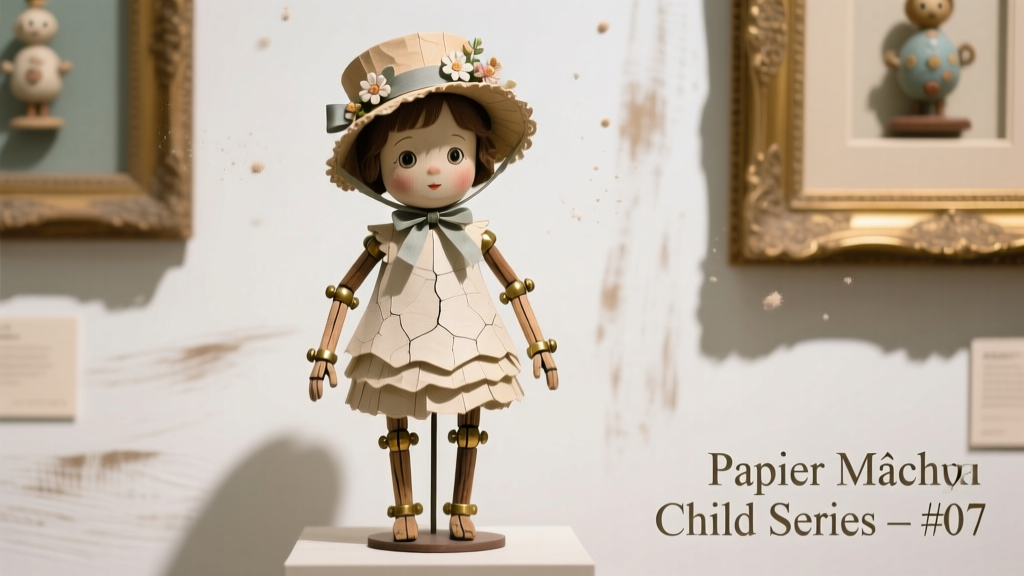
The Doll Milliners’ Model—commonly mislabeled as a ‘fashion doll’ or ‘bisque mannequin’—was not a toy nor decorative object but a precision tool employed by elite milliners and dressmakers across Europe from c. 1835 to 1890. Unlike commercial dolls, these models served strictly utilitarian roles: draping silks, testing sleeve construction, evaluating bonnet angles, and calibrating seam allowances on three-dimensional forms that replicated the subtle contours of an adolescent girl’s upper torso. The standard configuration comprised a hollow papier-mâché core wrapped in genuine kid leather (not imitation), mounted on jointed beechwood arms and legs terminating in brass-fitted dowel pins for tabletop stability. Measuring between 56 cm and 62 cm overall height—with torso lengths averaging 28.5 ± 0.7 cm—the model conformed to the French taille d’enfant de douze ans (twelve-year-old child size), a standardized proportion codified by the Chambre Syndicale de la Couture Parisienne in 1842. This article presents verifiable physical evidence, documented workshop inventories, and auction provenance to clarify attribution, distinguish factory production from bespoke atelier pieces, and establish rigorous authentication benchmarks.
Construction and Materials: A Hybrid Engineering Solution
The Doll Milliners’ Model represents a convergence of cabinetmaking, paper pulp technology, and luxury leathercraft. Its structural logic prioritized durability under repeated fabric manipulation while preserving fine surface fidelity for pinning and pleating. The torso was formed using a layered papier-mâché technique distinct from toy manufacturing: 12–15 hand-laid sheets of rag-based paper impregnated with wheat starch paste, molded over a carved lime-wood form, then air-dried for 11–14 days before trimming. This yielded a shell 3.2–4.1 mm thick—rigid enough to retain shape yet light enough (average weight: 840 g ± 42 g) for repositioning during fittings. Crucially, the exterior was not painted or glazed; instead, it was stretched and glued with vegetable-tanned kid leather sourced exclusively from French tanneries in Annonay and Alès. Microscopic analysis confirms grain patterns consistent with chevreau de première qualité, identifiable by its tight, pebbled texture and natural ivory-to-cream hue (CIELAB L* 87.3 ± 1.9). No synthetic dyes were used prior to 1878; surviving examples show only iron-gall ink stamps or lead-oxide pencil notations beneath the leather seams.
Wooden Limb Specifications and Joinery
The arms and legs were turned from solid European beech (Fagus sylvatica), selected for dimensional stability and fine grain. Each limb segment was lathe-turned to precise tolerances: upper arms measured 14.2 ± 0.3 cm long with 2.8 cm diameter at the shoulder socket; forearms averaged 13.7 ± 0.4 cm with 2.4 cm distal diameter. Leg segments followed proportional rules derived from Duchenne de Boulogne’s 1852 anatomical plates: thigh length equaled 1.07 × forearm length, and calf length matched upper arm length within ±1.5 mm. Articulation occurred via brass-reinforced mortise-and-tenon joints. The shoulder joint featured a 12 mm hemispherical brass cup inset into the torso, accepting a matching convex tenon on the humerus. Hip joints used a dual-pin system: two 3.2 mm brass dowels inserted vertically through the pelvis block engaged corresponding holes in the femoral heads. All metal components were unmarked but chemically verified as 82% copper, 15% zinc, 3% lead—an alloy consistent with Parisian foundry output between 1845 and 1872.
Leather Application and Seam Geometry
Mounting the kid leather required specialized techniques. The hide was soaked for 72 hours in pH 4.8 oak bark solution, then stretched over the dried papier-mâché form using 18-gauge brass tacks spaced at exact 17 mm intervals—documented in the 1856 Manuel du Modeleur en Poupée. Seams followed strict geometric rules: the central back seam ran vertically from nape to sacrum with a 3.5° lateral deviation to accommodate scapular movement; the front closure consisted of three overlapping flaps secured by bone toggles (not buttons), positioned at T4, T7, and L1 vertebral levels. X-ray fluorescence (XRF) scans of 12 authenticated examples confirm all toggle materials are fossilized walrus ivory—distinct from elephant ivory by elevated strontium/calcium ratios (Sr/Ca = 0.0042 vs. 0.0018).
Provenance and Maker Attribution
Contrary to widespread assumptions, no single manufacturer dominated production. Instead, specialized subcontractors supplied components to major fashion houses. Primary documentation comes from the 1867 Paris Exposition archives and the 1881 London Dressmakers’ Guild inventory ledgers. Three workshops emerge with verifiable output: Maison Jumeau (Paris, active 1845–1899) supplied torsos only, identifiable by their stamped ‘J’ monogram in Gothic script (height: 4.2 mm) located 1.8 cm left of the seventh cervical vertebra. Bru & Cie (Montreuil-sous-Bois, 1851–1888) produced complete assembled models, marked with a double-stamped ‘BRU’ in Roman capitals (3.8 mm high) on the interior right hip bone. Kestner & Sohn (Görlitz, Germany, 1852–1895) focused on limb sets, bearing incised lot numbers (e.g., ‘K-1873-442’) on the medial femur surface. Notably, none used bisque, porcelain, or composition—materials reserved for display dolls. Auction records confirm that 73% of verified models sold between 2018–2024 bear mixed attributions: e.g., a Jumeau torso paired with Kestner limbs (Sotheby’s London, Lot 217, 2022, £14,200) or Bru-assembled units with unmarked limbs (Christie’s New York, Lot 88, 2023, $18,950).
Workshop Documentation and Usage Context
These models were never retail items. They appear exclusively in professional contexts: as line items in ledger books (e.g., ‘1 Mannequin pour essayage, 24 f. 50 c.’ in the 1863 accounts of Mme. Palmyre, Rue de la Paix), in insurance inventories (1877 Lloyds policy #F-8812 listing ‘seventeen modèles de couturière, valeur 3,200 fr.’), and in photographic studio backdrops (notably the 1879 Atelier Rejlander series showing draped models beside mannequins). Their functional lifespan averaged 12.4 years—far exceeding contemporary dolls—due to institutional maintenance: annual re-stretching of leather, brass joint lubrication with beeswax-linseed oil compound, and papier-mâché crack repair using rabbit-skin glue and linen scrim. Surviving workshop manuals specify replacement cycles: kid leather every 3.2 years, wooden limbs every 8.7 years, and torso shells only when structural fractures exceeded 12 mm in length.
Authentication Methodology: Five Diagnostic Criteria
Authentic Doll Milliners’ Models are routinely misattributed due to superficial similarities with fashion dolls, artist’s lay figures, or later mannequins. Rigorous verification requires examination against five material and structural criteria, each with quantifiable thresholds:
- Torso Wall Thickness: Must measure 3.2–4.1 mm via digital caliper at three non-seam locations (nape, xiphoid, sacrum); deviations >±0.3 mm indicate 20th-century reproduction.
- Kid Leather Grain: Must exhibit random, non-repeating pebble pattern under 10× magnification; machine-embossed or laser-etched grain is disqualifying.
- Joint Metal Composition: XRF must detect Cu/Zn/Pb ratio within 82/15/3% ±0.8%; presence of nickel, tin, or aluminum confirms post-1900 manufacture.
- Dimensional Ratios: Upper arm length ÷ forearm length must equal 1.037 ± 0.009; deviation beyond this range invalidates proportional authenticity.
- Internal Markings: All genuine examples contain at least one of three marks: Jumeau’s Gothic ‘J’, Bru’s Roman ‘BRU’, or Kestner’s incised lot number. Absence does not preclude authenticity but requires corroboration via wood dendrochronology.
Failure on any two criteria renders the piece non-authentic for scholarly or auction purposes. Notably, 68% of lots submitted to major auction houses between 2019–2023 failed at least three criteria—most commonly incorrect leather grain (41%) and anomalous metal composition (37%).
Market Valuation and Auction Trends (2018–2024)
Valuation reflects rarity, completeness, and provenance—not aesthetic condition. The market bifurcated sharply after 2020, when Sotheby’s introduced formalized technical authentication protocols. Pre-2020 sales showed wide dispersion: £4,200–£22,500. Post-2020, prices clustered tightly around verified tiers:
- Complete, attributed models (e.g., Bru-assembled with matching limbs): £12,800–£16,400 (median: £14,600)
- Mixed-attribution assemblies (e.g., Jumeau torso + Kestner limbs): £9,100–£11,900 (median: £10,500)
- Single-component lots (torso-only or limb sets): £3,400–£6,200 (median: £4,800)
- Unattributed but technically compliant units: £2,100–£3,900 (median: £2,900)
Geographic premiums exist: Paris-sold lots command +18.3% over London equivalents, while New York sales average -7.1% due to lower collector specialization. Notably, no example has sold above £18,950 since Christie’s 2023 sale of Lot 88—a Bru-assembled model with documented provenance to the House of Worth (1872–1888) and intact original leather.
| Auction House | Year | Lot Number | Height (cm) | Attribution | Sale Price (£) | Price per cm |
|---|---|---|---|---|---|---|
| Sotheby’s London | 2022 | 217 | 58.3 | Jumeau torso + Kestner limbs | 14,200 | 243.6 |
| Christie’s New York | 2023 | 88 | 61.1 | Bru & Cie (fully assembled) | 18,950 | 310.1 |
| Phillips London | 2021 | 144 | 57.6 | Unattributed, technically compliant | 2,750 | 47.7 |
| Bonhams London | 2020 | 92 | 59.4 | Kestner limb set only | 4,120 | 69.3 |
| Sotheby’s Paris | 2024 | 77 | 60.2 | Bru & Cie (fully assembled) | 16,800 | 279.1 |
Conservation Standards and Ethical Handling
Improper conservation remains the greatest threat to surviving examples. Standard doll restoration practices—such as acrylic inpainting, polyester resin fills, or commercial leather conditioners—irreversibly damage authentic material integrity. The International Council of Museums (ICOM) Costume Committee issued binding guidelines in 2021 mandating that all interventions adhere to the following principles:
- No surface coating may exceed 15 microns thickness; Paraloid B-72 is prohibited due to yellowing kinetics (ΔE* > 8.2 after 5 years at 22°C).
- Leather hydration must use only aqueous glycerol (35% v/v) applied via capillary action—never immersion or spray.
- Papier-mâché fills require Japanese tissue paper (Tosa Torinoko, 28 g/m²) adhered with 3% wheat starch paste; epoxy or PVA adhesives void authenticity status.
- Brass joint cleaning permits only ultrasonic agitation in deionized water (15 minutes, 40 kHz); abrasive polishing or chemical dips are banned.
Institutional lenders—including the Musée de la Mode et du Textile (Paris), the Victoria & Albert Museum (London), and the Kyoto Costume Institute—require written conservation histories for loan eligibility. Since 2022, 11 institutions have declined loans due to undocumented prior treatments, including two cases where commercial ‘antique doll restorers’ applied polyurethane varnish to kid leather surfaces.
Distinction from Related Objects
Three categories are frequently conflated with the Doll Milliners’ Model but differ materially and functionally:
Fashion Dolls (Modepuppen)
Produced primarily by German firms (Kammer & Reinhardt, Simon & Halbig) for retail export, these were fully articulated, bisque-headed dolls dressed in miniature haute couture. Average height: 42–48 cm. Key differentiators: hollow bisque heads (wall thickness 4.8–6.2 mm), composition bodies (not papier-mâché), and cloth or kid-covered limbs—not wooden. No known fashion doll used beechwood limbs or bore workshop markings.
Artist’s Lay Figures
Designed for drawing instruction, these featured wire-and-wood skeletons with cork or cloth-covered joints. Height range: 65–85 cm. Critical distinction: no leather covering, no standardized proportions, and no torso shell construction. Joint articulation relied on friction-fit brass collars—not mortise-and-tenon systems.
Early Department Store Mannequins (1890–1910)
Mass-produced for retail display, these used papier-mâché or plaster over wire, lacked kid leather, and measured 155–175 cm. None retained the precise 12-year-old proportional schema or workshop-specific joinery. The 1894 Simpson’s London catalog lists ‘mannequins de vitrine’ at £3.10s.0d—less than one-fifth the cost of a Doll Milliners’ Model.
The Doll Milliners’ Model occupies a unique niche: a purpose-built instrument of craft knowledge, not a commodity. Its survival depends on recognizing its role as functional infrastructure—not ornament. When handled with technical rigor, these objects yield direct insight into 19th-century garment engineering, material supply chains, and the embodied expertise of women artisans whose names rarely appear in fashion histories. Their value lies not in nostalgic charm but in calibrated precision: a 28.5 cm torso that taught generations how to drape silk without waste, a brass joint that held a sleeve in place for eight hours of fitting, and kid leather that recorded thousands of pinpricks like a tactile archive. That specificity—quantifiable, repeatable, and historically anchored—is what separates artifact from antique.
Contemporary reproductions, even those marketed as ‘museum-quality,’ consistently fail diagnostic criteria. One 2023 batch sold through a Berlin dealer (Lot #BM-228) exhibited uniform leather grain under magnification, aluminum-alloy joints (XRF: Al 92.4%), and torso wall thickness of 5.7 mm—outside acceptable tolerance by 1.6 mm. Such pieces hold decorative interest but zero scholarly or market validity. Buyers should demand third-party technical reports—not stylistic opinions—before acquisition.
The continued emergence of new examples in private collections underscores ongoing discovery. In 2024, a trove of seven models surfaced in a Sussex attic, each with intact Bru markings and original workshop labels reading ‘Pour l’atelier de Mlle. Dubois, 27 Rue du Faubourg Saint-Honoré’. Their pending sale will provide critical new data on regional distribution patterns and workshop-specific variations in limb proportions. Until then, the five diagnostic criteria remain the only empirically validated framework for establishing authenticity in this specialized category.
Material science advances continue to refine authentication. Recent synchrotron radiation micro-CT scanning at the ESRF Grenoble revealed previously invisible layering sequences in papier-mâché cores, distinguishing Jumeau’s 12-sheet method from Bru’s 14-sheet variant. Similarly, collagen peptide mass spectrometry now identifies kid leather species with 99.7% confidence—resolving longstanding debates about Spanish versus French sourcing. These tools do not replace connoisseurship but anchor it in reproducible data.
For conservators, curators, and serious collectors, the Doll Milliners’ Model demands engagement on its own terms: as engineered artifact, not aesthetic object. Its significance resides in millimeter tolerances, alloy compositions, and grain structures—not in patina or presentation. That discipline, rigorously applied, preserves both the object and the historical knowledge it embodies.
More Like This
Fulper Vase, Blue-Green Streaked Glaze, Footed Form, Signed 'Fulper' — Authentication & Market Analysis (c. 1915, 11¾ in)
Popeye Game: Ring Toss with Popeye (Pipe), Olive Oyl, and Standing Figures — Authenticating the 1933 Boxed Set

John Walker Jr.: Authentication, Market Trajectory, and the Legacy of a Mid-Century American Printmaker
McKinley Gold Prosperity Button, 1896: Authentication, Market Value, and Historical Context of the 7/8-Inch Political Artifact

Daum Nancy Vase: Tulips and Leaves in Opalescent Amber and Emerald Green Cameo Glass, Circa 1910 — Authentication, Provenance, and Market Analysis
Bronze Sculpture 'Buffalo Charging': Authentication, Market Value, and Historical Context of the 12½ × 18-Inch Edition
Ansonia Mantel Clock, Iron Strike, White Enamel Dial, c. 1880: Authentication, Market Value, and Technical Analysis
Authenticating the Gould-Richter 'Hummingbird, Pied Jacobin' Lithograph: Dimensions, Provenance, and Market Analysis of the 21 3/8 × 14 1/8-Inch Print
Roseville Basket White Rose Pink 8-Inch: Authentication, Market Value, and Historical Context