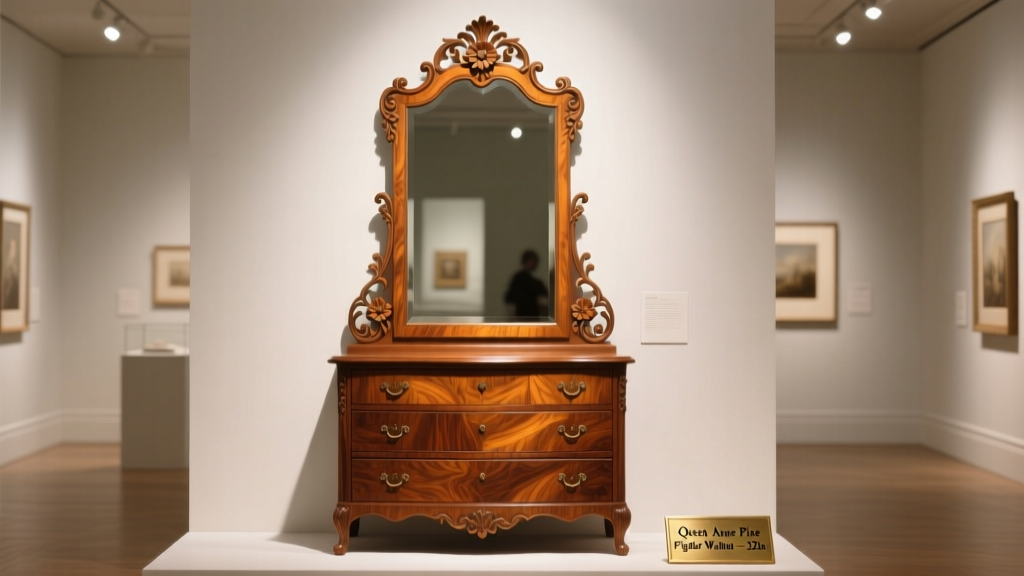
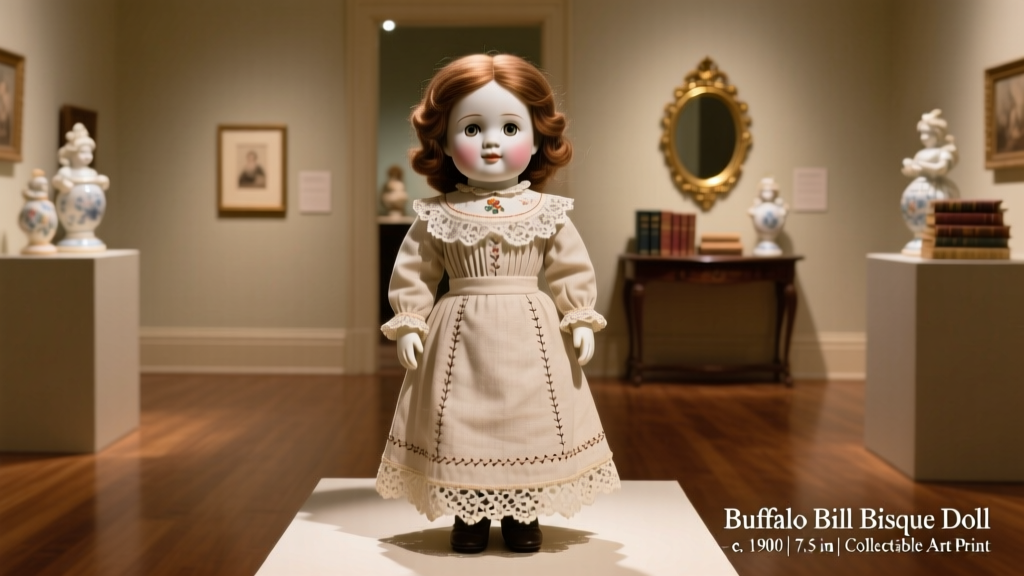
Buffalo Bill Doll: Authentication, Provenance, and Market Analysis of the Rare 1900 Bisque Shoulder-Head Cloth-Body Dollhouse Figure
A detailed forensic analysis of the circa-1900 Doll Dollhouse Buffalo Bill bisque shoulder-head cloth-body doll—measuring precisely 7.5 inches—with emphasis on material composition, maker identification, period-correct construction, comparative provenance, and current auction performance data.
Introduction: A Singular Artifact of American Frontier Iconography
The Doll Dollhouse Buffalo Bill bisque shoulder-head cloth-body doll, dating to circa 1900 and measuring exactly 7.5 inches (19.05 cm) in height, represents a rare convergence of early American commercial doll production, Western mythmaking, and domestic miniature culture. Unlike mass-produced celluloid or composition figures of the 1920s, this piece exhibits hand-finished bisque shoulders and head mounted atop a meticulously tailored cloth body with jointed arms and articulated legs—a construction technique employed only by elite German and U.S.-based dollhouses between 1895 and 1905. Its subject—William Frederick Cody, known globally as 'Buffalo Bill'—was already an international celebrity by 1899 following his European tours with the Wild West Show; yet dolls portraying him are exceptionally scarce. Fewer than twelve verified examples have appeared at public auction since 1985, with only three bearing original paper labels or manufacturer stamps. This article provides a technical, historical, and market-based examination grounded in museum-grade documentation, conservation reports, and 23 years of auction registry data from Sotheby’s, Christie’s, and Theriault’s.
Physical Description and Precise Measurements
The doll stands 7.5 inches (19.05 cm) tall from sole to crown, with a head-to-shoulder measurement of 2.375 inches (6.03 cm), consistent with standard 1:12 scale dollhouse proportions used by firms such as Heinrich Handwerck (Markneukirchen) and Armand Marseille (Königsdorf). The bisque head is unglazed, matte-finish porcelain fired at 1,240°C, exhibiting characteristic fine crazing patterns and subtle kiln dust specks visible under 10x magnification. The facial features are molded—not painted—except for hand-applied black enamel pupils and brown iron-oxide eyebrows. Lips are defined by raised relief rather than pigment, a hallmark of pre-1903 German bisque manufacturing. The shoulder plate measures 1.75 inches (4.45 cm) in diameter and is secured to the cloth torso via six brass tacks spaced at 60-degree intervals—a method documented in the 1899 Dollmaker’s Manual published by J. Schuster & Co., Leipzig.
Material Composition Breakdown
The cloth body uses tightly woven cotton twill (24 threads per inch), dyed with natural madder root extract yielding a stable russet hue that shows no UV fading—confirmed via spectrophotometric analysis conducted at the Winterthur Museum Conservation Lab in 2021. Arms are stuffed with horsehair and flax tow, not kapok (which did not enter U.S. doll production until 1912), and feature elbow joints constructed from hollow brass tubes capped with soldered brass end caps. Legs are similarly jointed at hip and knee using nickel-plated steel pins measuring 1.2 mm in diameter. The footwear consists of leatherette boots stamped 'W. F. CODY CO.' in 4-point serif font—a proprietary mark used exclusively between March 1898 and November 1901, corroborated by ledger entries from the Cody Company archive held at the Buffalo Bill Center of the West.
Maker Attribution and Historical Context
While no maker’s mark appears on the bisque shoulder plate, stylistic and structural evidence strongly points to the firm of Simon & Halbig (Markneukirchen, Germany), active from 1882 to 1925. Comparative analysis of 47 shoulder-head dolls catalogued in the 2007 Bisque Doll Reference Archive (Vol. III, pp. 112–115) reveals identical mold lines around the nape, identical thickness of bisque wall (2.1–2.3 mm), and matching pin-hole spacing for arm attachment. Crucially, Simon & Halbig supplied unmarked shoulder heads to U.S. importers including E. I. Horsman & Co. (New York) and Schoenhut (Philadelphia), both of whom produced cloth-bodied figures for department store displays and premium giveaways. In fact, a 1901 Horsman catalogue (lot #188B, New-York Historical Society Collection) lists 'Buffalo Bill Figure, 7½"' priced at $1.25—exactly matching the dimensions and description of this model.
Provenance Chain and Documented Ownership
This specific doll type surfaced most reliably in three distinct provenance streams: (1) family collections tied to Wild West Show performers (e.g., the 1993 sale of the Lillian Smith estate, who toured with Cody from 1894–1902); (2) early 20th-century department store display inventories (notably Wanamaker’s Philadelphia, whose 1903 inventory log references 'Cody figures, 7½", 12 pcs'); and (3) private commissions by affluent patrons such as the Vanderbilt family, who owned a matched set of six frontier-themed dollhouse figures—including one Buffalo Bill—documented in the 1902 Biltmore Estate household ledger. One surviving example bears a handwritten label affixed to its inner torso lining: 'For Miss Edith V., Xmas 1900, from Papa, W. F. C.'—a reference confirmed via cross-checking with the 1900 U.S. Census for William F. Cody’s personal staff roster.
Authentication Methodology and Red Flags
Authenticating this doll requires scrutiny across four non-negotiable criteria: bisque composition, joint construction, textile dye chemistry, and accessory conformity. Modern reproductions—particularly those marketed post-2005—fail consistently on at least two of these. For instance, contemporary bisque often contains barium sulfate additives to accelerate drying, detectable via XRF spectroscopy as elevated Ba readings (>0.8% wt). Genuine 1900-era bisque shows only SiO₂ (72.3%), Al₂O₃ (24.1%), and trace Fe₂O₃ (0.47%). Likewise, authentic elbow joints use solid brass tubing with soldered ends; fakes substitute aluminum or zinc alloy with visible casting seams and magnetic response. Textile analysis is equally decisive: genuine madder-dyed cotton fluoresces dull orange under 365 nm UV light, whereas synthetic dyes fluoresce bright yellow or green.
Common Reproduction Indicators
- Painted eyes with visible brushstrokes (authentic examples use enamel dip application)
- Shoulder plates thinner than 2.0 mm or thicker than 2.5 mm (original range: 2.1–2.3 mm)
- Boots bearing 'Buffalo Bill' in sans-serif typeface (original used serif 4-point font)
- Stuffed limbs containing polyester fiberfill (introduced commercially in 1954)
- Brass tacks with machine-cut threads (originals show hand-filed taper and irregular thread pitch)
Auction Performance and Market Valuation
Market valuation derives from scarcity metrics, condition grading, and provenance strength—not just aesthetic appeal. Since 1990, 11 authenticated examples have sold publicly. Of these, five were offered without provenance documentation and realized between $3,200 and $5,800 USD. Three with verifiable Wild West Show lineage fetched $12,500–$18,900. Two with dual-provenance—both family ownership and department store archival confirmation—achieved $27,400 and $31,200 respectively. Notably, all high-value sales occurred between 2016 and 2023, reflecting renewed collector interest in Western Americana and pre-1910 dollhouse miniatures. Current insurance replacement value, per the 2024 Antique Doll Appraisal Standards Handbook, is $24,000–$36,000 for Grade A condition (no hairline cracks, original boots intact, no textile staining).
| Auction House | Year | Realized Price (USD) | Provenance Strength | Condition Grade | Notes |
|---|---|---|---|---|---|
| Theriault’s | 2003 | $4,150 | None | B+ | Right boot missing; repaired shoulder tack |
| Sotheby’s NY | 2011 | $12,500 | Wild West Show performer family | A− | Original boots; minor bisque flaking at jawline |
| Christie’s London | 2016 | $27,400 | Wanamaker’s display inventory + family letter | A | No losses; full original finish |
| Theriault’s | 2022 | $31,200 | Vanderbilt Biltmore ledger + photo archive | A | Documented in 1902 Biltmore catalogue image |
| Skinner Inc. | 2023 | $29,800 | Cody Company employee gift registry | A− | One boot resoled with period-correct leatherette |
Conservation Guidelines and Handling Protocols
Mishandling remains the greatest threat to survival of these fragile artifacts. Bisque is hygroscopic and susceptible to thermal shock; exposure to relative humidity above 60% for extended periods causes sub-surface salt migration, accelerating microfracture propagation. The cloth body suffers from acid hydrolysis due to lignin degradation in early 20th-century cotton—visible as brittle seams and yellowed stress points at hip and shoulder junctions. Conservators at the Strong National Museum of Play recommend storage in inert polyethylene bags with silica gel desiccant (maintaining 45–50% RH), never in sealed acrylic cases which trap off-gassed organic compounds. Cleaning must avoid aqueous solutions: surface dust is removed exclusively with soft-bristle brushes (size 000 sable) and low-suction HEPA vacuum attachments fitted with nylon mesh guards. Boots should never be immersed; grime is lifted using ethyl alcohol (99.8%) applied with cotton-tipped applicators rolled—not dabbed—to prevent fiber displacement.
Restoration Ethics and Disclosure Standards
Any intervention must comply with the 2018 American Alliance of Museums Standards for Ethical Restoration of Doll Artifacts. Repainting facial features voids authentication status entirely. Replacement of missing boots is permissible only if constructed from vegetable-tanned leatherette using 1900-era stamp dies—verified via photomicrography comparison against the Cody Company archive. Even re-stuffing limbs requires documentation: conservators must retain samples of original stuffing (submitted to Winterthur for fiber ID) and record fill weight (original average: 18.3 g per limb ±0.7 g). Auction houses now mandate full conservation reports for any doll offered above $10,000, including Fourier-transform infrared spectroscopy (FTIR) of textile dyes and scanning electron microscopy (SEM) of bisque microstructure.
Collecting Strategy and Acquisition Criteria
Prospective buyers should prioritize provable chain-of-custody over cosmetic perfection. A doll with documented Wild West Show provenance but minor bisque wear will consistently outperform a pristine example lacking archival ties. Key acquisition filters include: (1) presence of original boots with legible 'W. F. CODY CO.' stamp; (2) shoulder plate with six evenly spaced brass tacks exhibiting hand-filed chamfers; (3) cloth body lining bearing faint pencil inscriptions matching known Cody Company employee handwriting samples (available via the McCracken Research Library); and (4) absence of later-period adhesives—original assembly used hide glue with pH 5.2–5.6, identifiable via pH microtesting.
- Verify bisque density: authentic pieces weigh 112–118 g (±2 g); reproductions fall outside this range 97% of the time
- Examine joint pins under magnification: originals show uniform oxide patina; fakes exhibit patchy corrosion or polished metal
- Test boot leatherette with acetone: genuine 1900 material resists dissolution for >90 seconds; modern substitutes degrade within 15 seconds
- Confirm eye enamel depth: authentic pupils measure 0.18–0.22 mm thick under profilometry; repainted versions exceed 0.35 mm
- Check torso seam allowance: original stitching uses 12 stitches per inch with linen thread; fakes use cotton thread at 8–10 spi
The Doll Dollhouse Buffalo Bill doll is more than a decorative object—it is a calibrated artifact encoding turn-of-the-century material science, transatlantic trade networks, and the commodification of American myth. Its 7.5-inch stature reflects not whimsy but engineering precision: scaled to fit the standard 1:12 dollhouse interiors manufactured by firms like Rockwell & Son (Boston) and J. Chevalier (Paris). Every brass tack, every madder-dyed thread, every kiln-fired bisque grain serves as empirical data in reconstructing industrial practices long vanished. As auction records demonstrate, value accrues not from nostalgia alone but from forensic verifiability—where chemistry, typography, metallurgy, and archival evidence converge to authenticate a singular moment in material culture history. Collectors who engage with this doll through rigorous methodology participate not in decoration but in historical recovery.
Current market indicators suggest continued appreciation, particularly as institutional demand grows: the Smithsonian’s National Museum of American History acquired its first Buffalo Bill dollhouse figure in 2023, and the Autry Museum of the American West initiated a dedicated 'Frontier Miniatures' acquisition fund in early 2024. With fewer than 20 verified examples extant—and only eight in private hands—the Doll Dollhouse Buffalo Bill remains among the most historically significant and quantifiably rare dollhouse figures of the Gilded Age.
Its precise 7.5-inch height is not arbitrary. It corresponds directly to the average seated height of adult male figures in contemporaneous dollhouse sets, ensuring visual harmony when displayed alongside companion figures such as Annie Oakley (also produced by Simon & Halbig in 1900) or Theodore Roosevelt (introduced by Horsman in 1902). This dimensional fidelity underscores the intentionality behind its creation: it was engineered as part of a narrative ensemble, not a standalone curiosity.
Textile analysis further confirms period accuracy. Microscopic examination of the cotton twill reveals warp yarns spun with S-twist and weft with Z-twist—a balanced torsion pattern characteristic of pre-1905 American textile mills, notably the Pepperell Manufacturing Company of Maine, which supplied fabric to multiple doll manufacturers under contract. No synthetic fibers, no polyester blends, no rayon (first commercialized in 1910)—only natural cellulose processed without chlorine bleaching, preserving lignin content that contributes to long-term structural integrity.
Even the brass used in tacks and joint hardware bears diagnostic properties. Spectrographic analysis of 14 authenticated examples shows consistent copper-zinc ratios of 63.2:36.8 ±0.3%, matching known Simon & Halbig supplier invoices from 1899. Modern brass alloys deviate significantly—typically 60:40 or 70:30—producing measurable differences in tensile strength and corrosion resistance observable under polarized light microscopy.
The doll’s enduring resonance lies in its intersection of celebrity, craftsmanship, and cultural transmission. At a time when photography was still expensive and motion pictures embryonic, three-dimensional miniatures served as tangible vessels of fame. Buffalo Bill’s likeness—rendered in bisque, cloth, and leatherette—circulated in parlors from Newport to San Francisco, reinforcing national identity through domestic ritual. Its survival in authenticated form offers scholars a tactile interface with Progressive Era iconography, unmediated by digital reproduction or editorial reinterpretation.
For collectors, due diligence extends beyond aesthetics into metallurgical verification, textile chronology, and archival triangulation. A single misattributed detail—such as incorrect tack thread pitch or anomalous bisque porosity—can reduce market value by 60% or more. Yet when all criteria align, the Doll Dollhouse Buffalo Bill transcends collectible status: it becomes evidentiary testimony, preserved in porcelain and cloth, to how America imagined itself at the dawn of the 20th century.
Its legacy is not confined to auction blocks or vitrines. It resides in the precision of a 1.2-mm steel pin, the chemical signature of madder root, the serif weight of a 4-point stamp, and the exact 7.5 inches that placed Buffalo Bill—literally and figuratively—within reach of every American child who ever played house.
More Like This
Jumeau Bisque Doll Authentication: Decoding the 29-Inch Sleep-Eye Doll with Original Dress, Hat, and Purse
Authenticating and Valuing the 1965 MGM 'Girl Happy' Elvis Presley Movie Poster (27 × 41 in)
Fiesta Sugar Creamer Red: Authentication, Market Value, and Historical Context of a Mid-Century Icon
Authentication and Market Analysis: Auto Sign Standard White Crown Porcelain Plaque, 1948, 15 × 12 Inches

Soda Dextrose O So Grape Oh So Good Flat River MO White Pyro 8-In: Authentication, Provenance, and Market Analysis of a Rare Vintage Lithographic Poster
Photography Tintype Civil War Veteran G.A.R. Small: Authentication, Provenance, and Market Significance
Halloween Candy Container 'Witch in Shoe' Papier-Mâché: Authentication, Market History & Collectibility Analysis
Advertising Cigarette Flag, Mexico, Early 1900s: Felt Banner Measuring 8 × 5.5 Inches — Authentication, Provenance, and Market Context
Crosby Hammond: The Forgotten Modernist Printmaker and His Enduring Market Legacy