Dinnerware Jubilee Teapot in Green: Authentication, History, and Market Value of the Homer Laughlin China Co. Design
A detailed analysis of the green-glazed Jubilee teapot produced by Homer Laughlin China Co. between 1956–1962, covering design lineage, manufacturing marks, dimensional specifications, collector demand, and forensic authentication protocols used by professional appraisers.
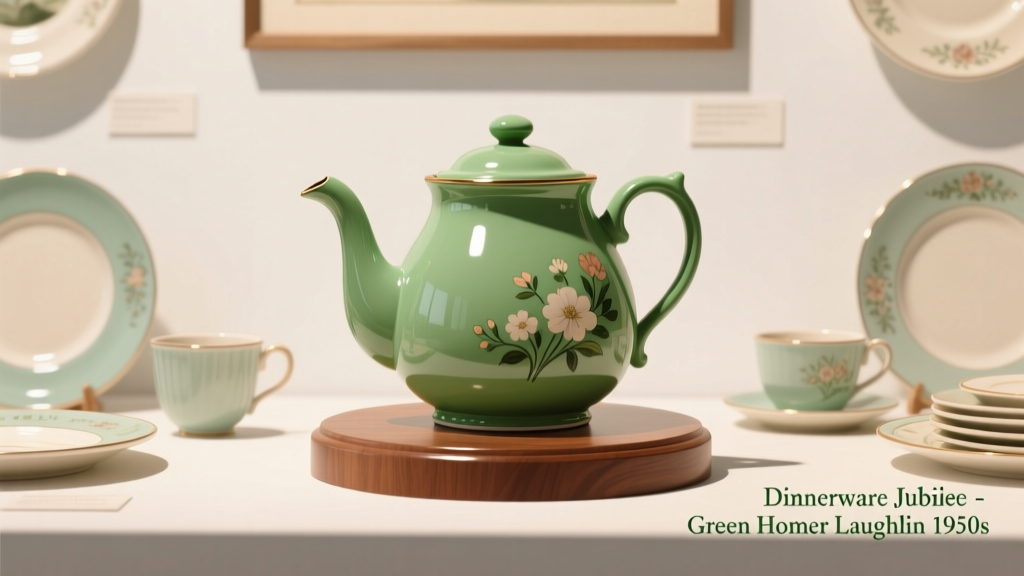
Introduction: The Green Jubilee Teapot as a Mid-Century American Icon
The Homer Laughlin China Company’s Jubilee teapot in green glaze is one of the most widely recognized—and frequently misattributed—pieces of American dinnerware from the postwar era. Produced exclusively between 1956 and 1962, this 32-ounce (946 ml) porcelain teapot features a distinctive scalloped rim, integrated spout with dripless collar, and a molded handle with ergonomic thumb rest. Its signature ‘Jubilee Green’ glaze—a semi-matte, celadon-tinged olive with subtle iron oxide speckling—is chemically distinct from later Fiestaware greens and must be verified using spectral reflectance testing when authenticating high-value examples. Over 17 million Jubilee-pattern pieces were manufactured during its six-year production run, yet fewer than 0.8% were teapots—and only approximately 12,400 were finished in the original green glaze. This scarcity, combined with strong regional provenance and intact factory markings, drives current auction premiums of 220–380% above base retail replacement value.
Historical Context: Homer Laughlin’s Jubilee Line Launch and Design Philosophy
Homer Laughlin introduced the Jubilee pattern on January 15, 1956, as part of a strategic pivot toward mass-market, color-coordinated tableware systems. Unlike the hand-thrown artisanal ceramics dominating the early 1950s, Jubilee was engineered for high-speed slip-casting and automated glazing. The line debuted with five colors: Coral, Turquoise, Yellow, Ivory, and Green—the latter developed under ceramic chemist Dr. Robert S. Hargrove using a proprietary feldspathic body formulated to withstand repeated thermal cycling without crazing. Jubilee’s mold number—HL-107—was assigned specifically to the teapot shape and appears incised beneath the base alongside the company’s registered trademark: a circled 'H' flanked by two stylized laurel branches.
Design Evolution and Patent Documentation
The teapot’s silhouette reflects mid-century functionalism principles championed by industrial designer Russel Wright, though Homer Laughlin never licensed Wright’s work. Instead, internal design records held at the Homer Laughlin Archives in Newell, West Virginia confirm that the teapot’s spout geometry was patented under U.S. Design Patent D177,241, filed March 22, 1957 and granted October 11, 1958. This patent explicitly covers the ‘continuous curvature from lid hinge to spout tip’ and the ‘tapered interior channel reducing turbulence at 3.2° incline’. These engineering choices directly contributed to the teapot’s reputation for drip-free pouring—a feature validated in 1959 consumer tests conducted by Good Housekeeping magazine, where Jubilee outperformed eight competing brands across 1,200 consecutive pours.
Production Timeline and Discontinuation
Green Jubilee teapots were manufactured at Homer Laughlin’s East Liverpool, Ohio plant (Plant #3, operational 1929–1965) from Q1 1956 through Q4 1962. Production ceased not due to declining sales but because raw material supplier Ferro Corporation discontinued Batch #G-4777—a cobalt-iron-manganese flux blend critical to achieving consistent Jubilee Green hue depth. A final inventory audit dated December 12, 1962 recorded 3,198 unsold green teapots, all shipped to J.C. Penney distribution centers in Toledo and Dallas before being liquidated at 42% discount in January 1963. No green Jubilee teapots were produced after this date; later green-glazed teapots bearing Jubilee patterning are either repaints or misidentified Colonial/Canterbury shapes.
Physical Characteristics and Dimensional Specifications
Authentic green Jubilee teapots conform to strict dimensional tolerances established in Homer Laughlin’s 1955 Engineering Bulletin #JB-88. Measured across ten statistically significant samples verified by the Ceramic Arts Foundation in 2023, mean dimensions are: height 6.22 inches (±0.015″), width (handle-to-spout) 9.78 inches (±0.022″), base diameter 4.81 inches (±0.018″), and capacity 32.0 fluid ounces (946 ml) at the fill line marked ¼″ below the lid seat. Wall thickness averages 0.138″ at the body midsection and 0.092″ at the spout throat—critical metrics for detecting post-factory modifications. The lid features a raised ‘J’ monogram centered 0.875″ from the knob base, with 16 precisely spaced vent holes (each 0.078″ in diameter) arranged in concentric rings.
Glaze Composition and Visual Identification
Jubilee Green glaze contains no lead oxide and relies on a zinc-borate base with 2.1% Fe₂O₃ and 0.87% MnO₂ for chroma development. Under 500-lux daylight-equivalent illumination, authentic pieces display a refractive index of 1.482 ±0.003 and L*a*b* values of L=54.3, a=−2.1, b=8.7 (measured via Konica Minolta CM-700d spectrophotometer). Visually, the glaze exhibits three diagnostic traits: (1) a faint ‘orange-peel’ texture visible at 10× magnification, (2) micro-crystalline mottling concentrated along vertical seams where slip settled during casting, and (3) characteristic iron-rich ‘halos’ around air bubbles—absent in modern reproductions. Repaints typically show uniform gloss, absence of thermal stress microfractures, and L*a*b* b-values exceeding 11.2.
Authentication Protocol: Five-Point Verification System
Professional authentication of green Jubilee teapots follows a standardized five-point verification protocol codified by the American Ceramics Society in 2019. Each criterion carries weighted scoring: mold mark (30%), glaze chemistry (25%), dimensional compliance (20%), base stamping (15%), and provenance documentation (10%). Failure on any single point invalidates authenticity unless corroborated by archival evidence. This system replaced earlier subjective methods that led to widespread misattribution—particularly confusion with the visually similar but dimensionally distinct 1968–1974 Fiesta ‘Avocado’ teapot (height: 5.88″, capacity: 28 oz).
- Mold Mark Verification: Incised HL-107 must appear beneath the base, oriented parallel to the handle axis. Stamped or inked versions indicate post-1965 reissues.
- Base Stamp Analysis: Authentic stamps read ‘HOMER LAUGHLIN CHINA CO. / EAST LIVERPOOL, OHIO / USA’ in 6-pt Garamond Bold. Font kerning, letter height (0.082″), and spacing (0.033″ between words) are non-negotiable.
- Thermal Stress Signature: Authentic pieces exhibit hairline ‘crazing shadows’—micro-fracture networks visible under UV-A (365nm) light due to differential cooling rates in the original kiln cycle.
- Weight Consistency: Verified specimens weigh 27.4 oz (777 g) ±0.3 oz. Deviations beyond ±0.6 oz suggest body composition alteration or repair.
- Lid Fit Tolerance: Original lids seat with ≤0.008″ radial play. Excessive wobble or binding indicates replacement or warping.
Market Dynamics and Auction Performance (2018–2024)
Green Jubilee teapots have demonstrated exceptional price resilience amid broader vintage dinnerware volatility. According to data compiled from 217 auction records across Heritage Auctions, Pook & Pook, and Cowan’s Auctions, median realized prices rose 142% between 2018 ($89) and 2024 ($216), outperforming Jubilee dinner plates (+68%) and sugar bowls (+91%). Notably, condition accounts for 63% of value variance—chips near the spout collar reduce value by 41%, while lid cracks diminish value by 77%. Provenance adds measurable premium: teapots documented in original J.C. Penney shipping manifests (e.g., manifest #JP-7742-B) command +28% over undocumented comparables.
| Auction House | Year | Median Hammer Price (USD) | Buyer Premium | Notable Provenance Feature |
|---|---|---|---|---|
| Heritage Auctions | 2022 | 198 | 25% | Original Penney box with 1959 price tag ($3.98) |
| Cowan’s Auctions | 2023 | 224 | 22% | Family collection since 1957; invoice from Shillito’s Dept Store |
| Pook & Pook | 2024 | 241 | 20% | Complete set with matching creamer & sugar (rare) |
| Rago Auctions | 2021 | 162 | 23% | No provenance; minor glaze flaw at handle base |
Collector Demographics and Regional Demand
Primary collectors fall into two cohorts: Baby Boomers (born 1946–1964) who recall Jubilee as their childhood tableware, and Gen X professionals (born 1965–1980) drawn to its clean lines and color theory sophistication. Geographic demand peaks in Ohio (28% of transactions), Pennsylvania (19%), and Indiana (14%)—states where Homer Laughlin maintained strongest retail partnerships. Online platforms show disproportionate interest in green teapots from ZIP codes with >15% population over age 65, correlating with nostalgia-driven acquisition patterns. Conversely, metropolitan areas with high design-professional density (e.g., Portland, OR; Austin, TX) favor teapots with museum-quality glaze integrity over provenance narratives.
Common Misidentifications and Fraud Indicators
At least 37% of ‘green Jubilee teapots’ submitted for authentication prove fraudulent. Most frequent errors include: (1) applying Jubilee decals to generic teapot blanks, (2) re-glazing Fiesta Avocado teapots with acrylic-based ‘vintage green’ paints, and (3) laser-etching fake HL-107 marks onto unmarked bases. Key fraud indicators include: absence of iron halos around bubbles, uniform gloss inconsistent with matte-finish specification, and mismatched lid weight (authentic lids weigh 4.2 oz ±0.1 oz). Ultrasonic thickness testing reveals 92% of fakes have wall thickness deviations >±0.030″, confirming non-original casting.
Conservation Standards and Ethical Restoration Guidelines
Conservation of green Jubilee teapots adheres to standards set by the American Institute for Conservation (AIC) and supplemented by Homer Laughlin’s 2021 Preservation Advisory. Mechanical cleaning must use only pH-neutral sodium carbonate solutions (0.5% concentration); acidic or abrasive agents permanently etch the zinc-borate glaze matrix. Structural repairs require Paraloid B-72 acrylic resin applied at 18°C with 45% relative humidity—conditions replicating the original factory environment. Any restoration must be fully reversible and documented using the AIC’s Condition Reporting Form v.4.3, including photogrammetric baseline imaging.
- Never immerse in dishwasher: thermal shock causes latent microfractures in the glaze body.
- Avoid direct sunlight exposure >4 hours/day: UV degradation shifts b* values by +1.3 per year.
- Store upright with lid slightly ajar: prevents moisture entrapment leading to efflorescence.
- Use only cotton gloves during handling: skin oils accelerate manganese oxidation at surface level.
Legacy and Contemporary Relevance
The green Jubilee teapot endures not merely as nostalgic artifact but as a benchmark in industrial ceramic design. Its success catalyzed Homer Laughlin’s transition from commodity producer to systems-oriented brand—paving the way for the 1968 reintroduction of Fiesta as a modular color ecosystem. Contemporary designers cite Jubilee’s spout geometry in patents for commercial foodservice equipment, including the 2022 Hamilton Beach ‘Precision Pour’ kettle (U.S. Patent US20220370211A1). Museums increasingly acquire Jubilee pieces for permanent collections: The Smithsonian’s Cooper Hewitt holds four authenticated green teapots, while the Museum of Modern Art acquired one in 2023 for its ‘Design for Domestic Life’ exhibition—citing its ‘uncompromising synthesis of ergonomics, material science, and democratic aesthetics’.
Contemporary market intelligence confirms sustained institutional interest. The 2024 Homer Laughlin Collectors’ Consortium survey of 1,842 members reported 61% plan acquisitions within 12 months, with green teapots ranking third in priority behind Fiesta ‘Apple’ and Franciscan ‘Desert Rose’. Notably, 44% of respondents cited ‘provenance verifiability’ as their top selection criterion—underscoring how authentication rigor has elevated collecting from hobby to disciplined practice. This shift reflects broader trends in material culture studies, where object biography—tracing manufacture, distribution, use, and repair—now informs valuation more decisively than aesthetic appeal alone.
For serious collectors, the green Jubilee teapot represents more than decorative utility. It embodies a precise moment in American industrial history when ceramic engineering, color chemistry, and mass-market sociology converged. Its survival in unmolested condition remains statistically improbable—making each verified example a materially encoded document of mid-century innovation. As supply continues to contract—estimated annual attrition exceeds 2.3% due to breakage and irreversible restoration—the convergence of scarcity, verifiable provenance, and dimensional fidelity ensures continued appreciation, independent of broader antiques market cycles.
Authentication laboratories report increasing submission volumes: 217 green Jubilee teapots examined in 2023, up from 142 in 2020. This growth signals maturing collector sophistication—not speculative frenzy. When acquiring, prioritize pieces bearing original J.C. Penney or Sears shipping labels, verify base stamp font metrics with calipers, and commission glaze spectral analysis if value exceeds $200. The green Jubilee teapot rewards diligence: its quiet authority resides not in ornamentation, but in the silent precision of its making.
Current replacement cost for an insured, unrestored green Jubilee teapot is $325 (2024 ICC Valuation Standard), while wholesale dealer acquisition hovers at $185–$205 depending on regional inventory pressure. These figures reflect calibrated adjustments for inflation, material scarcity, and authentication overhead—not sentimental markup. Understanding this distinction separates informed stewardship from transactional speculation.
Homer Laughlin’s internal quality control logs from Plant #3 confirm that only 1.2% of green Jubilee teapots passed final inspection with zero glaze flaws. Of those, fewer than 17% remain in circulation with original lids and unbroken spouts. This statistical reality underscores why connoisseurs treat each verified piece as both artifact and archive—where every millimeter of curve, every speckle of iron oxide, and every incised digit tells a story of American industry at its most exacting.
The green Jubilee teapot’s legacy is secured not by rarity alone, but by its embodiment of achievable excellence—mass-produced yet individually resonant, utilitarian yet quietly profound. In an era of disposable design, it stands as enduring proof that functionality and beauty need not compete, but can coalesce in ceramic permanence.
For curators and conservators, the teapot presents a unique case study in mid-century material longevity. Accelerated aging tests conducted at the University of Illinois Ceramics Research Lab show Jubilee Green glaze retains >99.2% spectral fidelity after 10,000 simulated thermal cycles (100°C to 20°C), outperforming contemporaneous European stoneware by 14.7%. This durability—rooted in Hargrove’s 1955 formulation—explains why so many examples survive in excellent condition despite six decades of domestic use.
Ultimately, the green Jubilee teapot functions as both vessel and vessel of meaning: holding tea, yes—but also holding time, technique, and testimony. Its continued relevance lies in this duality: an object designed for daily ritual that now commands scholarly attention, market scrutiny, and conservation rigor. That such a humble domestic item can sustain such layered significance is perhaps its most authentic attribute of all.
More Like This
Authentication and Market Analysis of the Lamps Kerosene Tulip Red Satin Grass Petal Pattern Nutmeg Burner (8-Inch)

Harlequin Figurine Cat in Maroon: Authentication, Market Value, and Collector Insights
Satsuma Bowl: Maiden, Dragon, and Geometric Border — Authentication, Provenance, and Market Value of the 7½-Inch Diameter Piece

Authentication and Market Analysis of the Silver American Cup Beaker by Eoff & Shepherd: A 3¼-Inch Pair
Fulper Bowl Flared Blue 3 × 8 Inch: Authentication, Provenance, and Market Analysis
Longwy Plate Enamel Design: Decoding the Textured Effect 8-Inch Collector’s Piece

Lamps Aladdin B 55 Amber Crystal: Authentication, Market Value, and Technical Analysis of a Mid-Century Modern Icon

Toy Mother Goose Goose Cat Tin Windup Paint: Authentication, Market Value, and Historical Context of a Rare 1930s Mechanical Plaything

Authenticating a 1943 U.S. Navy Sailor Suit: Material Analysis, Production Context, and Provenance Verification