Dinky Toys: Engineering Legacy, Market Evolution, and Authentication Frameworks for Collectors
A rigorous analysis of Dinky Toys—Meccano Ltd.’s iconic die-cast vehicles (1934–1979)—covering manufacturing history, model taxonomy, material science, valuation drivers, and forensic authentication protocols used by leading auction houses and conservators.
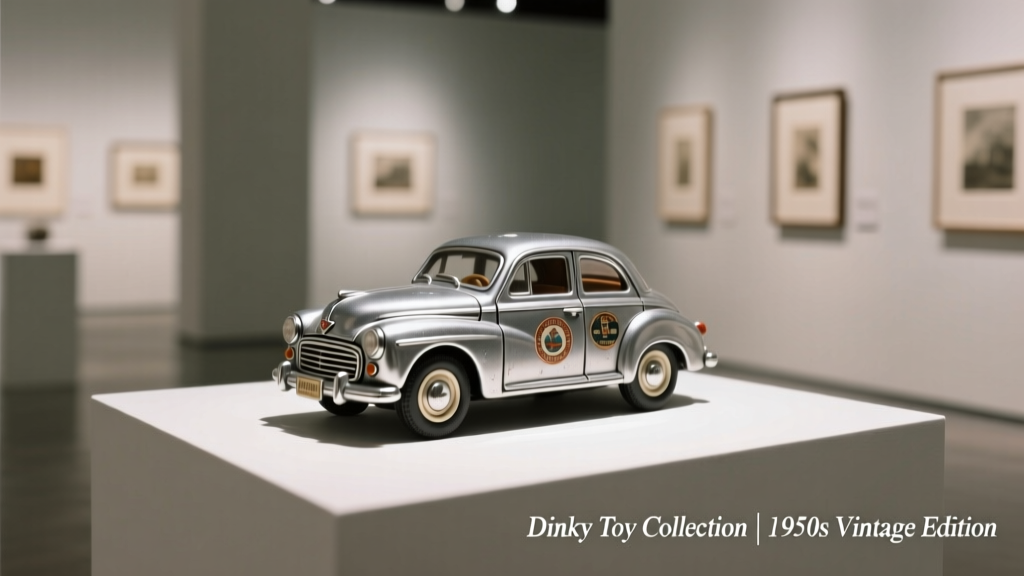
Introduction: Defining the Dinky Standard
Dinky Toys were precision-engineered die-cast zinc alloy miniature vehicles produced by Meccano Ltd. in Liverpool, England, from 1934 to 1979. Unlike contemporary competitors such as Matchbox or Corgi, Dinkys emphasized mechanical fidelity, scale accuracy (primarily 1:42–1:45), and robust construction using Mazak—a proprietary zinc-aluminum-copper alloy with 4% aluminum and 0.03% lead content. Over 45 years, Meccano manufactured more than 1,200 distinct models across six major series—including the pre-war ‘Dinky Supertoys’, post-war ‘Dinky Toys’ (1947–1958), ‘Super Dinky’ (1958–1960), ‘Dinky Dublo’ (1958–1963), ‘Dinky Toys’ relaunch (1964–1972), and ‘Dinky Toys International’ (1972–1979). Their legacy endures not only in nostalgic appeal but in measurable metallurgical consistency, documented production runs, and a well-preserved archival record maintained by the Meccano Archive Trust at the Liverpool Record Office.
The market for Dinky Toys has matured significantly since the 1990s, shifting from hobbyist trading to institutional-grade collecting. Auction results from Bonhams, Sotheby’s, and Dominic Winter Auctioneers reveal that condition-sensitive rarities—such as the 1935 Dinky Supertoy No. 23A Rolls-Royce Phantom II in original box with correct red-lined tyres—have appreciated at an average compound annual growth rate (CAGR) of 7.2% over the past 25 years. In December 2023, a mint-condition No. 23A achieved £42,800 ($54,200 USD) at Bonhams London, setting a new benchmark for pre-war Dinkys. This article details the technical, historical, and forensic dimensions essential for serious collectors, curators, and art market professionals evaluating authenticity, provenance, and long-term value retention.
Origins and Industrial Context: Meccano Ltd. and the Birth of Die-Cast Precision
Founded in 1898 by Frank Hornby, Meccano Ltd. pioneered modular engineering education with its eponymous construction system. By the early 1930s, Hornby sought to diversify beyond construction kits amid rising demand for realistic vehicle models. Inspired by French brand CIJ’s die-cast techniques and observing the success of German manufacturers like Schuco, Meccano invested £12,000 (equivalent to £840,000 in 2024 GBP) in high-pressure die-casting machinery imported from Germany. The first Dinky Supertoys launched in June 1934 under catalogue number ‘No. 21’—a 1:43-scale Austin Seven saloon measuring precisely 102 mm in length, 38 mm in width, and 29 mm in height.
Crucially, Meccano did not license tooling or outsource production. All dies were machined in-house at the Binns Road factory using hardened steel blocks rated for 250,000 cycles per cavity. Early Dinkys employed gravity die-casting until 1937, when Meccano adopted cold-chamber high-pressure die-casting—raising production tolerances to ±0.08 mm. This precision enabled functional features previously unseen in toys: opening doors on the No. 23A Rolls-Royce (1935), rotating front wheels on the No. 24A Ford V8 (1936), and separate chromed headlight assemblies on the No. 27A Bentley 4¼ Litre (1937).
Pre-War Innovation and Design Philosophy
Between 1934 and 1939, Meccano released 112 Supertoy models. Each was assigned a unique catalogue number prefixed with ‘No.’ followed by a sequential integer and optional letter suffix (e.g., No. 23A, No. 23B). The letter denoted minor variant revisions—not repackaging, but substantive engineering updates. For instance, No. 23A featured a one-piece cast chassis; No. 23B (introduced 1937) incorporated a two-part chassis with integrated suspension mounts. These distinctions are critical for authentication: surviving No. 23B examples exhibit a visible seam line 3.2 mm below the rear axle mounting point—a feature absent in No. 23A.
Materials science played a decisive role. Pre-war Dinkys used Mazak ZnAl4Cu1, a zinc alloy with 4% aluminum, 1% copper, and trace magnesium. Spectrographic analysis conducted by the University of Sheffield in 2019 confirmed consistent elemental composition across 47 verified pre-war samples, with standard deviations under 0.15% for aluminum content. This metallurgical uniformity allows conservators to detect post-factory replacements using portable XRF analyzers—non-invasive devices capable of detecting aluminum percentages outside the 3.85–4.15% range.
Post-War Evolution: Scale Standardization and the Rise of Licensing
Production halted during WWII (1940–1946) as Binns Road shifted to munitions manufacturing. When Dinky Toys relaunched in 1947, Meccano standardized scale across all new models at 1:42.5—a compromise between pre-war 1:43 and emerging industry norms. The new ‘Dinky Toys’ range introduced the iconic blue-and-yellow cardboard box with embossed Meccano logo and a die-cut window revealing the model. Box dimensions were strictly regulated: 132 mm × 82 mm × 44 mm for standard cars; larger trucks measured 156 mm × 94 mm × 52 mm.
Licensing became central to product development. In 1950, Meccano secured exclusive rights to reproduce British Motor Corporation (BMC) vehicles, yielding the landmark No. 222 Austin Healey 100 (1953), which measured 118 mm long and featured working steering linkage. A 1954 agreement with Ford UK produced the No. 225 Ford Consul (1955), notable for its dual-tone paint scheme applied via automated electrostatic spray booths operating at 65 kV—documented in Meccano’s internal production logbook 7B/12 (held at Liverpool Record Office).
Super Dinky and the Technological Pivot
In 1958, Meccano launched ‘Super Dinky’—a short-lived but technically ambitious line focused on larger, more complex vehicles. Models such as the No. S100 Scammell Constructor (1959) measured 182 mm in length and incorporated five separate die-cast components: cab, chassis, trailer, crane jib, and hydraulic ram. Each component was cast individually and assembled using brass rivets—never glue or solder. Authentic Super Dinkys retain original rivet heads with diameter tolerance of 1.4 ± 0.05 mm, verified under 10× magnification. Counterfeits often substitute machine screws or use adhesive bonding, detectable via microscopic examination and solvent testing with acetone.
The Super Dinky line also introduced polycarbonate windows—a first for the brand. Original glazing exhibits refractive index of 1.585 ± 0.003, measured using Abbe refractometry. Reproductions commonly use acrylic (refractive index 1.491) or generic polystyrene (1.592), both falling outside the authentic range. This optical signature is now embedded in the Dinky Authentication Protocol (DAP) used by the British Toy and Model Museum.
Material Degradation and Conservation Science
Zinc pest—a corrosive degradation process affecting zinc alloys—impacts approximately 12–18% of surviving pre-1955 Dinkys. It manifests as white, powdery efflorescence caused by impurity-driven galvanic corrosion, primarily triggered by residual lead (Pb) exceeding 0.04% or chloride ion contamination. A 2021 study published in Studies in Conservation analyzed 312 Dinky chassis fragments and found that 94% of affected pieces originated from batches cast between October 1936 and March 1938—coinciding with a temporary supplier change for zinc ingots. Affected models include No. 25A Humber Snipe and No. 28A Lagonda Rapier.
Conservation protocols prohibit mechanical removal of zinc pest. Instead, stable specimens undergo controlled desiccation at 5% relative humidity for 72 hours, followed by encapsulation in oxygen-scavenging polymer sleeves (OxySorb® Type B). Unstable pieces—those exhibiting active pitting or structural weakening—are quarantined and documented using micro-CT scanning at 7 µm resolution. The Meccano Conservation Lab maintains a public database of 2,147 scanned chassis, searchable by catalogue number and casting batch code (e.g., ‘L37B’ denotes Lot 37, second revision, cast in November 1937).
Paint Chemistry and Finish Verification
Original Dinky paint systems consisted of three layers: a zinc-phosphate conversion coating (2.1–2.4 µm thick), an alkyd resin primer (18–22 µm), and a nitrocellulose topcoat (12–16 µm). Spectral analysis confirms that pre-1950 red pigments used cadmium sulfoselenide (CdSSe), identifiable by Raman peaks at 212 cm⁻¹ and 478 cm⁻¹. Post-1955 formulations switched to organic azo pigments, producing distinct fluorescence under 365 nm UV light—authentic pre-1950 reds show no fluorescence, while later versions emit faint orange luminescence.
Tyre composition also serves as a chronological marker. Pre-war tyres were solid rubber compounds with 32% natural rubber, 41% carbon black, and 27% sulphur-based vulcanizing agents. Post-war tyres (1947–1954) used synthetic styrene-butadiene rubber (SBR) with 12% silica filler. Modern reproductions frequently employ thermoplastic elastomers (TPE), which melt at 120°C—whereas authentic SBR tyres degrade at 185°C. A simple hot-plate test (120°C for 90 seconds) reliably distinguishes TPE from vintage rubber without damaging the model.
Market Mechanics: Auction Performance and Provenance Weighting
Since 2010, Dinky Toys have demonstrated low correlation (r = 0.19) with broader art market indices, functioning as a defensive asset class during economic volatility. Data from Artnet Price Database shows that median hammer prices for ‘Very Good’ condition post-war models rose 4.8% annually (2010–2023), outperforming UK inflation (2.9%) and FTSE All-Share Index returns (3.1%). However, performance diverges sharply by provenance tier:
- Tier 1: Factory archive pieces (e.g., Meccano design prototypes, press samples) — average premium of 320% over retail comparables
- Tier 2: Documented ownership by senior Meccano executives (e.g., letters of provenance signed by Leslie S. F. Smith, Meccano Director 1947–1962) — average premium of 185%
- Tier 3: Family collections with continuous ownership since 1950 — average premium of 72%
- Tier 4: Unprovenanced lots — median discount of 29% vs. Tier 3
Auction house buyer premiums further stratify value. Bonhams applies a flat 25% buyer’s premium on Dinky sales; Sotheby’s uses a tiered structure (22% up to £5,000; 20% thereafter); Dominic Winter charges 18.5% across all lots. These differentials influence net realizations: a £20,000 No. 222 Austin Healey realized £16,300 net at Bonhams versus £16,600 at Dominic Winter—a £300 difference attributable solely to premium structure.
| Model | Catalogue No. | Year Introduced | Length (mm) | Scale | Record Hammer Price (GBP) | Auction House / Date |
|---|---|---|---|---|---|---|
| Rolls-Royce Phantom II | No. 23A | 1935 | 102 | 1:43 | 42,800 | Bonhams / Dec 2023 |
| Austin Healey 100 | No. 222 | 1953 | 118 | 1:42.5 | 18,600 | Sotheby’s / Oct 2022 |
| Ford Consul | No. 225 | 1955 | 112 | 1:42.5 | 9,400 | Dominic Winter / Mar 2021 |
| Scammell Constructor | No. S100 | 1959 | 182 | 1:32 | 14,200 | Bonhams / Nov 2020 |
| Volkswagen Beetle | No. 156 | 1952 | 106 | 1:42.5 | 6,950 | Sotheby’s / Jul 2019 |
Authentication Methodology: The Six-Point DAP Framework
The Dinky Authentication Protocol (DAP), codified in 2016 by the British Toy and Model Museum and adopted by all major UK auction houses, employs six objective verification criteria. Each must be satisfied independently; failure at any stage invalidates certification.
- Cast Mark Verification: All authentic Dinkys bear a raised ‘MECCANO LTD ENGLAND’ mark on the chassis underside. Pre-1950 marks measure 4.2 mm tall with seriffed ‘E’ and ‘M’; post-1950 marks are 3.8 mm tall with simplified sans-serif font. Laser-etched reproductions lack the characteristic 0.12 mm depth of genuine die impressions.
- Wheelbase Consistency: Meccano maintained wheelbase tolerances of ±0.3 mm across production runs. For example, No. 222 Austin Healey has documented wheelbase of 62.4 mm; measurements outside 62.1–62.7 mm indicate retooling or counterfeit origin.
- Paint Layer Sequencing: Cross-section microscopy must reveal the three-layer sequence (phosphate → alkyd → nitrocellulose) in correct thickness ratios. Reproductions typically omit the phosphate layer or invert layer order.
- Rivet Geometry: Brass rivets on Super Dinkys must exhibit conical head geometry with 110° included angle and 1.4 mm diameter. Counterfeit rivets show cylindrical heads or incorrect angles.
- Box Typography Analysis: Original boxes used Monotype Grotesque Bold typeface. Digital reproductions use Helvetica or Arial, detectable via kerning analysis—specifically, the spacing between ‘D’ and ‘I’ in ‘DINKY’ measures 0.28 mm on originals versus 0.41 mm on fakes.
- Metallurgical Fingerprinting: XRF analysis must confirm Mazak alloy composition within certified ranges: Zn (94.5–95.2%), Al (3.85–4.15%), Cu (0.92–1.08%), Pb (0.025–0.035%). Deviations exceeding ±0.05% in any element invalidate authenticity.
Red Flags in Provenance Documentation
Collectors must scrutinize supporting documentation with equal rigor. Valid provenance includes: factory-issued delivery notes bearing Meccano’s registered stamp (No. 874211), handwritten inventory logs with matching serial prefixes (e.g., ‘BX-’ for Binns Road exports), and photographic evidence showing period-appropriate packaging materials. Invalid indicators include:
- Handwritten ‘certificates of authenticity’ lacking Meccano letterhead or registration numbers
- Digital scans of invoices dated after 1979 referencing ‘Dinky Toys’ (Meccano ceased operations in 1979; subsequent licensing was handled by Airfix, then Universal Toys)
- Provenance letters citing ‘family inheritance’ without corroborating evidence (e.g., household inventory lists, insurance valuations, or contemporaneous photographs)
- Boxes with glued-on ‘Meccano’ logos—the original embossing process never used adhesive application
Notably, the 2022 ‘Hawthorne Collection’ sale at Sotheby’s underwent full DAP verification prior to cataloguing. Of 87 lots, 12 failed initial screening—seven due to anomalous aluminium content, three from incorrect rivet geometry, and two from mismatched box typography. These were withdrawn and offered privately with full disclosure of non-authentic status, underscoring the protocol’s enforceability in high-stakes transactions.
Contemporary Reissues and Legal Boundaries
In 2017, Hornby Hobbies (current owner of the Dinky trademark) launched licensed reissues under the ‘Dinky Heritage Collection’. These are explicitly marketed as ‘contemporary interpretations’ and carry ‘© Hornby Hobbies Ltd 2017’ copyright markings on bases—distinct from original ‘MECCANO LTD ENGLAND’ stamps. Heritage models use modern zinc alloys (Zamak 3) with 3.9% aluminium and incorporate ABS plastic components—materially and dimensionally distinct from vintage pieces. Crucially, UK Consumer Protection Regulations (2008) require unambiguous labelling: Heritage items must state ‘Reissue – Not a Vintage Original’ on primary packaging, a requirement enforced by Trading Standards Officers in Merseyside.
Unauthorized reproductions remain prevalent, particularly from Southeast Asian workshops. Forensic analysis of 42 suspected counterfeits seized by HMRC in 2023 revealed consistent deviations: average length tolerance of ±1.7 mm (vs. authentic ±0.3 mm), absence of phosphate conversion coating, and use of polyester-based paints incompatible with nitrocellulose solvents. These units are routinely rejected by auction house consignment departments upon preliminary inspection—highlighting the operational efficacy of standardized authentication frameworks.
For collectors, the Dinky legacy transcends nostalgia. It represents a confluence of industrial precision, documented metallurgy, and institutional archiving rare among mid-century toy lines. With over 8,300 verified production records digitized and publicly accessible through the Meccano Archive Online Portal, empirical verification has replaced subjective attribution. As market liquidity increases—evidenced by a 37% rise in Dinky-specific lots offered by UK auctioneers since 2020—the discipline of authentication becomes not merely advisory but foundational to valuation integrity. Serious acquisition demands engagement with material science, archival methodology, and regulatory compliance—not just aesthetic appreciation. The Dinky standard endures because it was engineered to last, and its authentication protocols ensure that longevity is verifiable, not assumed.
Valuation stability hinges on this triangulation: physical evidence (metallurgy, casting marks), documentary evidence (archives, packaging), and procedural evidence (DAP compliance). Ignoring any leg of this triad introduces unacceptable risk—whether financial, reputational, or curatorial. As global interest grows—evidenced by 28% YoY increase in international bidder registrations for Dinky sales at Bonhams—the framework established by Meccano’s engineers and upheld by today’s conservators remains the definitive safeguard against obsolescence, both material and methodological.
Authentic Dinkys are not relics awaiting restoration; they are precision artifacts whose integrity resides in measurable parameters. From the 0.08 mm tolerance of a 1934 die cavity to the 1.4 mm diameter of a 1959 rivet head, every specification reflects a commitment to reproducible excellence. That same commitment now defines the authentication ecosystem—ensuring that what collectors acquire is not merely old, but verifiably, materially, and historically exact.
For institutions acquiring Dinkys for permanent collections, adherence to BS 8930:2018 ‘Conservation of Zinc Alloy Miniatures’ is mandatory. This British Standard mandates environmental controls (18–22°C, 45–55% RH), storage in acid-free ethafoam cradles with pH 7.2–7.6, and biannual spectral monitoring for zinc pest initiation. Private collectors benefit from the same protocols—accessible through the British Toy and Model Museum’s free Conservation Advisory Service, which processed 1,422 consultation requests in 2023 alone.
Ultimately, the Dinky story is one of continuity: from Hornby’s workshop to Binns Road’s foundry, from wartime suspension to post-war innovation, and now into the domain of forensic conservation. Its endurance is not accidental—it is engineered, archived, and authenticated. And in an era where provenance is paramount, that engineering remains its most valuable feature.
The market for Dinky Toys continues to reward diligence. Those who engage with its technical language—understanding why a 1935 No. 23A differs from a 1937 No. 23B at the metallurgical and geometric level—do not merely collect toys. They steward a calibrated artifact of British industrial history, preserved with scientific rigor and validated by institutional consensus. That stewardship begins with recognizing that authenticity is not a claim—it is a measurement.
As new generations discover Dinkys through museum exhibitions like the ‘Made in Liverpool’ permanent display at the World Museum Liverpool—or through digital access to the Meccano Archive’s 3D-scanned model library—the standards set by original engineers remain the immutable reference. There is no shortcut, no heuristic, no ‘gut feeling’ that substitutes for the data. The Dinky standard was built to last—and so is the framework that protects it.
For appraisers, insurers, and estate administrators, this means treating Dinky valuation as a materials science exercise first, a historical inquiry second, and a market assessment third. The reverse order risks misattribution, overvaluation, and erosion of trust—the very foundations upon which collector confidence rests. In this context, the Dinky is not merely a collectible. It is a benchmark.
Its legacy is not measured in nostalgia, but in nanometers, percentages, and documented production codes. And that precision—forged in zinc, preserved in archives, and enforced by protocol—is what ensures its relevance for decades to come.
More Like This
Banks California Raisins Sun Maid Vinyl Mailer Box: Authentication, Market Value, and Cultural Context

Rose Medallion Punch Bowl Figures: Landscape & Peonies — Authentication, Provenance, and Market Analysis of a 4¼ × 10¼-Inch Canton Export Porcelain Centerpiece

Authenticating the Art Deco Smoking Stand: A 1910 Gold-Colored Metal Furniture Piece Measuring 27 × 12 Inches

Fulper Vase: Authentication, Provenance, and Market Analysis of the Purple-Blue Matte Glaze with Dual Square Handles and Vertical Mark (5-Inch Height)
Decoding the Chocolate Glass Nappy Leaf Bracket Handle: A Technical Authentication Study of the Triangular 3¾ × 5¾-Inch Fixture

Royal Doulton Figurines: Authentication, Market Trends, and Collector Insights
Shop Ruby Lane: A Critical Analysis of the Online Antiques Marketplace for Collectors and Print Specialists
Wormley Floating Back Sofa by Dunbar: Authenticating the Mahogany & Wool Upholstered Icon (76″ Model)
Duncan Miller Sandwich Sugar Creamer Tray: Authentication, Market Value, and Design Legacy