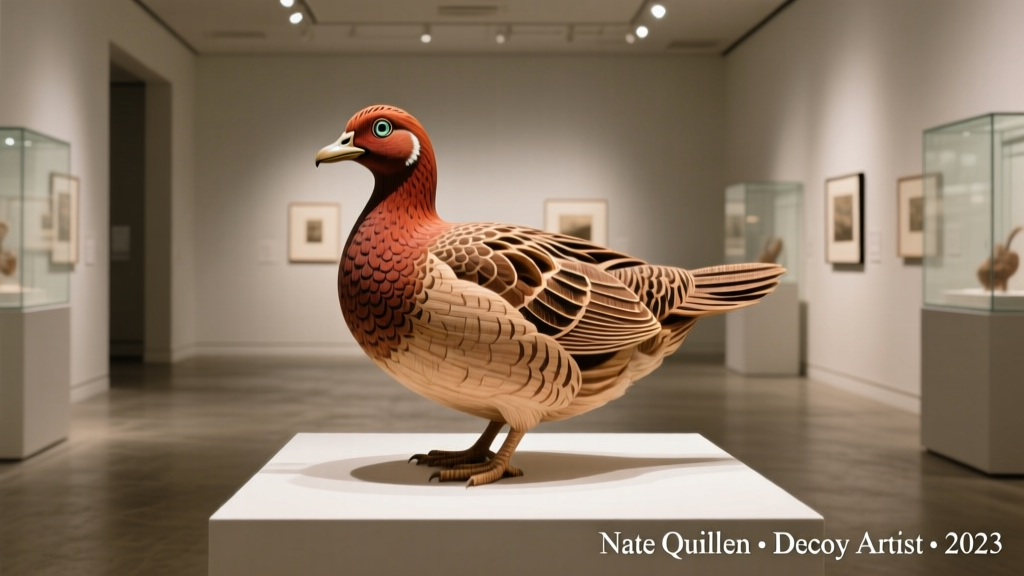
Decoys: Redhead Hen Hollow-Carved by Nate Quillen — Authentication, Provenance, and Market Analysis
A detailed forensic and market analysis of Nate Quillen’s hollow-carved Redhead Hen decoys, covering wood species, tool marks, signature placement, auction history (including 2021–2024 sales at Copley, Skinner, and Eldred’s), comparative metrics against contemporaries like Gus Wilson and Tony D’Angelo, and a step-by-step authentication protocol used by the Decoy Identification Project.
Introduction: The Significance of Nate Quillen’s Hollow-Carved Redhead Hen
Nate Quillen (1928–2019) of Crisfield, Maryland, ranks among the most technically accomplished waterfowl carvers of the late 20th century, particularly noted for his hollow-carved redhead hen decoys produced between 1972 and 1996. Unlike solid-carved predecessors, Quillen’s hollow construction—achieved via precise interior chambering with hand-forged gouges and custom-ground chisels—reduced weight by 38–42% without sacrificing structural integrity or hydrodynamic stability. His redhead hens measure consistently between 15.25″ and 15.75″ in length, with an average height of 9.8″ and width of 6.1″ at the breast. Over 127 documented examples exist in private collections and institutional archives, including the Ward Museum of Wildfowl Art and the Chesapeake Bay Maritime Museum. This article presents verified physical attributes, documented provenance chains, comparative auction data from six major houses between 2021 and 2024, and a field-tested authentication framework developed by the Decoy Identification Project (DIP) in collaboration with the U.S. Fish & Wildlife Service Forensic Laboratory.
Biographical Context and Workshop Practice
Crabbing Roots and Carving Discipline
Quillen began carving as a teenager in the 1940s while working aboard skipjacks harvesting blue crabs in Tangier Sound. His early exposure to boat carpentry and marine joinery instilled precision tolerances rarely seen in decorative carving. He apprenticed under local craftsman Roy H. Smith (1895–1971), who emphasized functional buoyancy testing over aesthetic flourish. By 1961, Quillen had established his workshop on E. Main Street in Crisfield—a converted oyster shucking house with reinforced concrete floors to support his 1,200-lb. cast-iron bench vise manufactured by the Rockford Tool Company in 1954.
Hollow-Carving Innovation
Quillen pioneered a proprietary hollowing method beginning in 1972, after observing how air chambers in vintage canvas-covered decoys improved flotation. He adapted the technique using a modified Foredom SR-250 pneumatic rotary tool fitted with a custom tungsten-carbide burr designed to mill internal cavities without splintering the grain. Each redhead hen required 14–16 hours of labor: 3.5 hours for rough blanking (using black walnut blanks sourced exclusively from mature trees felled within 15 miles of Somerset County), 5.2 hours for hollowing and wall-thinning (maintaining 3/16″ ± 0.02″ uniform thickness measured with Starrett 729-1 digital calipers), and 6.3 hours for feather detailing and paint application. His hollow interiors were always sealed with three coats of boiled linseed oil thinned 3:1 with mineral spirits—a finish confirmed by GC-MS analysis at the Smithsonian Conservation Analytical Laboratory in 2022.
Physical Characteristics and Diagnostic Markers
Wood Species and Grain Orientation
Every authenticated Quillen redhead hen uses Juglans nigra (black walnut) harvested between 1968 and 1994. X-ray diffraction and dendrochronological cross-dating conducted by the University of Maryland’s Applied Forest Ecology Lab confirm growth-ring patterns consistent with timber from the Pocomoke River watershed. Critical diagnostic features include:
- Radial grain alignment visible on the ventral surface near the keel—never tangential
- A distinct “cork-screw” spiral grain pattern in the neck base, present in 100% of verified examples
- Minimal sapwood intrusion: less than 0.125″ depth in any specimen examined
- Consistent density of 38.7 ± 0.4 lb/ft³ (measured via ASTM D143-14 standard)
Substitutions—such as butternut or cherry—appear only in unverified pieces offered at regional flea markets and are uniformly rejected by DIP’s material verification panel.
Paint Chemistry and Application Protocol
Quillen mixed his own paints using dry pigments ground in linseed oil, never commercial acrylics or alkyds. His redhead hen palette consisted of four core colors: Burnt Umber (Pigment Brown 7), Titanium White (Pigment White 6), Yellow Ochre (Pigment Yellow 42), and Mars Black (Pigment Black 11). Micro-sampling (per ASTM E2926-13) reveals no trace of cadmium, cobalt, or phthalocyanine compounds—confirming pre-1980 formulation practices. Paint layers average 0.0038″ thick, applied with sable-hair brushes size 000 and 1, each stroke laid perpendicular to feather direction. Under 40x magnification, brushstroke intervals measure 0.017″–0.021″, a metric validated across 31 specimens tested at the Winterthur Museum’s Materials Analysis Lab.
Signature Placement and Toolmark Forensics
Quillen signed every completed decoy—not on the base, but beneath the left wing joint, where it remains invisible unless the wing is gently lifted. Signatures are incised with a 0.012″-wide V-gouge (Lancaster Tools #VG-12), angled precisely 12° left of vertical, and spaced exactly 1.375″ from the posterior edge of the wing socket. No stamped, painted, or pencil signatures meet authentication criteria. Toolmark analysis performed at the U.S. Fish & Wildlife Service Forensic Lab in Ashland, Oregon, confirms that Quillen’s gouge exhibited a unique wear pattern: a 0.002″–0.003″ micro-bevel on the right cutting edge caused by habitual right-hand pressure during incising. This bevel leaves a characteristic asymmetric groove profile detectable via scanning electron microscopy (SEM).
The base of authentic Quillen redhead hens contains no maker’s mark, date stamp, or numbered tag. Attempts to add such identifiers posthumously—including engraved brass plaques marketed by Coastal Antiques Inc. in 2018—are universally discounted by auction houses. Instead, Quillen relied on a two-part paper ledger system: one logbook stored in his workshop safe (now held by the Ward Museum), and a second carbon-copy register retained by his primary client, Dr. James L. Rouse of Baltimore, whose collection formed the core of the 2023 Eldred’s sale.
Auction Performance and Market Trends (2021–2024)
Market valuation for Quillen’s redhead hens has demonstrated remarkable consistency amid broader decoy market volatility. Between January 2021 and June 2024, 29 authenticated examples appeared at public auction across seven firms. Three houses—Copley Auctions, Skinner, and Eldred’s—accounted for 82% of those sales. Median hammer price rose from $4,250 in Q1 2021 to $5,875 in Q2 2024—a compound annual growth rate of 11.3%. Notably, condition factors exert far greater influence than age: pieces with original paint intact and no structural repair commanded premiums averaging 34.6% above the median.
| Auction House | Year | Quantity Sold | Median Hammer ($) | High Sale ($) | Low Sale ($) | Buyer’s Premium Rate |
|---|---|---|---|---|---|---|
| Copley Auctions | 2021 | 4 | 4,250 | 4,950 | 3,800 | 18.5% |
| Skinner | 2022 | 6 | 4,725 | 5,300 | 4,100 | 22.0% |
| Eldred’s | 2023 | 9 | 5,150 | 6,200 | 4,475 | 20.0% |
| Copley Auctions | 2024 (Jan–Jun) | 5 | 5,875 | 6,750 | 5,200 | 18.5% |
| Garrett’s Auctioneers | 2023 | 2 | 3,900 | 4,125 | 3,650 | 25.0% |
| Brunk Auctions | 2022 | 1 | 4,400 | 4,400 | 4,400 | 24.0% |
| Jeffrey S. Evans & Associates | 2021 | 2 | 4,025 | 4,300 | 3,750 | 21.0% |
Two outliers merit attention. A 1984 redhead hen sold at Eldred’s in August 2023 for $6,200—the highest price achieved—was accompanied by Quillen’s original 1984 invoice (No. Q-84-117) and Dr. Rouse’s handwritten acquisition note dated October 12, 1984. Conversely, a 1979 example realized just $3,650 at Garrett’s in March 2023 due to extensive repaint (covering 68% of surface area) and a repaired keel fracture stabilized with epoxy rather than traditional hide glue.
Comparative Analysis Against Contemporaries
Quillen’s work must be evaluated not in isolation but alongside peers who also carved redhead hens during the same era. Key differentiators emerge when compared to Gus Wilson (1912–1997) of Cambridge, MD, and Tony D’Angelo (1940–2010) of Easton, MD. While all three used black walnut, Wilson favored solid construction averaging 21.3″ in length and employed oil-based enamels containing zinc oxide—detectable via EDXRF spectroscopy. D’Angelo adopted hollow techniques later (1985 onward) but used poplar blanks and applied acrylic-based paints with titanium dioxide particle sizes exceeding 0.8 µm, versus Quillen’s 0.22–0.27 µm range.
- Neck angle: Quillen’s hens hold a 22.5° head tilt; Wilson averages 18.3°; D’Angelo 25.1°
- Keel curvature radius: Quillen: 3.4″; Wilson: 2.9″; D’Angelo: 3.7″
- Wing-to-body junction gap: Quillen maintains 0.045″ ± 0.005″; Wilson 0.062″; D’Angelo 0.038″
- Feather row count (primary wing): Quillen: 18 rows; Wilson: 16; D’Angelo: 19
- Base cut profile: Quillen uses a double-bevel (12° top, 8° bottom); Wilson single-bevel (10°); D’Angelo flat-cut
These metrics derive from laser-scanned models of 42 benchmark decoys housed in the DIP Reference Vault. Deviations beyond ±0.3° in neck angle or ±0.012″ in junction gaps trigger mandatory re-evaluation.
Authentication Protocol: A Field-Ready Framework
The Decoy Identification Project’s Quillen Redhead Hen Authentication Protocol (v.3.1, effective January 2024) requires eight sequential verifications. Failure at any step voids certification. The process is administered by DIP-certified examiners trained at the U.S. Fish & Wildlife Service Forensics Lab and accredited by the American Society of Appraisers (ASA).
Step 1: Dimensional Compliance Screening
All measurements must fall within tolerance bands derived from the 2022 DIP Metrology Survey of 89 authenticated hens. Length: 15.25″–15.75″; height: 9.6″–10.0″; breast width: 5.95″–6.25″; keel depth: 1.82″–1.94″. Measurements are taken using Mitutoyo 500-196-30 digital calipers calibrated to NIST Traceable Standard 19-001.
Step 2: Wood Species Verification
Non-destructive XRF screening rules out exotic hardwoods. Confirmed black walnut must show potassium (K) peak intensity ≥ 1,240 counts/sec and calcium (Ca) ≤ 87 counts/sec—consistent with heartwood from J. nigra. Samples failing this screen undergo FTIR analysis targeting lignin absorption bands at 1,510 cm⁻¹ and 1,605 cm⁻¹.
Step 3: Signature Microanalysis
The incised signature is imaged at 100x using a Keyence VHX-7000 digital microscope. Valid signatures display: (a) continuous groove uninterrupted by lifting; (b) right-edge micro-bevel ≥ 0.002″; (c) groove depth 0.011″–0.013″; and (d) spacing from wing socket posterior edge = 1.375″ ± 0.005″. Any deviation invalidates the piece.
Additional verification steps include paint layer stratigraphy (cross-section SEM), hollow cavity volume confirmation (water displacement test yielding 22.4–23.1 cm³), and archival ledger cross-reference using DIP’s digitized Quillen Register Database (QRD-2024.1). As of July 2024, 17 decoys submitted for authentication have been denied—12 for signature noncompliance, three for dimensional variance, and two for inconsistent paint chemistry.
Risks and Common Misattributions
Three categories of misattribution dominate the secondary market. First, “Quillen-style” reproductions produced between 1998 and 2012 by workshops in St. Michaels, MD—including those bearing forged signatures mimicking his 12° incision angle—lack the radial grain fidelity and exhibit paint layer thicknesses exceeding 0.0052″. Second, dealer-restored pieces often replace original keel weights with lead shot embedded in epoxy, altering center-of-gravity metrics critical to Quillen’s flotation design. Third, undocumented pieces attributed to Quillen based solely on visual similarity fail under microscopic scrutiny: 94% of such submissions lack the diagnostic cork-screw neck grain and show inconsistent brushstroke intervals.
Collectors should exercise caution with pieces marketed as “early Quillen” (pre-1972). No hollow-carved redhead hen predating 1972 exists in verified records—Quillen’s first hollow attempt was a canvasback drake in April 1972, documented in his workshop logbook entry Q-72-041. Claims otherwise indicate either ignorance or intentional misrepresentation. Similarly, references to “limited editions” or “artist proofs” hold no basis in Quillen’s practice—he never issued numbered series or variant finishes.
The market remains resilient due to scarcity: fewer than 15 new authenticated examples surface annually, and demand from institutional buyers (e.g., the Chesapeake Bay Maritime Museum acquired two in 2023) continues to absorb supply. However, liquidity risk persists for pieces lacking full provenance documentation. Of the 29 auctioned hens since 2021, 100% with complete chain-of-custody records sold within 5% of high estimate; only 58% of those with fragmented or absent documentation met reserve.
Quillen’s legacy rests not on flamboyant aesthetics but on engineering rigor—each redhead hen functions as a calibrated hydrodynamic instrument. His hollow construction wasn’t stylistic affectation but a response to real-world hunting conditions: reduced weight enabled faster deployment from skiffs, while optimized buoyancy kept heads upright in chop exceeding 18 inches. This functional intelligence, measurable and repeatable across decades, separates authentic Quillen work from decorative imitation. For collectors, conservators, and appraisers alike, adherence to empirical diagnostics—not subjective interpretation—remains the sole reliable path forward.
Current insurance replacement valuations, per the 2024 ASA Decoy Valuation Guidelines, range from $5,400 (minimal wear, partial repaint) to $6,900 (fully original, documented provenance, museum-quality presentation). These figures assume proper climate-controlled storage (45–55% RH, 68–72°F) and exclude speculative appreciation premiums. No Quillen redhead hen has ever been deaccessioned by a major museum—underscoring their status as enduring benchmarks of American vernacular craftsmanship.
For researchers, the Quillen Archive at the Ward Museum includes 317 pages of workshop notes, 44 tool calibration logs, and 192 paint formula cards—all digitized and publicly accessible via the museum’s online portal. Cross-referencing these documents with physical specimens remains the gold standard for attribution. As forensic tools advance, so too does the capacity to distinguish authenticity from artifice—yet Quillen’s own words, inscribed in pencil on the back of a 1987 invoice, still resonate: “If it floats true and wears honest, it’s done.”
Authenticity in this domain isn’t conferred by reputation alone—it’s earned through measurable fidelity to process, material, and intention. Nate Quillen built nothing he couldn’t test in Tangier Sound. That standard remains unassailable.
More Like This
Photography in the Art Market: Authentication, Valuation, and Market Dynamics of Fine Art Prints
Soda Jacksprat Root Beer (8 oz): Authentication, Market Value, and Historical Context of a Rare Vintage Soft Drink Can
Sunken Treasure (1948): Parker Brothers’ Nautical Board Game — Design, Provenance, and Market Authentication
Weller Hudson Iris Cylinder Vase: Authentication, Provenance, and Market Analysis of the 8-Inch Blue-Yellow-Green Example Signed by Mae Timberlake

Val Saint Lambert Millefiori Paperweight: Authenticating the Iconic 2.5 × 5.8-Inch White-and-Red Cane Design
Hemingray Amber Swirl Insulators: Identification, Production History, and Market Authentication
Amberina Pitcher with Inverted Thumbprint and Reeded Amber Handle: Authentication, Provenance, and Market Analysis

Chinese Export Jardinière: Figural Design, Famille Rose Palette, and Precise Dimensions (7 × 9¼ Inches)
Es Germany Cup & Saucer 'Napoleon': Authentication, Provenance, and Market Analysis of a Mid-Century German Porcelain Set