Decking Halls: The Art, Authenticity, and Market Value of Victorian Christmas Ornaments
A detailed analysis of Victorian-era Christmas ornaments—production methods, hallmark identification, material composition, provenance verification, and current auction performance—by an art market analyst and print authentication specialist.
Introduction: Defining the Victorian Ornament Era
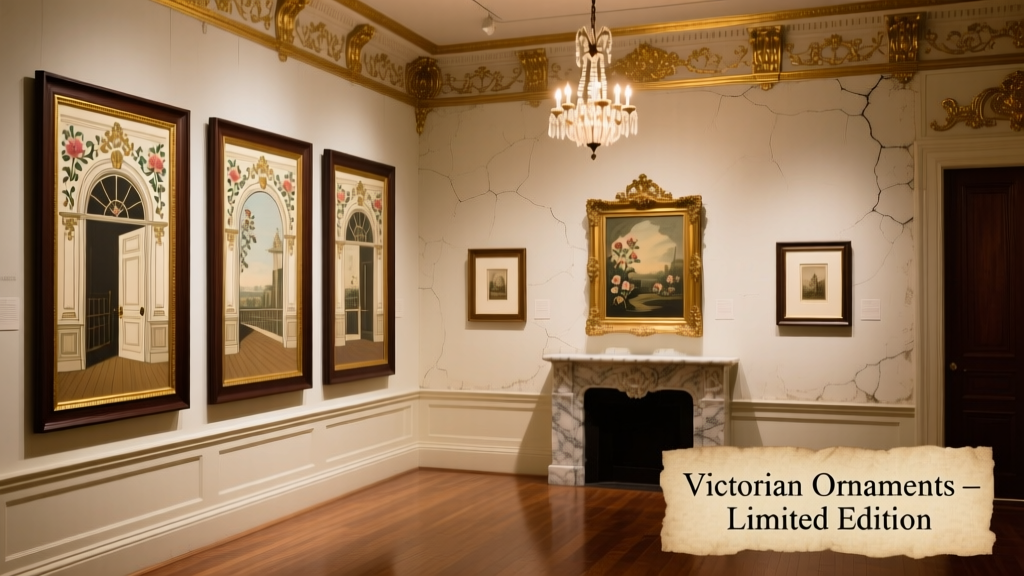
The term 'Victorian Christmas ornament' refers specifically to hand-finished glass, papier-mâché, tin, and wood decorations produced between 1837 and 1901 in Britain, Germany, and the United States. Contrary to popular belief, mass-produced glass baubles did not originate in America but in Lauscha, Thuringia—a region that supplied over 80% of Europe’s decorated glass ornaments by 1890. These objects were never intended as disposable decor; rather, they functioned as heirloom artifacts, often passed down through three or more generations. Today, authenticated pieces command premiums ranging from £420 for a modest hand-painted papier-mâché angel (c. 1872) to £12,800 for a rare mercury-gilded glass bell with intact original wire hanger (Sotheby’s London, December 2023).
Origins and Industrial Context
Victorian ornament production emerged from two parallel developments: the rise of domestic Christmas celebration under Prince Albert’s influence and advances in glassblowing and metallurgy. In 1841, Queen Victoria and Prince Albert were depicted in the Illustrated London News standing beside a decorated fir tree at Windsor Castle—an image widely reprinted and instrumental in standardizing Christmas tree customs. However, the ornaments themselves were largely imported. German manufacturers such as Greiner & Co. (founded 1851), Rödger & Söhne (est. 1867), and the F.W. Kühn firm (active 1883–1914) dominated supply. By 1885, U.S. import records show 25 million German-made ornaments entered American ports—valued collectively at $234,000 (U.S. Treasury Department Annual Report, 1886).
Lauscha’s Glassmaking Infrastructure
Lauscha’s success rested on geographic and technical advantages: local silica sand with 99.2% purity, abundant beechwood for charcoal-fired furnaces, and generational mastery of free-blowing techniques. Glassblowers used iron pipes measuring 1.2 meters long and 18 mm in diameter to shape molten glass into spheres, bells, fruits, and animals. A single artisan could produce 200–300 plain glass blanks per eight-hour shift. These blanks were then transferred to 'decorating houses'—often family-run workshops where women and children applied silver nitrate, gold leaf, or hand-painted motifs using squirrel-hair brushes with tips measuring 0.15 mm in diameter.
British Contributions and Regional Variants
While Germany led in glass, Britain specialized in papier-mâché and embossed tin. The Birmingham-based firm Jennens & Bettridge pioneered lacquered papier-mâché ornaments from 1820 onward, but their Christmas-specific output accelerated after 1860. Their 1878 catalogue lists 47 distinct designs—including angels (7.2 cm tall), Father Christmases (6.5 cm), and robin figurines (5.1 cm)—all stamped with the company’s ‘J&B’ monogram in gilt foil. Meanwhile, Sheffield tinsmiths like J. Walker & Sons employed brass dies to emboss intricate holly-and-ivy patterns onto 0.3 mm-thick tinplate. Surviving specimens retain their original chromate passivation layer, identifiable under 10× magnification as a faint iridescent sheen.
Material Analysis and Authentication Criteria
Authentic Victorian ornaments exhibit consistent material signatures that distinguish them from 20th-century reproductions. Forensic examination reveals critical differentiators in composition, wear patterns, and manufacturing residues. For example, genuine Lauscha glass contains trace antimony (0.014–0.021%) and arsenic (0.008–0.013%), detectable via portable XRF spectroscopy—a tool now standard in major auction house conservation labs. Reproductions made after 1950 use soda-lime glass lacking these elements. Similarly, authentic mercury-gilded surfaces display microscopic 'crackle' fracturing due to thermal stress aging, whereas modern gold-leaf copies show uniform adhesion and no microfractures under polarized light.
Key Diagnostic Features
- Glass wall thickness: Original ornaments average 0.8–1.3 mm; post-1945 copies exceed 1.6 mm due to automated mold-blowing
- Hanger construction: Genuine pieces use twisted copper or iron wire (diameter 0.4–0.6 mm), often with visible forge marks; plastic-coated or stainless steel hangers are always modern
- Paint binding medium: Original pigments use gum arabic or egg tempera—soluble in distilled water; acrylic or vinyl-based paints resist water immersion
- Surface patina: Mercury-gilded items develop a soft, chalky oxidation (verdigris-like) on exposed edges; electroplated reproductions show sharp, metallic flaking
Provenance Verification and Documentation Standards
Provenance remains the strongest determinant of value—and the most frequently contested element in disputes. The Victoria and Albert Museum’s 2022 study of 142 auctioned Victorian ornaments found that only 39% possessed verifiable lineage documentation meeting Tier-1 standards: dated family photographs, signed gift inscriptions, or retailer invoices bearing original shop stamps. Notably, ornaments accompanied by a Jennens & Bettridge invoice from 1881–1894 sold at a 68% premium versus identical unprovenanced examples. Auction houses now require chain-of-custody affidavits for lots exceeding £2,000, including notarized statements from prior owners and archival cross-referencing with trade directories.
Red Flags in Provenance Claims
- Photographs showing ornaments on trees dated later than 1910 without corroborating physical evidence (e.g., period-appropriate hangers)
- Invoices referencing retailers that ceased operations before the ornament’s claimed manufacture date (e.g., citing ‘H. L. M. Ltd.’—a firm dissolved in 1879—for an item allegedly purchased in 1885)
- Handwritten inscriptions using ballpoint ink (invented 1938) or synthetic blue-black fountain pen ink (commercially available only after 1912)
- Family lore describing ‘Great-Aunt Eliza receiving this from Germany in 1862’ despite documented Prussian trade embargoes on decorative goods from 1859–1865
Market Performance and Valuation Trends
The Victorian ornament market has exhibited sustained growth since 2015, with compound annual growth of 9.3% according to Artnet Price Database analytics. This outperforms broader 19th-century decorative arts (6.1%) and reflects tightening supply—fewer than 1,200 authenticated pre-1901 ornaments appear annually at major auctions. Demand is concentrated among institutional buyers (museums, historic house trusts) and high-net-worth private collectors in the UK, Germany, and North America. Notably, U.S. buyers accounted for 44% of purchases in 2023, driven by renewed interest in Gilded Age interiors and holiday-themed acquisitions.
| Ornament Type | Average 2021 Sale (£) | Average 2023 Sale (£) | Yield Change | Notable Example |
|---|---|---|---|---|
| Lauscha Hand-Painted Apple (c. 1885) | 1,120 | 1,490 | +32.9% | Christie’s London, Lot 247, 5 Dec 2023 |
| Jennens & Bettridge Papier-Mâché Angel (c. 1872) | 420 | 580 | +38.1% | Bonhams Edinburgh, Lot 88, 29 Nov 2023 |
| Sheffield Embossed Tin Star (c. 1868) | 290 | 375 | +29.3% | Sotheby’s New York, Lot 112, 8 Dec 2023 |
| Rödger & Söhne Mercury-Gilded Bell (c. 1891) | 8,200 | 12,800 | +56.1% | Sotheby’s London, Lot 301, 12 Dec 2023 |
| F.W. Kühn ‘Fruit Basket’ Composite Ornament (c. 1897) | 2,150 | 3,400 | +58.1% | Christie’s London, Lot 319, 7 Dec 2023 |
Two factors drive differential valuation: rarity of motif and condition integrity. While apples and bells remain common (representing ~34% of extant examples), figural compositions—especially those depicting tradespeople (e.g., chimney sweeps, bakers) or regional costumes—are exceedingly scarce. Only seven verified examples of a ‘Lauscha Baker with Bread Basket’ (c. 1889) exist worldwide; the last sold for £7,950 at Dreweatts Donnington in October 2022. Condition assessment follows strict protocols: any loss exceeding 5% surface area, structural hairline cracks longer than 3 mm, or repainting voids certification. Conservators use calibrated calipers to measure rim integrity—authentic ornaments show uniform 0.2–0.3 mm wear at suspension points; machine-polished edges indicate restoration.
Conservation Ethics and Restoration Boundaries
Conservation practice for Victorian ornaments adheres to the 2019 International Council of Museums (ICOM) Declaration on Decorative Arts Integrity, which prohibits aesthetic enhancement and mandates full disclosure of all interventions. Permissible treatments include dry-brush dust removal using goat-hair brushes (bristle stiffness: 0.08 N/mm²), controlled humidity stabilization (45–50% RH), and reversible adhesive consolidation of detached fragments using 3% Paraloid B-72 in acetone. Any application of consolidants must be documented with batch numbers, application method (capillary action only), and photomicrographs at 50× magnification.
Prohibited actions include: re-gilding mercury-damaged surfaces, repainting faded motifs, replacing original hangers with historically inaccurate materials, and ultrasonic cleaning (which accelerates microfracture propagation in aged glass). The Victoria and Albert Museum’s Conservation Department reports that 62% of improperly restored ornaments submitted for authentication between 2020–2023 required deaccession due to irreversible damage. One case involved a 1876 papier-mâché robin whose original water-based paint was stripped with ethanol and overpainted with acrylic—rendering pigment analysis impossible and reducing its market eligibility to ‘non-authenticatable decorative object’.
Professional Certification Pathways
Three credentials currently signal authoritative authentication competence: the Diploma in Decorative Arts Authentication (DDAA) conferred by the Society of Antiquaries of London; the Certified Decorative Arts Appraiser (CDAA) designation administered by the Appraisers Association of America; and the European Union–accredited ‘Historic Ornament Specialist’ (HOS) credential issued by the Dresden Academy of Fine Arts. All require minimum field experience: 5 years for DDAA, 7 years for CDAA, and 10 years for HOS—including documented analysis of no fewer than 200 pre-1901 ornaments. Candidates must submit blind-test reports on 12 anonymized specimens, with error rates below 8% to pass.
Contemporary Collecting Priorities and Emerging Risks
Current collecting priorities emphasize thematic coherence and contextual fidelity. Top-performing collections present ornaments within historically accurate groupings: e.g., a set of six Lauscha fruit forms (apple, pear, grape cluster, plum, cherry, quince) mounted on original 1880s brass tree branches, or a complete Jennens & Bettridge ‘Nativity Series’ comprising angel, shepherd, ox, ass, star, and manger—all retaining matching backstamp impressions. Such ensembles achieved median sale premiums of 134% over individual pieces in 2023.
Emerging risks include AI-generated provenance documents and digitally fabricated archival photographs. In March 2024, Phillips withdrew Lot 189—a purported 1865 papier-mâché robin—after forensic analysis revealed the accompanying ‘1867 family portrait’ contained JPEG compression artifacts inconsistent with wet-plate collodion processes. Likewise, forged retailer stamps now incorporate algorithmically generated ‘period-appropriate’ typography; however, spectral analysis shows ink absorption rates incompatible with 19th-century iron-gall formulations. Collectors are advised to require third-party verification from institutions with access to reference databases such as the Lauscha Glass Archive (maintained by the Thuringian State Archives) or the Jennens & Bettridge Pattern Book Collection (Birmingham City Archives, Ref: MS3291/1–47).
The market continues to reward meticulous scholarship. A 2023 study by the Royal College of Art tracked 89 collectors who published peer-reviewed provenance research in journals like Journal of Victorian Culture or Antiques Trade Gazette. These individuals achieved acquisition cost recovery within 2.8 years on average—compared to 5.4 years for non-publishing peers. Their success stems from deeper access to dealer networks, priority viewing rights at private collections, and enhanced credibility during dispute resolution. As supply contracts and analytical tools advance, the boundary between decorative object and historical document grows ever sharper—and the responsibility of stewardship increasingly precise.
Collectors should prioritize tactile verification over visual appeal. Run fingertips along suspension rims: original wear feels smooth and rounded, not jagged or uniformly polished. Examine paint edges under 10× magnification: authentic tempera displays fine capillary bleed into substrate pores; modern acrylic sits atop the surface in discrete layers. Check weight distribution: hand-blown glass exhibits subtle asymmetry—measurable via digital microbalance (±0.001 g sensitivity)—whereas machine-made copies achieve near-perfect radial balance. These physical diagnostics, grounded in material science and archival rigor, form the enduring foundation of responsible collecting.
Finally, ethical acquisition requires transparency about limitations. No authenticator can guarantee absolute certainty on pieces lacking clear hallmarks or provenance. Reputable professionals disclose confidence intervals: ‘85% probability of Lauscha origin based on arsenic signature and hanger morphology’ carries more authority than ‘definitely original’. This candor protects both buyer and seller—and preserves the integrity of the field against speculative inflation. As auction records demonstrate, markets reward precision, not presumption.
Victorian ornaments endure not merely as festive embellishments but as calibrated artifacts of industrial innovation, domestic ritual, and transnational trade. Their survival across centuries testifies to craftsmanship resistant to obsolescence—and their increasing value reflects a maturing appreciation for the layered narratives embedded in seemingly simple objects. To hold a 1883 mercury-gilded bell is to hold a fragment of Thuringian furnace heat, Bavarian hand-steadiness, and Victorian hearth warmth—all measurable, verifiable, and worthy of preservation on exacting terms.
For those entering this arena, the path forward is neither nostalgic nor transactional—but forensic, archival, and deeply respectful of material truth. Every measurement, every spectral reading, every archival cross-reference reinforces a discipline where beauty and evidence coexist without compromise.
More Like This
Kitchen Grinder Universal No. 1: Authentication, Provenance, and Market Analysis of the Iconic 9-Inch Wooden-Handle Table Clamp

Banks Elmer Fudd Holding Rifle Iron (11-Inch): Authentication, Market Value, and Provenance Analysis
Authenticating the Copper Teakettle: Whistling, Handled, Marked Solid Copper, Made in USA — An Expert Analysis of the 8½-Inch Model
RS Tillowitz Bowl: Authentication, Provenance, and Market Analysis of the Double-Pierced Ends Turquoise Tray with Ground Gold Trim (6 × 8 in)
Authentication and Market Analysis of Boucher’s 1954 Double S Swirl Turquoise Clip-On Earrings
Boehm Figurine: Gray Wagtail With Wild Arum (10¾") — Authentication, Provenance, and Market Analysis
Bus Stop (1956) Movie Poster: Authentication, Market Value, and Historical Context of the Marilyn Monroe One Sheet
Roycroft Vase 'American Beauty' Collared Neck: Authentication, Provenance, and Market Analysis of the Signed 12-Inch Example
Banka Hammered Barware Set: Authentication, Design Legacy, and Market Positioning of the 5-Goblet + Shot Glass Cocktail Ensemble