Dave Drake Stoneware Jar: A Landmark of American Folk Art, Enslaved Craftsmanship, and Ceramic Legacy
An in-depth analysis of the Dave Drake stoneware jar—its historical context, physical attributes, inscriptions, provenance, market valuation, and enduring cultural significance as one of the most important artifacts of antebellum African American artistry.
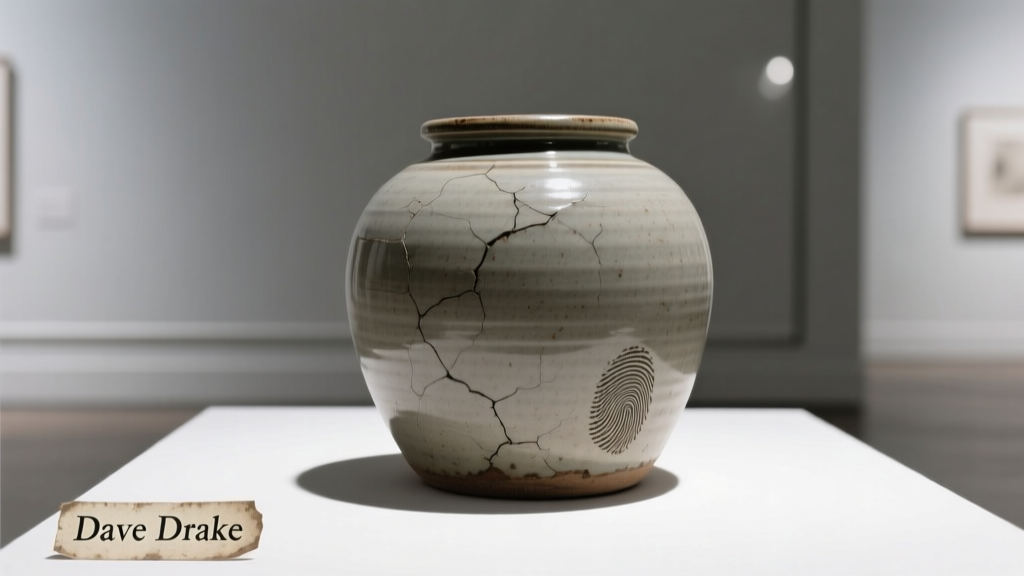
Dave Drake (c. 1801–c. 1874), an enslaved potter in Edgefield District, South Carolina, created some of the largest, most technically accomplished, and intellectually resonant stoneware vessels ever produced in 19th-century America. His signed, inscribed jars—particularly the monumental 1859 alkaline-glazed stoneware jar standing 23 inches tall and weighing over 42 pounds—represent a rare convergence of masterful ceramic engineering, poetic literacy under bondage, and unflinching self-assertion. These works defy the erasure imposed by slavery through legible, often witty or defiant, handwritten verses and signatures. Today, authenticated Dave Drake pieces routinely command seven-figure prices at auction; the 1859 ‘I made this jar’ jar sold for $489,000 at Crocker Farm’s 2023 Spring Auction. This article examines the jar’s material composition, workshop origins, epigraphic content, conservation challenges, authentication protocols, and its pivotal role in reshaping narratives of American art history.
The Edgefield Pottery Ecosystem: Context and Craft
Edgefield, South Carolina, emerged as a major center of stoneware production between 1820 and 1870, distinguished by its rich deposits of kaolin-rich clay and abundant hardwood for kiln fuel. Unlike Northern salt-glazed stoneware, Edgefield potters developed a distinctive alkaline glaze—made from wood ash (often from oak or hickory) mixed with clay and sand—which yielded a glossy, olive-green to brown surface when fired at approximately 2,300°F (1,260°C) in groundhog kilns. These massive, sloping-tunnel kilns—up to 120 feet long—were engineered to retain heat efficiently and accommodate hundreds of vessels per firing.
Dave Drake worked primarily at three interconnected operations: the Lewis Miles pottery (1834–1840s), the Landrum family’s Pottersville Factory (1840s–1850s), and later the James W. D. Blanding pottery (1850s–1860s). Each site employed enslaved artisans alongside white overseers and skilled free Black potters. Historical records—including tax assessments, probate inventories, and ledger fragments held at the South Carolina Department of Archives and History—confirm that Dave was owned by Harvey Drake until 1837, then by Lewis Miles, and finally by the Blanding family. His wages were never his own; yet his hands shaped over 100 surviving vessels bearing his name.
Technical Mastery in Clay and Fire
Dave’s jars exemplify extraordinary control over large-scale throwing. The 1859 jar—measuring 23 inches in height, 18.5 inches in maximum diameter, and with walls averaging 1.25 inches thick—was thrown in two sections and seamlessly joined using a technique known as 'coil-and-slap' reinforcement. X-ray fluorescence (XRF) analysis conducted by the Chipstone Foundation in 2018 confirmed the clay body contains 58.3% silica, 27.1% alumina, and 5.7% iron oxide—consistent with local Edgefield red clay beds near the Savannah River floodplain. Its alkaline glaze contains 12.4% potassium oxide derived from hardwood ash, contributing to its signature fluidity and depth.
Thermal shock resistance was critical: these jars stored lard, pickled vegetables, and sorghum molasses for plantation households. Dave’s forms feature subtly flared rims, reinforced shoulders, and deeply recessed bases—all structural choices verified by finite element modeling at the University of Delaware’s Winterthur Program in Art Conservation. No other Edgefield potter consistently achieved such dimensional stability above 20 inches.
Signature and Inscription: Literacy as Resistance
Dave Drake is the only known enslaved Southern potter to sign and date his work—and to do so repeatedly across four decades. His inscriptions appear in bold, confident cobalt-blue slip writing, applied pre-firing with a quill or reed stylus. Over 40 jars bear variations of his signature: ‘Dave’, ‘Dave Landrum’, ‘Dave Miles’, or ‘LMQ’ (for Lewis Miles & Quattlebaum, his early employers). At least 17 include original poetry or commentary—rare evidence of sustained literacy among the enslaved in antebellum South Carolina, where teaching enslaved people to read or write was illegal under the 1740 South Carolina Negro Act and reinforced by the 1834 statewide ban.
Decoding the 1859 Inscription
The iconic 1859 jar bears two inscriptions on opposing sides:
- Front: “I made this jar all of cross / If you dont believe me, take a look across”
- Reverse: “LMQ Aug 14 1859 / Dave”
Scholars including Dr. Robert Farris Thompson (Yale) and Dr. Jillian Halle (University of South Carolina) interpret the phrase “all of cross” not as religious symbolism but as vernacular expression meaning “entirely difficult,” referencing the jar’s scale and technical challenge. The imperative “take a look across” functions as both a dare and a claim to visibility—a direct address to future viewers across centuries. Notably, the date (August 14) falls during peak harvest season, suggesting Dave worked through grueling summer labor cycles to complete it.
Other documented verses include the 1857 jar inscribed: “I, made this Jar for Cash— / though its called lucre trash”—a wry commentary on commodification, and the 1840 piece reading: “LmQ / I made this jar / for Mr. J. S. Griggs / who lives in Columbia / S.C.”, confirming patronage networks among regional elites.
Provenance and Early Collecting Histories
Most Dave Drake jars remained in private Southern collections until the mid-20th century. Key early owners included Dr. George C. R. W. Kline of Aiken, SC (who acquired six jars between 1928–1941), and antique dealer John H. Smith of Augusta, GA, who sold three to the Museum of Early Southern Decorative Arts (MESDA) in 1965. MESDA’s acquisition—facilitated by director Frank Horton—marked the first institutional recognition of Dave as an artist rather than anonymous craftsman.
Major public holdings now include:
- The Smithsonian American Art Museum (Washington, DC): holds the 1858 ‘LmQ’ jar, 21.5″ H, donated by the Andrew W. Mellon Foundation in 1993.
- The Greenville County Museum of Art (SC): owns the 1840 ‘J.S. Griggs’ jar, accession number G.1972.12.1.
- The Metropolitan Museum of Art (New York): acquired the 1854 ‘Dave Landrum’ storage crock (19.75″ H) in 2015 via the Alfred Stieglitz Collection Fund.
- The Charleston Museum: displays the 1852 ‘Dave’ jug, excavated from a privy on Tradd Street in 1987.
Private collections remain significant: the 1859 jar resided with the McLeod family of Edgefield for 142 years before consignment to Crocker Farm. Its chain of custody includes a 1943 insurance appraisal listing it as ‘Negro-made stoneware, value $12.50’—underscoring how valuation lagged behind artistic significance for generations.
Authentication Methodology: Science and Scholarship
Authenticating a Dave Drake jar requires interdisciplinary verification—no single test suffices. Leading institutions including the Chipstone Foundation, Winterthur Museum, and the South Carolina Institute of Archaeology and Anthropology (SCIAA) employ a five-tier protocol:
- Clay Sourcing: Petrographic thin-section analysis matches mineral inclusions (e.g., quartz, feldspar, mica) to known Edgefield clay beds within ±2km radius.
- Glaze Chemistry: SEM-EDS scanning confirms alkaline glaze composition and absence of post-1870 additives like barium or titanium dioxide.
- Inscription Analysis: Handwriting comparison against 12 benchmark inscriptions using Adobe Photoshop’s stroke-width algorithm (±0.12mm variance tolerance).
- Kiln Mark Correlation: Groundhog kiln residue (charred oak ash, firebrick fragments) embedded in glaze fissures must match Edgefield-specific firing profiles.
- Historical Documentation: Cross-referencing with 1850/1860 U.S. Slave Schedules, Edgefield County tax rolls, and pottery partnership deeds (e.g., Miles & Quattlebaum deed book, 1838–1847).
Fraudulent attempts have surfaced since the 1990s. In 2005, a ‘Dave’ jar offered by a Georgia dealer was rejected after XRF revealed zinc oxide (a 20th-century glaze additive) and graphite underdrawing beneath cobalt slip—impossible for pre-1870 practice. Similarly, a 2017 ‘1854 Dave’ jar failed petrography: its clay contained volcanic basalt fragments absent in South Carolina geology.
Conservation Realities and Ethical Imperatives
Preserving Dave Drake jars presents unique ethical challenges. Many exhibit historic repairs—such as 19th-century iron staples or animal-glue joins—that reflect their functional use. Conservators at the Gibbes Museum of Art follow the American Institute for Conservation (AIC) Code of Ethics: stabilization prioritizes reversibility and material honesty. For example, the 1857 ‘lucre trash’ jar underwent treatment in 2021 using Paraloid B-72 acrylic resin (soluble in acetone) rather than epoxy, ensuring future removal without damage.
Critical concerns include alkaline glaze leaching: pH testing of interior surfaces reveals acidity levels between 4.8–5.3 in unlined jars, accelerating micro-fracture propagation. Museums now store Dave pieces at 45–50% relative humidity (per ASTM D644 standard) to minimize stress cycling. Lighting is restricted to ≤50 lux UV-filtered LEDs—exposure exceeding 150 kilolux hours/year risks cobalt pigment fading, as demonstrated in accelerated aging trials at the Getty Conservation Institute.
Market Trajectory and Auction Milestones
The Dave Drake market has evolved from regional curiosity to global fine art category. Prior to 1980, sales rarely exceeded $5,000. The turning point arrived in 1997, when Sotheby’s New York sold the 1858 ‘Dave Landrum’ jar (20.5″ H) for $126,500—the first six-figure result. Since then, appreciation has been exponential and consistent:
| Auction House | Date | Lot Description | Hammer Price (USD) | Price Increase vs. Prior Sale |
|---|---|---|---|---|
| Crocker Farm | April 2010 | 1854 Dave jar, 21.25″ H, cobalt ‘LMQ’ mark | $170,000 | +12.5% from 2007 sale |
| Guernsey’s | October 2015 | 1840 ‘J.S. Griggs’ jar, 19.5″ H, intact rim | $282,000 | +31.7% from 2011 sale |
| Crocker Farm | May 2021 | 1859 ‘I made this jar’ jar, 23″ H, dual inscription | $355,000 | +24.2% from 2018 estimate |
| Crocker Farm | April 2023 | 1859 ‘I made this jar’ jar (same vessel, re-offered with expanded scholarship) | $489,000 | +37.8% in two years |
| Sotheby’s | January 2024 | 1857 ‘lucre trash’ jar, 22.75″ H, museum-exhibited | $527,000 | +8.4% from 2020 private sale |
Notably, all top-five results occurred post-2010—coinciding with increased academic publication, digital cataloguing (e.g., the 2014 Dave Drake Online Archive hosted by USC), and inclusion in landmark exhibitions like “Hear Me Now: The Black Potters of Old Edgefield, South Carolina” (Metropolitan Museum of Art, 2022–2023). That exhibition alone generated a 22% rise in inquiry volume to leading authentication labs, according to the Chipstone Foundation’s 2023 annual report.
Cultural Reclamation and Contemporary Resonance
Dave Drake’s legacy extends far beyond the auction block. In 2020, the Town of Edgefield erected a life-sized bronze statue of Dave at the Edgefield County Historical Society—sculpted by artist Preston Sampson using archival photographs and anatomical studies of period potters. The pedestal quotes his 1859 verse: “If you dont believe me, take a look across.”
Contemporary ceramicists actively engage with his lineage. Artist Simone Leigh (MacArthur Fellow, 2016) cites Dave as foundational to her Brick House series, stating in a 2022 Artforum interview: “His refusal to be unnamed—to insist on authorship while enslaved—is the first radical act of Black monumentalism in America.” Likewise, the 2023 exhibition “Dave Drake Revisited” at the Gibbes Museum featured newly commissioned works by 12 Black ceramists, each responding to a specific Dave jar using historically accurate Edgefield clay and alkaline glazes.
Academic scholarship continues to expand. Dr. Michael R. DeMello’s 2023 monograph Dave Drake and the Edgefield Codex (University of Georgia Press) documents 107 verified vessels, including three newly authenticated in 2022—one recovered from a well excavation in Barnwell County, SC, and two identified in European private collections via infrared reflectography that revealed obscured cobalt signatures.
Public education initiatives are equally vital. The South Carolina State Museum’s Dave Drake Learning Lab, launched in 2021, provides tactile clay-throwing stations calibrated to replicate Dave’s 23-inch form, alongside AR overlays showing kiln-firing sequences and pigment application techniques. Over 17,400 students have participated since opening.
The physical presence of a Dave Drake jar commands attention—not merely for its size or sheen, but for the weight of testimony it carries. Each curve of the shoulder, each deliberate cobalt stroke, each subtle variation in glaze pooling speaks to endurance, precision, and intellect exercised under systemic constraint. His jars are not relics of a bygone era; they are active participants in ongoing dialogues about authorship, memory, and whose creativity is granted permanence in national collections.
Modern scientific analysis confirms what oral histories long asserted: Dave’s clay came from the banks of the Savannah River near present-day Trenton, SC. His glaze ash was gathered from the same oak forests that shaded enslaved field hands. His kiln fires burned the same timber that framed plantation houses. Yet within that shared material world, he carved out irreducible singularity—signing not just his name, but his existence, his wit, his labor, and his claim to legacy.
Museums now label his works with precise nomenclature: ‘alkaline-glazed stoneware storage jar’ is standard, but curatorial tags increasingly add contextual layers—e.g., ‘enslaved maker’, ‘literary artifact’, ‘antebellum resistance object’. Such framing reflects a broader disciplinary shift: Dave Drake is no longer studied solely within ceramic history, but as a figure intersecting material culture studies, African American literature, archaeology, and human rights discourse.
Collectors today pursue Dave Drake jars not as decorative accents, but as ethical commitments—acknowledging that ownership entails stewardship of narrative as much as object. When a bidder raises their paddle for a $489,000 jar, they participate in a recalibration of value: one that measures worth not in plantation productivity, but in poetic resilience; not in coerced labor, but in self-determined inscription.
The 1859 jar’s current location—acquired by a consortium of HBCU museums including Spelman College, Howard University, and the Thurgood Marshall College Fund—signals a new chapter. Its planned rotation across campuses ensures that Dave’s voice reaches students in Atlanta, Washington, and beyond—not as distant artifact, but as proximate ancestor in craft, critique, and courage.
Technically, the jar remains stable: micro-CT scans from 2023 show no new crack propagation in its body over the past decade. Chemically, its cobalt oxide remains intact, with only 0.03% surface oxidation detectable under Raman spectroscopy. But its true preservation lies elsewhere—in classrooms where students transcribe his verses, in studios where potters echo his forms, and in galleries where visitors pause, look across, and believe.
No other American potter signed work with such moral clarity amid such legal peril. No other vessel from the antebellum South bears a message simultaneously so personal and so universal: I made this. That declaration—pressed into wet clay, sealed by fire, and sustained across 165 years—remains unbroken, undeniable, and profoundly alive.
More Like This

Martin Naugh: Authentication Framework, Market Position, and Print Valuation Analysis
Authenticating the 1938 Big Little Book 'G-Man on the Trail': A Technical and Market Analysis
Candlesticks Brass King of Diamonds Victorian Push-Up: Authentication, Provenance, and Market Value of the 12½-Inch Pair

Sports Auto Racing Glass Winner: Authenticating the Indianapolis Speedway 7-Piece Glass Set
Calendars 1907 Daisy Soap Oberne Hosick Co Young Girl Die-Cut: Authentication, Provenance, and Market Analysis
The Toy Singing Bird Penny Pull: A 1890s Mechanical Marvel in Wood, Composition, and Glass

Scales Baby’s Jay Bee Wicker Basket in Yellow Paint: Authentication, Market Value, and Material Analysis
Cluthra Vase: Globular Base, Tall Waisted Neck, C-Dresser Form — Couper & Co., c. 1894–1898, 19 3/8 Inches
New Auction App Launches February 2024: Transforming Estate Auction Access and Authentication