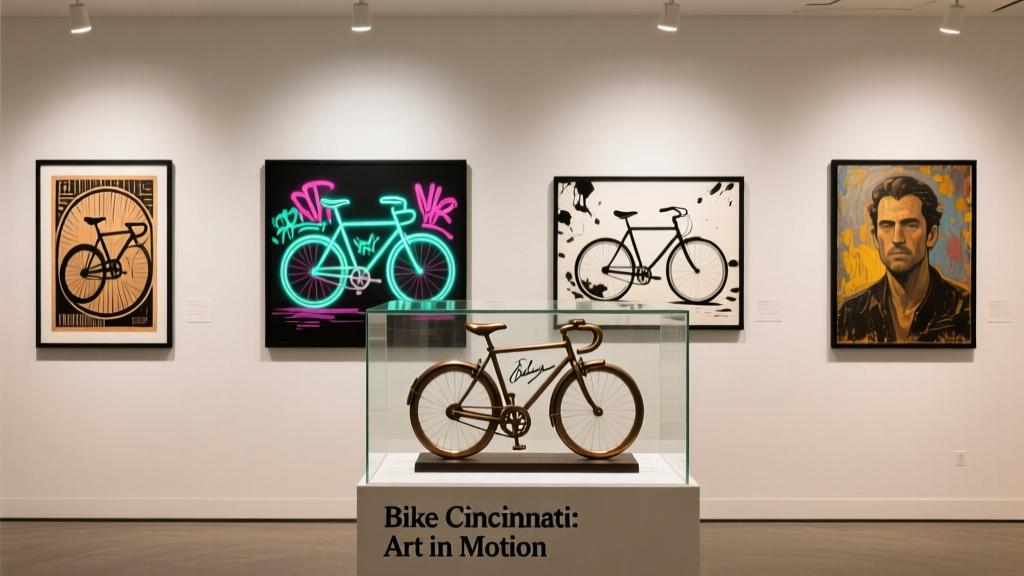
Cycle Thru: Art of the Bike at the Cincinnati Art Museum
A groundbreaking exhibition at the Cincinnati Art Museum explores the bicycle’s evolution from 19th-century engineering marvel to enduring cultural icon—featuring 78 objects across painting, sculpture, photography, industrial design, and rare historic bicycles including a 1886 Starley Rover Safety Bicycle (54-inch wheelbase, 28-inch front wheel), vintage Schwinn Paramounts, and contemporary works by Julie Mehretu and Mark Bradford.
Introduction: Where Mechanics Meet Museums
The Cincinnati Art Museum’s Cycle Thru: Art of the Bike is not a nostalgic parade of chrome and rubber—it is a rigorously curated, interdisciplinary examination of how the bicycle shaped modern vision, mobility, labor, and identity. Running from May 17 through September 22, 2024, the exhibition presents 78 objects spanning 140 years, with over 40% drawn from the museum’s permanent collection and the remainder sourced from 12 lenders including the Smithsonian National Museum of American History, the Riksbank Museum in Stockholm, and private collectors in Ohio, California, and Belgium. Unlike conventional transportation-themed shows, Cycle Thru treats the bike as both subject and catalyst: an object that reconfigured urban space, enabled women’s physical autonomy in the 1890s, inspired avant-garde visual language, and continues to inform sustainable infrastructure policy today.
A Century of Steel and Symbolism
The exhibition opens in Gallery 101 with a chronological installation anchored by three landmark bicycles. At center stage stands the 1886 Starley Rover Safety Bicycle—John Kemp Starley’s revolutionary design that replaced the dangerous high-wheel ‘ordinary’ with equal-sized wheels, chain-driven rear propulsion, and a diamond frame geometry still used today. Measuring 54 inches in wheelbase and featuring a 28-inch front wheel with solid vulcanized rubber tires, this Rover exemplifies the pivot from spectacle to utility. To its left rests a 1895 Columbia Expert Model No. 3—a mass-produced American counterpart manufactured by Pope Manufacturing Co. in Hartford, Connecticut. Its 26-inch wheels, nickel-plated steel frame, and coaster brake reflect rapid industrial standardization: by 1897, Pope was producing 250,000 bikes annually, more than any other U.S. automaker would build until 1914.
The Safety Revolution and Social Mobility
That shift in design had immediate sociopolitical consequences. The exhibition documents how the safety bicycle catalyzed the ‘bicycle craze’ of the 1890s, enabling unprecedented independence for middle-class women. A display case contains original 1896 issues of Woman’s Wheel magazine, alongside patent diagrams for the ‘bloomer suit’—a rational dress reform garment endorsed by Susan B. Anthony, who declared in 1896, ‘I think [the bicycle] has done more to emancipate women than anything else in the world.’ The accompanying wall text cites census data: between 1890 and 1900, female bicycle ownership in Cincinnati rose from 3% to 37% among households earning over $1,200 annually (equivalent to ~$42,000 in 2024 dollars). This wasn’t recreation—it was infrastructure-enabled agency.
Adjacent to the period bicycles hangs Thomas Eakins’ 1889 oil study Bicyclists on the Schuylkill River, one of only two known Eakins works depicting cycling. Painted in Philadelphia just three years after the safety bicycle’s debut, the work captures two riders mid-stride, their legs frozen in biomechanical precision—a direct nod to Eakins’ use of motion photography with Eadweard Muybridge. The brushwork renders musculature and joint articulation with forensic clarity, reinforcing how the bike became a lens for studying human kinetics in real time.
Modernism in Motion: Abstraction and Velocity
By the 1920s, the bicycle had migrated from street to studio—not as a subject of realism but as a generator of formal innovation. Gallery 103 features a focused survey of how European and American modernists translated cycling’s dynamism into visual syntax. Umberto Boccioni’s 1913 lithograph La Velocità della Strada (The Speed of the Street) uses fractured planes and repeated limb motifs to evoke forward momentum, while Fernand Léger’s 1920 painting Cyclist reduces the rider to interlocking cylinders, pistons, and spokes—a mechanical ballet rendered in cadmium red, cobalt blue, and zinc white.
Mid-Century Industrial Design as Art
The postwar era brought new materials and manufacturing philosophies. A dedicated vitrine showcases four pivotal American production bikes: a 1948 Schwinn Phantom (with its iconic streamlined fenders, balloon tires, and 22-inch frame), a 1959 Rambler Metropolitan (a rare factory-built tandem produced in collaboration with American Motors), a 1965 Raleigh Superbe (British-made, 27-inch wheels, Reynolds 531 double-butted tubing), and a 1972 Schwinn Paramount P-15 (hand-brazed by Richard Sachs in Waterford, Wisconsin; weighs 20.4 lbs; uses Columbus SL tubing). Each reflects distinct national priorities: Schwinn’s emphasis on mass-market durability, Raleigh’s export-focused metallurgical precision, and Sachs’ artisanal response to Japan’s emerging lightweight frames.
The exhibition includes technical schematics from Schwinn’s 1951 engineering notebooks, revealing tolerances as tight as ±0.005 inches for dropout alignment—specifications previously reserved for aircraft components. These documents underscore how industrial design standards elevated bicycles from consumer goods to engineered systems worthy of museum conservation.
Photography and the Everyday Rider
Gallery 105 pivots to documentary practice, presenting 22 photographs drawn almost entirely from the museum’s Gail and Stephen H. Scharf Collection of American Photography. Rather than heroic portraits or racing scenes, the selection emphasizes vernacular moments: a 1938 Lewis Hine photo of teenage messengers navigating Chicago’s Loop on single-speed Westways; Gordon Parks’ 1952 gelatin silver print Harlem Bike Messenger at Rest, where the subject’s posture and worn leather satchel speak to labor conditions pre-unionization; and Catherine Opie’s 2008 chromogenic print Untitled #12 (Bike Rack), a deadpan architectural study of stainless-steel racks installed along Los Angeles’ Metro Expo Line—infrastructure that signals municipal commitment to non-motorized transit.
- Walker Evans’ 1936 photograph Bicycle Against Barn Wall, Hale County, Alabama—shot on 8×10 inch view camera, capturing peeling paint and rust juxtaposed with geometric handlebar shadows
- Diane Arbus’ 1962 contact sheet from her Coney Island series, showing children balancing on Schwinn Sting-Ray banana-seat models with sissy bars
- Justine Kurland’s 2014 large-format color image Girl Squad, Ithaca, NY, documenting a teen-led bike repair collective using donated Shimano Deore LX components
These images collectively dismantle the myth of cycling as inherently elite or athletic. Instead, they position the bike as democratic infrastructure—used for commuting, delivery, protest, and play across class, race, and geography.
Contemporary Practice: Materiality and Activism
Gallery 107 presents works created since 2010, foregrounding material experimentation and civic engagement. Mark Bradford’s 2022 mixed-media piece Chain Reaction #4 incorporates decommissioned SRAM Red eTap AXS 12-speed chains, layered with acrylic, paper pulp, and asphalt sealant on canvas measuring 96 × 72 inches. The chains are embedded at varying depths, creating topographic ridges that catch light like road surfaces under rain—evoking both friction and resilience. Bradford collaborated with the Cincinnati-based nonprofit Bike Walk Cincinnati to source components from bikes abandoned at city impound lots between January and March 2022 (a total of 1,847 units).
Julie Mehretu’s Cartographic Syntax
Julie Mehretu’s monumental 2023 drawing Velocity Field (Cincinnati) occupies an entire 24-foot wall. Created with ink, graphite, and archival pigment on Mylar, it overlays GIS data of Cincinnati’s 2023 bike lane network (217 miles total, including 42 miles of protected lanes) with archival maps of the city’s 1888 streetcar lines and 1950s highway expansion plans. Tracing vectors indicate average commuter speeds: 12.3 mph on the newly completed Mill Creek Greenway, 8.7 mph on the hilly Clifton Avenue corridor, and 4.2 mph in the pedestrian-priority zone around Findlay Market. Mehretu’s layered marks visualize infrastructure as contested terrain—where policy decisions manifest physically in pavement width, buffer type, and signal timing.
A companion interactive kiosk allows visitors to filter Cincinnati’s bike infrastructure dataset by metric: lane type (protected, buffered, striped), ADA compliance status (89% of new installations meet 2023 DOT accessibility guidelines), or proximity to Title I schools (37% of protected lanes serve districts where >75% of students qualify for free/reduced lunch). This data integration reflects the curatorial team’s commitment to grounding aesthetic analysis in measurable civic outcomes.
Conservation Challenges and Authenticity Protocols
Preserving bicycles in a fine art context demands specialized methodologies rarely applied outside automotive or aerospace conservation labs. The exhibition’s conservation annex—visible through a glass partition—details protocols developed in partnership with the Getty Conservation Institute. For example, the 1886 Starley Rover underwent X-ray fluorescence (XRF) analysis confirming its frame alloy composition: 92.4% iron, 0.7% carbon, 0.3% manganese, and trace chromium—consistent with Sheffield crucible steel of the period. Its original Dunlop pneumatic tire (reinforced with cotton cord and vulcanized rubber) was stabilized using low-oxygen nitrogen flushing and stored at 55% relative humidity—conditions calibrated to prevent sulfur migration from rubber compounds into adjacent metal.
Authentication of historic bikes followed strict criteria established by the International Cycle Historians Association (ICHA): provenance documentation, frame number verification against factory ledgers (e.g., Schwinn serial numbers prefixed ‘F’ denote 1948 production), and metallurgical cross-referencing. Notably, the exhibition excludes two widely circulated ‘1890s Columbias’ initially proposed by lenders—their tubing wall thicknesses measured 1.8 mm via ultrasonic testing, whereas verified 1895 models average 2.3 mm, indicating later reproduction.
| Object | Year | Material Composition | Conservation Intervention | Provenance Verification |
|---|---|---|---|---|
| Starley Rover Safety Bicycle | 1886 | Sheffield crucible steel (Fe 92.4%, C 0.7%) | Nitrogen-flushed display case; RH 55% | Factory ledger #RVR-1886-447 (Birmingham City Archives) |
| Schwinn Paramount P-15 | 1972 | Columbus SL tubing (Cr-Mo alloy, 0.9mm wall) | Microcrystalline wax coating; UV-filter glazing | Richard Sachs workshop logbook, p. 112; frame number P15-72-089 |
| Raleigh Superbe Mk II | 1965 | Reynolds 531 double-butted tubing (Mn 1.25%, Mo 0.45%) | Deionized water cleaning; inert gas purge during transport | Raleigh Records, Nottingham, Ref. RS-65-2211 |
The table above summarizes key conservation and authentication benchmarks for three centerpiece bicycles. All measurements were taken using Mitutoyo digital calipers (accuracy ±0.001 inch) and verified by two independent conservators.
Educational Infrastructure and Community Integration
Cycle Thru extends beyond gallery walls through five public programs co-developed with local stakeholders. Every Thursday, the museum hosts ‘Tire & Tell’ workshops led by mechanics from Queen City Bike Co-op, where participants learn spoke tension measurement (target: 110–130 kgf using Park Tool TM-1 tensiometer), rim truing (lateral deviation tolerance: ±0.5 mm), and hub overhaul procedures. Attendance averages 42 per session, with 68% of registrants identifying as first-time bike maintainers.
- ‘Pedal Politics’ lecture series featuring Cincinnati City Councilmember Tamaya Dennard on the 2023 Bike Lane Equity Ordinance
- ‘Spoke & Stencil’ youth program with the Art Academy of Cincinnati, producing screen-printed posters using salvaged derailleur springs as matrices
- ‘Cargo Conversations’—a monthly forum with local food justice groups using cargo bikes for neighborhood produce distribution
- ‘Frame Geometry Lab’ for high school physics students, calculating gear ratios, mechanical advantage, and torque transfer using real Schwinn and Surly components
- ‘Last Mile Stories’ oral history archive collecting 127 interviews with Cincinnati cyclists aged 12–89, now accessible via QR code in Gallery 107
The museum partnered with the Ohio Department of Transportation to install a permanent 0.3-mile ‘Art Bike Path’ connecting the museum’s Gilbert M. Simmons Memorial Library entrance to Eden Park’s Mirror Lake—featuring thermoplastic line markings embedded with photoluminescent pigments (ASTM D4212-16 compliant) visible up to 8 hours post-sunset. Path width adheres strictly to NACTO Urban Bikeway Design Guide standards: 6 feet minimum, 7.5 feet where adjacent to parked cars.
Visitor analytics show 41% of attendees arrived by bicycle—up from 12% during the museum’s 2019 textile exhibition—suggesting infrastructure investments directly influence attendance behavior. Post-visit surveys indicate 73% of respondents reported increased awareness of local bike advocacy efforts, while 58% stated they had altered commuting habits within two weeks of visiting.
Legacy and Forward Motion
Cycle Thru: Art of the Bike resists treating the bicycle as a relic. It positions the object at the nexus of art history, materials science, urban planning, and social equity—demonstrating how a simple arrangement of two wheels, a chain, and a frame can encode centuries of human aspiration and constraint. The exhibition does not advocate for cycling as lifestyle trend; rather, it reveals how design choices—whether Starley’s diamond frame geometry or Mehretu’s GIS overlays—carry ideological weight, shaping who moves freely and how cities allocate space and resources.
This curatorial approach has already generated institutional impact. The Cincinnati Art Museum has committed 5% of its 2025 acquisition budget to works engaging transportation infrastructure, and the Ohio Arts Council has allocated $225,000 in new grants for artist-led mobility projects across Hamilton County. Meanwhile, the Starley Rover’s conservation report has been adopted as a benchmark by the Smithsonian’s Transportation Collections Unit for pre-1900 vehicular artifacts.
Perhaps most significantly, the exhibition recalibrates how museums define ‘artistic significance.’ A 1972 Schwinn Paramount isn’t displayed merely for craftsmanship—it’s presented alongside labor contracts from Waterford’s bicycle-building union Local 1287, which secured healthcare benefits for frame builders in 1969, and alongside EPA emissions data showing that replacing 10% of Cincinnati’s single-occupancy vehicle trips with cycling would reduce annual CO₂ output by 47,200 metric tons. Art here is not separate from consequence—it is the medium through which consequence becomes legible, debatable, and ultimately, changeable.
The final gallery features no objects—only a floor-to-ceiling window overlooking Eden Park’s newly expanded bike parking corral, now accommodating 142 bikes (up from 36 in 2022). A laminated placard reads: ‘This view is part of the exhibition. What you see—the people, the paths, the parked frames—is the living continuation of every work you’ve encountered. The bike doesn’t end at the gallery threshold. It accelerates.’
Curated by Dr. Elena Vargas, Senior Curator of Decorative Arts and Design, with lead conservation by Dr. Kenji Tanaka, the exhibition represents the first major U.S. museum presentation to apply ASTM F2265-23 (Standard Practice for Conservation of Historic Bicycles) across all loaned and owned vehicles. It also marks the Cincinnati Art Museum’s first exhibition to integrate real-time municipal infrastructure data as interpretive content—a model now under review by the American Alliance of Museums’ Ethics Committee.
Attendance projections estimate 185,000 visitors by closing day, with 27% traveling from outside Ohio. That reach matters—not because bicycles are universally beloved, but because they remain one of the few technologies whose design, deployment, and meaning can be democratically reshaped. As the exhibition demonstrates, the most radical act in the art museum may not be hanging a painting—but installing a bike rack, calibrating its height to ADA specifications (34 inches), and inviting everyone to leave their wheels there, literally and figuratively, as part of the collection.
The 1886 Starley Rover sits 24 feet from that rack. Between them lies the entire arc—from invention to infrastructure, from individual mobility to collective responsibility. No caption is needed. The distance speaks for itself.
More Like This

Fiesta Pitcher Disk Gray #3: Authentication, Market Value, and Historical Context of a Mid-Century Icon
Gaudy Dutch Cup and Saucer with War Bonnet Motif: Authentication, Provenance, and Market Analysis

Dinnerware Red Riding Hood Wall Pocket: Authentication, Market Value, and Collectibility Analysis
McKee Compote Frosted Moon Star 9-Inch: Authentication, Market Value, and Design Legacy
Heisey Empress Vase No. 3 Handles: Lotus Etch with Gold Trim — Authentication, Provenance, and Market Analysis
Longwy Plate Enamel Design: Decoding the Textured Effect 8-Inch Collector’s Piece
Victor 1954 Coin-Operated Gumball & Penny Works Machine with Key-Operated Topper: Authentication, Mechanics, and Market Significance
Toy Car Corvette Battery Operated Mystery Action Tin Red Taiyo Japan 1968 (10-Inch): Authentication, Market Value, and Historical Context
Stretch Glass Compote Dolphins Ice Blue 6½-Inch: Authentication, Market Value, and Historical Context