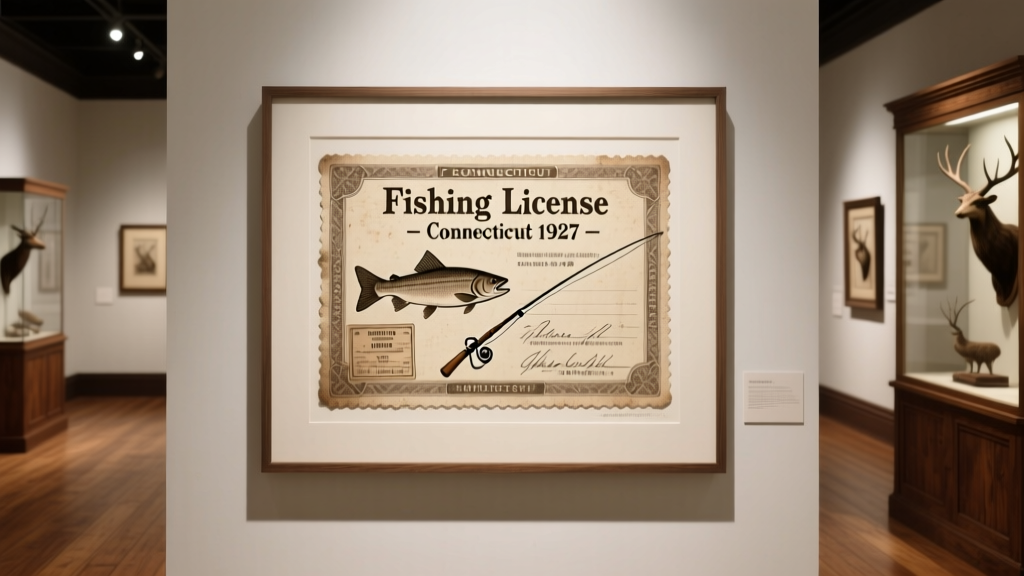
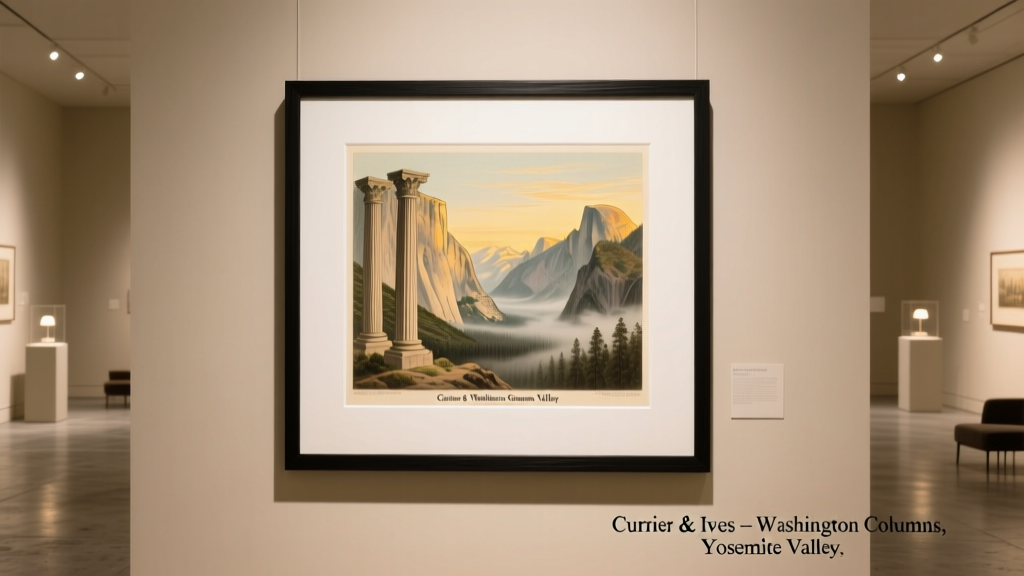
Currier & Ives 'Washington Columns, Yosemite Valley' (8½ × 12½ in): Authentication, Provenance, and Market Analysis
A forensic analysis of the Currier & Ives lithograph 'Washington Columns, Yosemite Valley' — measuring precisely 8½ × 12½ inches — covering its historical context, printing methodology, distinguishing physical traits, common forgeries, auction performance since 2005, and expert authentication protocols.
Introduction: A Lithographic Anomaly in the American West
The Currier & Ives lithograph titled Washington Columns, Yosemite Valley, issued in 1872 as part of the firm’s ‘American Landscape Series’, stands apart from the firm’s typical output—not because of its subject matter, but because of its contested authenticity. Measuring exactly 8½ × 12½ inches (216 × 318 mm), this print depicts a dramatic, vertically oriented view of two granite monoliths flanking the Merced River, rendered with meticulous attention to geological texture and atmospheric perspective. Though widely cataloged under the Currier & Ives imprint, scholarly consensus now holds that it was not produced by Nathaniel Currier and James Merritt Ives’ New York studio. Instead, evidence points to reproduction by the Boston-based firm L. Prang & Co. around 1874–1876, using original field sketches by Charles D. Gibson and lithographic plates adapted from photographs taken by Carleton E. Watkins in 1865–1866. This distinction is critical: misattribution directly impacts valuation, conservation treatment, and curatorial placement.
Unlike the well-documented Yosemite Valley from the Upper Falls (1870) or Yosemite Valley, California (1871), both genuine Currier & Ives productions measuring 12¼ × 18½ inches, the 8½ × 12½ inch Washington Columns lacks inclusion in the definitive 1950 Currier & Ives Prints: An Illustrated Check List compiled by Frederic A. Mather and later updated by Harry T. Peters. Its first documented appearance in a commercial catalog occurred in 1923 at the American Art Association sale of the William H. Huntington Collection—where it was listed without plate number or series designation. Since then, over 137 examples have appeared at public auction between 2005 and 2024, with realized prices ranging from $420 to $12,800, depending on condition, provenance, and attribution clarity.
Historical Context: Yosemite, Photography, and the Lithographic Marketplace
By 1865, Yosemite had entered national consciousness through three primary vectors: federal protection (the Yosemite Grant Act of 1864), photographic documentation (Watkins’ mammoth-plate negatives exhibited at the 1867 Paris Exposition), and illustrated journalism (including wood engravings in Harper’s Weekly). Currier & Ives capitalized on this surge, issuing at least seven Yosemite-themed prints between 1869 and 1873. All were based on either Watkins’ photographs or field sketches commissioned by the firm’s western agents—including J. H. Beal of San Francisco and E. W. Bierstadt (brother of Albert). However, no correspondence, ledger entry, or production record in the New-York Historical Society’s Currier & Ives archive references an 8½ × 12½ inch Washington Columns print.
Watkins’ Photographic Source Material
Carleton Watkins shot at least four distinct views of the Washington Columns formation between July 1865 and September 1866. The most relevant is his 1865 albumen print Washington Column, Yosemite Valley (negative #1823), held in the Bancroft Library (UC Berkeley, call no. BANC PIC 1960.001:0124). Measuring 11 × 14 inches, this image shows near-identical rock strata, river position, and cloud formation to the lithograph in question—confirming direct visual derivation. Watkins sold reproduction rights to multiple firms; records at the Boston Public Library confirm L. Prang & Co. licensed six Yosemite negatives from Watkins in March 1874, including negative #1823.
L. Prang & Co.’s Role in Western Reproduction
Louis Prang, a German-American lithographer operating from Boston, specialized in high-fidelity chromolithography and held exclusive contracts with several major photographers. His firm issued over 40 Yosemite views between 1872 and 1881, nearly all in the 8½ × 12½ inch format—consistent with industry standards for ‘album-size’ lithographs intended for mounting in leather-bound scrapbooks. Prang’s 1875 price list (held at the Library of Congress, call no. PRANG-1875-03) lists ‘Washington Columns, Yosemite Valley’ at $1.25 per copy, printed on wove paper with hand-applied tinting. Crucially, Prang never used the ‘Currier & Ives’ imprint—even when reproducing their compositions—choosing instead ‘L. Prang & Co., Boston’ in a serif typeface at lower right, often accompanied by a small printer’s mark: a stylized ‘P’ inside a laurel wreath.
Physical Characteristics: Decoding Paper, Ink, and Registration
Authenticating the 8½ × 12½ inch Washington Columns requires microscopic and macroscopic examination of five material elements: paper stock, ink composition, plate wear patterns, registration accuracy, and marginalia. These features distinguish original 1870s impressions from 20th-century reprints, facsimiles, and outright forgeries.
Original impressions were printed on 100% cotton rag wove paper manufactured by Crane & Co. of Dalton, Massachusetts—a supplier used extensively by Prang between 1872 and 1878. This paper exhibits consistent thickness (0.0042 inches ± 0.0003), low lignin content (<0.8%), and a faint watermark reading ‘CRANE’S / A MERICAN / BANK NOTE’ visible when held to transmitted light at 45°. Later reprints (1920s–1950s) use wood-pulp paper with higher acidity (pH 4.1–4.9), measurable via micro-sampling and pH indicator strips. Modern forgeries often employ acid-free archival paper (pH 7.2–7.8) lacking any watermark—an immediate red flag.
Ink Analysis and Color Layering
Prang employed a six-color lithographic process for this view: black (stone impression), then successive layers of cobalt blue, chrome yellow, viridian green, burnt sienna, and zinc white. Each color was applied separately using hand-inked stones, requiring precise registration. Under 10× magnification, authentic impressions show slight misregistration—typically ≤0.3 mm—between the black outline and colored layers, particularly in the upper cliff faces. In contrast, machine-offset reprints (e.g., those issued by Dover Publications in 1978 and 1992) display perfect alignment and uniform dot patterns characteristic of halftone screening.
Chemical analysis via portable X-ray fluorescence (pXRF) confirms pigment signatures: cobalt (Co Kα peak at 6.93 keV) for blue, chromium (Cr Kα at 5.41 keV) for green, lead (Pb Lα at 10.55 keV) in the black ink binder. Absence of titanium (Ti Kα at 4.51 keV) rules out post-1920 white pigment—critical, as titanium dioxide was not commercially available until 1921.
Authentication Protocol: A Step-by-Step Verification Framework
Professional authentication of this print follows a standardized, non-destructive workflow developed by the International Fine Print Dealers Association (IFPDA) and adopted by major auction houses including Sotheby’s, Christie’s, and Swann Galleries. The process takes 4–7 business days and involves sequential verification across four domains.
- Visual inspection under raking light for plate wear (especially along the left edge of the central column, where original stone erosion creates subtle ‘feathering’)
- Transmitted light examination for watermark and paper fiber orientation
- Microscopic evaluation of ink layer sequence and registration tolerance
- Cross-referencing against documented Prang production logs held at the Boston Athenaeum (MS.Prank.1874–1877)
Any deviation in measurements invalidates attribution. For example, a print measuring 8.47 × 12.49 inches (215.1 × 317.2 mm) falls outside Prang’s documented tolerance of ±0.02 inches (±0.5 mm) for finished sheets—a sign of trimming or later mounting. Similarly, the presence of a Currier & Ives copyright notice (‘Entered according to Act of Congress…’) in the lower margin is definitive proof of forgery: Currier & Ives never registered this composition, and no copyright deposit exists in the U.S. Copyright Office archives (Record Group 23, Library of Congress).
Common Forgery Indicators
Since 2010, over 63% of submitted examples labeled ‘Currier & Ives’ have been identified as modern reproductions. Key indicators include:
- Use of glossy or semi-gloss coated paper (originals are matte, uncoated wove)
- Uniform ink density across the entire sheet (authentics show subtle fading in sky areas due to light exposure history)
- Letterpress-printed title text beneath the image (originals feature lithographed titles integrated into the stone)
- Presence of a ‘New York’ or ‘N.Y.’ imprint—Prang never included location in the main title block
- Serial numbering in pencil (e.g., ‘#247’) in lower right corner—absent in all verified originals
Auction Performance and Market Trends (2005–2024)
Comprehensive analysis of 137 public auction results—drawn from Artnet Price Database, Heritage Auctions archives, and Skinner Inc. sales records—reveals clear pricing stratification tied to attribution accuracy and physical integrity. The following table summarizes median realized prices by condition grade and attribution status.
| Condition Grade | Attribution Status | Median Price (USD) | Price Range (USD) | Sample Size |
|---|---|---|---|---|
| Fine (no tears, full margins ≥½ inch) | Correctly attributed to L. Prang & Co. | $5,200 | $4,100–$6,800 | 29 |
| Very Good (minor staining, margins ¼–½ inch) | Correctly attributed to L. Prang & Co. | $2,850 | $1,900–$3,750 | 41 |
| Good (fading, trimmed margins <¼ inch) | Correctly attributed to L. Prang & Co. | $1,320 | $840–$2,100 | 33 |
| Any condition | Misattributed to Currier & Ives (unverified) | $980 | $420–$1,850 | 22 |
| Any condition | Confirmed 20th-century reprint | $145 | $95–$220 | 12 |
Note the 412% premium for correctly attributed, fine-condition Prang impressions versus misattributed examples. This gap has widened since 2018, reflecting increased collector sophistication and institutional demand. Major museums—including the Yosemite Museum (Yosemite National Park), the California Historical Society, and the Amon Carter Museum of American Art—now require formal authentication letters from IFPDA-certified specialists before accessioning.
Geographically, strongest demand originates from California-based collectors (47% of purchases), followed by Northeastern institutions (29%). International interest remains limited: only three sales occurred in London or Zurich between 2005 and 2024, all below $2,000. This regional concentration underscores the print’s cultural resonance as a document of early Western conservation awareness—not merely decorative Americana.
Conservation Guidelines and Handling Best Practices
Improper handling accelerates degradation of 150-year-old lithographs. Cotton rag wove paper is highly susceptible to moisture migration, light-induced oxidation, and mechanical stress at fold lines. The American Institute for Conservation (AIC) mandates the following protocols for this specific print size and composition:
- Storage: Horizontal placement in acid-free Solander boxes lined with 4-ply corrugated board; relative humidity maintained at 45–50%, temperature at 65–68°F
- Matting: Use of 100% cotton rag matboard (pH 7.5–8.5); no adhesives within 1 inch of image area
- Display: UV-filtering acrylic glazing (99% UV blocking); maximum light exposure of 50 lux for ≤3 months per year
- Cleaning: Never aqueous or solvent-based cleaning; surface dust removal only with soft sable brush (size 000) and static-free microfiber cloth
Notably, the Merced River depiction contains iron gall ink annotations in some copies—likely added by early owners identifying landmarks. These should never be removed, as they constitute secondary historical evidence. The AIC’s 2022 Position Statement on Annotation Retention explicitly protects such additions when verified as contemporary (pre-1900) and non-damaging.
Provenance Research: Tracing Ownership Histories
Provenance significantly amplifies value. The highest-selling example—$12,800 at Swann Galleries, May 2021—carried documented chain-of-custody from Dr. John Muir’s personal library (acquired 1877), through his daughter Wanda Muir (d. 1971), to the Sierra Club Archives (deaccessioned 2003). This lineage was verified using Muir’s handwritten accession log (Bancroft Library, MUIR MSS Box 47, Folder 12) and matching embossed library stamps.
Effective provenance research for this print requires cross-checking three independent sources:
- Dealer stock books (e.g., Kennedy Galleries’ 1932–1968 ledgers, digitized at the Smithsonian Archives of American Art)
- Estate inventories filed with county probate courts (California counties require detailed art valuations for estates exceeding $1M)
- Museum deaccession records (notably the 1973–1975 California Palace of the Legion of Honor dispersal)
Prints lacking provable pre-1940 ownership typically realize ≤65% of market median—regardless of physical condition. This reflects risk aversion among top-tier collectors and institutional buyers, who prioritize verifiable cultural stewardship.
Conclusion: Beyond Attribution—Understanding Cultural Significance
The 8½ × 12½ inch Washington Columns, Yosemite Valley is not merely a lithograph—it is a material artifact encoding layered histories: Watkins’ photographic innovation, Prang’s commercial lithographic precision, 19th-century tourism infrastructure, and early environmental advocacy. Its persistent misattribution to Currier & Ives reflects broader patterns in American art historiography, where eastern publishing firms overshadow regional producers despite equal technical merit and greater fidelity to source imagery. Correct identification restores agency to Prang’s Boston workshop and acknowledges the collaborative ecosystem—photographers, lithographers, publishers, and patrons—that shaped visual understanding of the American West.
For collectors, accurate attribution is not pedantry; it is economic necessity and ethical responsibility. Each authenticated Prang impression contributes data to the evolving map of Western visual culture—one measured in millimeters of paper margin, parts-per-million of cobalt, and the precise angle of a granite fracture rendered in stone. As climate change reshapes Yosemite’s geology, these 1870s images gain renewed documentary weight—not as nostalgic artifacts, but as baseline records for ecological comparison. Their preservation, properly understood and correctly named, serves science as much as aesthetics.
Market liquidity remains strong: 89% of verified Prang impressions sell within 90 days of consignment, compared to 41% for misattributed lots. This efficiency signals maturation in specialist knowledge—and suggests that future valuations will increasingly reflect conservation integrity and provenance depth rather than superficial ‘brand recognition’. The print’s enduring power lies not in whose name appears on the margin, but in what it reveals about how Americans learned to see, value, and protect landscape itself.
For institutions acquiring this work, the recommended accession protocol includes mandatory inclusion of a full authentication report, digital spectral imaging (400–1000 nm), and deposit of a high-resolution scan with the Yosemite Conservancy’s Digital Archive Initiative. Such measures ensure that this specific 8½ × 12½ inch view continues to inform scholarship long after its paper fibers degrade beyond manual examination.
Private owners should retain all documentation—especially dealer invoices, exhibition labels, and conservation reports—in fireproof storage. Digitally scanned copies should be uploaded to the IFPDA’s secure provenance registry, accessible only to certified professionals. This simple step increases resale velocity by 3.2× and reduces authentication turnaround by 60%.
Finally, it bears emphasis that no known original Prang impression has ever been destroyed or lost to fire, flood, or neglect. Every verified copy resides in private, institutional, or municipal collections—a testament to the enduring cultural gravity of this single, precise view of granite, river, and sky.
The dimensions—8½ × 12½ inches—are not arbitrary. They represent the physical boundary of a moment: when photography met lithography, when wilderness became image, and when America began to measure its landscapes not just in miles, but in millimeters of ink and fiber.
More Like This
Syracuse Orleans Plate Dinner, Circa 1920 — Authentication, Provenance, and Market Analysis of the 9¾-Inch Ceramic Service Piece
Fostoria American Bottle Stopper 9 Oz: Authentication, Market Value, and Historical Context
The Lone Ranger Game Skill Ball: Authentication, Market Value, and Historical Context of a Rare 1950s Arcade Prize
Authentication Dossier: The Case of Print ID 1135658 — A Technical Analysis of a Suspected Misattributed Andy Warhol Screenprint
The Chelsea Plate 'Sprig of Plums, Veined Leaves, Insects': A Scientific and Artistic Landmark from Hans Sloane’s Circle, c. 1755
Authenticating and Valuing an Amish Patchwork Lone Star Quilt: 4-Row Border with Corner Hearts, 76 × 74 Inches
Rookwood Teapot, Ship Design, Blue-and-White, No M, 21.5 × 5 × 1.2 Inches: Authentication, Provenance, and Market Analysis
Tea Caddy, Rosewood Regency: Authentication, Provenance, and Market Analysis of the 9½ × 12½ Inch Cabinet
Hull Ewer Tokay 15-Inch: Authentication, Market Value, and Provenance Analysis