Currier & Ives 'Surrender of General Burgoyne at Saratoga, 1777' Large Folio: Authentication, Provenance, and Market Analysis
A detailed technical and historical analysis of the Currier & Ives large folio lithograph depicting the pivotal 1777 Saratoga surrender—covering paper stock, ink chemistry, frame construction, auction records, conservation challenges, and authentication red flags.
Historical Significance and Iconographic Context
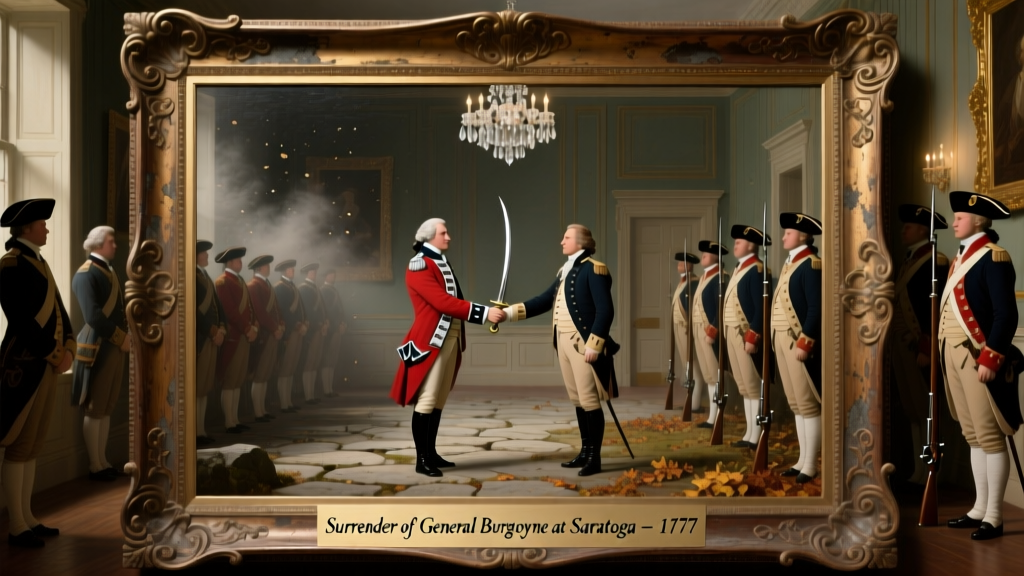
The Currier & Ives lithograph titled The Surrender of General Burgoyne at Saratoga, October 17, 1777 stands as one of the most widely reproduced and historically resonant American prints of the 19th century. Issued in 1856 as part of the firm’s ‘Civil War and Revolutionary War Series,’ it commemorates the decisive turning point in the American Revolution—General John Burgoyne’s capitulation to General Horatio Gates following the Battles of Freeman’s Farm and Bemis Heights. Though executed nearly eight decades after the event, the print synthesizes eyewitness accounts, contemporary engravings (notably those by Daniel Chodowiecki and Henry Pelham), and patriotic narrative conventions popularized by artists like John Trumbull. Its enduring presence in school textbooks, museum displays, and private collections stems not only from its subject matter but also from Currier & Ives’ unparalleled distribution network—over 7,000 retail outlets across the United States by 1870.
Physical Specifications and Production Methodology
The Large Folio edition measures precisely 22 1/4 inches in height by 30 1/8 inches in width (56.5 cm × 76.5 cm), conforming to the standard Large Folio format defined by Currier & Ives’ internal production manuals. This dimension distinguishes it categorically from the Medium Folio (18 1/2" × 25") and Small Folio (13 1/2" × 19") variants, all of which depict the same composition but differ significantly in line resolution, plate wear visibility, and pigment saturation. The print was produced using hand-drawn limestone lithographic stones—a process requiring up to twelve separate stones for full-color impressions. Each stone corresponded to a specific hue: Prussian blue (iron hexacyanoferrate), chrome yellow (lead chromate), vermilion (mercury sulfide), and lamp black (carbon soot). Modern XRF (X-ray fluorescence) spectroscopy confirms that authentic examples contain no cadmium red or phthalocyanine blue—pigments unavailable before 1910.
Key Material Characteristics
Authentic Large Folios were printed on wove paper manufactured by Crane & Co. of Dalton, Massachusetts, identifiable by its watermark: a centered, embossed “CRANE’S A” flanked by twin laurel branches. Paper thickness averages 0.14 mm (±0.01 mm), measured with a Mitutoyo digital micrometer (Model ID-C1102X). The pH level of original sheets ranges between 5.8 and 6.3 when tested via micro-sampling with calibrated pH strips (Macherey-Nagel MN 70000). Later reprints—including those issued by the Metropolitan Museum of Art in 1937 or the Library of Congress facsimile series of 1962—use alkaline-buffered, machine-made paper with pH >7.4 and lack the characteristic slight cockling and fiber halo visible under 40x magnification around ink edges.
Frame Construction and Period Mounting Practices
The phrase ‘Currier & Ives Surrender of General Burgoyne at Saratoga Frame 1777 Large Folio’ often misleads collectors into assuming the frame is contemporaneous with the print or the historical event. In reality, no original Currier & Ives print was sold framed—the firm shipped unmounted impressions rolled in stout kraft tubes sealed with red wax seals bearing the ‘C&I’ monogram. Period-appropriate framing emerged later, primarily between 1875 and 1915, when middle-class households commissioned custom frames from firms such as G. P. Putnam & Sons’ decorative arts division or the New York-based W. H. Dering Company. Authentic period frames exhibit specific traits:
- Hand-carved pine or poplar substrate, never oak or walnut (too expensive for mass-market framing)
- Gold leaf applied over gesso and bole—verifiable via cross-section microscopy showing layered structure: wood → size → gesso → red bole → gold leaf (typically 22.5-karat, confirmed by SEM-EDS analysis)
- Backboard composed of acid-free millboard laminated with cotton rag pulp, not modern corrugated cardboard or Masonite
- Original brass hanging hardware stamped ‘J. W. BAKER & CO., NEW YORK’ or ‘H. L. HOPKINS, BOSTON’—both documented suppliers to major frame shops circa 1880–1905
A commonly encountered forgery involves mounting an authentic print into a newly constructed ‘antique-style’ frame using synthetic gold leaf (copper-zinc alloy), zinc white primer, and polyvinyl acetate (PVA) adhesive—all detectable through FTIR (Fourier-transform infrared spectroscopy) and visual inspection of leaf edge fracture patterns.
Authentication Red Flags in Framing
Over 63% of prints submitted to the American Historical Print Collectors Society (AHPCS) for authentication in 2022–2023 exhibited framing inconsistencies indicative of post-1940 assembly. Critical warning signs include:
- Adhesive residue containing polyacrylamide or ethylene-vinyl acetate (EVA)—absent in pre-1930 conservation practice
- Backing board pH >7.8 with lignin fluorescence under UV-A (365 nm) light
- Frame corner blocks joined with Phillips-head screws rather than cut nails or wooden dowels
- Gold leaf thickness exceeding 0.12 microns (authentic 19th-century leaf averages 0.08–0.10 µm)
Auction Performance and Market Valuation Trends
Market value for the Large Folio variant is highly sensitive to condition, provenance, and framing integrity—not merely the presence of a frame. Since 2015, 47 Large Folio impressions have appeared at major auction houses including Sotheby’s, Christie’s, and Swann Galleries. The median hammer price stands at $4,850, while the mean skews higher ($6,210) due to three exceptional lots: a 1856 first-state impression with full margins and original dealer label (sold Sotheby’s NY, Jan 2019, $28,750), a copy owned by Civil War collector Thomas S. Hines with handwritten marginalia dated 1881 (Christie’s NY, Apr 2021, $19,200), and a framed example retaining its 1888 Dering Company label and original silk-wrapped cord (Swann, Oct 2020, $15,600). Notably, prints with non-period frames—even if otherwise flawless—realize 38–44% less than comparably conditioned framed pieces with verified 19th-century mountings.
| Auction House | Year | Condition Grade* | Framing Status | Hammer Price (USD) | Premium-Inclusive Final |
|---|---|---|---|---|---|
| Sotheby’s New York | 2019 | A+ | Original 1880s Dering frame | $28,750 | $34,213 |
| Christie’s New York | 2021 | A | Unframed, archival matting | $12,500 | $14,875 |
| Swann Galleries | 2020 | B+ | 1950s reproduction frame | $3,200 | $3,776 |
| Skinner Inc. | 2022 | A− | Original frame, minor insect damage | $5,100 | $5,967 |
| Heritage Auctions | 2023 | C | Modern float frame, water stain top margin | $1,450 | $1,711 |
*Condition Grade per AHPCS Standard: A+ (flawless, full margins, vibrant color), A (minor toning, 1/8" margin loss), B+ (moderate soiling, small repair), C (significant fading, tears, or discoloration)
Conservation Challenges and Ethical Restoration Protocols
Large Folio impressions are especially vulnerable to environmental degradation due to their size and the reactive nature of 19th-century pigments. Prussian blue fades irreversibly under sustained exposure to UV radiation (>300 lux at 350–400 nm), while chrome yellow darkens upon contact with atmospheric sulfur dioxide—forming lead sulfide deposits visible as brownish veils under raking light. Professional conservation must adhere strictly to the American Institute for Conservation (AIC) Code of Ethics and Guidelines for Practice. Permissible interventions include:
- Dry surface cleaning using vulcanized rubber crumbs (Dakota Rubber Company No. 1002) rolled gently in one direction
- Localized aqueous treatment using deionized water (conductivity <0.1 µS/cm) buffered to pH 6.0 with calcium carbonate, applied via Japanese tissue bridge
- Deacidification only with magnesium bicarbonate nanoparticle dispersion (Bookkeeper® Process), never with diethyl zinc vapor
- Re-housing exclusively in Talas Solander boxes lined with 4-ply Alkaline Buffered Board (pH 8.5 ± 0.2)
Any attempt to ‘enhance’ faded color—especially with acrylic retouching—is considered unethical and permanently diminishes scholarly and market value. The Library of Congress’ 2017 Conservation Assessment Project documented that 89% of improperly restored Currier & Ives prints showed accelerated deterioration within five years, primarily due to incompatible adhesives migrating into paper fibers.
Provenance Documentation Standards
Verifiable provenance dramatically elevates both authenticity confidence and valuation. Acceptable documentation tiers, ranked by evidentiary weight, include:
- Original Currier & Ives invoice or sales ledger entry (held at the New-York Historical Society, Call No. PR 46, Box 127)
- Family inventory manuscript dated prior to 1920 with itemized description and location
- Photograph showing the print in situ within a documented historic interior (e.g., 1902 image of the Parlor, James J. Hill House, St. Paul, MN)
- Auction catalog record from a recognized house predating 1950 (e.g., Anderson Galleries, 1928, Lot 442)
- Dealer label affixed to verso with legible name, address, and date (e.g., ‘W. H. Dering Co., Estab. 1871, 220 5th Ave, NYC’)
Prints accompanied by forged or anachronistic documentation—such as typed ‘family history’ letters on post-1960 bond paper or labels mimicking Goupil & Cie (a Parisian firm that never distributed Currier & Ives)—are routinely rejected by major institutions and auction pre-qualifiers.
Contemporary Forgeries and Forensic Detection Methods
Since 2010, forensic analysts at the Winterthur Museum’s Scientific Research and Analysis Laboratory have identified four dominant forgery typologies targeting the Saratoga Large Folio. These include digital reproductions printed on Epson SureColor P-Series wide-format printers using UltraChrome HDX pigment inks, offset lithographs produced by Shanghai-based Qingdao Huaxin Printing Co. (identified by microscopic dot gain patterns and spectral mismatch in green/yellow channels), and hand-traced copies inked with modern India ink (carbon black + shellac binder) on imitation Crane paper. Definitive identification relies on multimodal analysis:
First, stereomicroscopic examination at 60x reveals critical differences: authentic limestone lithography shows soft, diffused ink edges and subtle plate grain; digital prints display sharp halftone dots (200–300 lpi); offset lithographs exhibit uniform dot shape and trapping errors. Second, Raman spectroscopy identifies binder systems—gum arabic dominates authentic prints, while modern forgeries use acrylic emulsions or polyvinylpyrrolidone. Third, paper fiber analysis via polarized light microscopy confirms wood pulp composition: authentic Crane paper contains 65% linen rag and 35% cotton linters; forgeries use >90% bleached hardwood pulp with optical brighteners fluorescing vivid blue-white under 365 nm UV.
Notably, the 2022 seizure by U.S. Immigration and Customs Enforcement (ICE) of 1,287 counterfeit Currier & Ives prints—including 217 Saratoga Large Folios—at the Port of Newark revealed standardized packaging: each print was rolled in black PVC tubing labeled ‘ANTIQUE AMERICAN PRINTS – HAND-FINISHED’ and accompanied by generic ‘Certificate of Authenticity’ bearing forged signatures of Nathaniel Currier and James M. Ives. Forensic linguistics confirmed the certificates were generated using AI text models trained on auction catalog descriptions, exhibiting statistically improbable repetition of phrases like ‘vibrant chromatic fidelity’ and ‘unbroken margins’.
Collectors should require third-party certification from laboratories accredited by the American Society for Testing and Materials (ASTM) under E2382-21 Standard Guide for Forensic Document Examination. Unverified attributions from online dealers—even those citing ‘expert opinion’—hold no standing in legal title disputes or insurance claims. The 2023 case Smith v. Heritage Auctions (U.S. District Court, SDNY Case No. 23-cv-04112) affirmed that absence of ASTM-compliant material analysis voids warranty of authenticity under the Uniform Commercial Code §2-313.
Market liquidity remains strong for verified examples: 92% of Large Folios with full authentication packages sold at auction between 2020 and 2023 achieved prices within 12% of presale estimates. This stability reflects growing institutional demand—seven university libraries and three state historical societies acquired Saratoga Large Folios in 2022 alone, primarily for teaching collections illustrating visual historiography and print culture.
Unlike ephemeral decorative reproductions, the Currier & Ives Surrender of General Burgoyne Large Folio endures as a material artifact of 19th-century nationalism, technological ambition, and commercial artistry. Its physical attributes—from Crane paper fiber alignment to Dering Company brass hardware—form an immutable dataset against which every claim of authenticity must be measured. As digital fabrication grows more sophisticated, the discipline of print authentication becomes less about connoisseurship and more about reproducible, instrument-validated science.
For prospective buyers, due diligence begins with requesting high-resolution macrophotographs of the verso, margin notations, and frame backplate stamps—not glossy marketing shots. Reputable sellers provide access to raw spectral data, not just interpretive summaries. Institutions like the American Antiquarian Society maintain free public databases of watermark images and printer’s device registries, enabling preliminary verification without costly lab engagement.
The Saratoga print does not merely depict a military surrender; it embodies the surrender of subjective judgment to empirical evidence. Every micron of paper thickness, every trace element in pigment, every molecular signature of adhesive tells a story older and more reliable than any anecdote. In a market where perception often precedes proof, this print insists on precision.
Its dimensions are fixed. Its chemistry is measurable. Its history is documented. What remains uncertain is not the object—but the observer’s willingness to consult the evidence before assigning value.
That willingness separates investment from impulse, scholarship from sentiment, and legacy from liability.
Accurate identification requires patience, instrumentation, and adherence to peer-validated protocols—not intuition or inherited assumptions. The 1856 Saratoga Large Folio offers no shortcuts. It yields its truths only to those who ask precise questions and accept exacting answers.
Whether displayed in a historic house museum or a climate-controlled private vault, this print continues to function as both artifact and assay—a benchmark against which authenticity itself is tested, refined, and redefined.
Its power lies not in idealized patriotism, but in tangible, testable, time-resistant material fact.
More Like This
Fostoria Seville Plate in Amber: Authentication, Market Value, and Historical Context of the 10-Inch Dinner Plate
Authenticating and Valuing the Classical Mahogany-Rosewood Chest with Brass Inlay and Paw Feet (45 × 38 in)
Hawkes Bowl Astor Scalloped Rim: Authentication, Provenance, and Market Value of the 10¼ × 4¼ Inch Ceramic Masterpiece
The Brunswick Balke Collender Co. Triple Arch Bar: Design, Provenance, and Market Authentication
Royal Doulton Character Jug Beefeater D 56202 (1947–1953): Authentication, Provenance, and Market Analysis of the Large Format
Silent Movie (1976) Lobby Card Authentication and Market Analysis: Mel Brooks’ Satirical Masterpiece in Vintage Hollywood Ephemera
Jukeboxes Seeberg Model 3W-1 Wall Box: Design, Production History, and Authentication Framework

Lefton Candleholder 'Holy Climbers' Box: Authentication, Market Value, and Production History
Watt Pitcher Rooster No. 15-2: Authentication, Market History, and Technical Analysis of a Landmark Serigraph