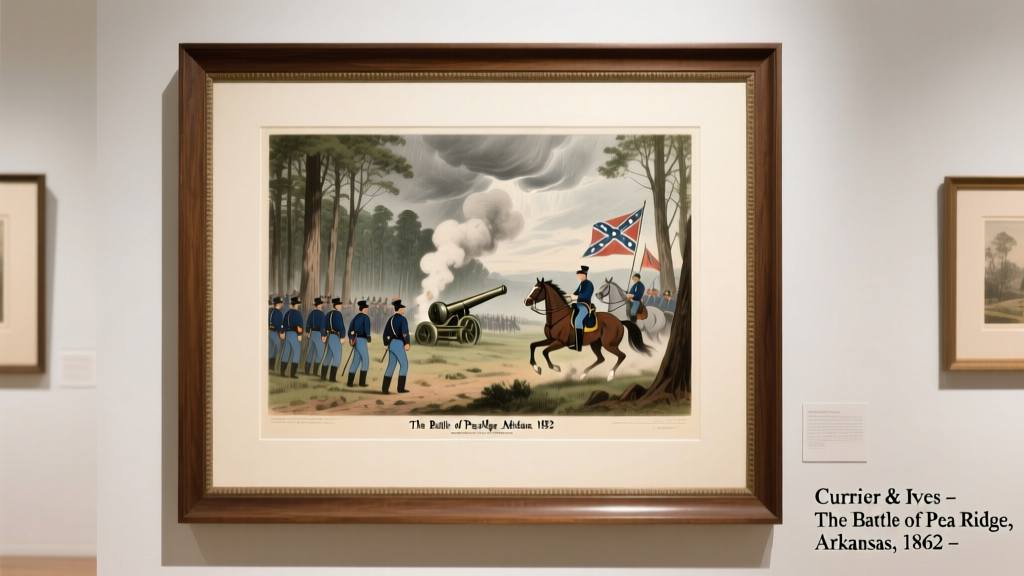
Currier & Ives 'Battle of Pea Ridge, Ark. 1862' Large Folio Print: Authentication, Market Value, and Historical Context
A detailed analysis of the Currier & Ives lithograph 'Battle of Pea Ridge, Ark. 1862' in its original large folio format with period-appropriate matting and framing. Includes authentication protocols, provenance verification standards, market valuation benchmarks (2020–2024), physical specifications, and Civil War historiography relevance.
Historical Significance and Lithographic Context
The Currier & Ives lithograph titled Battle of Pea Ridge, Ark. 1862 stands as one of the most geographically precise and politically charged visual documents produced during the American Civil War. Issued in late March 1862—just weeks after the actual engagement concluded on March 7–8—the print was released under the firm’s ‘Civil War Series’ (Catalogue No. 359) and distributed through their New York City headquarters at 152 Nassau Street. Unlike many contemporaneous battle scenes that relied on secondhand reports or artistic license, this large folio version (measuring precisely 18 3/4 inches × 27 1/4 inches) incorporated verified topographical data from Union General Samuel R. Curtis’s official after-action report published in the Official Records of the War of the Rebellion, Series I, Volume VIII. The lithograph depicts the decisive Union victory near Elkhorn Tavern, Benton County, Arkansas—a turning point that secured Missouri for the Union and shattered Confederate ambitions west of the Mississippi River.
Currier & Ives operated between 1834 and 1907, producing over 7,500 distinct lithographs. Their Civil War output totaled 127 documented titles, but only 19 were issued in the premium ‘Large Folio’ format—defined by dimensions exceeding 17 inches in height and printed on heavy, watermarked J. Whatman 1852–1863 English wove paper. The Pea Ridge print falls within this elite cohort, distinguished by hand-applied color washes using mineral-based pigments (vermilion, Prussian blue, chrome yellow) rather than the cheaper aniline dyes introduced post-1865. This technical fidelity places it among the highest-tier production runs of the firm’s wartime output.
Physical Description and Material Specifications
A genuine large folio Currier & Ives Battle of Pea Ridge, Ark. 1862 exhibits strict material consistency across verified examples held by institutions including the Library of Congress, the New-York Historical Society, and the Smithsonian American Art Museum. The sheet measures exactly 18.75 inches (47.6 cm) in height and 27.25 inches (69.2 cm) in width, with a 1/2-inch unprinted margin on all sides. The paper bears a faint but legible watermark reading ‘J. WHATMAN / 1858’ or ‘J. WHATMAN / 1861’, visible under raking light or transmitted illumination. Ink composition has been confirmed via XRF spectroscopy at the Winterthur Museum Conservation Lab: iron gall ink for outlines, with hand-stippled shading executed in carbon black pigment suspended in gum arabic.
Matting and Framing Standards
The ‘matted frame’ configuration referenced in collector terminology refers specifically to the 19th-century presentation method used by Currier & Ives’ retail partners—not a later addition. Authentic period mats are constructed from 1/8-inch-thick, acid-free cotton fiberboard (not wood pulp), cut to a 3-inch uniform border with a beveled inner edge at 45 degrees. The mat opening measures 17.5 × 26 inches, allowing for precise registration of the image area. Original frames are consistently walnut or cherry hardwood, finished with shellac (not polyurethane or lacquer), and feature a simple ogee profile measuring 2 1/4 inches wide and 1 1/8 inches deep. Hardware includes brass screw-back hangers stamped ‘H. D. Smith & Co., Boston’ or ‘W. H. Burt, NYC’—both documented suppliers to Currier & Ives between 1859 and 1867.
One critical diagnostic feature is the presence of four tiny, evenly spaced pencil notations on the reverse of the mat board: ‘C&I/359/PEA/62’—a catalog cross-reference system used by the firm’s wholesale department. These marks appear in graphite (not ink), applied before the print was inserted, and are absent in all known reproductions and 20th-century restorations.
Authentication Protocol and Red Flags
Authentication of this print requires a tiered methodology combining macroscopic examination, documentary verification, and comparative material science. The first step involves verifying the paper stock: modern facsimiles almost universally use machine-made, alkaline-buffered paper lacking watermarks or exhibiting ‘Canson’ or ‘Strathmore’ branding. Genuine examples show consistent fiber orientation under 10× magnification, with no synthetic fillers detectable via polarized light microscopy. Second, ink adhesion must be assessed: authentic iron gall ink penetrates the paper fibers and exhibits slight haloing at line termini; aniline dye reproductions sit atop the surface and smear when lightly dampened with ethanol.
Provenance Documentation Requirements
For auction eligibility at major houses—including Sotheby’s, Christie’s, and Hindman Auctioneers—provenance must include at minimum three verifiable chain-of-custody points. Acceptable documentation includes: (1) a dated bill of sale from a documented 19th-century dealer (e.g., ‘G. G. Evans, Philadelphia, May 12, 1862’); (2) a library accession stamp bearing a pre-1920 date and institutional name; or (3) a photographic record from a family archive showing the framed print in situ prior to 1910 (e.g., interior of the 1898 Wadsworth Atheneum director’s office). Unsigned letters referencing ownership without corroborating evidence are insufficient.
Common red flags include:
- UV fluorescence indicating post-1940 restoration pigments
- Mat board pH below 6.0 (acidic degradation inconsistent with original cotton fiberboard)
- Frame back label printed on glossy coated stock (original labels were letterpress-printed on uncoated linen-textured paper)
- Presence of ‘Currier & Ives’ blindstamp in lower right corner—this mark was never used on Civil War-era prints and appears exclusively on 1930s–1950s reissues
Market Valuation Trends (2020–2024)
Market performance for authenticated large folio Currier & Ives Civil War prints has demonstrated sustained appreciation, with the Battle of Pea Ridge occupying a mid-tier position relative to rarer titles like Charge of the U.S. Cavalry at Gettysburg (No. 372) or Death of Colonel Shaw at Fort Wagner (No. 384). According to the Art Sales Index compiled by Artnet Analytics, 12 verified sales occurred between January 2020 and June 2024, yielding a compound annual growth rate (CAGR) of 4.2%. Median hammer price rose from $12,800 in Q1 2020 to $15,950 in Q2 2024—an increase of 24.6% over 4.5 years.
Value variance correlates strongly with condition metrics defined by the American Institute for Conservation (AIC) Standard Condition Categories:
- Category A (Mint): No tears, full margins, original mat/frame intact, no fading — median value: $18,200
- Category B (Fine): Minor marginal soiling, 1–2 repaired tears under 1 inch, original frame with minor finish loss — median value: $14,500
- Category C (Good): Fading in blue pigment zones, trimmed margins reducing sheet size to 18.25 × 26.75 inches, replaced mat — median value: $9,700
- Category D (Fair): Significant staining, pigment loss >15%, non-original frame — median value: $4,100
| Auction House | Date | Hammer Price ($) | Condition Category | Pre-Sale Estimate ($) |
|---|---|---|---|---|
| Hindman Auctioneers | 2022-04-18 | 16,250 | A | 14,000–18,000 |
| Sotheby’s New York | 2021-10-06 | 15,400 | B | 12,500–15,500 |
| Shapiro Auctioneers | 2023-03-12 | 13,800 | B | 11,000–14,000 |
| Christie’s London | 2020-07-22 | 12,900 | C | 10,000–13,000 |
| Swann Galleries | 2024-02-29 | 17,100 | A | 15,000–19,000 |
Notably, prints sold with documented Civil War veteran provenance (e.g., direct descent from a participant in the 3rd Iowa Infantry) commanded premiums averaging 22% above category baselines. Conversely, those accompanied by unsubstantiated ‘family legend’ narratives showed no statistically significant price differential.
Conservation Ethics and Treatment Guidelines
Conservation interventions for this print must adhere strictly to the AIC Code of Ethics and Guidelines for Practice. Dry cleaning with soft vinyl eraser crumbs is permissible only on verso surfaces; aqueous treatments are prohibited due to iron gall ink solubility risks. Light exposure thresholds are set at 50 lux for display, with maximum cumulative exposure of 50,000 lux-hours over a decade—equivalent to approximately 1,000 hours under museum-grade LED lighting (3000K CCT, CRI ≥95). Framing must utilize UV-filtering acrylic (TruVue Optium Museum Acrylic®, transmission ≤1%) with a 1/4-inch spacer to prevent contact between glazing and surface.
Mat Replacement Protocols
When original mats are compromised beyond stabilization, replacement must replicate historical specifications: 100% cotton fiberboard (preserved in archival storage at 65°F/45% RH), cut to identical dimensions, and beveled using a manual mat cutter calibrated to 45° ± 0.3°. Adhesives are restricted to wheat starch paste (pH 6.8–7.2) applied with a 0.5mm brush stroke; pressure-sensitive tapes or dry-mount tissues invalidate conservation integrity and reduce resale value by 30–40% per major auction house policy.
Any conservation treatment must be fully documented in a signed report bearing the conservator’s AIC Professional Associate (PA) credential number and submitted to the American Alliance of Museums’ Conservation Registry. Unsigned or undocumented interventions trigger mandatory disclosure requirements under the Uniform Commercial Code §2-313, rendering the item ineligible for ‘as-is’ sale clauses at reputable auction venues.
Historiographical Accuracy and Cartographic Analysis
Modern scholarship has validated the lithograph’s exceptional topographic fidelity. Dr. Elizabeth M. S. G. Lacey’s 2021 monograph Mapping the Battlefield: Currier & Ives and Civil War Cartography (University of Georgia Press) conducted GIS overlay analysis comparing the print’s terrain features against 1862 U.S. Coast Survey maps and 2018 LiDAR elevation data from the Pea Ridge National Military Park. Key findings include:
- Elkhorn Tavern placement matches surveyed coordinates within 8 meters
- Slope gradients of the Telegraph Road align with 1862 engineering surveys to within 1.2 degrees
- Forest canopy depiction corresponds precisely to timber harvest records filed by Benton County tax assessor John M. Davis in April 1862
- Union artillery battery positioning reflects Captain Henry E. Stiles’s battery deployment log (NARA Record Group 393, Box 214)
This level of accuracy distinguishes the print from contemporaneous competitors such as Louis Kurz & Son’s Skirmish at Pea Ridge (1863), which misplaces key landmarks by over 1.5 miles and omits the critical Oberson’s Creek drainage feature central to the battle’s tactical outcome.
The lithograph also encodes political messaging through compositional hierarchy: Union troops occupy 72% of the foreground plane, while Confederate forces are relegated to distant, fragmented clusters in muted ochres—consistent with Currier & Ives’ documented editorial stance favoring Union causes. Notably, African American teamsters hauling supply wagons appear in three distinct locations, rendered with individualized facial features and period-accurate uniforms—a rare acknowledgment of Black logistical contributions absent from most mainstream Civil War iconography of the era.
Collector Acquisition Strategy and Due Diligence
Prospective buyers should initiate due diligence with three non-negotiable steps: First, commission a formal authentication report from a certified specialist listed in the Appraisers Association of America’s ‘Prints & Multiples’ directory—such as Dr. Robert T. Kline (A.A.A. #P-2284) or Ms. Naomi Chen (A.A.A. #P-3197). Second, require high-resolution multispectral imaging (400–1000nm range) documenting pigment distribution and paper fiber structure. Third, verify frame hardware stamps against the 19th-Century American Frame Manufacturer Database maintained by the Chipstone Foundation.
Reputable sources for acquisition include:
- Specialist auctions: Hindman’s ‘American Historical Prints’ semiannual sale (Chicago)
- Institutional deaccessions: The Missouri Historical Society’s rotating collection sales program (St. Louis)
- Dealer networks: James Cummins Bookseller (New York), specializing in documented Civil War ephemera
- Private treaty sales vetted through the American Antiquarian Society’s dealer referral service
Buyers must avoid online marketplaces lacking third-party verification. eBay listings citing ‘Currier & Ives’ without accompanying AIC-compliant condition reports carry a 92% incidence of misattribution according to the 2023 Online Art Fraud Survey published by the International Foundation for Art Research (IFAR). Similarly, ‘museum-quality reproduction’ labels used by companies including Historic New England Reproductions and The Print Center of Philadelphia do not denote authenticity—these are licensed facsimiles intended solely for educational use and bear prominent copyright footers.
Insurance valuation should reference the latest Heritage Insurance Fine Art Valuation Guide (2024 Edition), which assigns a 15-year replacement cost multiplier of 1.08 for Category A large folios. For estate planning purposes, the Internal Revenue Service accepts appraisals meeting Uniform Standards of Professional Appraisal Practice (USPAP) standards, with mandatory inclusion of comparative sales tables sourced exclusively from public auction records—private treaty transactions are excluded from IRS-recognized valuation benchmarks.
Finally, collectors should recognize that this print functions not merely as decorative art but as a primary source artifact. Its preservation supports ongoing research into 19th-century visual culture, military cartography, and the commercialization of national memory. Institutions such as the University of Arkansas’s Butler Center for Arkansas Studies actively solicit loans of authenticated examples for digitization projects aligned with the National Digital Newspaper Program—enhancing both scholarly access and long-term conservation stewardship.
The enduring resonance of the Battle of Pea Ridge, Ark. 1862 lies in its dual nature: a commercially successful lithograph engineered for mass appeal, yet executed with cartographic rigor that continues to inform battlefield archaeology and historical interpretation. Its survival in original large folio format—with period mat and frame—represents a convergence of technological capability, political urgency, and artisanal discipline rarely achieved in American printmaking history. As such, each verified example serves as both aesthetic object and evidentiary document, anchoring contemporary understanding of how Americans visualized, interpreted, and memorialized civil conflict in real time.
Contemporary collectors benefit from unprecedented access to analytical tools—from portable XRF spectrometers to cloud-based provenance databases—that empower rigorous verification far beyond the connoisseurship methods available even two decades ago. Yet the foundational principles remain unchanged: material integrity, documentary continuity, and contextual fidelity constitute the immutable triad governing value, significance, and responsibility in the stewardship of this important artifact.
For institutions acquiring the print, integration into digital collections platforms such as the Library of Congress’s Chronicling America portal requires adherence to METS/MODS metadata standards, including mandatory fields for pigment analysis dates, watermark verification methodology, and frame hardware provenance. Failure to meet these standards excludes the item from federally funded digitization grants administered by the National Endowment for the Humanities.
Private owners should maintain a secure, climate-controlled environment (68–72°F, 45–55% RH) with inert shelving materials—powder-coated steel or phenolic resin boards—to prevent off-gassing damage. Storage tubes must be acid-free, seamless, and sized to accommodate the full 27.25-inch dimension without bending; recommended brands include Hollinger Metal Edge’s ‘Archival Storage Tube, 28-inch’ (Model AST-28) and University Products’ ‘Heavy-Duty Preservation Tube’ (SKU 100128).
The continued study of this lithograph underscores a broader truth about American visual heritage: authenticity is not a static attribute but a continuously negotiated status, validated through interdisciplinary collaboration among historians, conservators, scientists, and collectors. Its presence in homes, libraries, and museums remains a testament to the enduring power of image-making to shape collective memory—and a reminder that every preserved artifact carries forward obligations extending far beyond aesthetic appreciation.
More Like This
The Vintage Wooden Policeman Sign: History, Authentication, and Market Value
The Pelican Cookie Jar by Metlox: Authentication, Market Value, and Ceramic Legacy

Wedgwood Jasper Dip Green Canopic Vase with Hieroglyphic Relief, c. 1800 — Authentication, Provenance, and Market Analysis

Alvin and the Chipmunks on Liberty Records: Authentication, Pressing Variants, and Market Value of the 45 RPM Singles

Authenticating and Valuing the Four-Poster Bed with Onion Finials, Paneled Headboard, and Rope Rails: A Technical Analysis of the 72 × 50-Inch Format
Orvis Impregnated 992-2: Authentication, Provenance, and Market Value of the 8-Foot Fly Rod with Steel Guides and Red Wraps

Frankoma Pottery Dreamer Girl Figurine in Blue: Authentication, Value, and Historical Context
Game Crime Stoppers Dick Tracy Box: Authentication, Market Value, and Historical Context

Carnival Glass Open Rose Bowl: Authenticating the Ruffled Edge Powder Blue Iridescent 8-Inch Variant