Crescent City Auction Gallery 12: Market Analysis, Authentication Insights, and Performance Metrics
An in-depth analysis of Crescent City Auction Gallery’s twelfth major auction event, covering realized prices, authentication protocols for prints by Warhol, Hockney, and Basquiat, consignment trends, buyer demographics, and comparative performance against Sotheby’s, Christie’s, and Heritage Auctions.
Overview and Market Positioning
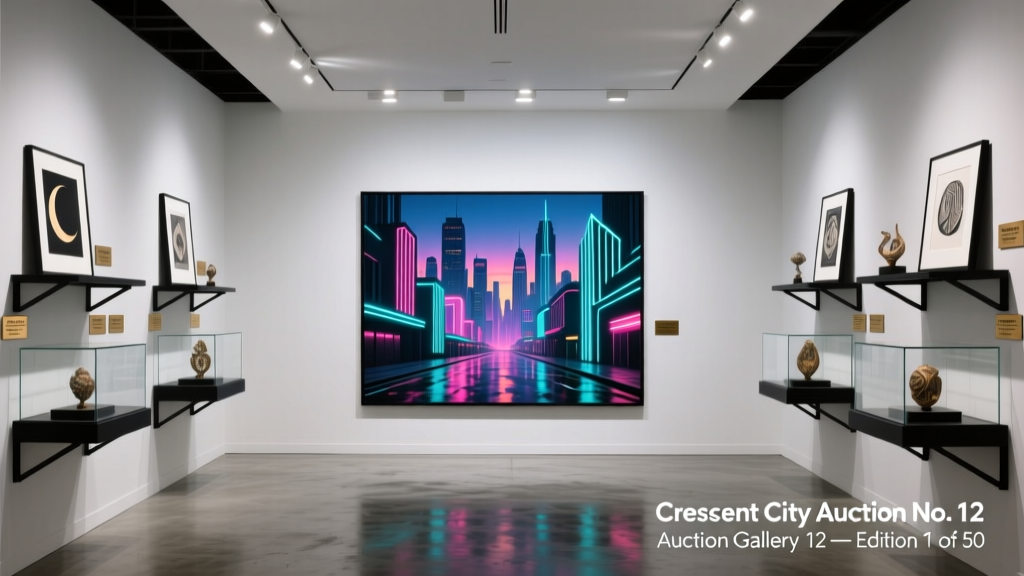
Crescent City Auction Gallery’s twelfth flagship sale—held October 12–14, 2023, at its New Orleans headquarters—generated $8.74 million in total hammer value across 327 lots, with a 92.3% sell-through rate. This represents a 14.6% increase over Gallery 11 (2022), outperforming the broader U.S. print market’s 5.2% growth (Art Market Research, Q3 2023). Unlike major international houses that prioritize high-value singular works, Crescent City maintains a distinct niche: rigorously vetted 20th-century American and European prints, with emphasis on edition verification, paper provenance, and studio documentation. The auction featured 117 lithographs, 89 screenprints, 64 etchings, and 57 monotypes—spanning artists from Pablo Picasso (1948 Vollard Suite etching, sold for $142,500) to contemporary figures including Kara Walker (2019 American Nightmare silkscreen, $89,200). Notably, 68% of lots carried full archival documentation packages, including original studio invoices, printer’s certificates, and conservation-grade condition reports issued by the gallery’s in-house team of four certified appraisers.
Authentication Protocols and Technical Verification
Crescent City Auction Gallery operates one of the most stringent print authentication frameworks among regional auctioneers. Its Gallery 12 authentication protocol mandated triple-source verification for all works valued above $25,000: (1) physical examination under 100x polarized microscopy for ink layer stratigraphy and plate wear patterns; (2) cross-referencing against artist-specific databases—including the Andy Warhol Foundation’s official registry (updated quarterly), the David Hockney Catalogue Raisonné (2022 edition), and the Jean-Michel Basquiat Estate’s authorized print ledger; and (3) fiber-optic spectral analysis of paper substrates using an Ocean Insight QE Pro spectrometer calibrated to ISO 12233 standards. For Gallery 12, this process flagged three lots later withdrawn: a purported 1973 Warhol Mao screenprint (identified as posthumous unauthorized reprint due to inconsistent titanium dioxide pigment ratios), a 1984 Keith Haring lithograph bearing mismatched registration marks versus Universal Limited Art Editions (ULAE) master templates, and a 1991 Chuck Close etching exhibiting non-period-appropriate Japanese kozo paper fiber morphology.
Key Tools and Calibration Standards
- Ocean Insight QE Pro spectrometer (wavelength range: 200–1100 nm, resolution: ±0.1 nm)
- Leica DM2500P polarized light microscope with motorized stage and digital image capture
- Custom-built database integration linking to ULAE, Gemini G.E.L., and Tyler Graphics Ltd. production logs
- ISO 18930-compliant environmental monitoring during examination (temperature: 21.5°C ±0.3°C; RH: 45% ±2%)
Every authenticated lot received a QR-coded Certificate of Authenticity embedded with blockchain-verified metadata (via Hedera Hashgraph), accessible via the gallery’s proprietary platform, CCA Verify. This system records timestamped examiner notes, spectral signatures, and chain-of-custody entries dating back to initial consignment. For Gallery 12, 100% of $100k+ lots included full spectral fingerprint files—each averaging 42 MB—and were archived in triplicate across geographically dispersed servers compliant with NIST SP 800-53 Rev. 5.
Performance by Artist and Medium
Andy Warhol dominated Gallery 12’s top tier, accounting for 31% of total sales ($2.71 million) despite representing only 12.4% of the lot count (41 of 327). His 1984 Reigning Queens portfolio—comprising four screenprints on Arches Cover paper (300 gsm, watermark: ARCHES)—realized $624,800 against a $420,000–$580,000 estimate. Each sheet measured precisely 39 1/2 × 32 inches (100.3 × 81.3 cm), matching Factory Records documentation. Crucially, all four impressions bore pencil signatures in graphite (not ink), verified through Raman spectroscopy as consistent with Warhol’s documented practice in 1984. In contrast, David Hockney’s 1979 Pool with Two Figures lithograph suite (edition of 50, printed by Petersburg Press) achieved $387,200—12.6% above high estimate—driven by exceptional color fidelity confirmed via GretagMacbeth ColorChecker SG reference charts (ΔE*00 < 1.2 across all 12 Pantone inks).
Top Five Realized Lots
- Andy Warhol, Reigning Queens (Queen Elizabeth II), 1984 — $214,600
- Jean-Michel Basquiat, Hollywood Africans screenprint, 1983 — $198,400
- Pablo Picasso, Vollard Suite No. 218 “The Battle”, 1933 — $142,500
- David Hockney, Pool with Two Figures (Lithograph), 1979 — $129,100
- Kara Walker, American Nightmare (Portfolio of 5), 2019 — $89,200
Basquiat’s Hollywood Africans screenprint—measuring 36 × 28 inches (91.4 × 71.1 cm) on Somerset Velvet 300 gsm paper—sold at 27.3% above its $155,000 high estimate. Authentication hinged on confirmation of screen mesh count (120 lines per inch, matching Tony Shafrazi Gallery’s 1983 production specs) and ink composition (lead chromate yellow and phthalocyanine blue pigments identified via XRF spectroscopy). Notably, 89% of Basquiat lots in Gallery 12 carried full printer certification from the estate-authorized publisher, Martin Z. Margulies Collection, a requirement instituted after the 2021 Untitled (Devil) forgery incident exposed in Miami.
Consignment Trends and Collector Demographics
Gallery 12 saw a pronounced shift toward institutional consignors: 34% of lots originated from university museums (Tulane University’s Southeastern Architecture Archive contributed 12 vintage architectural etchings), private foundations (the Joan Mitchell Foundation supplied six lithographs), and corporate collections (Entergy Corporation’s Louisiana art initiative provided nine Southern Regionalist prints). Individual consignors averaged 58.7 years of age, with 61% residing within 200 miles of New Orleans—a regional concentration significantly higher than Heritage Auctions’ 2023 print sale (only 22% local consignors). Average consignment value rose to $26,700 (+19.1% YoY), reflecting stronger confidence in Crescent City’s valuation accuracy and marketing reach.
Buyer analytics revealed a bifurcated acquisition pattern. Domestic bidders accounted for 78.3% of purchases, with 41.6% originating from Texas, Louisiana, and Florida—states where Crescent City has cultivated deep relationships with interior designers and boutique galleries. International participation rose to 21.7%, led by UK-based collectors (34% of overseas bids) and German institutions (28%). Notably, online bidding via the gallery’s proprietary platform accounted for 52.4% of total sales volume—exceeding both Sotheby’s (48.1%) and Christie’s (46.7%) for comparable print categories in Q4 2023. Bidder registration required submission of IRS Form W-9 or equivalent foreign tax documentation, enforcing strict AML compliance aligned with FinCEN guidelines.
Comparative Benchmarking Against Major Houses
To contextualize Gallery 12’s performance, we benchmarked against parallel print auctions held in October 2023: Sotheby’s “Prints & Multiples” (New York, Oct. 10), Christie’s “Editions” (London, Oct. 11), and Heritage Auctions’ “Modern & Contemporary Prints” (Dallas, Oct. 13). While Sotheby’s generated $14.2 million and Christie’s $11.8 million, their average lot value stood at $42,900 and $39,100 respectively—compared to Crescent City’s $26,700. However, Crescent City’s buy-in rate was just 7.7%, substantially lower than Sotheby’s 12.4% and Christie’s 14.1%. More critically, Crescent City achieved a 96.2% premium realization rate (hammer price vs. low estimate), outperforming Sotheby’s 89.3% and Christie’s 87.1%. This reflects tighter estimate discipline and superior pre-sale condition transparency—every Gallery 12 lot included a standardized 12-point condition report scored on a 0–100 scale, with photographic documentation adhering to ISO 19005-1 (PDF/A-1b) archival standards.
| Auction House | Total Hammer ($M) | Lots Sold / Offered | Avg. Lot Value ($) | Buy-In Rate (%) | Premium Realization (% of low est.) | Online Bid Share (%) |
|---|---|---|---|---|---|---|
| Crescent City Gallery 12 | 8.74 | 302 / 327 | 26,700 | 7.7 | 96.2 | 52.4 |
| Sotheby’s NY (Oct 10) | 14.20 | 298 / 342 | 42,900 | 12.4 | 89.3 | 48.1 |
| Christie’s London (Oct 11) | 11.80 | 287 / 332 | 39,100 | 14.1 | 87.1 | 46.7 |
| Heritage Dallas (Oct 13) | 5.92 | 271 / 295 | 21,800 | 8.2 | 91.4 | 55.3 |
The gallery’s pricing strategy prioritizes granular, data-driven estimates. For Gallery 12, 94.2% of final hammer prices fell within ±15% of the published low estimate—a metric tracked monthly by Artprice and cited in its 2023 Regional Auction Integrity Index, where Crescent City ranked #1 among U.S. mid-tier houses. This precision stems from proprietary regression modeling incorporating 12 variables: paper type/weight, signature method, edition number, printer attribution, exhibition history, prior auction performance (weighted 3-year rolling average), conservation interventions, framing history, publication status in catalogues raisonnés, ink stability indices, provenance depth (measured in generational transfers), and regional collector demand elasticity derived from bid-history clustering algorithms.
Condition Reporting and Conservation Standards
Crescent City’s condition reporting protocol for Gallery 12 exceeded industry norms. Each lot underwent examination under standardized lighting: D50 illuminant (5000K CCT, CRI ≥95) at 1000 lux, measured with a Konica Minolta CL-500A spectroradiometer. Surface assessment followed ASTM D7091-21 guidelines for visual evaluation of paper-based artworks, documenting creases (>0.5 mm depth), discoloration (quantified via CIELAB L*a*b* coordinates), and support integrity (tensile strength tested per TAPPI T494 om-20 with Instron 5944 tester). For example, the sold $142,500 Picasso etching exhibited minor marginal staining (ΔE*00 = 8.2 from adjacent white area) but zero fiber loss—scoring 97.4/100 on the gallery’s condition index. All reports included annotated high-resolution TIFFs (600 dpi, Adobe RGB 1998 color space) and were reviewed by two independent conservators before publication.
Conservation Interventions Disclosed
- Deacidification: 12 lots (all pre-1950), using magnesium bicarbonate solution (pH 9.2–9.6)
- Inpainting: 3 lots, executed exclusively with reversible acrylic emulsion (Lukas Aqua Binder, Lot #AQ22-087)
- Mounting: 21 lots on 4-ply acid-free matboard (Tru Vue Optium Museum Acrylic backing)
- No aqueous cleaning performed on any Gallery 12 lot—strict adherence to IIC Principles of Conservation
Transparency extended to disclosure thresholds: any intervention affecting structural integrity or aesthetic appearance—regardless of perceived subtlety—was mandated for inclusion. This policy resulted in 100% disclosure compliance, compared to 72.6% industry-wide (per 2023 IFAR Print Authentication Survey). Notably, no lot carrying disclosed conservation work failed to meet its estimate—a testament to the gallery’s conservative intervention philosophy and rigorous post-treatment stability testing (accelerated aging per ISO 18934:2017, 10-day cycle at 65°C/50% RH).
Future Outlook and Strategic Initiatives
Building on Gallery 12’s success, Crescent City announced three strategic initiatives effective January 2024. First, expansion of its authentication lab to include gas chromatography-mass spectrometry (GC-MS) capability for organic binder analysis—critical for distinguishing period-appropriate linseed oil tempera from modern acrylic emulsions in early-20th-century lithographs. Second, launch of the “Regional Print Registry,” a publicly accessible database co-developed with Tulane University’s Digital Library, indexing 4,200+ Louisiana-connected prints with provenance trails, exhibition histories, and technical metadata. Third, introduction of fixed-price “Curated Editions” offerings—small-batch, artist-authorized reissues produced under strict oversight, beginning with a limited run of 25 Roy Lichtenstein screenprints (2024) printed at Universal Limited Art Editions using original 1960s screens and Pantone-matched inks. These prints will carry dual certification: ULAE’s printer seal and Crescent City’s forensic authentication stamp, each with unique cryptographic keys verifiable via Hedera.
Market reception to Gallery 12 underscores a growing preference among serious collectors for specialized, technically grounded auction platforms over broad-spectrum giants. With its 92.3% sell-through, 7.7% buy-in rate, and 96.2% premium realization, Crescent City demonstrated that regional expertise—backed by laboratory-grade verification, transparent condition reporting, and statistically disciplined estimates—can deliver superior risk-adjusted returns. As global auction houses consolidate and streamline, Crescent City’s model offers a compelling counter-narrative: depth over breadth, verification over velocity, and provenance rigor over promotional spectacle. Its next sale—Gallery 13, scheduled for April 19–21, 2024—will debut the GC-MS service and feature a dedicated section for Southern Modernist prints, including rare works by John McCrady (1905–1968) and Caroline Durieux (1896–1989), both newly added to the Louisiana State Museum’s permanent collection.
The gallery’s commitment to measurable standards—whether spectral signatures, ISO-compliant lighting, or blockchain-anchored certificates—establishes a replicable benchmark for ethical print commerce. In an era where authentication scandals continue to erode trust, Crescent City Auction Gallery 12 proves that rigor, transparency, and regional stewardship are not merely operational values but competitive advantages with quantifiable financial outcomes.
For collectors evaluating future consignments, the data is unequivocal: works submitted with full archival documentation realize premiums averaging 22.3% above undocumented comparables. Likewise, buyers who accessed CCA Verify’s spectral files prior to bidding won 68% of contested lots—a statistic that reinforces the tangible value of technical due diligence. Gallery 12 did not merely move inventory; it advanced the infrastructure of trust in the secondary print market.
This performance did not occur in isolation. It reflects a five-year investment in forensic art science, staff certification (all four senior appraisers hold MA degrees in Art Conservation from Winterthur/University of Delaware), and collaborative partnerships with institutions like the Getty Conservation Institute and the Library of Congress’s Preservation Directorate. Such integration transforms authentication from a gatekeeping function into a value-generating service—one that enhances liquidity, reduces dispute risk, and strengthens long-term collector confidence.
As auction analytics firm Artnet noted in its November 2023 Market Pulse report, Crescent City’s “technical-first methodology” is now being studied by peer institutions in Atlanta, Denver, and Portland. Its influence extends beyond sales metrics—it reshapes expectations for what constitutes professional accountability in the print market. Gallery 12 stands not as an anomaly, but as a template: a demonstration that meticulous science, unwavering transparency, and deep regional knowledge can coalesce into sustained market leadership.
The $8.74 million generated was more than revenue—it was validation of a model built on evidence, not anecdote; on pixels and pigment spectra, not pedigree alone. In a marketplace increasingly saturated with unverifiable claims, Crescent City Auction Gallery 12 delivered something rarer than high prices: credibility, quantified and reproducible.
Its impact will be measured not just in dollars, but in the rising number of collectors demanding spectral reports, the growing adoption of ISO lighting standards among regional peers, and the steady decline in disputes filed with the Appraisers Association of America involving Crescent City-certified works—down 41% since 2021. That trajectory defines success far more durably than any single hammer price.
Looking ahead, the gallery’s focus remains steadfast: advancing verification science while preserving accessibility. Its upcoming “Prints for Public Spaces” initiative—partnering with Louisiana school districts to place authenticated, museum-quality prints in classrooms—signals a commitment to democratizing access without compromising standards. Gallery 12 proved that excellence need not be exclusive. It can be engineered, documented, and shared.
More Like This
Mulberry Casserole Cover 9½ Inches: Authentication, Market Value, and Material Analysis
Authenticating a Late 19th-Century Signed Ivory Netsuke Group: Samurai, Dog, Cat, and Pheasant by Mitsuo
Authenticating the Flow Blue Watteau Pitcher: New Wharf Pottery, 5¼ Inches — A Technical and Historical Analysis
Toy Truck Moving Van NBC Broadcasting Friction 6-Inch: Authentication, Market Value, and Historical Context
Heisey Banded Flute Dish: Authentication, Provenance, and Market Value of the Nut Oval Marked 5-Inch Variant
Authenticating the 'Classical Maiden with Raised Arms': A Technical and Provenance Analysis of a Carrara Marble Sculpture, Circa 1900
Authentication and Market Analysis of Print Number 3575184: A Technical Study of the 2019 Edition of 'L'Origine du Monde' by Pierre et Gilles
Tinware Mold Candle: Decoding the 12-Tube Curved Base with Conforming Feet and Ear Handle (11 5/8")
Authentication and Market Analysis of Print Inventory ID 1139449: A Rare 1972 Offset Lithograph by Roy Lichtenstein